The new policy released by nine government departments has once again addressed property management, so what should property service providers do in community recycling?
On November 17, 2026, 9 government departments including the Ministry of Commerce issued the *Opinions on Further Promoting the Construction of the Renewable Resource Recycling System and Boosting High-Quality Development of the Recycling Industry* (hereinafter referred to as the "Opinions"), which arranges a total of 16 specific measures.
The Opinions advocates the "integration of two networks", requiring enhanced connection and integration between domestic waste sorting and renewable resource recycling outlets, promoting the sharing of facilities and sites as well as the joint building of operation teams, and including renewable resource recycling into the scope of basic guaranteed convenient services. Article (2) of the Opinions proposes to support recycling enterprises to strengthen cooperation with property service enterprises to carry out recycling of large-sized used furniture.
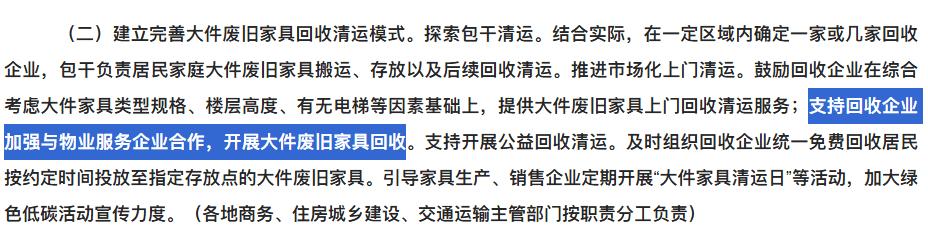
Article (12) proposes that property service enterprises may provide convenience for recycling personnel and vehicles to enter and exit residential communities according to the demands of property owners.
At present, some consumers still face the difficulty that "discarding large-sized used furniture is more troublesome than buying new ones". In some cities, the number of mobile waste recyclers is insufficient, and there are service blind spots in their coverage, which narrows the channels for residents to dispose of used home appliances and large-sized furniture. Some property owners have reflected that if they need door-to-door removal of large-sized used furniture, the removal personnel will charge extra fees, which reduces owners' willingness to dispose of such items. Some owners then stack large items in corridors or underground parking lots, creating safety hazards and increasing the property management's burden of environmental maintenance.
Apart from large-sized furniture, small recyclables in domestic waste also face the problem of poor connection. Since the implementation of domestic waste sorting, it has been quite common for residents to sort and discard small recyclables such as waste paper, plastic bottles and metal cans, but mixed disposal of recyclables and domestic waste still exists in some residential communities, causing resource waste and increasing the waste treatment volume. At the same time, waste management in some communities is relatively loose, and some people dump garbage on the ground when picking through waste, leaving non-recyclable garbage on the spot, which directly undermines public environmental sanitation.
Communities need to deal with two types of problems at the same time: the difficulty in disposing of large-sized furniture and the poor connection of small recyclables.
Intelligent recycling bins and mobile recycling vehicles are the facility forms clearly specified in the Opinions: recycling enterprises shall set up intelligent recycling bins in qualified residential communities, and deploy mobile recycling vehicles with functions of waste collection, temporary storage and transportation in areas with limited recycling sites or remote outlets. Meanwhile, the policy also encourages relevant entities to set up storage points for large-sized waste, and guarantee the right of way for recycling operation vehicles. However, all the above contents involve the use of public areas in residential communities. Article 278 of the Civil Code lists changing the use of common parts or using common parts for business operations as matters to be jointly decided by property owners. Article 282 of the Civil Code stipulates that the income generated from the use of common parts of property owners shall be owned by all property owners after deducting reasonable costs, so the relevant revenue and expenditure shall be made public. Therefore, the establishment of intelligent recycling bins and large-sized waste storage points must go through the procedure of joint decision by property owners, and the income generated therefrom shall also belong to all property owners.
The Opinions advocates integrating recycling into the existing waste sorting system, proposes to empower scattered recycling teams such as front-line individual operators, provide standardized and convenient recycling services, and strengthen environmental sanitation management. Residential projects that have carried out waste sorting supervision already have the foundation for sorted disposal of small recyclables such as waste paper and plastics. Property service enterprises can set up recycling zones for recyclables at the existing disposal points to reduce additional land occupation, maintain the environmental sanitation around trash bins, step up publicity on waste sorting, reduce scattered waste picking through persuasion, and avoid environmental problems caused by waste picking.
Communities are the end link for the implementation of the recycling system, and property service enterprises undertake supporting responsibilities such as releasing information and providing on-site guidance. The policy gives the direction of the model, while the procedural rules and division of rights and responsibilities still need to be implemented in specific projects. With the advancement of relevant work in pilot cities and pilot enterprises, the operation rules on the community side are expected to be further refined.
This article is from the WeChat Official Account "China Index Academy", written by China Index Property Research, and authorized for release by 36Kr.