The inevitable development trend of real estate enterprises: transforming from "developers" to "asset management platforms"
China's urban development is shifting from the stage of large-scale incremental expansion to the stage focusing on stock quality improvement and efficiency enhancement, and the real estate industry has entered the stock era. After August 28, the development of the real estate sector has accelerated into a new model period. The transformation of real estate enterprises' development model from developers to operation service providers, and further upgrading to asset management platforms, is the inevitable destination after the industry reshuffle.
Transformation of Outstanding Real Estate Enterprises to Asset Management Platforms: Typical Models of CapitaLand, China Resources Land, and Seazen
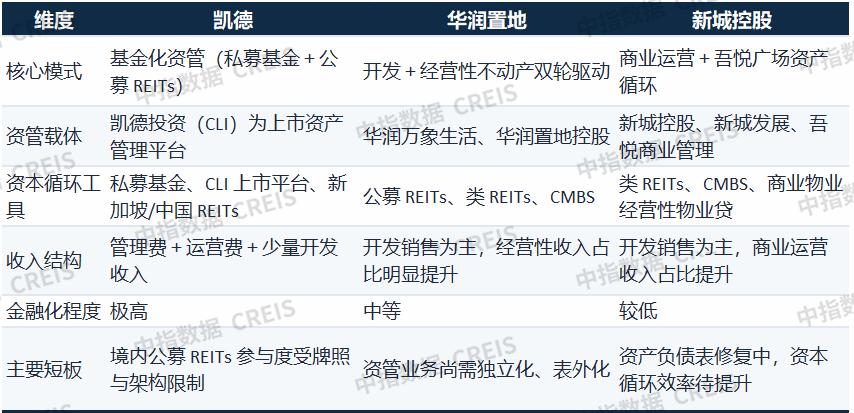
Three types of representative samples are selected: global benchmark CapitaLand (pure asset management gene), leading central state-owned enterprise China Resources Land, and leading private commercial enterprise Seazen Holdings. The common point of the three is that they have all established a two-wheel structure of "Fund/REITs + operation management", and the difference lies in the maturity of capital circulation and the degree of financialization.
CapitaLand: An Excellent Sample of the Global "Investment, Financing, Management and Exit" Model. In 2021, CapitaLand completed a major restructuring, splitting its investment management platform from its real estate development business. CapitaLand Investment operates independently as a listed asset management company, clarifying the business model of "focusing on management fee income". After the restructuring, the proportion of CapitaLand's own capital investment continues to decline, the scale of assets under management continues to expand, and the proportion of management fee-related income rises steadily. The industry implication of this move is extremely important: if an asset management platform wants to independently become a viable business, it must be completely separated from the development business in terms of organization, assessment and capital. Otherwise, the role conflict of "acting as both athlete and referee" will weaken the trust of investors. The core of CapitaLand is not "holding assets", but "managing funds". Its business structure consists of three parts: as a Sponsor, CapitaLand contributes a low proportion of its own funds to set up private equity funds together with institutional investors (pension funds, insurance capital, sovereign wealth funds); as a Manager, it collects management fees (usually 1%-2% of the net asset value) and performance remuneration; as an Operator, it collects property management and commercial operation service fees. Assets are held at the fund level, and CapitaLand consolidates them with minority equity or accounts for them under the equity method, thus realizing "off-balance sheet of heavy assets while retaining management capabilities on the balance sheet". The subtlety of this model lies in the capital cycle: 4-6 years after the fund is established, CapitaLand promotes asset maturity (increasing occupancy rate, rising rent, stable NOI), and then realizes exit through REITs listing, asset sale or fund share transfer, and recovers funds to reinvest in a new round of funds.
China Resources Land: A Model of Mainland Chinese Real Estate Enterprises Transforming into Asset Management Platforms. The first stage is "residential development + commercial holding", which holds commercial assets represented by MixC and MixC Life, and uses profits from development and sales to feed commercial investment. The second stage is "two-wheel drive", which clearly proposes the parallel development of development and sales business and operating real estate business, and requires the operating real estate business to achieve "high-quality growth". The third stage is the ecologization of "development + operation + asset management". Through the spin-off and listing of China Resources Mixc Lifestyle, the issuance of public REITs, and the establishment of private equity funds, the held assets are gradually transferred from on-balance sheet to off-balance sheet management.
The three pillars of China Resources' asset management platform are as follows: First, the operation platform (Mixc Lifestyle): with commercial operation and property management as the core, its income comes from management fees and value-added services, forming a carrier for "securitization of management capabilities". After the spin-off and listing, its valuation no longer depends on development profits, but is priced based on the managed area and commercial operation scale, providing the parent company with a capital market pricing anchor for its management capabilities. Second, the asset platform (held real estate): core assets such as shopping malls, office buildings and hotels provide a recyclable underlying asset pool for the asset management business through the rhythm of "investment - cultivation - maturity - exit". China Resources emphasizes that "shopping malls have high gross profit margins and stable rent growth", which is essentially preparing for asset quality for REITs exit. Third, the financial platform (REITs and funds): public offering REITs for consumer infrastructure, public offering REITs for commercial real estate, and inter-institutional REITs are the key tools for China Resources to move heavy assets off the balance sheet and recover funds for reinvestment. Through REITs, China Resources can retain operation management rights and collect management fees, while transferring asset ownership to public investors, realizing the combination of "asset-light operation + heavy asset exit".
Seazen Holdings: A Pioneer in the Transformation and Development of Private Real Estate Enterprises. The company takes "Wuyue Plaza" as its core product line, rapidly deploys in third- and fourth-tier cities, and forms the combination of "residential sales proceeds + commercial holding operation": residential sales provide cash flow for commercial investment, and commercial rent and operation income form long-term stable cash flow assets. Seazen's asset management path has the "characteristics of private real estate enterprises": first, through tools such as quasi-REITs, CMBS, and operating property loans, it securitizes the rental cash flow of mature Wuyue Plazas, and the recovered funds are used for new project investment and debt repayment; second, it promotes the independence of commercial management capabilities, and exports operation services to the outside world under the brand of "Wuyue Commercial Management"; third, it explores consumer REITs, packages mature assets for listing, and realizes real equity exit.
Table: Comparison of Asset Management Platform Models of CapitaLand, China Resources Land and Seazen
Troubled Real Estate Enterprises Shift to Asset Management Platforms after Restructuring: Sunac and Jinke Accelerate Exploration
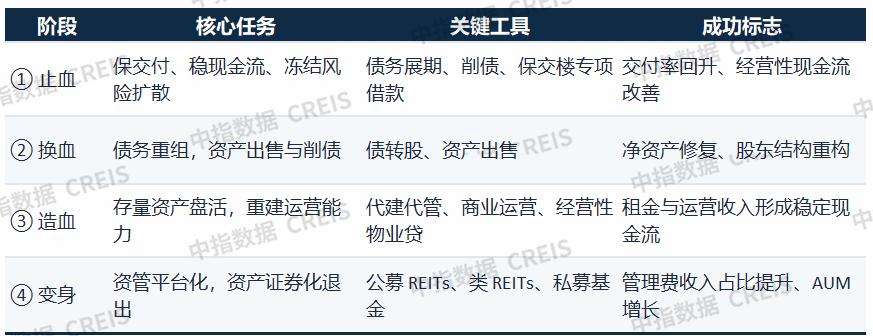
The problems faced by troubled real estate enterprises can be summed up as three imbalances: cash flow imbalance (operating cash flow cannot cover interest expenses), credit imbalance (rating downgrade, financing channels closed, pre-sale restricted), and asset-liability imbalance (the scale of liabilities far exceeds the asset realization capacity). Debt restructuring solves the short-term gap of cash flow, while the platformization of asset management solves the long-term development problem.
Table: Stages for Troubled Real Estate Enterprises to Get out of Difficulties
Sunac has established a two-wheel-driven transformation and development strategy of "asset management + asset operation". Sunac China acquired Erjin Management and incorporated it into the listed company as an asset-light construction agency platform to accelerate development and transformation, upgrading from the traditional "integrated investment and development" model to a dual-track structure of "asset management + project construction and operation management". The two-sector structure: ① The asset management sector focuses on capital integration and investment opportunity mining in the real estate sector, connects insurance capital, local state-owned assets and industrial capital, launches real estate funds, and earns management fees and investment sharing; ② The construction management sector (taking Erjin Management as the carrier) provides construction, operation, sales and other services for asset management projects and market-oriented third-party projects, undertakes construction agency, construction management orders from government platforms, state-owned enterprises and third-party owners, and earns service fees. Its core advantages are high-quality stock asset base, in-depth cooperation foundation with leading AMCs (Citic Financial Assets, Great Wall Assets), and high-end market appeal.
After restructuring, Jinke Stock is transforming into a "technology-driven comprehensive real estate operator". After completing the largest judicial restructuring of A-share real estate enterprises (deleveraging 147 billion yuan), Jinke Stock has established its strategic positioning of transforming from a traditional developer to a technology-driven comprehensive real estate operator, bidding farewell to the high-leverage development model. The strategic focus after restructuring is obviously tilted towards "asset-light, operation-intensive", with core business layout in "four major sectors": investment management, development services, operation management, and special assets, to implement strategic transformation. It focuses on first-tier and strong second-tier cities, develops stock asset renovation and operation and asset-light construction agency business, and builds a full-cycle large asset management model of "investment, financing, reconstruction, construction, management and exit". Asset operation: sort out the stock assets such as commercial properties, industrial parks and long-term rental apartments, retain the operation rights of high-quality assets, and reduce capital occupation through cooperative development, entrusted management and other methods. Management output: export brand and management capabilities through "construction agency + management agency", forming an income model of "management fee + brand royalty".
Trend Outlook
The transformation and development of the real estate industry will present the following characteristics: First, the REITs market will continue to expand: consumer infrastructure, affordable rental housing, industrial parks, logistics and other tracks will see regular issuance, the participation of real estate enterprises will increase, and "REITs + operation management" will become the standard configuration for leading enterprises. Second, asset management platforms will diverge: a small number of enterprises (CapitaLand model, China Resources model) will form real capital circulation capabilities, while most enterprises will stay at the "quasi-REITs financing" stage, and the valuation gap between the two will further widen. Third, industry concentration will focus on "operation capabilities": enterprises with commercial operation, property management and long-term rental operation capabilities will get more third-party entrustment opportunities, and management scale will become a new dimension of competition. Fourth, reshuffle and rebirth go hand in hand: troubled real estate enterprises re-enter the market through restructuring and asset management transformation, but their role will change from "developer" to "asset manager and operator", and scale is no longer the core goal.
All types of enterprises should follow the trend according to their own endowments and capability characteristics:
Central state-owned enterprises, local state-owned enterprises and high-quality private enterprises: take REITs as the starting point to accelerate asset circulation. It is recommended to prioritize packaging assets of "core cities + high occupancy rate + stable rent" for public REITs issuance, forming a standardized process of "investment - cultivation - REITs exit - reinvestment". At the same time, promote the independence of operation platforms (such as spin-off of commercial management and property services), so that the value of management capabilities can be priced separately in the capital market. The key is to transform the asset management platform from a "cost center" to a "profit center", and establish an assessment system with AUM, management fee income and LP return as the core.
Mid-sized regional real estate enterprises: take asset-light output as a transition to avoid the heavy asset trap. For mid-sized real estate enterprises that lack core held assets, it is not recommended to blindly invest in heavy asset holding. Instead, they should prioritize the development of asset-light models such as construction agency, management agency, and commercial operation output, and use management fees and brand royalties to build stable income. At the same time, revitalize stock assets through tools such as operating property loans and CMBS, gradually accumulate asset securitization experience, and prepare for future participation in REITs.
Troubled real estate enterprises: take cash flow restoration as the top priority, and make the asset management platform serve credit reconstruction. It is recommended to position the asset management platform as a "credit restoration tool", first solidify the delivery guarantee and debt restructuring, then prove cash flow capacity through the operation improvement of high-quality assets, and finally promote securitization. Post-restructuring corporate governance should introduce strategic investors and independent directors, strengthen information disclosure and related party transaction control, which is the prerequisite for gaining the trust of institutional LPs.
What China's real estate industry is experiencing is not an ordinary cycle adjustment, but a reconstruction of business models. The winners in the incremental era rely on "daring to borrow money, daring to acquire land, daring to turnover", while the winners in the stock era rely on "being good at selecting assets, being good at managing operations, being good at designing financial structures". The transformation from developer to asset management platform essentially shifts the core competence of enterprises from "capital mobilization ability" to "capital allocation and operation ability". CapitaLand has proved with 30 years of practice that asset management platforms can survive through cycles. China Resources is verifying the feasibility of this path in the Chinese market with its central state-owned enterprise resources and commercial operation capabilities. The exploration of Seazen and troubled real estate enterprises shows that there is no unified answer for transformation, but there are common prerequisites: assets must be real, operation must be professional, finance must be transparent, and governance must be credible.
This article is from the WeChat Official Account "China Index Academy", author: China Index Academy, published with authorization from 36Kr.