Swire's financial trick of "selling at increasingly higher prices": three stake reductions in Cathay Pacific have cashed out more than 10 billion.
On November 23, Swire Pacific (00019.HK) announced the placement of 253 million shares of Cathay Pacific (00293.HK).
This is the third time this long-established trading house has used the same asset within nine months.
The placement price is HK$14.23 per share, representing a discount of approximately 8.5% to Cathay Pacific's closing price of HK$15.55 on the same day; the shares sold account for approximately 4.15% of Cathay Pacific's issued shares, with net proceeds of approximately HK$3.575 billion and an estimated recorded gain of approximately HK$870 million.
After the transaction is completed, Swire's shareholding in Cathay Pacific will drop from approximately 39.15% to approximately 35.00%, remaining the largest shareholder.
The wording of the announcement is as restrained as ever: the net proceeds will be used for general working capital, the company reaffirms that its confidence and commitment to Cathay Pacific remain unchanged, and it states that it has no intention of further reducing its shareholding in Cathay Pacific for the time being.
However, when the three transactions are listed in the same table, another clue emerges — the same asset has been split three times within one year, cashing out a total of more than HK$10.1 billion.
Three Transactions
The structure of this transaction is not complicated. Swire has entered into agreements with three placement agents, JPMorgan Chase, Morgan Stanley and HSBC, to sell 252.655 million shares. The placees are independent third parties, the settlement date is set as November 26, and the lock-up period lasts for 12 months after settlement.
What is complicated is the connection with the previous two transactions. The announcement specially uses a section titled "Previous Transactions" for explanation: the Cathay Pacific share placement disclosed on March 13, the bond issuance disclosed on June 9, and the accelerated share conversion transaction disclosed on September 2. When combined with this placement, the highest applicable percentage ratio exceeds 25% but is lower than 100%. Therefore, this placement constitutes a "major transaction" under Chapter 14 of the Listing Rules, and is subject to the provisions on filing, announcement, circular and shareholder approval.
This technical treatment of combined calculation indicates that the three transactions are of the same nature.
For the transaction in March, Swire placed approximately 153 million shares at HK$11.74 per share, accounting for approximately 2.52% of Cathay Pacific's issued shares, representing a 9.6% discount to the previous closing price, raising a net amount of HK$1.789 billion. At that time, the expected gain was approximately HK$365 million, and the actual amount confirmed in the interim report was HK$318 million.
In June, the tool was changed. Wholly-owned subsidiary Swire Pacific Finance issued HK$4.7 billion of zero-coupon exchangeable bonds due in 2027, with an initial exchange price of HK$13.18 per share. Full exchange is equivalent to approximately 5.9% of Cathay Pacific's shares, raising a net amount of HK$4.652 billion.
In the third transaction in September, the bonds and shares were processed together. Swire repurchased bonds with a principal of HK$4.689 billion at 109.08% of the bond principal, accounting for approximately 99.77% of the total bond amount; at the same time, it placed 362.6 million Cathay Pacific shares to independent third parties at a price of HK$13.2 per share, representing a 7.7% discount, with a total amount of HK$4.787 billion.
The share placement recorded a gain of approximately HK$1.118 billion, and the overall net gain from the accelerated share conversion transaction is expected to be approximately HK$704 million.
The calibers of the three moves are not consistent. The first and third transactions are placements of existing shares, and the second is a bond with Cathay Pacific shares as exchange assets. The actual reduction in shareholding depends on the share conversion situation.
If the amounts disclosed in the announcement are roughly summed up, the net amount in March is HK$1.789 billion, the total amount in September is HK$4.787 billion, and the total amount in November is HK$3.595 billion, totaling more than HK$10.1 billion.
The shareholding trajectory is thus divided into five segments: at the beginning of 2026, Swire held approximately 43.08% of Cathay Pacific; in February, Cathay Pacific completed the over-the-counter repurchase and cancellation of its shareholding in Qatar Airways, and Swire's shareholding passively increased to approximately 47.64%; after the placement in March, it dropped to approximately 45.12%; after the accelerated share conversion in September, it dropped to approximately 39.15%; after the completion of this placement, it will be approximately 35.00%.
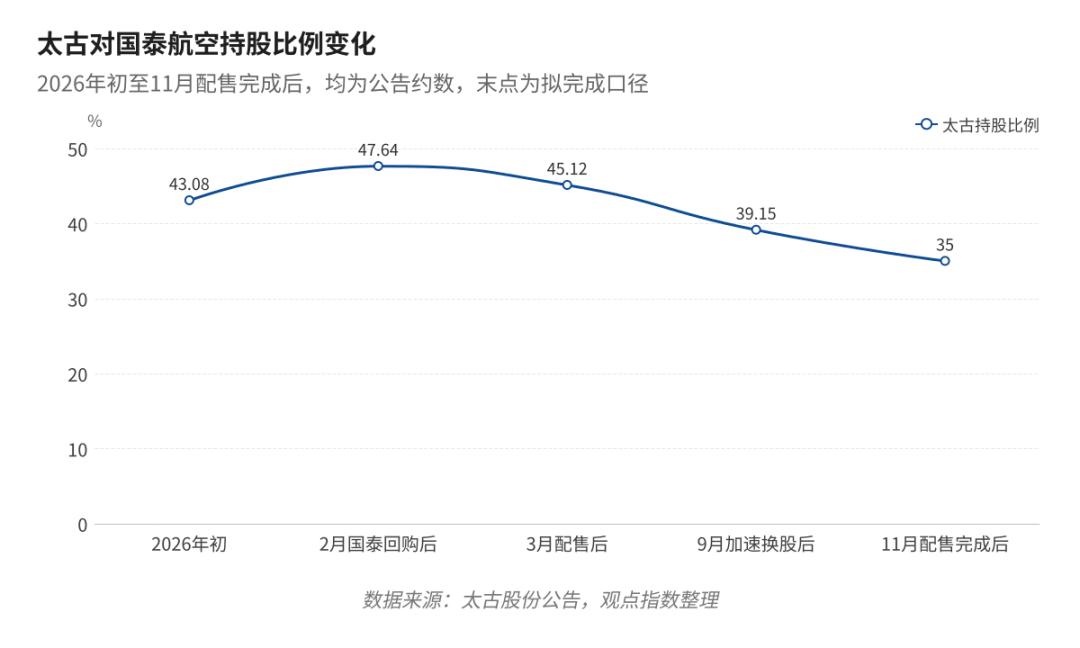
What is worth noting is the price curve: HK$11.74, HK$13.2, and HK$14.23, getting higher each time; the discount rates are 9.6%, 7.7%, and 8.5%, fluctuating within a narrow range. It can be seen that Swire is selling the same stock at higher and higher prices, and the proportion of concessions has not expanded accordingly.
Discounts and Ledger
The 8.5% discount seems to be a concession, but when placed on the timeline, it looks more like a calibration.
The announcement lists five sets of benchmarks: a discount of approximately 8.5% to the closing price of HK$15.55 on November 23; a discount of approximately 9.7% to the average price of the previous 5 trading days of HK$15.75; a discount of approximately 8.5% to the average price of the previous 10 trading days of HK$15.55; a discount of approximately 4.2% to the average price of the previous 20 trading days of HK$14.85; and a discount of only approximately 0.8% to the average price of the previous 30 trading days of HK$14.35.
The longer the benchmark period, the smaller the discount, indicating that Cathay Pacific's stock price rose rapidly in the month before the placement. The 30-day average price is almost equal to the placement price. HK$14.23 is roughly equal to Cathay Pacific's average transaction level in the past month, and the 8.5% discount only gives up the gains of the recent few days. Cathay Pacific hit a 52-week high of HK$16.28 during intraday trading on November 19, and the placement pricing was exactly at the middle of this round of rise.
Based on the total placement amount and estimated gains disclosed in the announcement, the book gain of this transaction is approximately HK$870 million; the share placement in the accelerated share conversion transaction in September recorded a gain of approximately HK$1.118 billion, with an overall net gain of approximately HK$704 million.
It is clearer when placed in the valuation coordinate: Cathay Pacific's unaudited consolidated net asset value at the end of June was HK$58.026 billion. What Swire is selling is not a loss-making asset, but a hen that is laying eggs.
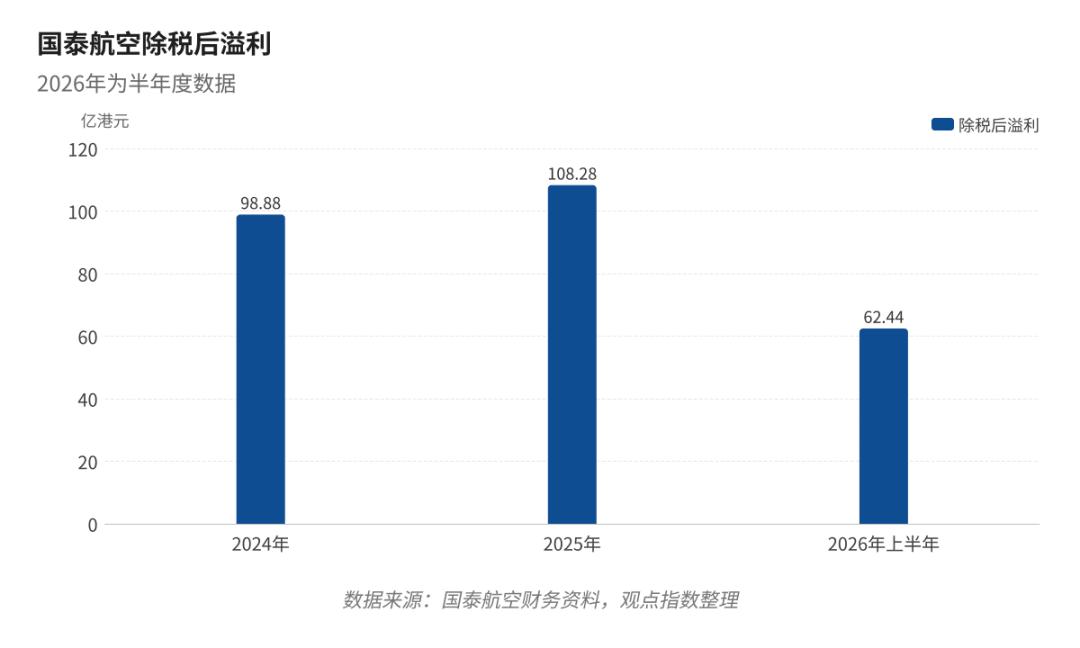
Cathay Pacific's profit curve is still at a high level: after-tax profit in 2025 was HK$10.828 billion, and it reached HK$6.244 billion in the first half of 2026, a year-on-year increase of approximately 71%; revenue in the same period was HK$68.061 billion, an increase of 25.3%. Among them, passenger revenue was HK$43.203 billion, up 26.3%, cargo revenue was HK$13.806 billion, up 23.9%, and passenger capacity recovered to over 90% of the 2019 level.
Cathay Pacific also disclosed that the first-half profit includes non-cash gains generated from the dilution of its equity in Air China, which is a one-off item; after excluding this item, the profit attributable to its airlines and subsidiaries was HK$4.9 billion, compared with HK$3.8 billion in the same period of the previous year, and the results of associated companies turned from a loss of HK$181 million to a net amount of HK$410 million.
There is real operational improvement, but the magnitude is smaller than the apparent growth rate of 71%.
For Swire, the contribution of this part of equity is equally substantial. In the first half of 2026, Swire's share of profit of the Cathay Pacific Group was HK$2.826 billion, a year-on-year increase of 72.1%; the profit attributable to shareholders of the aviation division was HK$3.481 billion, a year-on-year increase of 55.9%. Comparing HK$2.826 billion with Swire's basic profit attributable to shareholders of HK$7.843 billion, Cathay Pacific alone accounts for approximately 36%.
In that case, why sell?
The reason given in the announcement is to "increase working capital, further strengthen the balance sheet and improve financial flexibility", adding that this move is part of the company's capital allocation strategy.
This sentence has been used repeatedly in the past three years, and it does not constitute an explanation in itself. What better illustrates the intention is the investment principle that Swire itself wrote into its interim report: "We withdraw from businesses that have fully realized their potential and inject capital into existing or new businesses."
This principle, matched with the figures on the capital demand side, forms a complete logic: the capital expenditure plans of Swire Properties, Swire Coca-Cola and HAECO Group are still advancing.
At the same time, the cash return of Hong Kong office properties is slowing down. Swire Properties' Hong Kong office rental income in the first half of the year was roughly flat, and part of the increase in occupancy rate was obtained through rental concessions; although mainland retail rental income has grown, new projects are still in the investment period.
At the group level, net debt was HK$62.511 billion, the net debt-to-capital ratio was 19.3%, and the weighted average cost of debt was 3.4%. The financial statements are not strained, but they are not so ample that no trade-offs are needed.
The governance structure makes the execution cost of such trade-offs very low. John Swire & Sons (H.K.) Limited and its wholly-owned subsidiaries hold approximately 69.20% of the voting rights of Swire. The company obtained written shareholder approval in accordance with Rule 14.44 of the Listing Rules, replacing the convening of a general meeting of shareholders, and does not need to go through the complete voting procedure for this major transaction.
The handling of the lock-up undertaking is also a technical task. The June bond has a 180-day disposal restriction, and the September placement has a 90-day restriction. Before both undertakings expire, Swire obtained written consent from the three placement agents — the same institutions are both bond subscribers and placement agents, so the exemption is logical.
After 35%
Looking back at Swire itself, the explanation of "short of money" does not hold.
In the first half of 2026, Swire Pacific's revenue was HK$49.446 billion, a year-on-year increase of 8%; basic profit attributable to shareholders was HK$7.843 billion, a year-on-year increase of 43%; recurring basic profit excluding one-off items was HK$6.962 billion, a year-on-year increase of 48%; interim dividend was HK$1.5 per A share and HK$0.3 per B share, a year-on-year increase of 15%. Operating cash flow was HK$9.217 billion, a year-on-year increase of 9%. The net proceeds of this placement are approximately equivalent to 40% of the net cash inflow before financing in the first half of the year.
This is a statement that does not require emergency capital injection. A net debt ratio of 19.3% and a financing cost of 3.4% are in a comfortable range in the current financing environment. The three reductions are more like active capital circulation rather than passive liquidity remedy.
This is exactly the weight of the term "financial skill": not selling because you can't sell, but selling when you can get a good price; not clearing out and leaving, but cashing out a long-term equity repeatedly while retaining the position of largest shareholder and strategic discourse power.
The switching of the three tools also illustrates the technique: direct placement, exchangeable bond plus accelerated share conversion, and then back to placement, each time falling on the most unrestricted use of "general working capital".
There is a price to pay, but it is scattered among different entities.
For Cathay Pacific, the largest shareholder reduced its shareholding three times within nine months, and the market needs to absorb the supply. On November 24, Cathay Pacific opened lower, hitting an intraday low of HK$15.13, a drop of approximately 2.7%; morning trading volume expanded to 263 million shares, involving HK$3.749 billion; on the same day, Swire's A and B shares performed relatively steadily.
Some foreign-funded brokerages believe that although Swire has stated that it has no intention of further reducing its shareholding, the short-term stock price may still be under pressure, but they maintain a buy rating on Cathay Pacific, on the grounds that after the free float rises to 35%, the possibility of its inclusion in indices is expected to increase.
For Swire, the dilution is two-way. Cathay Pacific contributed more than one-third of Swire's basic profit in the first half of the year. After the reduction, this part of profit contribution will shrink proportionally. Some brokerages estimate that the accelerated share conversion transaction in September may reduce Swire's dividend income from Cathay Pacific in 2026 by approximately HK$340 million, equivalent to 5.6% of its expected dividend payout.
Another institution's judgment is more long-term: the reduction "helps reduce the fluctuation of Swire's overall profit and net asset value". In other words, what is sold is not only gains, but also volatility.
The real variable is on Cathay Pacific's side. In the first half of the year, the net aviation fuel cost increased by HK$7.909 billion year-on-year, an increase of 59.1%. The management stated that the aviation fuel price in the second quarter almost doubled compared with the first quarter, and expected fuel price pressure to continue in the second half of the year.
This means that a considerable part of the HK$6.244 billion half-year profit is based on the revenue level that has not been completely eroded by costs. If both fuel prices and yield turn downward, Cathay Pacific's high profit will retreat from "normal state" to "cyclical state", and the gold content of the remaining 35% held by Swire will need to be recalculated at that time.
35% is a delicate number. Swire's shareholding in Cathay Pacific has retreated from nearly half to slightly more than one-third, which is still sufficient to support the statement of "significant long-term strategic shareholding", but the safety cushion is nearly 12 percentage points thinner than a year ago. If another placement of the same scale is carried out, the shareholding will drop to around 31%, and this statement will face greater pressure for explanation.
A more realistic question is how binding the commitment is. The announcement says "no intention to further reduce the shareholding level", which is a statement of intent and does not constitute a legal obligation; three moves within one year already show that the intent can be adjusted as the window changes.
The real constraint comes from price: the higher the stock price, the better the cost-effectiveness of selling, and the stronger the motivation to reduce shareholding; conversely, if Cathay Pacific's stock price falls below the 30-day average price, the anchor point of HK$14.23 will appear relatively high, and "suspension" is more in line with financial rationality than