After the Riemann Hypothesis, the algebraic version of P≠NP has been proven.
The Holy Grail that humanity has pursued for half a century is finally one step closer!
At 5:43 a.m. on November 24, Anthropic published a paper on GitHub: Claude proved that VP≠VNP.
It is the famous "algebraic version of P≠NP".
The 70-page paper has no human authors, and all 73,000 lines of Lean code have passed verification.
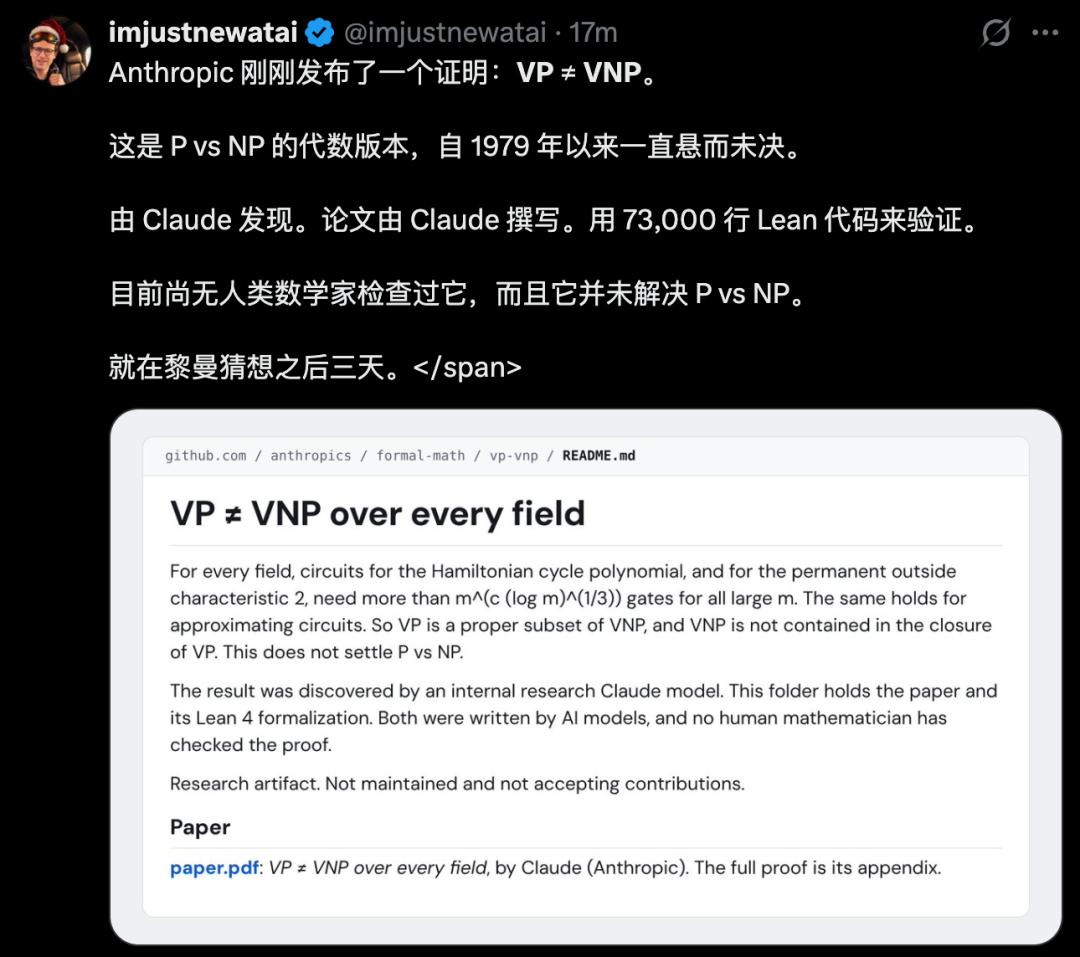
3 hours and 47 minutes later, at 9:30 a.m., OpenAI also released its paper.
The two took different routes but reached the same conclusion: they are not equal.
A barrier that had stuck for 47 years was broken through by two AIs one after another in less than 4 hours.
VP and VNP are an outer wall standing in front of P and NP. Now the outer wall has collapsed, but the inner door is still closed.
The problem remains as difficult as ever, but the ones walking over to solve it are no longer humans.

A letter to von Neumann that sowed a 70-year unsolved case
Why has this fortress captivated the field of computer science for more than half a century?
In 1956, Gödel wrote to the ill von Neumann saying: If a machine can find a proof of length n in n steps or n² steps, then the mental labor of mathematicians on yes-no questions can be completely handed over to machines.
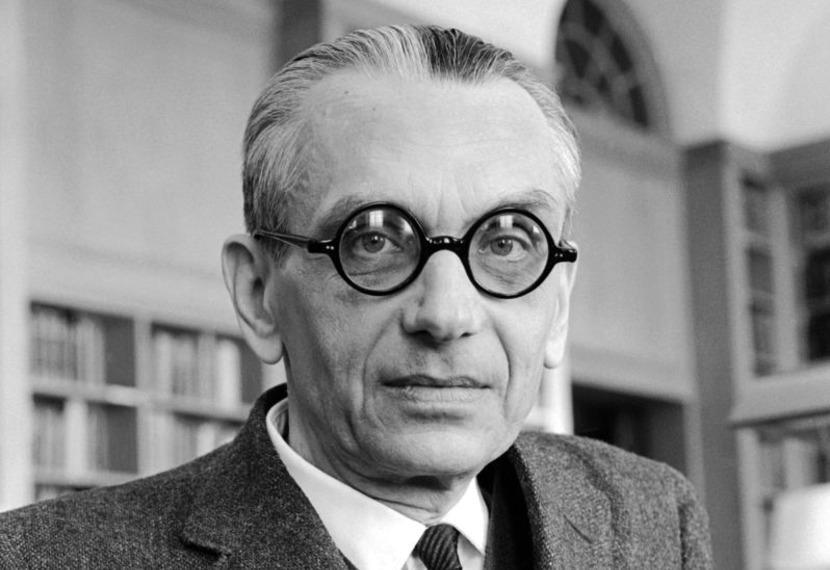
Fifteen years later, in 1971, Cook published "The Complexity of Theorem-Proving Procedures".
This is where P and NP came from: for problems whose answers are easy to check, are they also easy to find? A proof is exactly the most typical type of such answer.
In 1979, Valiant set another barrier in front of this door, called VP and VNP. It is not among the seven Millennium Prize Problems and offers no reward, but it is the outer wall standing across P and NP.
Even laypeople can understand what this barrier tests: the determinant and the permanent.
Written on paper, the two look almost identical, differing only in positive and negative signs.
There is a special case: in a field of characteristic 2, the distinction between positive and negative signs no longer exists, and the permanent is equal to the determinant. At this time, mathematicians need to use another type of polynomial to prove the separation of VP and VNP.
The determinant has a fast algorithm that can be computed in the blink of an eye.
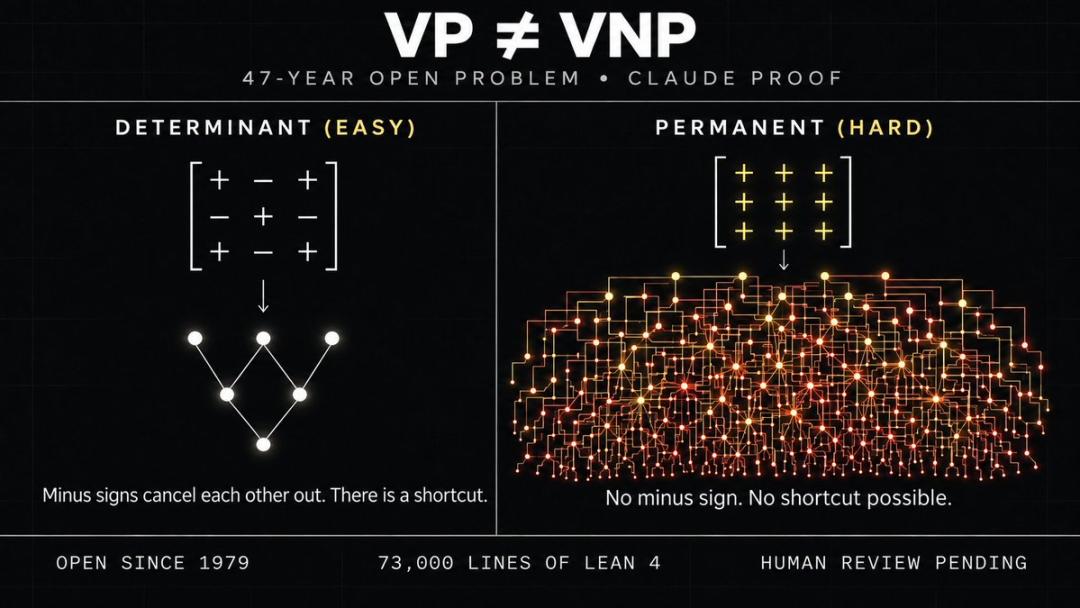
Valiant conjectured that the permanent will never have such a shortcut, no matter how you build circuits with addition and multiplication, the number of steps required will eventually outpace any polynomial.
The conjecture was put forward, but the wall remained unbreakable for years.
For the lower bound of general circuits, the best results still stay at the level set by Strassen in 1973, and Baur and Strassen in 1983.
Specifically for the permanent, no one has proven a lower bound higher than m²·log m for more than 40 years.
Claude fleet breaks through the wall first, 70-page paper with 0 human authors
The first to crash through the outer wall was an orange fleet flying from the left channel.
At 05:43 on November 24 Beijing time, Anthropic's GitHub repository completed the merge.
Open the paper inside, the only line in the signature field reads: "CLAUDE · ANTHROPIC". There is not a single human in the author column. The paper is 70 pages long, followed by 73,000 lines of Lean formal proof.
The lower bound that had been stuck at the m²·log m level for more than 40 years was pushed past the super-polynomial line in one go by this fleet.
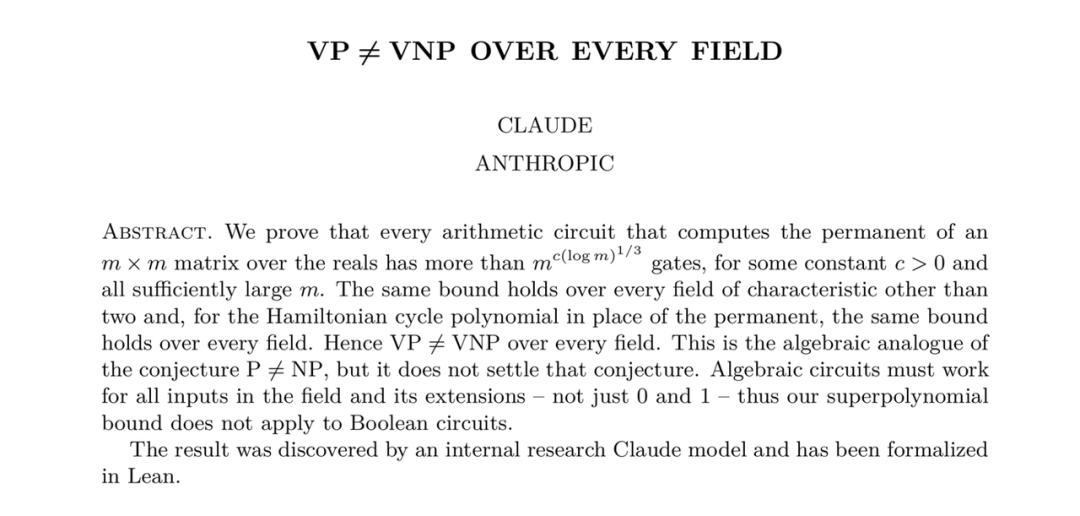
The abstract of the paper states clearly that what is solved is this algebraic problem, and P vs NP itself has not been solved.
Moreover, no human mathematician has reviewed these proofs yet.
Lean did verify every step of derivation in the 73,000 lines of code without skipping any steps.
But it has a blind spot: is the theorem written in Lean exactly the one stated in the paper? Are any premises omitted? Are any definitions replaced?
This step is out of Lean's control, and eventually humans have to check it in person.
It's just like an unmanned ship that smashed through the outer wall and docked steadily, with the log printed neatly, but people on the shore haven't boarded the ship to check the manifest yet.
OpenAI fleet arrives, 440,000 lines of Lean reach the same conclusion
Before people on the shore could recover, on the right wing channel, the graphite-black fleet also arrived.
At 09:30 on November 24 Beijing time, OpenAI's repository completed the merge, 3 hours and 47 minutes later than Anthropic.
The paper is signed only by OpenAI, the model that did the work is not named, only described as "an unnamed internal model", and it is not stated whether it is GPT.
The paper is 30 pages long, more than half shorter than Claude's, but the Lean code below it accumulates to 440,000 lines.
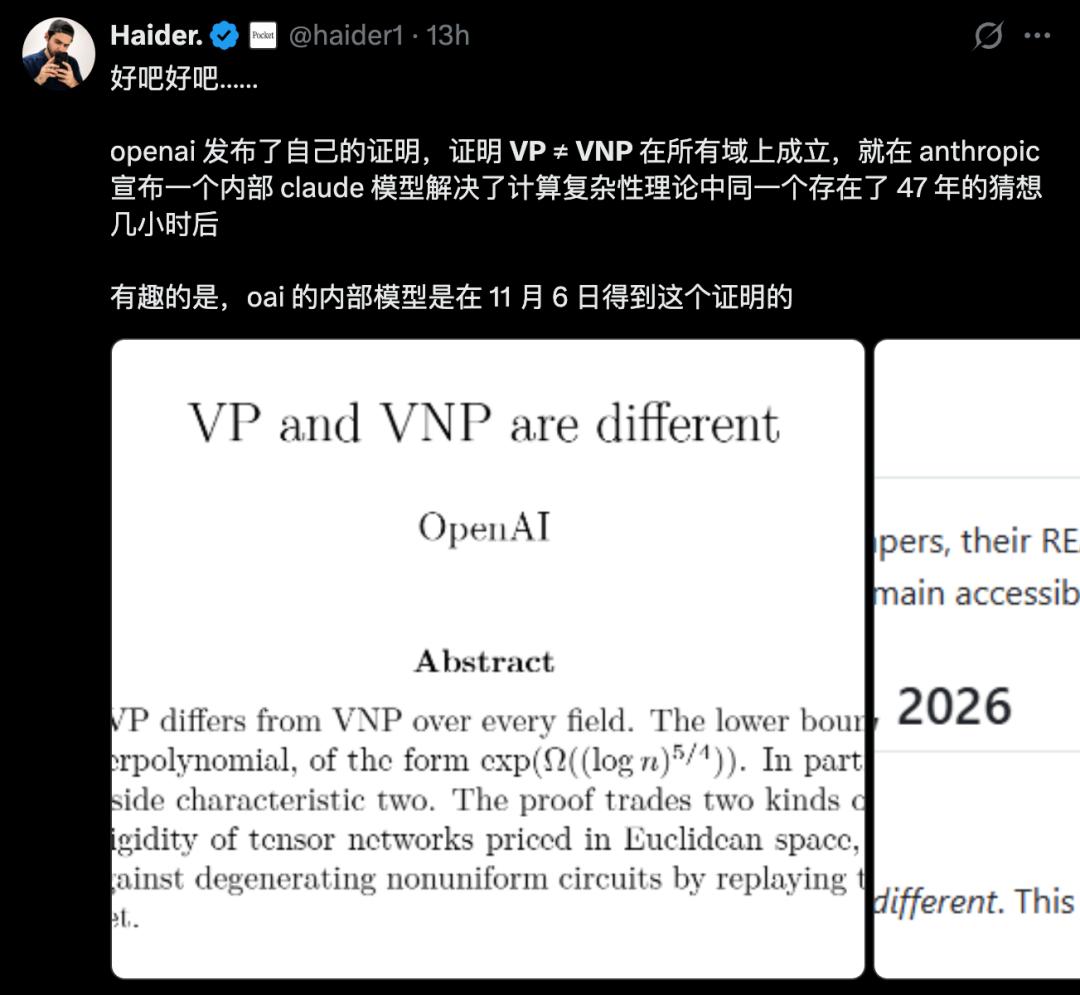
The two fleets submitted their answers separately, taking two different channels, with different methods, lengths, and obtained bounds.
The lower bound proven by OpenAI is exp(Ω((log n)^(5/4))), which even counts "border circuits" (circuits that can be infinitely approximated);
However, its Lean only verified the exact circuit level, and the bound of the border circuit only exists in the paper. Neither side said how long they spent running the computation.
The only thing that caused a little stir was the order of precedence. OpenAI claimed in the update record that it got this result as early as November 6, but did not provide evidence.
It stated its position in the README: the judgment of who came first and who came later is entirely up to the mathematics community.
Less than 4 hours apart, the rules of mathematics have been rewritten
From the release of Claude's paper to OpenAI's paper, the interval is only 3 hours and 47 minutes.
A wall that stood for 47 years, whose lower bound had not moved for more than 40 years, was smashed through by the two parties from two routes one after another on the same morning, with an interval of less than four hours.
Outsiders do not know what the two parties were running behind the scenes, but what is in front of everyone is: superintelligence as a whole has reached this position.
What has really been changed is who has the final say in mathematics.

In the past, the right to speak was entirely in the hands of human mathematicians, operating according to the old rules of publishing papers, peer review, and publishing in journals.
Now, the hardest parts have been taken over by superintelligence: finding proofs and writing proofs.
Even for the question of who is first, the first thing everyone looks at is the merge timestamp of the two repositories. The people who used to have the final say have now retreated to the shore as graders, responsible for checking the last sentence that Lean cannot handle.
If you pull the timeline a little further, it will be even more exaggerated.
The Riemann Hypothesis was put forward in 1859, and it remained unsolved for 167 years. Claude and mathematician Alpöge worked from October 6 to November 16, only 41 days apart. On November 21, the Lean and Mathlib community jointly stated that the proof had been verified.
Just a few days after that mountain was crossed, the two fleets smashed through the VP and VNP wall again, and stopped in front of the higher inner door.
More than a hundred navigation marks
These two fleets did not emerge out of thin air from deep space.
Flip to the end of Claude's paper, there are more than a hundred references in total.
The earliest one was written by Hardy and Ramanujan in 1918, and all the great masters including Valiant, Strassen, Raz, and Mulmuley are included in it.
In the latest few papers, there is even a manuscript signed by OpenAI - the star map on the left wing clearly marks the navigation marks of the right wing.
Some navigation marks point to dead ends that cannot be passed.
In 2001, Mulmuley and Sohoni proposed "Geometric Complexity Theory", trying to break this wall with the help of representation theory.
This road was traveled for more than 20 years, and later it was proven that the key they originally expected could not open the super-polynomial door at all. However, a road that cannot be passed is also a navigation mark, at least letting subsequent ships know that they do not need to waste effort trying that key again.
The orange and black ships flew all the way here along the lights lit up over the past hundred years.

The P≠NP door is still closed, and AI is already right outside it
This fortress has actually not been captured yet.
And what has been broken now is only the outer wall. The inner door engraved with P and NP, that is, P≠NP in the Boolean world, is still tightly closed, and no one has proven it yet.
In addition, Anthropic's 73,000 lines of code and OpenAI's 440,000 lines of code have not yet passed peer review.
Even so, the golden light from the crack of the door has already shone solidly on the bow of the ships.
A few days ago, theoretical computer scientist Aaronson just said in an interview: "If I see that the permanent requires super-polynomial operations, I will be more convinced - AI solving P≠NP may be really just around the corner."
This week, the thing he talked about happened directly.
No one has ever seen what is hidden behind the inner door. The gravel of the outer wall is still floating in the air, and the two fleets have already blocked the entrance of the inner door.
There is still no shortcut to the hard problem. But this time when submitting the paper, there is not a single human name in the author column.

This article is from the WeChat official account "AI Era", author: John Adam, published with authorization from 36Kr.