Xiaomi continues to increase its investment in AI. On what basis can MiMo recover its costs?
Xiaomi's investment in AI is still on the rise, but the hardware business supporting this investment is facing profit pressure.
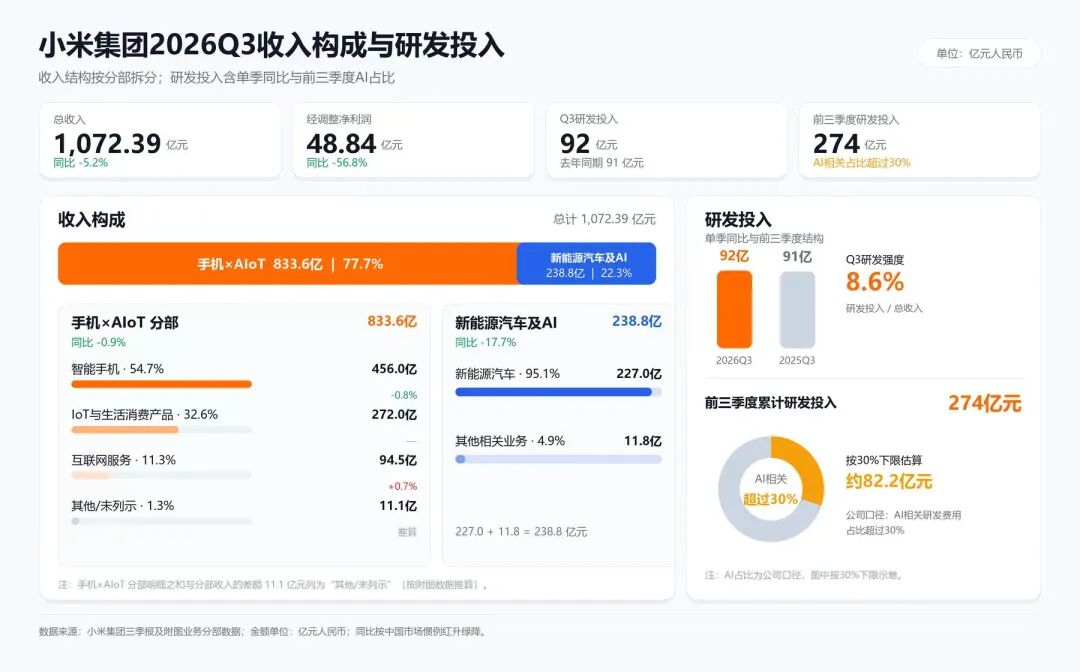
After the Hong Kong stock market closed on November 24, Xiaomi Group released its financial report for the third quarter of 2026: revenue for the quarter reached 107.24 billion yuan, down 5.2% year on year; adjusted net profit was 4.88 billion yuan, down 56.8% year on year.
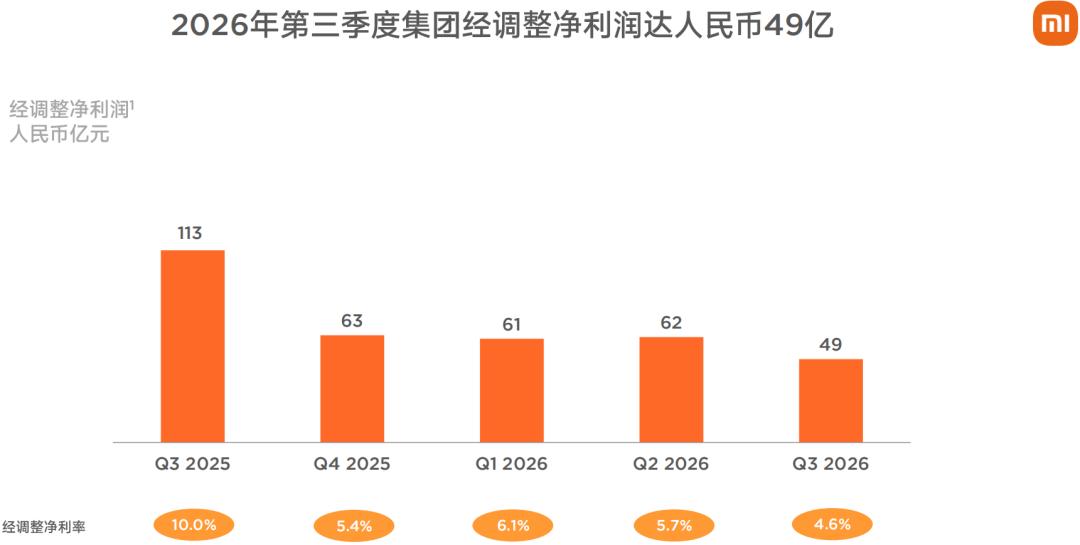
Source: Xiaomi's Q3 2026 performance materials.
Rising costs of core components such as storage and intensifying industry competition are the operational challenges listed by Xiaomi in its financial report. In the third quarter, the group's gross margin dropped to 20.2% from 22.9% in the same period of the previous year. In addition to the decrease in revenue, the gross margin retained for every yuan of revenue is also declining.
At the same time, Xiaomi has not scaled back its AI layout. In the first three quarters, the company's R&D expenditure was about 27.4 billion yuan, of which AI-related R&D expenses accounted for more than 30%. At the earnings call, the management stated that the API calls of the MiMo large model and AI-related revenue continue to increase, and the model is gradually being applied to mobile phone, automotive and home scenarios.
However, the scale of revenue growth has not been disclosed separately. In the third quarter, the revenue of Xiaomi's new energy vehicle, AI and other innovative business segments was about 23.9 billion yuan, of which new energy vehicle revenue was about 22.7 billion yuan, and revenue from other related businesses was about 1.2 billion yuan.
What business does MiMo aim to serve?
Compared with professional large model companies, Xiaomi has a different starting point. Mobile phones, automobiles and smart homes are not only its revenue sources, but also application scenarios where the model can be deployed.
In the early stage, Xiaomi focused on deploying end-side models, and then gradually increased investment in basic large models. In November 2025, Luo Fuli, who once participated in the R&D of DeepSeek-V2, publicly confirmed that she joined Xiaomi's MiMo team. In September 2026, Xiaomi released the MiMo-V2.6 series.
According to the Artificial Analysis comprehensive intelligence index cited by Xiaomi at the time of release, MiMo-V2.6-Pro scored about 46 points, ranking among the leading open-weight models on the list at that time. This shows that the model capability has made progress, but there is still a gap of product adaptation and user usage between the ranking performance on the list and commercial returns.
For professional large model companies, APIs, subscriptions and enterprise services are important sources of revenue. Model performance, service stability and usage cost affect whether customers are willing to pay.
Xiaomi's "full ecosystem of people, vehicles and homes" is exactly such an application foundation. Device interconnection solves the connection problem, and large models are expected to further help devices understand instructions, identify environments, and complete cross-device tasks.
The hardware entry points owned by Xiaomi are advantages that professional large model companies can hardly replicate in a short period of time. However, owning devices does not mean that the model can automatically enter users' daily lives. Whether a task can be completed smoothly, whether the response is timely, and whether cross-device operations are reliable all need to be verified in specific products.
In other words, the value of MiMo depends not only on whether external customers are willing to pay, but also on whether internal businesses are improved by it. Only looking at the model ranking or only the API revenue cannot cover Xiaomi's entire AI investment.
Under high investment, what is the commercialization status of MiMo?
The R&D expenditure of about 27.4 billion yuan in the first three quarters covers a number of Xiaomi's technologies and products, of which AI-related expenses account for more than 30%.
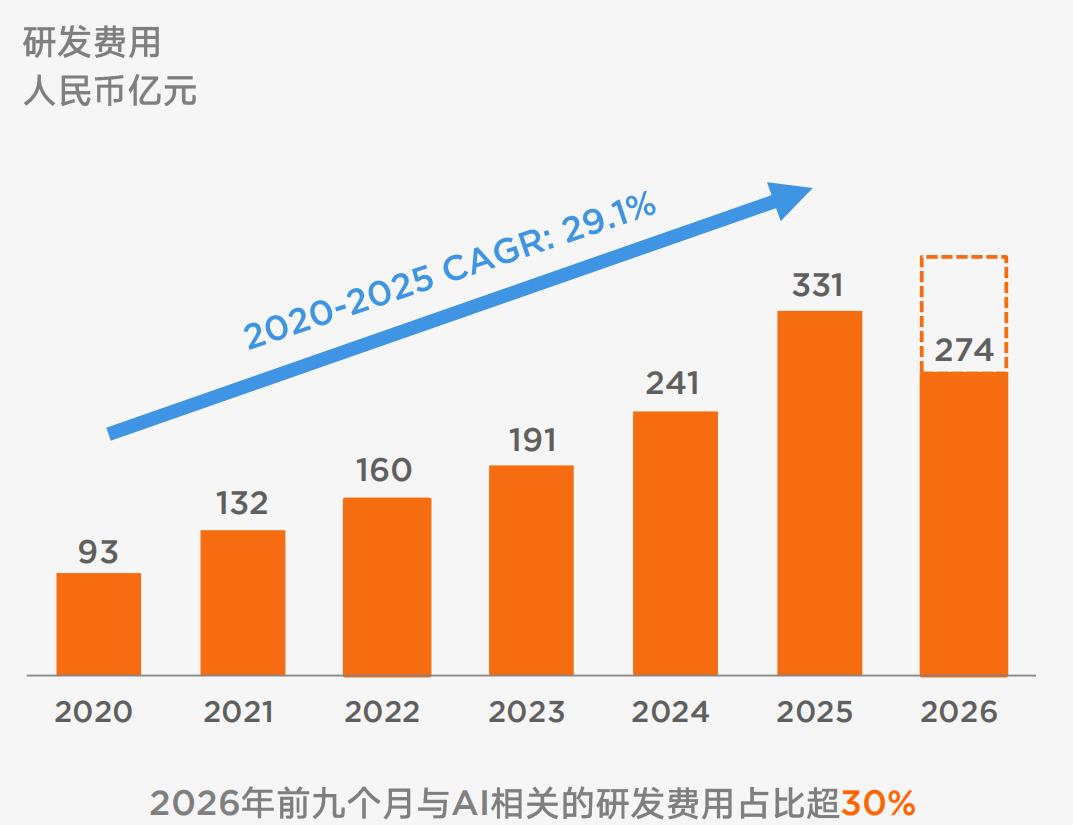
Source: Xiaomi's Q3 2026 performance materials. The 2026 R&D data is calculated on the basis of the first three quarters.
Xiaomi did not separately disclose the R&D expenses of the MiMo team in its financial report, nor did it publish the full costs of large model training, reasoning and infrastructure.
Compared with professional large model companies such as Zhipu AI, Xiaomi's R&D investment scale is significantly larger. Zhipu AI's R&D investment in the first half of 2026 was 2.13 billion yuan, while Xiaomi's AI R&D investment in the same period reached 5.5 billion yuan.
The question is, after the money is invested, can the model capability be converted into external revenue?
According to the standard real-time call price announced by Xiaomi's model open platform, the cache-miss input price of MiMo-V2.6-Pro overseas is 0.435 US dollars per million Tokens, and the output price is 0.87 US dollars; the corresponding prices in China are 3 yuan and 6 yuan respectively.
Xiaomi cited the comprehensive intelligence index and single-task cost data of Artificial Analysis in September 2026 in its Q3 performance materials, stating that the single-task cost of MiMo-V2.6-Pro is about 1/20 to 1/60 of that of overseas models with the same intelligence level.
Xiaomi has also opened the weights of the MiMo-V2.6 series models and provides API services through the model open platform. Open weights can attract developers to test, adapt and carry out secondary development, while hosted APIs can directly generate revenue.
Xiaomi's CFO also stated at the earnings call that MiMo API calls continue to increase, and external revenue has increased month on month. However, the absolute scale of revenue, the number of paying customers and the specific growth of call volume have not been disclosed yet.
For Zhipu AI and Kimi, the model itself is the core product, and its revenue is directly related to the survival of the company. Xiaomi has another option: even if the model does not bring large-scale external revenue, as long as it can improve the experience of its own mobile phones, automobiles and IoT products and reduce dependence on external models and technology suppliers, it may indirectly obtain returns through hardware sales, user retention and Internet services.
Can 1.2 billion devices help MiMo deliver satisfactory results?
Xiaomi is extending AI applications to factories and homes. According to disclosures, Xiaomi's robots have completed 8-hour operation verification in automobile factories, with autonomous charging twice during the period, which initially verifies the production line-level operation capability.
In home scenarios, the closed-loop agent system built based on the Xiaomi-Robotics-1 embodied basic model has completed long-term verification covering 3 rooms and more than 50 tasks, and has started trial operation in Xiaomi's youth apartment.
At the earnings call, Lu Weibing, President of Xiaomi, disclosed these internal application progress and said that he welcomes external B2B cooperation.
These cases show that Xiaomi is trying to extend the model capability from language interaction on the screen to physical operations in the real world.
However, the 8-hour production line operation and home scenario trial operation are more technical verifications. At least based on the currently disclosed information, Xiaomi has not announced large-scale sales revenue of the embodied basic model for external customers, nor has it proved that the robotics business has formed an independent and mature business model.
In contrast, large manufacturers such as Tencent and ByteDance have been trying to export model capabilities to robot ontology enterprises to expand the actual application scope of the models.
Tencent's Tairos embodied intelligence open platform, combined with the Hunyuan embodied intelligence model, provides capabilities such as models, development tools and simulation environments. At present, Tencent has cooperated with ontology manufacturers such as Unitree Robotics and Zhongqing Robotics to promote the implementation of model capabilities in scenarios such as robot tour guiding and retail.
ByteDance's Seed team is also continuously advancing embodied intelligence models and robot technologies, and exploring the external export of model capabilities by combining with industry scenarios such as manufacturing and automobiles. At the same time, ByteDance also invests in robot enterprises to find more physical carriers for its own models.
For most robot ontology enterprises, the capital and computing power threshold for training a general basic model from scratch is extremely high. Directly accessing the "brain" capabilities of large manufacturers such as Tencent and ByteDance, and focusing their energy on ontology structure, motion control (cerebellum) and vertical scenario data accumulation, is a more pragmatic commercial path.
This does not mean that Tencent and ByteDance have completed the large-scale commercialization of embodied models. But at least in terms of business models, they have begun to try to export technical capabilities to external ontology manufacturers, while Xiaomi's current path is still more inclined to internal digestion within the ecosystem. Whether its ecological advantages can be converted into commercial returns requires more time and data to prove.
Xiaomi indeed does not have to rely entirely on selling models externally to make profits like Zhipu AI and Moonshot AI. Instead, it can feed back the mobile phone, automobile and IoT ecosystem through large models, and finally recover the investment from hardware and services.
Theoretically, if MiMo can make mobile phones and automobiles sell better by being smarter, or greatly improve the production efficiency of automobile factories, even if MiMo does not have much external revenue, the incremental benefits obtained by internal businesses may cover the investment in large models.
But at present, this logic has not been fully verified.
In the third quarter, Xiaomi delivered 100,975 electric vehicles, down 7.2% year on year and 3.1% month on month; mobile phone shipments reached 30.7 million units, down 29.3% year on year and 1.6% month on month.
The weakening of core products means that even if MiMo plays a greater role internally, it can only help Xiaomi operate more stably in a shrinking market in the short term. However, the more the core business is under pressure and the profit margin narrows, the more Xiaomi needs to continuously invest in long-cycle technologies such as large models, chips and robots.
Of course, AI investment is not the main reason for Xiaomi's profit decline this quarter, but these investments ultimately need to find a sufficiently large commercial outlet.
As of September 30, 2026, the number of connected devices on Xiaomi's AIoT platform reached 1.2035 billion, up 16.2% year on year; the global monthly active users reached 771.9 million. The ecosystem is a good card in Xiaomi's hand, but the number of devices and user scale do not directly equal AI demand, let alone commercial revenue.
MiMo already has an entrance for external charging and a test field for internal applications. What Xiaomi needs to deliver in the next stage is clearer revenue and usage data, to show the outside world how model progress is converted into operational returns.
(The content and views in this article are for reference only and do not constitute investment advice. Investment is risky, please be cautious when entering the market.)
This article is from the WeChat official account "The Fourth Wave", written by Chen Junyi, and authorized for release by 36Kr.