Jensen Huang has just made his comeback, and the AI credit alerts are blaring nonstop.
With Jensen Huang returning to the helm of NVIDIA, the credit market in the artificial intelligence sector has once again seen drastic fluctuations.
On Tuesday, as Wall Street began to reassess what Jensen Huang's return means for the continued funding of the AI boom, market concerns over the huge debt burden supporting the expansion of AI infrastructure rose significantly once again.
Jensen Huang has long been regarded as one of the core funders in the AI industry, which even earned NVIDIA the reputation of "the AI central bank" for a time. Jensen Huang led a number of core transactions between NVIDIA and new cloud computing power vendors such as CoreWeave, supporting their procurement of computing chips through methods including partial guarantees from NVIDIA. Now, his return not only rekindles the market's expectation that NVIDIA may continue the "circular financing" model for AI chips and data centers, but also alerts fixed income and credit bond investors.
Market data shows that CoreWeave, NVIDIA's closely backed enterprise that has become a typical representative of AI debt concerns, saw its stock price drop by nearly 12% again on Tuesday. Even more chilling figures show that the yield of its bonds maturing in 2031 with a coupon rate of 9.75% broke through 17% in one go. Bond yields move in the opposite direction to prices.
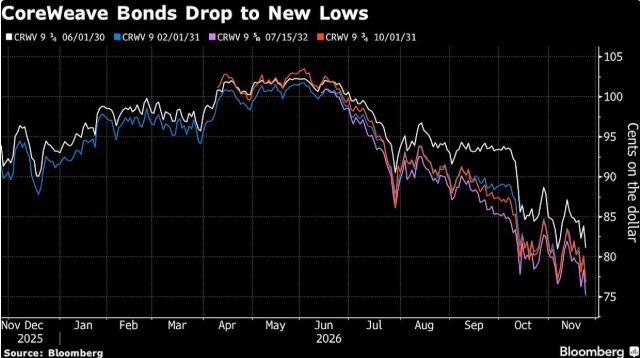
At the same time, the 5-year credit default swap (CDS) spread of this new cloud operator jumped 8.5% on Tuesday, breaking through 1200 basis points. CDS is essentially an insurance tool to prevent debt default, often regarded as a barometer for the market to measure default risk; the rapid widening of its spread directly reflects that investors believe its solvency risk has risen sharply.
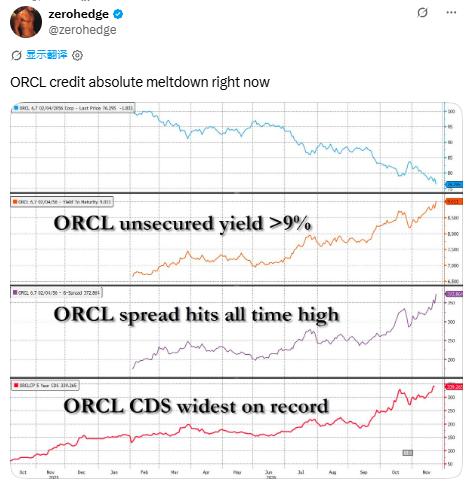
It is not just CoreWeave that is facing the pressure of widening spreads. Oracle's 5-year CDS spread also jumped 7% to 355.68 basis points on Tuesday; the well-known financial blog site zerohedge described that Oracle's credit is currently in a state of total collapse.
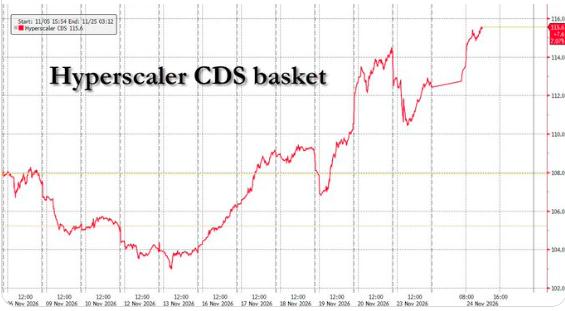
Even the ultra-large-scale cloud giants Meta and Amazon, which have extremely high credit ratings, saw their CDS spreads widen by more than 2%; NVIDIA's own CDS spread also expanded by 3.4%. The overall CDS spread of ultra-large-scale cloud service providers soared to a record level in one go.
Larry Holzenthaler, Senior Portfolio Manager of Fixed Income at Catalyst Funds, believes that the turmoil caused by Jensen Huang's return to the helm of NVIDIA can hardly convince picky credit investors completely.
"Many old-school fixed income investors will re-examine the cause of the whole incident and the process of White House intervention and pressure. I think many participants in the credit market will choose to take the initiative to avoid risks and exit gradually," he admitted, "Fixed income and credit investors are inherently averse to such dramatic farces and high uncertainty."
Ben Emons, Founder and Chief Investment Officer of FedWatch Advisors, said that this marks that the "Jensen Huang effect" is weakening. He said these trends show that "the market regards government intervention as a kind of 'moral persuasion', which will bring credit risk and interest rate risk."
Jensen Huang's Return Still Leaves Doubts: Will "Circular Financing" Be Increased or Reduced?
Although NVIDIA has a wide layout in the entire artificial intelligence industry chain, new cloud vendors are facing the strictest scrutiny. Such companies that operate by leasing AI computing power and cloud infrastructure generally have high leverage, and previously relied heavily on NVIDIA's financial endorsement to reduce their exposure to the public bond market.
Since the financial lifeline that sustains the industry ecosystem is largely tied to NVIDIA, Jensen Huang's next move after his return is under close watch.
During Jensen Huang's short departure, NVIDIA's Chief Financial Officer Cores stated on an earnings call that the company will "review future investments with extremely strict standards" and maintain strict discipline in capital expenditure, investment and financing activities.
Paul Meeks, Head of Technology Research at Freedom Capital Markets, believes that the CFO's previous statement implied that NVIDIA would turn to prudence in external financing guarantees. "But with Jensen Huang returning to his post, this prudent expectation is likely to be dispelled."
Steve Eisman, a senior investor famous for being one of the prototypes of *The Big Short* and the host of the podcast *The Real Eisman Playbook*, believes that the powerful Jensen Huang is likely to act more aggressively. "He will not back down on 'circular financing', but instead double down," Eisman asserted on a TV program on Tuesday.
Eisman previously thought that after Jensen Huang left, the ecosystem he built by injecting capital into artificial intelligence companies would likely collapse, leaving some companies in "big trouble". "But now that he's back, the situation is different," he said.
However, some analysts in the market are skeptical about the sustainability of this aggressive capital injection model.
Ruben Roy, an analyst at investment bank Stifel, wrote in a research report on Monday: "Given the strict regulatory review of related financing and guarantee disclosure... we do not think Jensen Huang's return will prompt NVIDIA to quickly resume the large-scale customer credit support of the past."
NVIDIA disclosed on its latest quarterly earnings call that as of October 25, the total amount of financing guarantees the company has used to back various AI projects has reached 118 billion US dollars.
Rising Debt Risk
In fact, anxiety about the debt risk accumulated to support the expansion of AI infrastructure has long been widespread before the turmoil of Jensen Huang's leaving and returning to his post.
"These deep hidden dangers can never be dispelled just by the White House pressuring the weak NVIDIA board of directors to bring back Jensen Huang," commented David Rosenberg, a well-known macroeconomist and Founder & President of Rosenberg Research.
John Lloyd, Head of Global Diversified Industries and Corporate Credit at Janus Henderson, believes that Jensen Huang's retaking the helm "is actually a confirmation of NVIDIA's existing business expansion strategy". However, before the long-term supply and demand pattern is completely clear, the credit market will still maintain a highly cautious defensive stance towards such new cloud vendors.
That said, Lloyd remains cautiously optimistic about CoreWeave held in his portfolio. He pointed out that many real-world data at the underlying level of computing power still show a "quite healthy operating environment", including the strong residual value performance of second-hand GPUs and the high spot computing power rental prices.
"This company is going all out to ensure the delivery of business implementation," Lloyd said, "At least for now, they don't need to rush back to the high-yield junk bond market to raise funds."
At present, the investigations targeting NVIDIA and Jensen Huang personally are still advancing in full swing. Jensen Huang is expected to attend a joint hearing of three committees of the U.S. House of Representatives next week; NVIDIA is conducting an independent internal investigation into its related activities; California Attorney General Rob Bonta has also officially launched a state-level investigation.
At the federal judicial level, President Trump publicly claimed on Monday that U.S. Attorney General Todd Blanche "confirmed that the federal government has no evidence that Jensen Huang is involved in any illegal activities". But the market still has not let down its guard.
"The other shoe could drop at any time," Rosenberg warned, "In my opinion, this turmoil is far from being settled."
This article is from the WeChat official account "CLS.cn", written by Xiao Xiang, and published with authorization from 36Kr.