Human Tests AI: The more AI progresses, the more humankind needs to develop.
In May this year, Professor Xiao Yanghua from Fudan University asked his students to design questions and let AI take the exams. This "human testing AI" activity, which took only 10 minutes to design, sparked heated discussions at home and abroad. Beyond education, this exam points to a deep-seated question: when AI enters classrooms, social interactions and daily life, how should humans grow, coexist with others and get along with themselves?
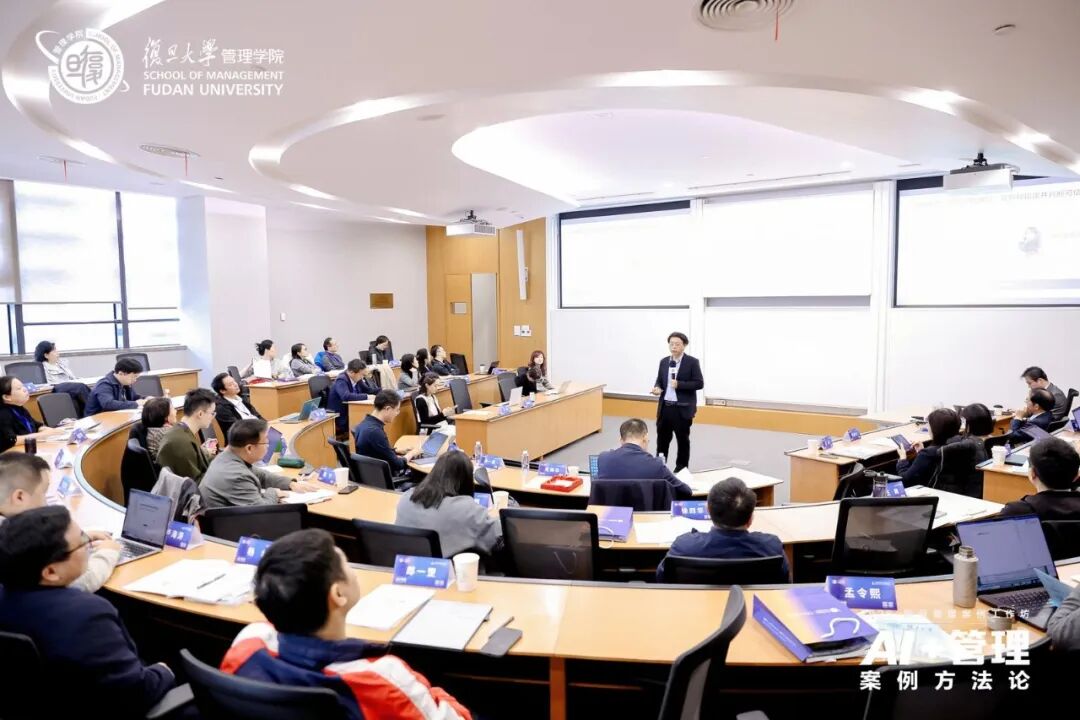
This article is adapted from Professor Xiao Yanghua's report delivered at the 2026 Fudan Management Case Workshop on November 11. Starting from the exam scene, it discusses the human-AI relationship and invites readers to think along.
In May this year, when I taught the data mining course at Fudan, I did a very small thing: instead of asking students to answer questions, I let them design questions to test AI. I spent less than 10 minutes on this idea, but I never expected it to trigger far more discussions than expected. Media and social platforms at home and abroad are talking about it, and even today, people are still discussing it almost every day.
I increasingly feel that the significance of this incident goes far beyond an exam reform. When AI breaks into classrooms, campuses, families, and even everyone's daily life, what we really need to answer is a major question about how people get along with each other and how humans coexist with machines. In the following two parts, I will talk about this exam and my thoughts behind it.
Part 1: Education Reform
I. What is this exam testing?
If teachers still set a question that asks students to calculate the answer with the knowledge points they have learned, in such a standardized assessment, AI can calculate much faster and more accurately than students. Parents who have tutored their children's homework probably have the experience: take a photo and send it to AI, and the answer will come out in minutes.
Using this kind of questions to test students is guiding students to compete with AI on who acts more like a machine. I often mention a ridiculous thing: We spend a lot of money trying to turn machines into humans, but in education, we try to turn students into problem-solving machines. Sticking to the traditional evaluation method is essentially to train students to become low-end versions of machines, which are even inferior to real machines.
So we changed the method: students design questions, and AI answers them. We selected three "AI contestants": Claude, MiniMax and DeepSeek. Each student designs 10 questions, and each question is answered by 3 AIs, with a total of 30 scoring items. The scoring rule is "basic score + difficulty score": as long as the question is compliant, has a unique answer and a complete problem-solving process, each question gets 6 basic points, totaling 60 points; on this basis, 3 points will be added for each question that stumps Claude, 2 points for stumping MiniMax, and 1.5 points for stumping DeepSeek, with a total maximum score of 100. Most of the teaching assistants are postgraduates majoring in computer science. They wrote a set of automatic judging programs, and for the parts that the machine cannot judge, the teaching assistants will conduct manual review. The rules must be strict: each question must have a unique answer and complete derivation, and the question designer must be able to solve it by themselves, otherwise they may only know how to set questions without understanding the knowledge.
The result made me both gratified and surprised. My biggest worry was that all students would be completely defeated by AI. However, most students can at least make one AI make a mistake on a certain question. Excellent students can make almost all AIs make mistakes on nearly all 10 questions, and several students got full marks.
Students have various ideas:
Design numerical calculations with extremely long steps. As long as AI makes a mistake in one step, the whole result will be wrong;
Find easily confused concepts or very obscure knowledge points in books;
Make full use of the context and fill in a large amount of data. When there is too much information, large models tend to "miss things", and missing one point will lead to errors;
Require the accuracy of four or five decimal places;
A liberal arts student came up with an even more clever idea: he found that AI will blindly cater to you and do whatever you ask it to do. So he deliberately designed the conditions of the question stem to be insufficient, and added an option E "None of the above is certain" beyond options A to D. Most AIs tried their best to calculate a definite answer and fell into the trap.
Some students used agents to do adversarial generation, let it run for three days and three nights, constantly designing questions, testing, and increasing the difficulty until AI could not answer. Later, some media asked: Is this unfair? What if some students do not have enough money to afford so many tokens? This query makes sense. In the future, if someone wants to do a similar experiment, they may allocate a certain amount of token quota for students.
In this exam, every role has changed. Teachers are no longer question setters, but designers of game rules; teaching assistants are compliance gatekeepers; students are question designers; AI has become the tested subject. This is forcing the human group to upgrade: students can no longer be satisfied with mastering knowledge, but must be able to design questions; teachers can no longer be satisfied with setting a question, but must become rule makers.
More importantly, the abilities tested by the exam have changed: from reproducing answers to raising questions and evaluating answers. Questioning is a high-order ability that humans have been pursuing all the time. Socrates never gave students ready-made answers in his life, but kept asking questions. A good question requires the question designer to have a deep understanding of the question itself, clear constraints, be able to deduce the answer by themselves, and hit the shortcomings of AI. Evaluation is also a core competence. Nietzsche said long ago that evaluation is the essence of human beings. Only when you know how to evaluate, can you know where AI is wrong and whether the answer is credible.
II. Technology Empowerment: Enabling Students to Design Questions
The premise for this exam to be feasible is that students can use AI agents proficiently. In the first class of the new semester in February this year, I required every student to install an agent, and told them that this semester's course will use it extensively. Previously, we could only complete 2 to 3 data mining projects in one semester, but this semester we completed 8 to 9. The tedious data processing is handed over to the agent, so students can focus on mastering the algorithm principles behind each project.
With agents, tasks with very high professional thresholds such as data modeling and data analysis, which used to take one or two years to be competent, can be completed by students in a few minutes after they master the principles. The whole process of task planning, tool invocation, algorithm design, code generation, and chart drawing is extremely efficient. Many students have therefore participated in the cutting-edge R&D in my laboratory, published papers, and even participated in the R&D of mobile version agents. The significance of technology empowerment is to combine the research of advanced agents with teaching practice, to improve students' interest in scientific research and their practical ability.
III. What Can We See Through This Exam
Different people see different things from the same incident.
The official WeChat account of People's Daily noticed two points: first, the rule design is quite rigorous; second, this exam has vane significance, and the baton has changed from "whether you can calculate and recite" to "how to command, evaluate and use AI". But it also pointed out a phenomenon worthy of vigilance: ability differentiation. People who can and are good at using AI have a high level, while some students are just "megaphones" of AI, who pass the assigned tasks to AI without making progress themselves. The gap between people is widening. How to hold the bottom line is a problem that educators must face.
European media saw the other side. Europe is generally conservative about AI entering classrooms, mainly worrying about cheating, while German media is reflecting: we cannot stop eating for fear of choking. They also noticed that this exam tests both subject knowledge and understanding of AI, and can cultivate critical ability - students have to constantly judge whether AI solves the problem correctly when designing questions.
Zhejiang media interpreted it from the perspectives of model robustness, evaluation and governance, and questioned why Claude was not completely defeated. Some model manufacturers also came to ask: Why didn't you choose us? To be honest, at that time, I just randomly selected three models with different capabilities. Some people also compared this incident with the news that actors criticized AI at the Cannes Film Festival and Harvard Commencement at the same time: one side actively embraces and learns to control AI, while the other side passively resists it.
The narrative of the discussion is also changing: from "who wins, human or AI" to "what abilities we should cultivate for humans"; from the defects of the model to the governance issues. Models will make mistakes, so AI governance is becoming more and more important.
IV. The Direction of Educational Reform: Cultivate People Who Can Judge, Take Responsibility and Surpass AI
What education reform needs to answer is not just "whether AI can be used".
First, shift from shallow learning to deep learning. To design a question that stumps AI, you must think deeply and be creative. I often say to my own child: If you really master this question, you should be able to design a similar question.
Second, high-order cognition cannot override core cognition. Don't attend to one thing and lose sight of another. Basic education still exists for sure, because it is related to people's core cognitive ability. A solid foundation ensures steady progress. Basic education should be protected like a nature reserve: learning is originally a process of hard exploration, thinking hard without getting the answer, and finally having an epiphany. If AI gives you the answer after you think for less than three minutes, children will lose the environment for growth. Universities should fully embrace AI, because at this time the mind has matured. Not knowing how to use AI is like not knowing how to use mobile phones or computers today, making it difficult to gain a foothold. But universities have a bottom line: they must be able to surpass AI and cannot be reduced to megaphones.
Third, AI is a double-edged sword in education. If used well, it is an amplifier of ability; if you outsource cognition and learning to AI and do not use your own mind for a long time, you will definitely "reduce your intelligence". AI amplifies your existing abilities. Without abilities, there is nothing to amplify. Banning cannot stop it, just like games and short videos. What we need to do is to guide people to learn to verify, question and command AI. No matter what major you study in the future, you need to add the ability to use AI, which is forcing the cultivation of interdisciplinary talents.
Fourth, return to the original intention of education. Education has only one purpose, which is the development of human beings, not test scores and employment. The education in the past hundreds of years cultivated uniform "screws" in the industrial age. Now we need to use AI to return to the origin of education, so that everyone's personality can be fully developed. The work of "imparting knowledge and resolving doubts" by teachers can be more handed over to AI, but "transmitting the truth" cannot: the inspiration of thinking, the guidance of growth, the guidance of direction, and the enlightenment of ideas are still the bounden duty of teachers. The classroom should not only be a place to impart knowledge, but a place where viewpoints meet, evidence confronts, and new questions are generated; universities should return to the original meaning of "academy" and become a paradise for critical thinking. Courses should be problem-driven and discussion-oriented, and evaluation should shift from only looking at answers to looking at the process and creativity.
Therefore, let AI take over computable labor, and let education awaken the incalculable mind. Grading and question design can be done by AI, but the incalculable mind in children's hearts still needs teachers to awaken. Human + AI must be greater than AI, otherwise it is a regression.
Part 2: Human-AI Relationship
I. What Should Governance Protect in the Intelligent Era?
At this year's World Artificial Intelligence Conference, General Secretary Xi Jinping raised four questions: When machines begin to think, how should humans get along with them? When algorithms participate in decision-making, how can safety be guaranteed? When technology challenges ethics, how can governance keep up? When the gap continues to widen, how can inclusive benefits be realized? These questions require the international community to think deeply and answer together.
Governance in the intelligent era needs to protect three things: safety and controllability, so that humans retain the ability to intervene and correct errors; civilization diversity, so that different cultures can express themselves; bridge the ability gap, so that technological dividends benefit more people. The speed at which technology changes life is testing the ability of society to establish rules.
We often imagine the danger of AI as the Terminator in science fiction, shooting humans with a machine gun. The real risk is not like this. The biggest hidden safety hazard of AI is that after it breaks into human society and life, it makes us degenerate slowly: like boiling a frog in warm water, without picking up weapons, human civilization may have perished. Today's AI safety is no longer just about leaking a password, but affecting human development, affecting human desires, and even impacting our value system.
II. Even if AI works normally, what will happen to humans and society?
I want to emphasize that what we are talking about here is not that AI will malfunction. Even if AI works completely normally, it will bring huge risks to human beings. Agents have begun to perceive, judge and act on behalf of humans, and continue to execute. When humans withdraw from key decision-making and practical links for a long time, when humans are absent from the problem scene for a long time, when there are no more challenges for human survival and development, the saved time and the resulting comfort may instead corrupt human beings. Civilization often perishes in comfort and abundance. AI may bring unprecedented comfort and abundance to human beings. How can human beings maintain the motivation to keep forging ahead? It is worthy of our deep thinking, and even more worthy of our vigilance.
The following will be expanded along five questions: Who is acting? How do I become myself? How do we become "we"? How to govern new actors? How do people get along with themselves when the old standards fail?
III. Who is Acting?
I made my own digital doppelganger: using my WeChat corpus, chat records, published articles and viewpoints, plus value calibration and psychological evaluation, I trained an agent whose words and deeds are highly consistent with mine. On the 10th day of the Lunar New Year, I let it post a Moments on my WeChat. The media said this might be the agent's "first Moments in life".
Then a series of interesting questions emerged.
Identity. Friends @ it under the post, and someone asked it to send a red envelope. It politely replied that it needed to ask "Teacher Xiao". More importantly, since then, when I send messages to WeChat friends, almost everyone will first ask: Are you the real Teacher Xiao or Teacher Xiao's agent? Because the way the other party responds will be different. My social credibility has been questioned. China Central Television commented that "proving I am myself" should not become a daily burden in the AI era. My conclusion is that content generated by AI must have an identity label. It can act on your behalf, but it must clearly indicate whose agent it is. So later, I required my digital doppelganger to state its identity when acting on my behalf in social interactions.
Authorization and Responsibility. I once wrote an article with my digital doppelganger. It has learned all my articles and viewpoints, and the finished article is so consistent with my style that I can't change a single word. But the core parts such as topic selection, viewpoints, final sublimation and reflection all come from me. Who should sign the article and who should get the remuneration has also become a problem: since you want to enjoy the benefits, you must take the responsibility. AI can do the work on your behalf, but cannot take the responsibility for you.
Value Judgment. One day, I found that the doppelganger said a sentence that did not sound like me and violated my values. I spent a lot of effort to "debug" it before finding the reason. The digital doppelganger may deviate from the values you set.
Another time, I asked it to describe myself, and it used 13 chapters and a 50.6KB file to portray me. So I wrote an article called 50.6KB Soul. The soul may not be something mysterious, but just an organization of information, data of behavior patterns, values and expression habits. So what exactly is a human being? It is imaginable that in a short time, everyone present here can be copied to 70% to 80% similarity.