Gemini 4 takes all top three spots, and the only one that can beat Google is Google itself.
Google alone has taken the top three spots on the Arena text leaderboard!
Just recently, on the latest Arena text leaderboard shared by X user Alex, the top three positions are all claimed by Gemini 4 (Carbon, Argon, Neon), with Carbon topping the list at 1527 points.
Two months ago, the top six spots on this leaderboard were all occupied by Claude; now, the highest rank Claude can reach is only fifth.
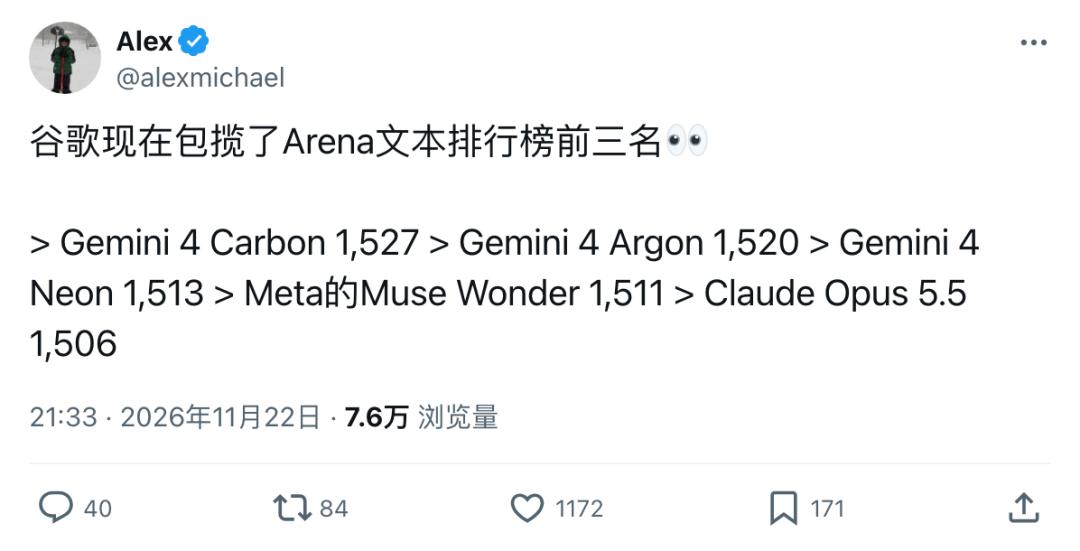
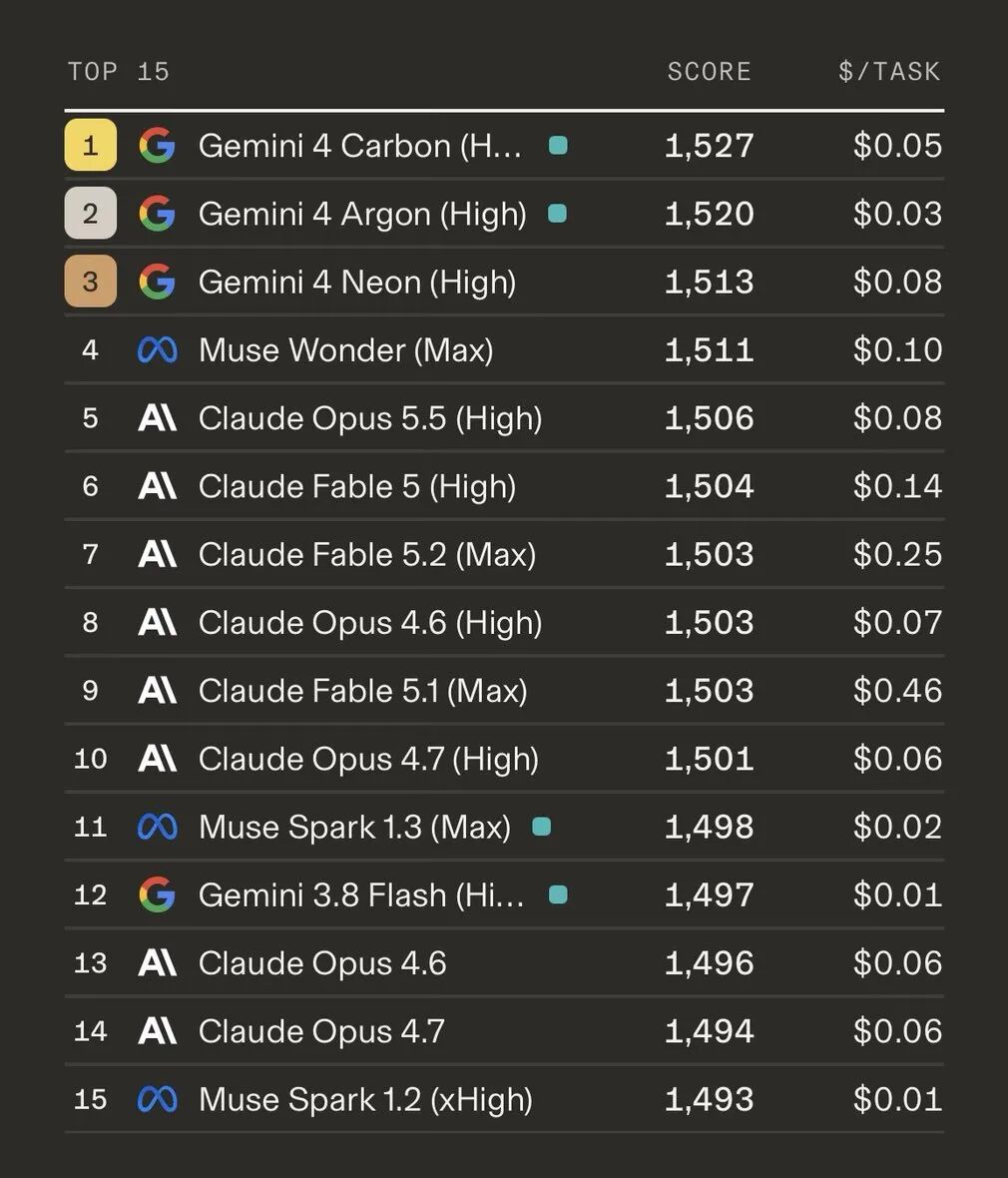
Ranked right after the three Google models, the fourth place goes to Meta's Muse Wonder, while Anthropic's flagship model Claude Opus 5.5 has dropped to fifth.
Anthropic's glory of taking all top six spots only lasted for 4 days. Over the following more than 50 days, three Gemini 4 models from Google landed on the leaderboard one after another, displacing its own top-ranked model.
Three Gemini 4 models take turns to lead, Google outcompetes its own products
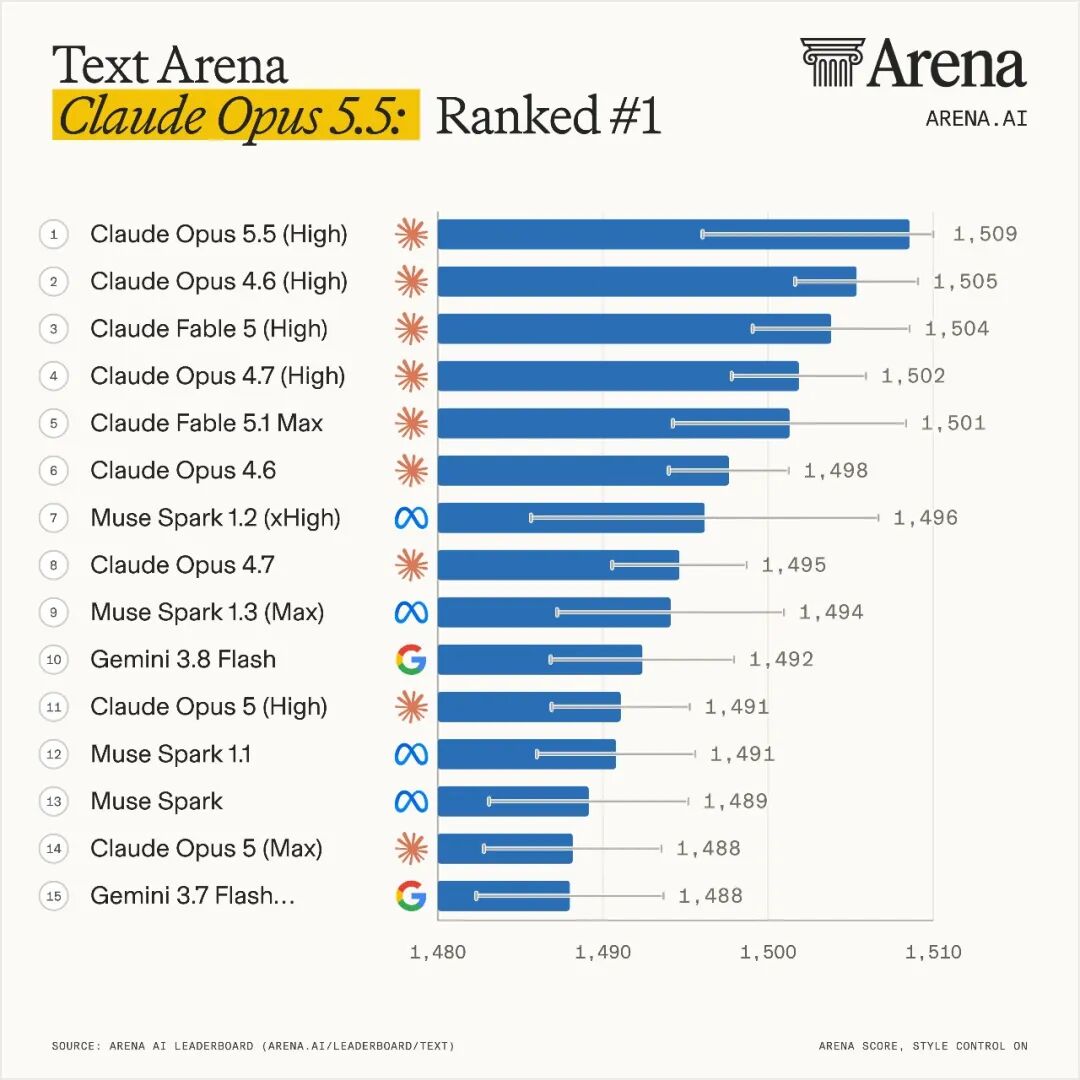
Back then, Claude Opus 5.5 (High) took the first place on the text leaderboard with 1509 points in its debut, 18 points higher than its predecessor Opus 5.
Just 4 days later, Google released Gemini 4 Argon:
We are proud to introduce Gemini 4 Argon: our brand new cutting-edge model.
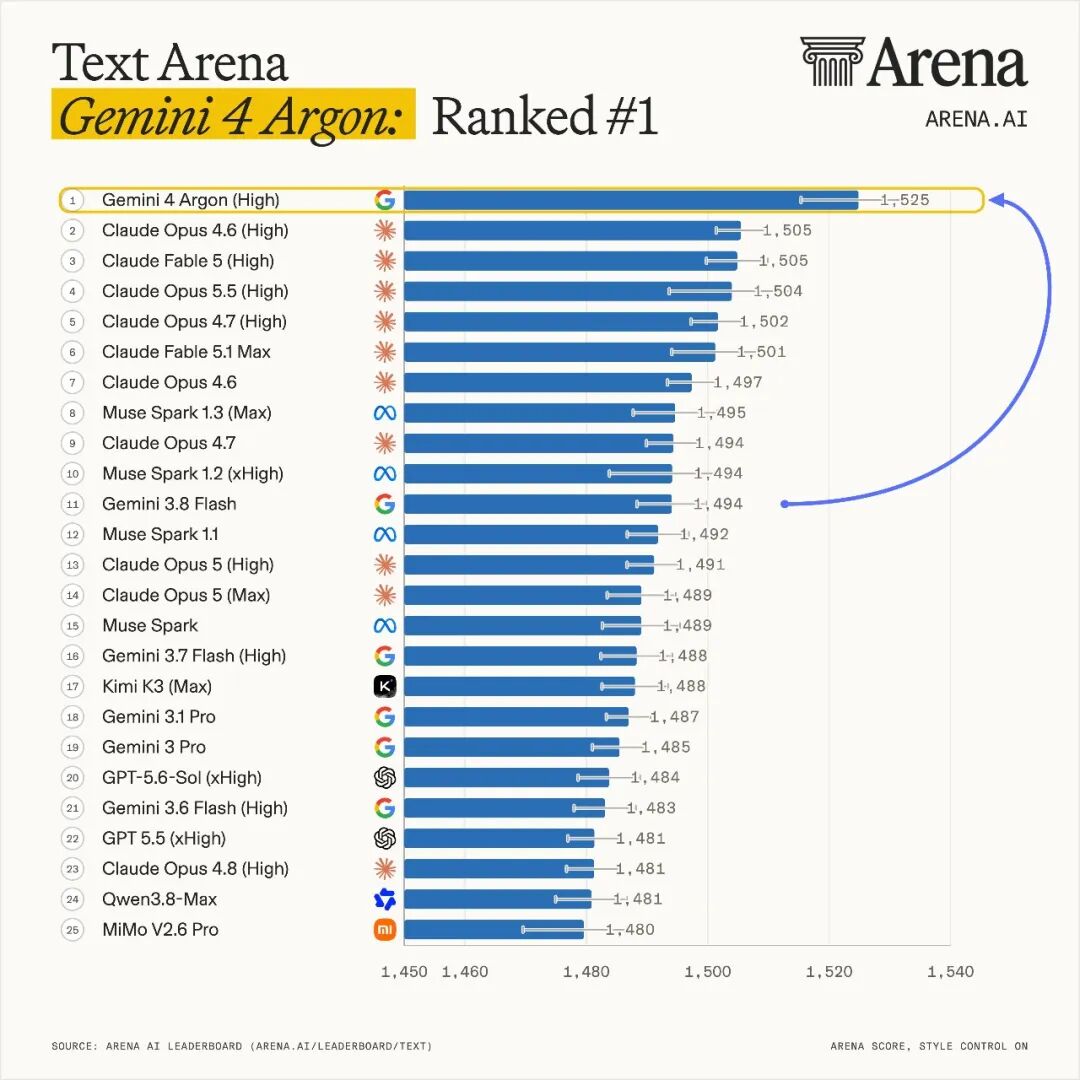
Gemini 4 Argon (High) took the first place as soon as it entered the leaderboard, scoring 1525 points, a full 20 points ahead of the second-ranked Claude Opus 4.6 at that time; the newly topped Opus 5.5 has already dropped to fourth place (1504 points).
In the sub-categories of programming, hard problem solving, instruction following, long query processing, creative writing, as well as in languages including English, non-English, Chinese, Russian and more, Argon took the first place across all categories.
The price is also reduced, its hybrid price is about 8 dollars per million tokens, only half of that of Opus 5.5, and it is rated as the "most cost-effective" model by Arena.
Right after Google took the top spot, Meta caught up with its new model.
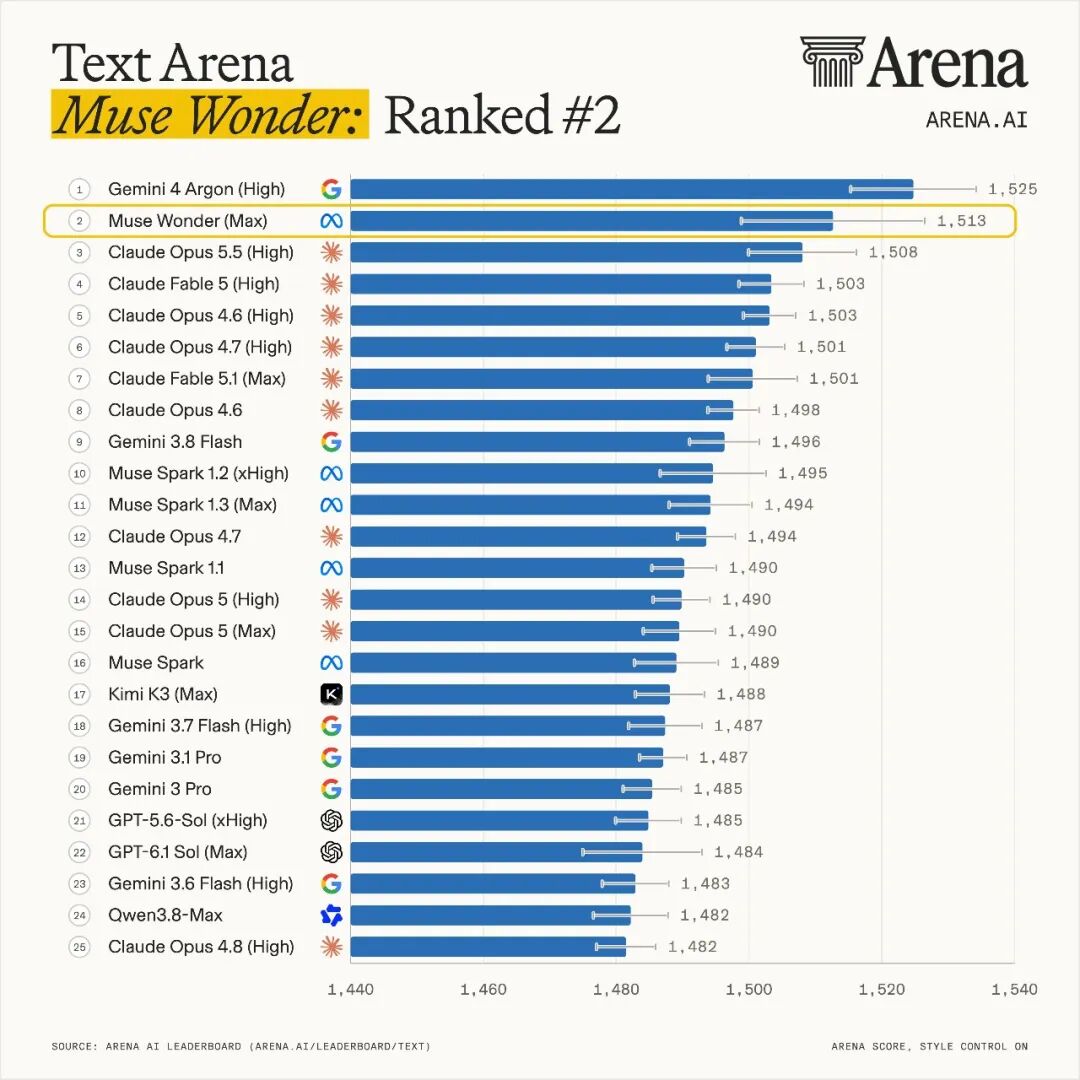
On October 13, Meta's superintelligence lab led by Alexandr Wang launched its first cutting-edge model Muse Wonder (Max) since its establishment, publicly claiming that this is its "strongest model to date".
On October 14, Muse Wonder rushed to the second place (1513 points) in its debut on Arena, only 12 points behind the top-ranked Argon.
But before any other competitor could make a move, it was Google itself that pushed Argon out of the top spot.
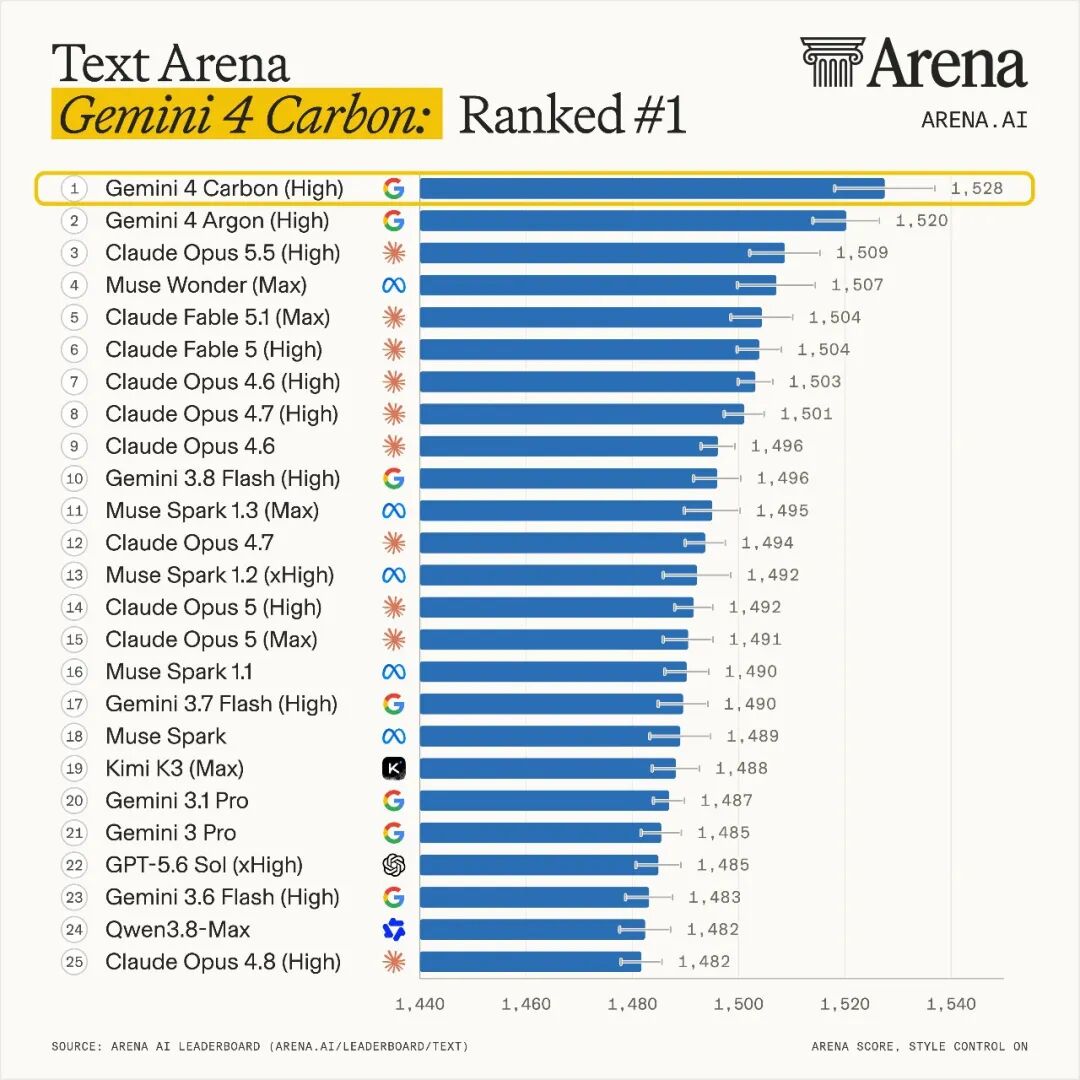
On October 29, Gemini 4 Carbon (High) built on the basis of Argon topped the leaderboard with 1528 points, pushing its sibling Argon (1520 points) to the second place. Google DeepMind stated confidently at the release:
Gemini 4 Carbon is our next-generation cutting-edge model, reaching the industry's best level in both cybersecurity and long-horizon task capabilities.
Shortly after that, on November 19, Google released the third model Gemini 4 Neon, positioned between Carbon and Hydrogen, focusing on complex software engineering, knowledge work and scientific tasks.
On the Arena text leaderboard updated on November 22, Neon ranked third, scoring 1512 points the same as Meta's Muse Wonder, so the top three spots all belong to Google.
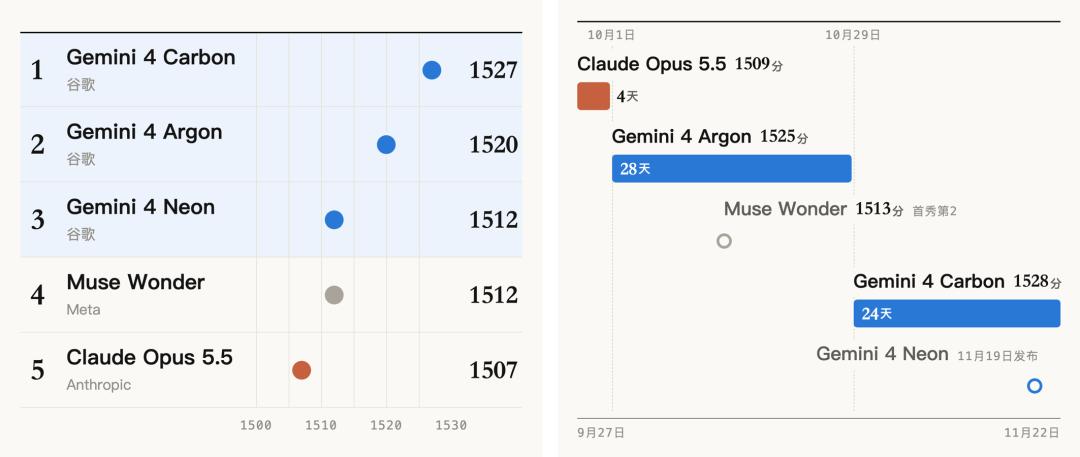
In two months, three Gemini 4 models took turns to lead, forcing Claude to drop from the first place all the way to the fifth.
Google has also caught up behind Claude's last remaining stronghold
Having lost the text leaderboard, Claude still has one last stronghold left — the Agent Arena Index that evaluates real-world Agent tasks.
According to the leaderboard announced on November 19, the top spot here still belongs to Claude Fable 5.2 (Max), with 1453 points.
But the second place is already taken by Google.
The newly released Gemini 4 Neon, based on 4200 real Agent sessions, rushed to the second place on the Agent leaderboard with 1336 points as soon as it was launched, 1 point higher than the third-ranked Claude Opus 5.5 (Max) (1335 points), and 117 points behind the top-ranked Fable 5.2.
Its senior sibling Carbon (4th place, 1303 points), Hydrogen (9th place) and Argon (11th place) are all ranked behind it, Neon has become the strongest Google model on this leaderboard.
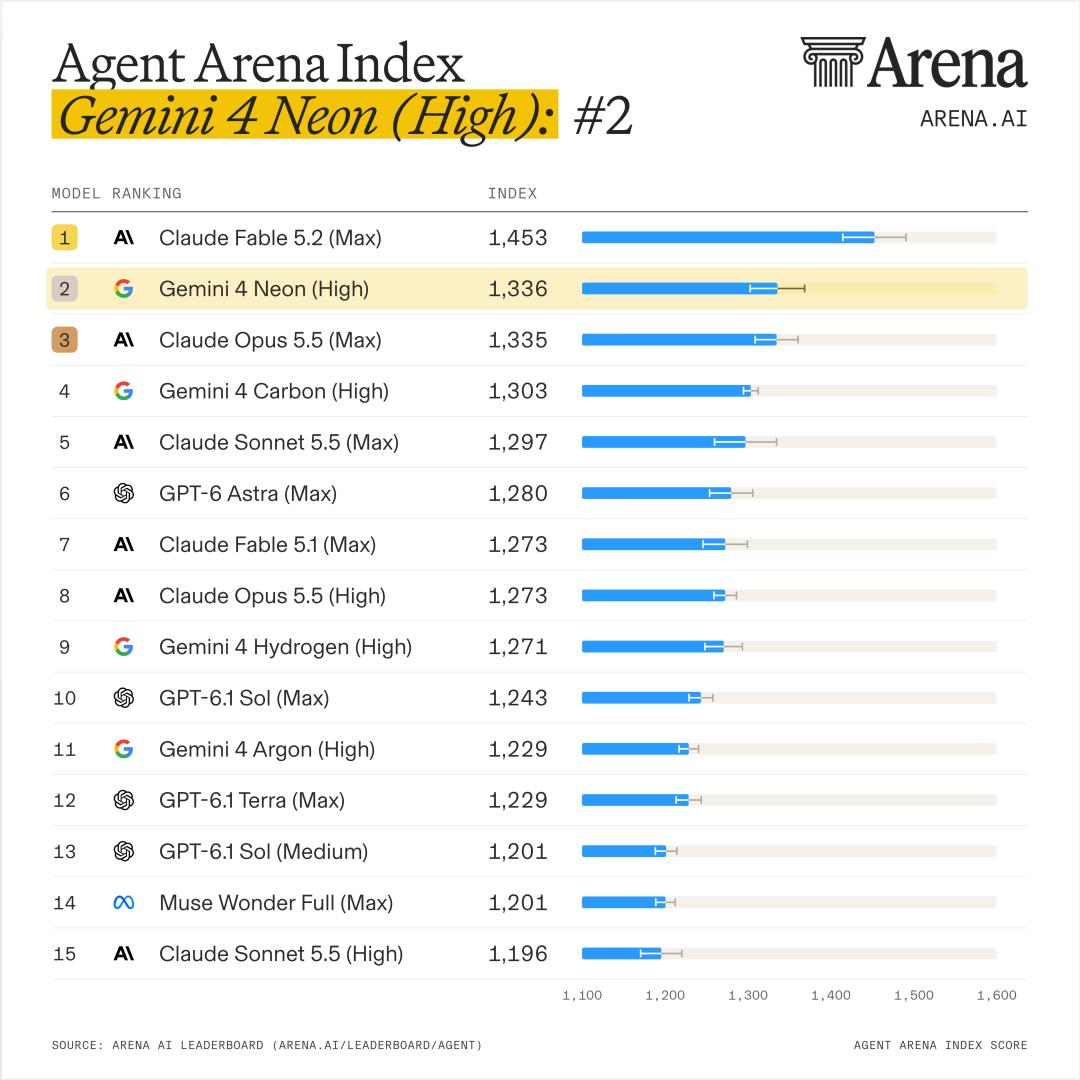
Looking at the sub-categories, Neon ranks second in both user satisfaction and error correction capability (whether it can correct itself after being corrected by users), and ranks third in task completion rate.
On the programming practical benchmark CursorBench 4.1 self-reported by Google, Neon also achieved a high score of 65.4%, directly beating Claude Opus 5.5's 58.1%.
The truly critical point is the price: Neon's API is priced at 3 dollars per million input tokens and 15 dollars per million output tokens.
In the real sessions of Agent Arena, Neon's median cost per task is only 2.82 dollars, 53% cheaper than the third-ranked Claude Opus 5.5 (Max), and 69% cheaper than the top-ranked Claude Fable 5.2 (Max).
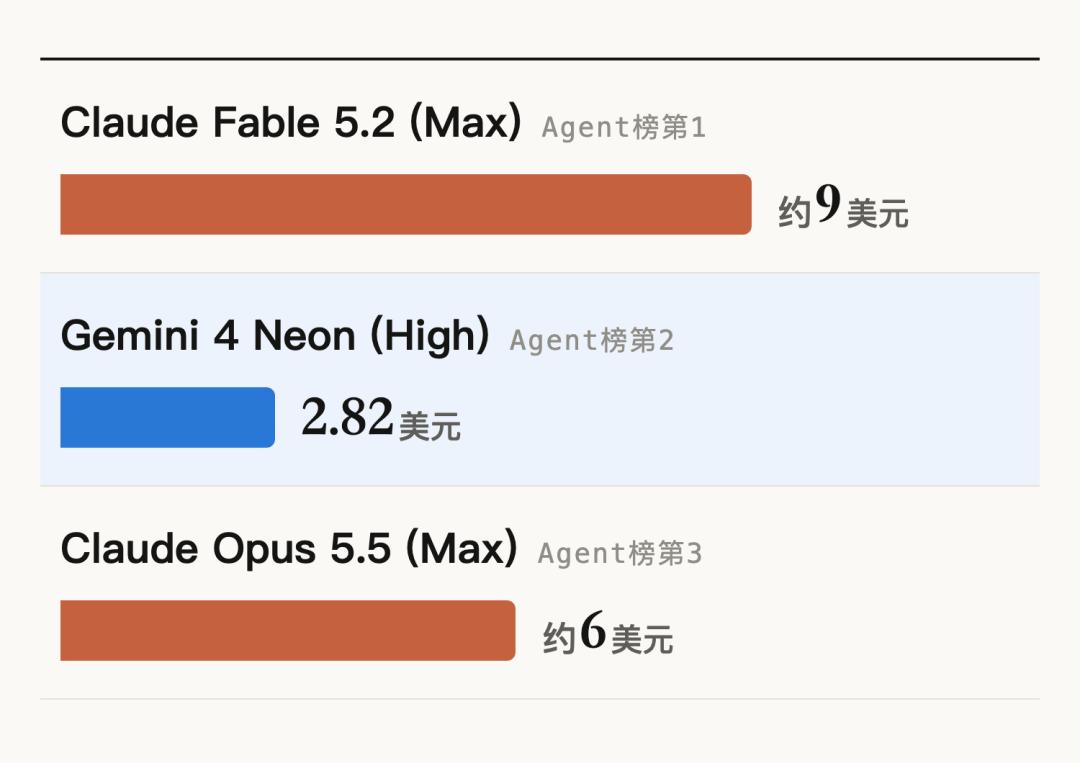
It has almost the same score as Opus 5.5, but the cost is less than half.
$7 vs $27! Hands-on test of Neon on Arena
With such a big price cut, how is its actual performance?
On November 20, Peter Gostev from Arena released a hands-on test video, comparing the newly launched Gemini 4 Neon with Opus, Fable, Astra and Sol on 3D scene, game and UI generation tasks.
The first task required the model to write code to generate the 3D scene of Hagia Sophia and the Golden Horn in Istanbul, and this task cost Neon about 6 dollars.
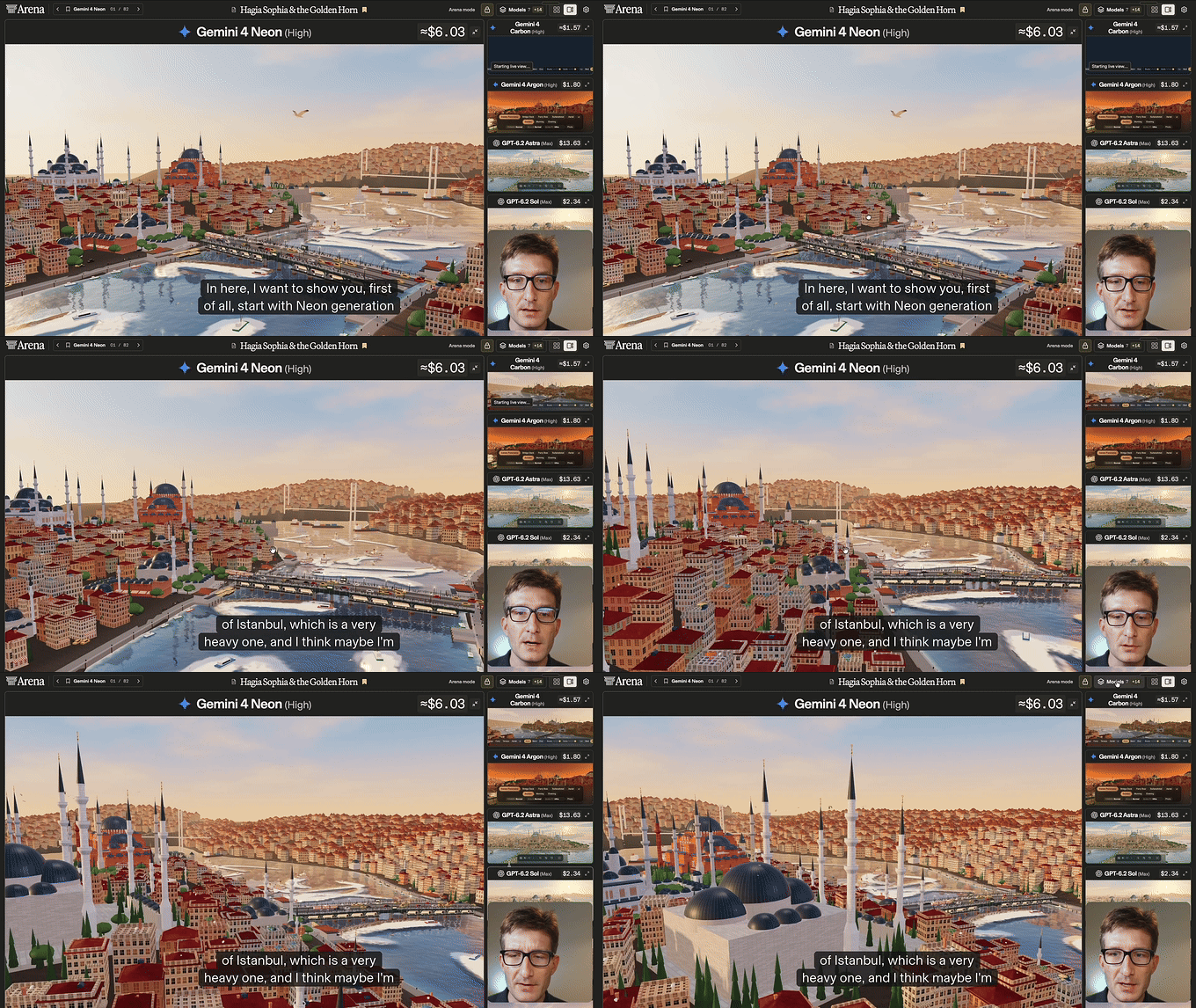
The 3D scene of Istanbul generated by Neon with code, this task cost about 6 dollars
For the second task of generating the 3D scene of the White House, Peter placed the generated images from Gemini 4 Neon and Claude Opus 5.5 (Max) side by side, with their respective costs marked above the images.
Claude Opus 5.5 (Max) spent about 27.66 dollars finishing this task, while the Gemini 4 Neon next to it only cost about 7.17 dollars in total, whose cost is only a quarter of the former!
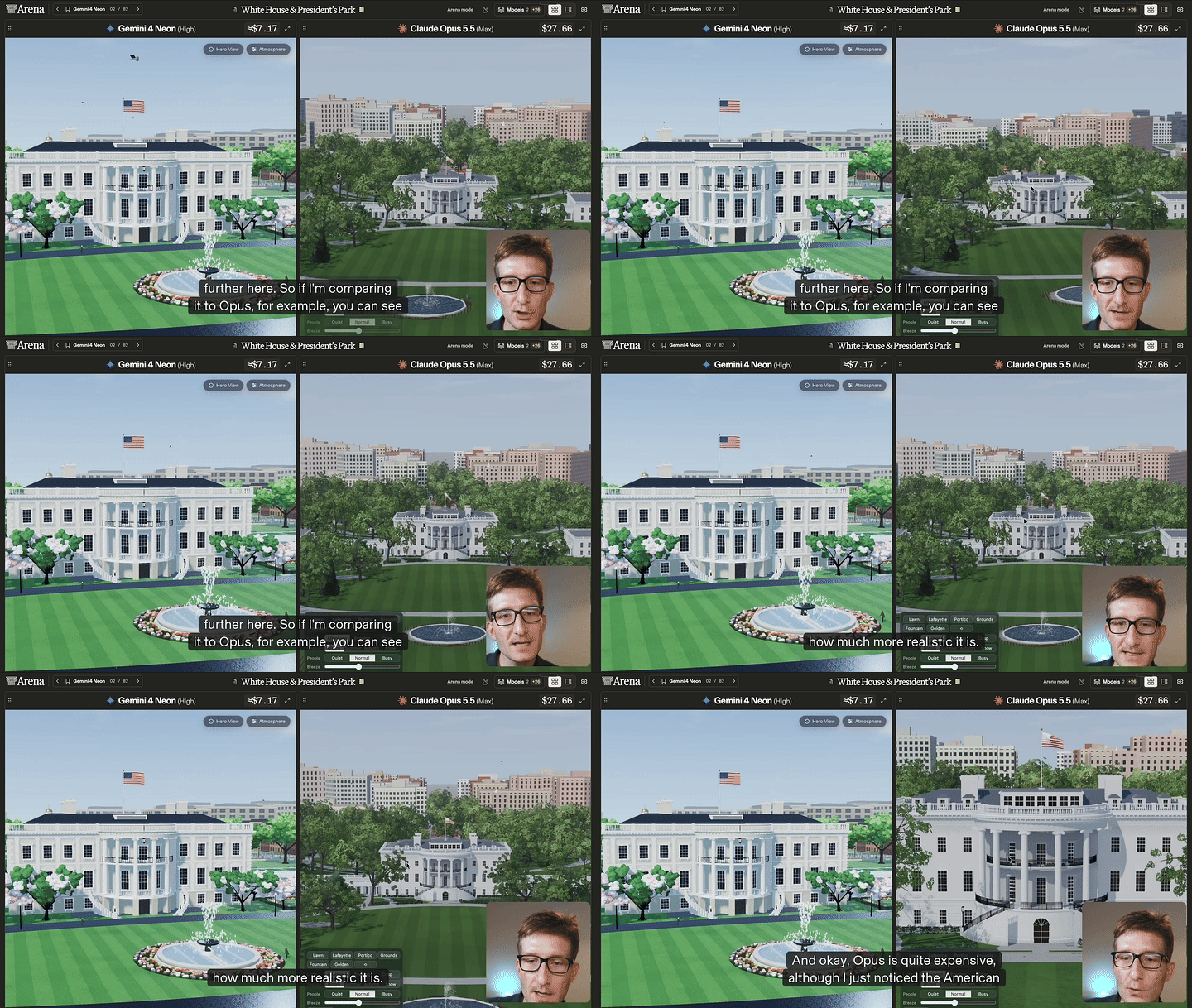
For the same White House scene task, the left side is Gemini 4 Neon costing about 7.17 dollars, the right side is Claude Opus 5.5 (Max) costing 27.66 dollars
In the third test, Neon wrote a rooftop parkour mini-game set in New York that can be played directly, and this task cost about 3 dollars.
However, Gostev also frankly complained during the trial play that the operation feel of this mini-game is not very good.
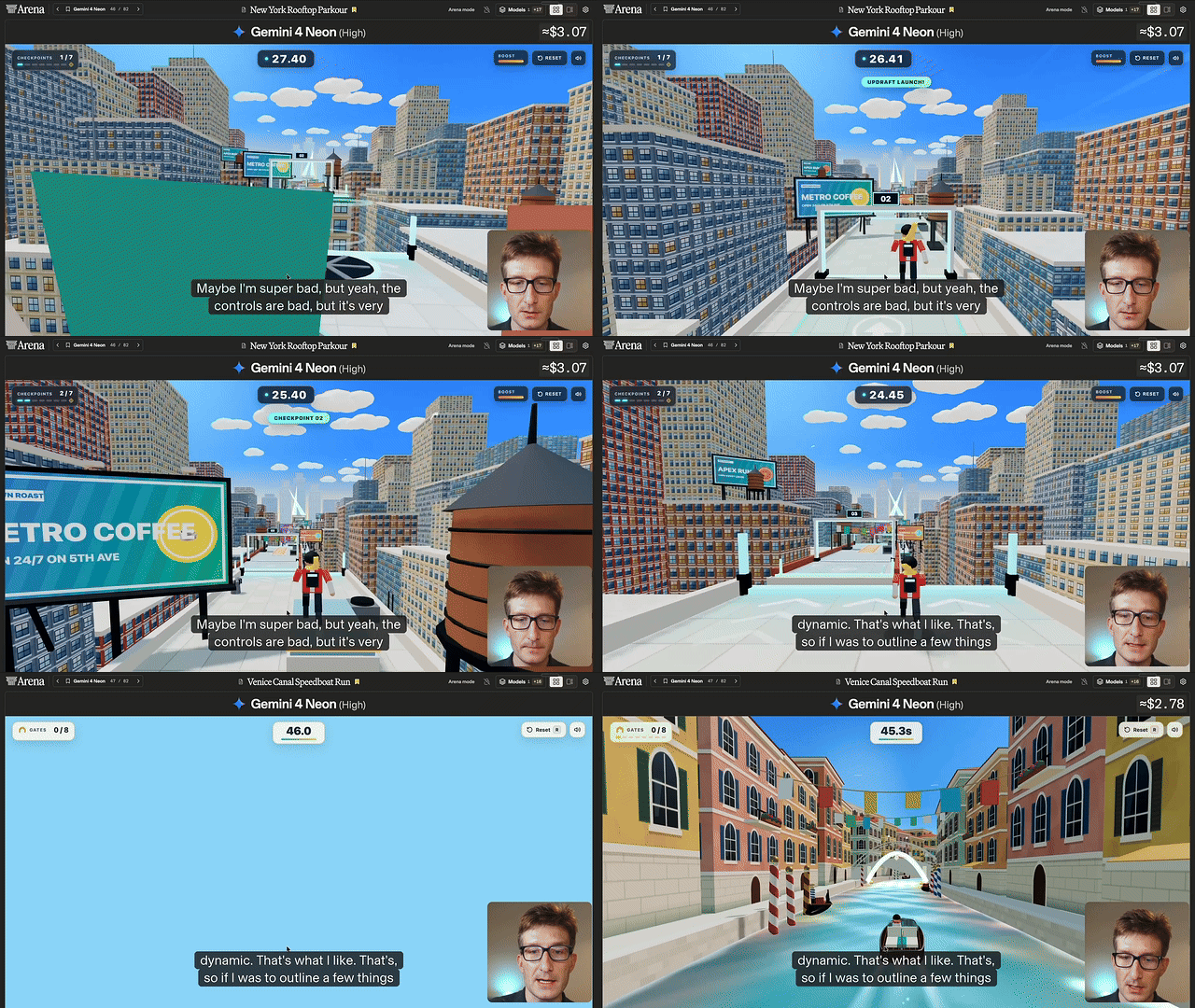
The New York rooftop parkour mini-game written by Neon, Peter Gostev is testing it
Google has taken all top three spots on the chat leaderboard; on the work-focused leaderboard, Claude still holds the first place — but the second place is already Google's, with a price less than half of Claude's.
Counting from the day Opus 5.5 topped the leaderboard on September 27, in less than two months, the top spot on the text leaderboard has changed hands twice.
References:
https://x.com/alexmichael/status/2124496549036077213
https://arena.ai/leaderboard/chat/text
https://x.com/arena/status/2103893011164017018
https://x.com/arena/status/2115495002998751262
https://x.com/arena/status/2123169189397709174
This article is from the WeChat official account "AI Era", author: ASI Revelation, published with authorization from 36Kr.