Company A and OpenAI simultaneously prove: VP≠VNP
The Riemann Hypothesis has just been proven by Claude to become the Riemann Theorem. Before the mathematics community has had time to digest this result, Anthropic has quietly dropped another bombshell.
Just now, Anthropic released a 70-page (?) paper on GitHub. This time, it targets the core conjecture in the field of theoretical computer science that has been pending for 47 years:
VP ≠ VNP.
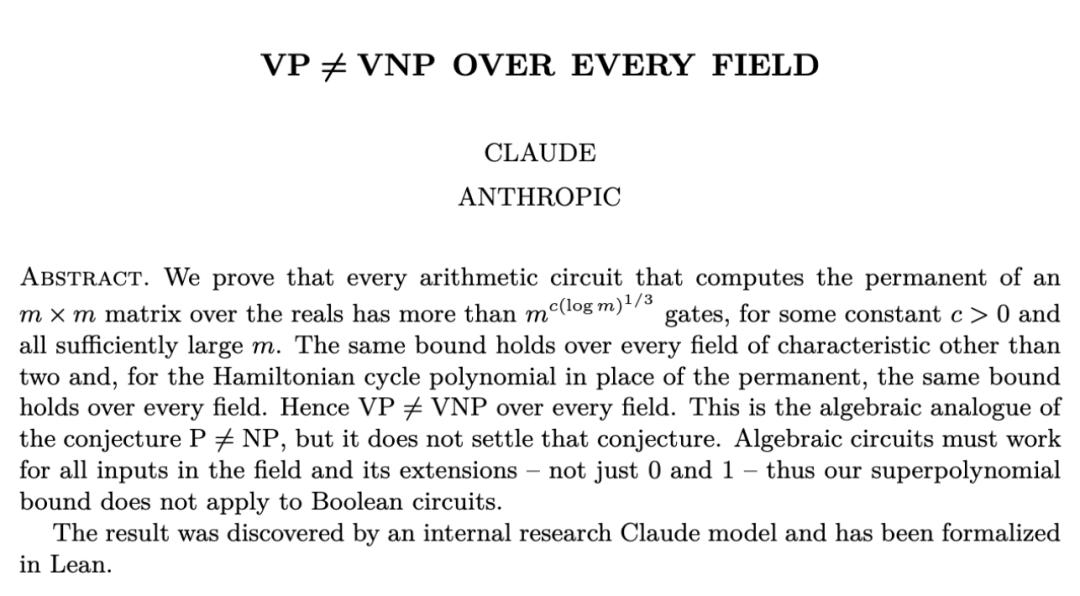
Looks familiar? This is essentially the algebraic version of the famous Millennium Prize Problem P vs NP.
The author list no longer includes human mathematicians, only Claude and Anthropic — from mathematical discovery to paper writing, and then to nearly 73,000 lines of Lean formalized proof code, all completed by AI.
Even if the VP vs VNP problem is proven, it does not mean that the P vs NP problem is solved; and no human mathematician has verified Anthropic's proof results so far, but mathematics enthusiasts have already been in an uproar...
Is Anthropic concentrating its firepower to attack the P vs NP problem, and conveniently cleared the line of VP ≠ VNP in the process?
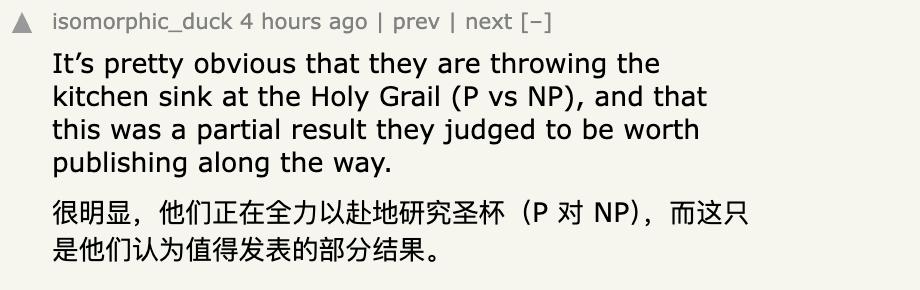
If this is really the case, what is even more surreal is that a major mathematical conjecture that has plagued mankind for 47 years can now even be discussed as a "side quest" for AI.

The algebraic version of P vs NP has been cracked by Claude!?
We have to start with the highly concerned P vs NP problem.
Simply put, P vs NP discusses a problem about the boundary of computing power:
If the answer to a problem can be verified quickly, can the problem itself also be solved quickly?
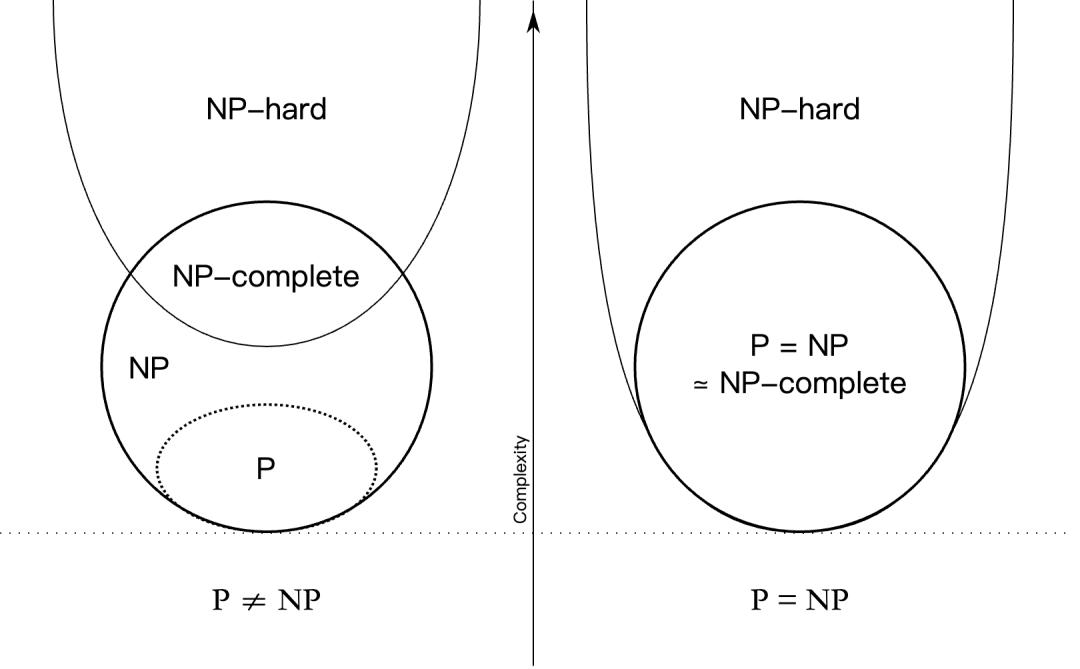
If P = NP holds, then all decision problems whose solutions can be verified in polynomial time can theoretically also be solved in polynomial time.
If P ≠ NP holds, it means that there is indeed an insurmountable computational gap between verifying the answer and finding the answer.
Then how did the VP vs VNP problem come about?
In 1979, computer scientist Valiant introduced similar problems into the algebraic field and defined two new complexity classes:
VP: A family of polynomials that can be computed by arithmetic circuits of polynomial size.
VNP: A family of polynomials that can be expressed by summing over an exponential number of easily computable polynomials.
The so-called arithmetic circuit here can be understood as a computing network composed of operations such as addition and multiplication.
For those polynomials that seem to require massive summation to get results, can we always find some clever algebraic shortcut to compress the computation amount to polynomial size? — This is the VP vs VNP problem.
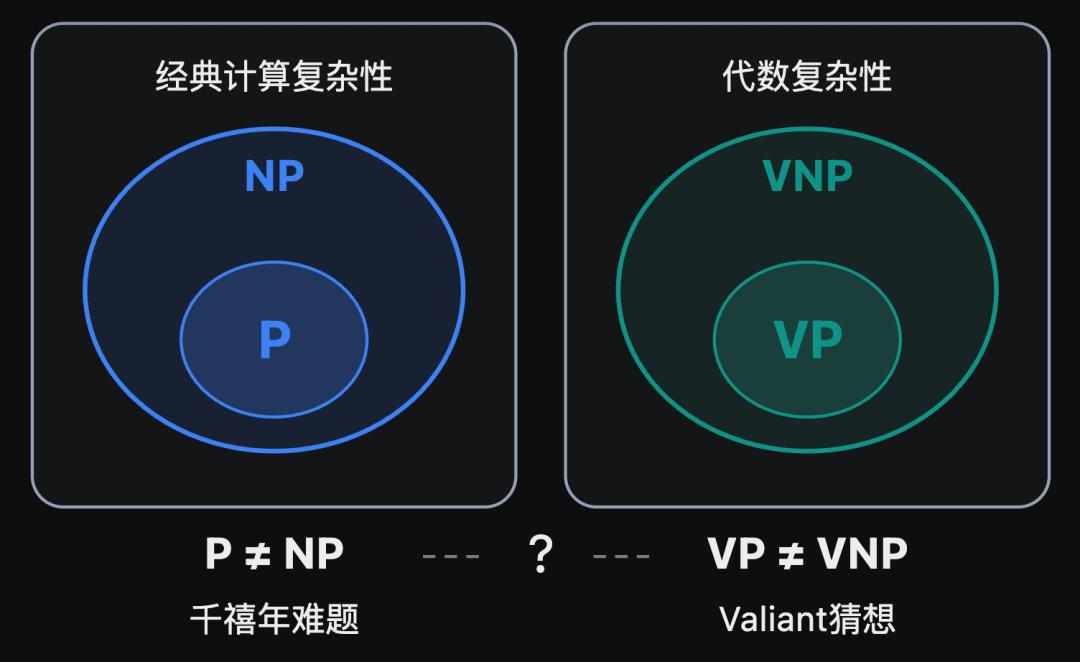
△ Generated by AI
The most classic example here is the Determinant and Permanent of a matrix.
The mathematical expressions of the two are extremely similar, the main difference is that there are alternating positive and negative signs in the determinant, while all terms in the permanent are added together.
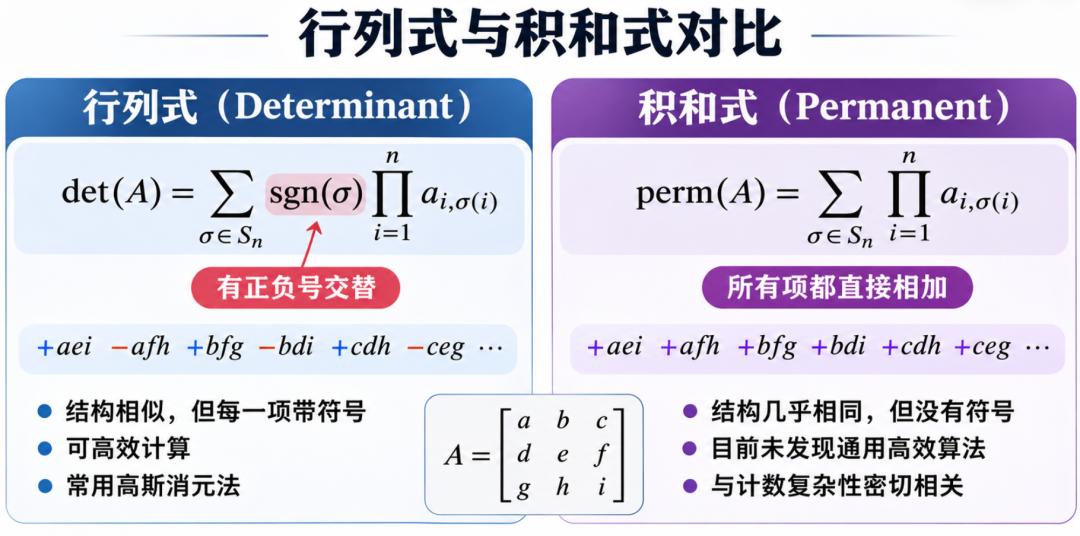
△ Generated by AI
Despite only one missing sign, the computational complexity of the two can be vastly different.
For calculating the determinant of a matrix, we already have efficient algorithms, such as the familiar Gaussian elimination method.
But for the permanent, after decades of searching, humans have not found a method that can complete the calculation with an arithmetic circuit of polynomial size in general cases.
Valiant's conjecture holds that this is not because humans are not smart enough to find the correct algorithm, but because under the corresponding algebraic calculation model, such an efficient algorithm does not exist at all, that is, VP ≠ VNP.
Now Claude claims to have proven this point.
Specifically, Claude's conclusion is that for a sufficiently large m, there is a super-polynomial lower bound on the size of the arithmetic circuit required to compute the permanent of an m×m matrix:
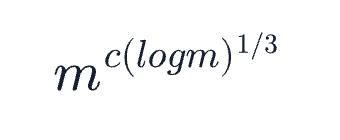
Here c is a constant greater than 0.
The key point is that as m continues to increase, the exponent part also keeps increasing.
This means that no matter how large a fixed exponent you choose, you cannot cover this computational cost with the corresponding polynomial size.
In other words, Claude proved that all eligible arithmetic circuits cannot break through this complexity lower bound. VP ≠ VNP.
This conclusion is not only applicable to the real number field. For the permanent, Claude extended the conclusion to all fields whose characteristic is not 2; for another VNP-complete problem — the Hamiltonian cycle polynomial, the conclusion covers all fields.
Transforming computational complexity problems into geometric problems
Interestingly, Claude did not start directly from the calculation process of the permanent, but transformed a problem about computational complexity into a geometric problem.
Its core tool is the asymptotic spectral theory of tensors developed by mathematician Volker Strassen.
Simply put, Claude first uses tensors to describe the computational structure, then introduces a set of mathematical tools to measure tensor complexity, and converts some algebraic relationships into distance relationships in geometric space.
Subsequently, it proves that these distances have the geometric property of non-positive curvature, and divides the problem into two cases:
Flat Case
Contracting Case
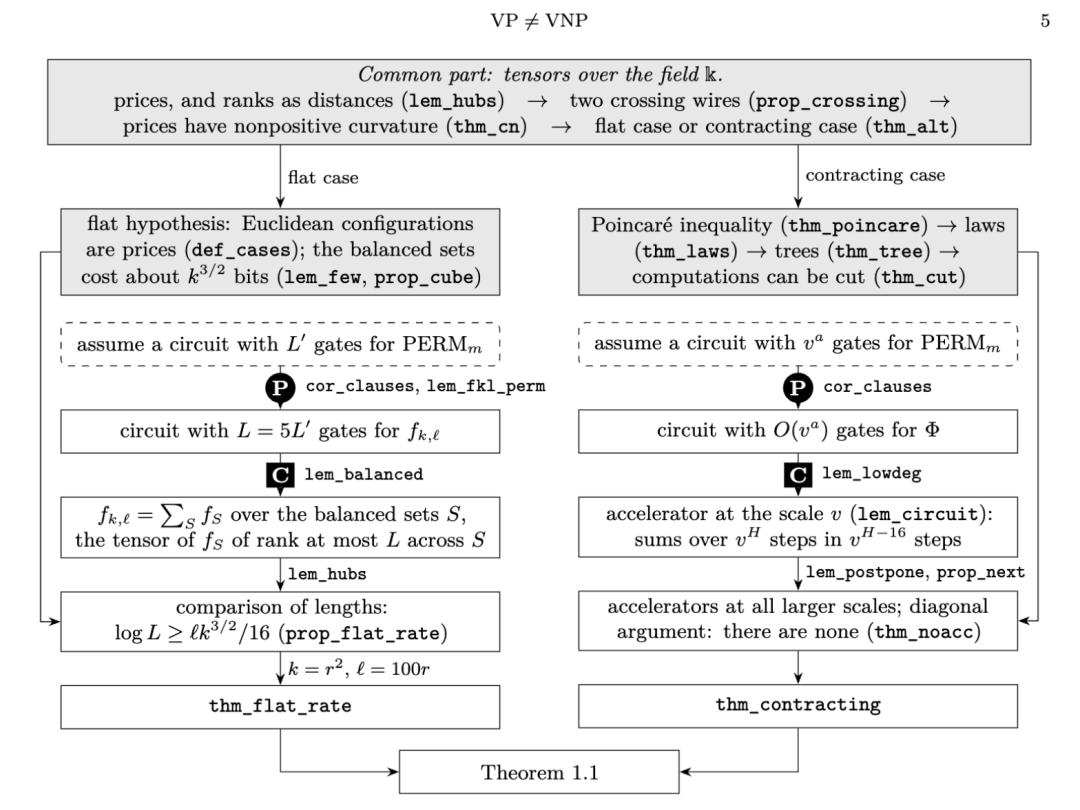
It needs to be clarified that Claude has not figured out which case holds for a specific field.
But this does not prevent the entire proof from being valid.
Because it proves that at least one of the two cases holds, and establishes the required complexity lower bounds on both paths respectively, so that VP ≠ VNP holds in any case.
Of course, the lower bound given by Claude is not the strongest yet.
At present, the known upper bound of computational complexity for related problems is exponential, while Claude gives a super-polynomial, quasi-polynomial lower bound. There is still considerable room between the two.
What is the significance for P vs NP?
After talking so much, it must be emphasized that although VP vs VNP is called the algebraic version of P vs NP, the two are not equivalent —
Mathematically, arithmetic circuits are only a specific way of computation.
Even if it is proven that a polynomial cannot be efficiently computed through finite-scale addition and multiplication operations, it cannot rule out that ordinary computers can find computational shortcuts through other means such as bit operations and logical judgments.
Even if VP ≠ VNP really holds, it does not mean that the P vs NP problem is solved.
However, algebraic and geometric methods have always been one of the important research lines for mathematicians to try to overcome P vs NP.
The Geometric Complexity Theory (GCT) proposed by Ketan Mulmuley and Milind Sohoni in 2001 hopes to use mathematical tools such as algebraic geometry and representation theory to establish lower bounds of computational complexity, and finally explore the P vs NP problem. VP vs VNP is one of the core difficult problems in this research direction.
If Claude's proof this time holds, what is really worth paying attention to is that AI has made a major potential breakthrough on the way to explore the limits of computational complexity. Next, it remains to be seen whether the mathematical methods it uses can be further transferred to the classical computational complexity theory.
What may be more touching to netizens is that...
In September, the Navier-Stokes equations problem was cracked by AI.
In November, the Riemann Hypothesis was also successfully proven by AI.
The Millennium Prize Problems, which were designated as hard-to-pick fruits on the way to AGI, are being cracked one by one in front of everyone. Is P vs NP really far away?
At present, someone has initiated an open third-party review of Anthropic's paper.
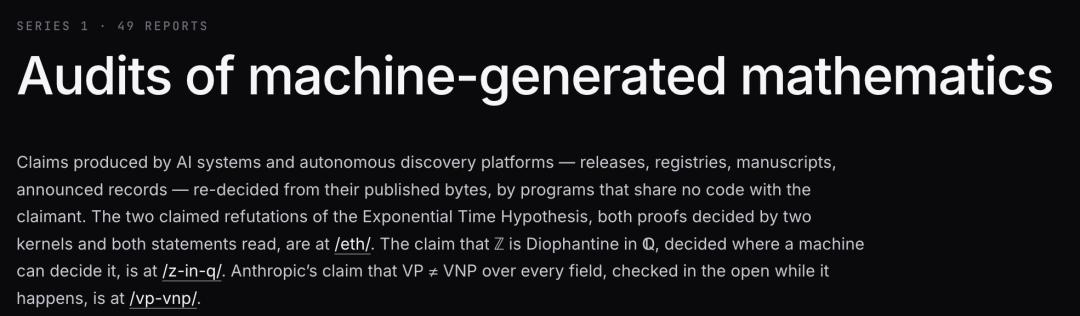
The review report from Carlos Toledo stated that the relevant proof passed three independently written proof checkers, and the recheck was completed on another machine.
We are just waiting for confirmation from human mathematics experts.
One More Thing
Coincidentally, just a few hours after Anthropic released the paper, OpenAI also came up with similar results.
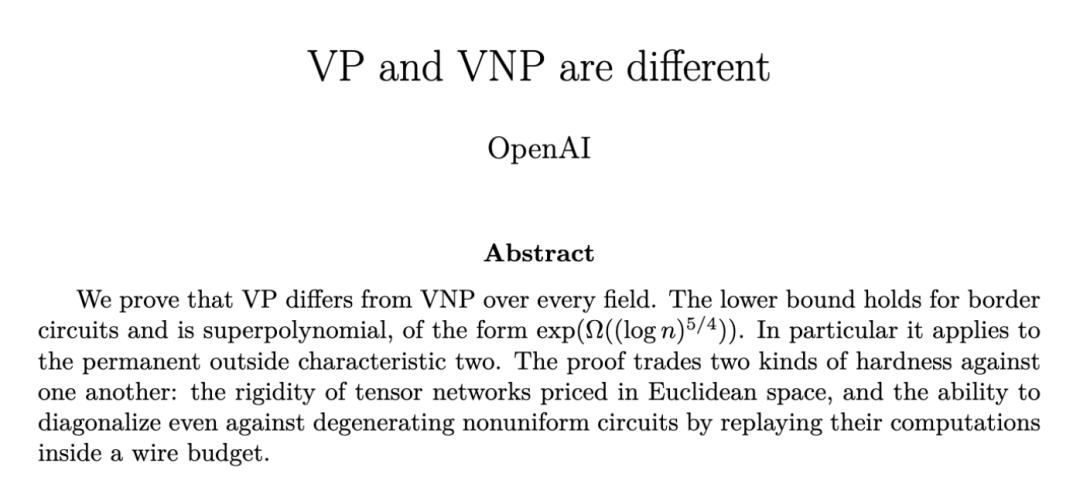
And OpenAI emphasized that they proved VP ≠ VNP as early as November 6.
OpenAI's paper is slightly shorter, with 30 pages, but the Lean code reaches 440,000 lines. In addition, judging from the resulting lower bound, Anthropic's result is more restrictive.
Another collision of similar achievements, well, it's interesting...
References:
[1]https://github.com/anthropics/formal-math/blob/main/vp-vnp/paper.pdf
[2]https://github.com/openai/math/blob/main/preprints/VP-and-VNP-are-different-November-23-2026/paper.pdf
This article is from the WeChat official account "QbitAI", author: Yuyang, released with authorization from 36Kr.