The Bank of Korea may announce an interest rate hike on Thursday.
Amid the drastic volatility of global AI-related stocks, the Bank of Korea is likely to usher in the penultimate interest rate hike in this tightening cycle soon.
According to a survey of economists released by media on Tuesday, the Bank of Korea is expected to raise interest rates by 25 basis points at its last monetary policy meeting of the year this Thursday (November 26), raising the benchmark interest rate from 3% to 3.25%, followed by one more rate hike in the first quarter of next year to bring the interest rate to a peak of 3.5%.
Behind this expectation lies the reality of uneven performance in the South Korean economy: the boom in semiconductor exports drives economic growth, while inflation and housing price pressures support further policy tightening; however, the recovery of household consumption is relatively slow, and the recent sharp drop in technology stocks may weaken household wealth, limiting the room for the central bank to continue raising interest rates.
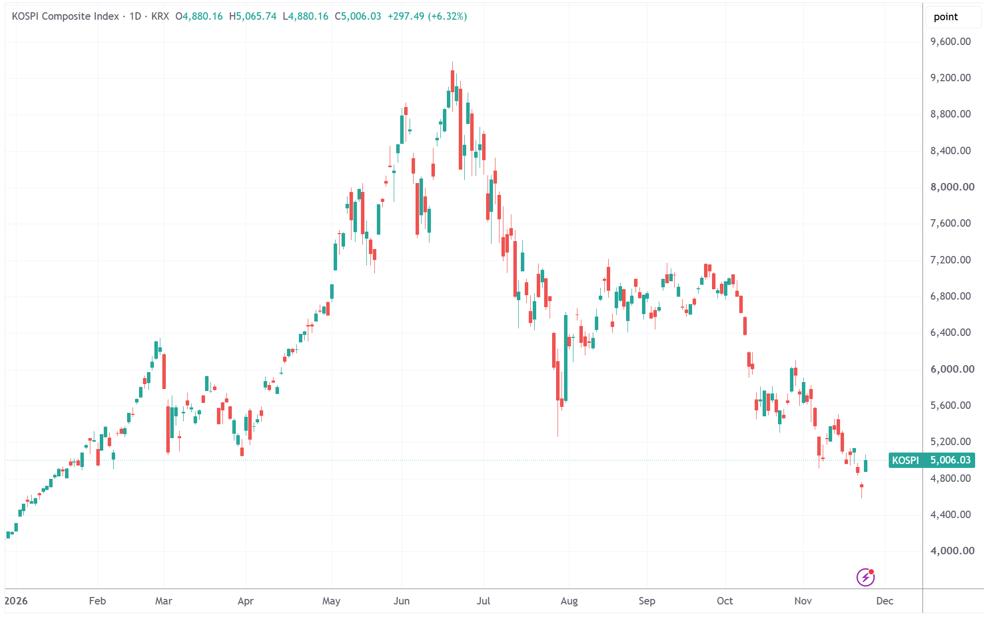
The KOSPI has halved since June, Source: TradingView
The Penultimate Rate Hike
In the survey conducted from November 17 to 23, 32 of the 34 surveyed economists expected the Bank of Korea to raise interest rates this week, and only two expected to keep interest rates unchanged. The median survey shows that the rate hike in the first quarter of next year will be the last one in this cycle, after which the interest rate will remain unchanged for the rest of 2027.
Michelle Lam, an economist at Societe Generale, said, this week's rate hike has been fully priced in by the market, and if the central bank does not raise interest rates, it will surprise the market instead. She pointed out that South Korea's gross domestic product in the third quarter performed significantly stronger than expected, semiconductor exports remain strong, coupled with inflation continuing to stay above the target and housing prices still rising, the rationale for further rate hikes remains valid.
South Korea's consumer price index rose 2.8% year-on-year in October, which was slightly lower than the 2.9% in September but still higher than the central bank's 2% target. According to Lam's judgment, inflation may not return to the target until the second half of 2027.
The Bank of Korea's current tightening cycle began in July this year. On July 16, the Bank of Korea raised the benchmark interest rate from 2.5% to 2.75%, citing stronger economic growth driven by exports and investment, inflation expected to stay above the target for a long period, and persistent financial stability risks. At the subsequent August meeting, the Bank of Korea further raised interest rates by 25 basis points, raised its 2026 economic growth forecast from 2.6% to 3.3%, and raised its 2027 growth forecast from 2.1% to 2.9%.
At the October meeting, facing uncertainties brought by the situation in the Middle East and policies of major economies, the Bank of Korea paused raising interest rates but retained the direction of further interest rate hikes.
The core force supporting South Korea's economic growth is the export boom brought by global AI infrastructure investment.
Data from the South Korean government shows that as of November 19, the cumulative export volume this year exceeded 1 trillion US dollars for the first time, making South Korea the fourth country after China, the United States and Germany to achieve annual exports of this scale. The South Korean government expects the total annual export volume to be about 1.17 trillion US dollars, an increase of about 65% compared with 709.3 billion US dollars in 2025.
Not Everyone Benefits from the AI Boom
However, the rapid growth of export revenue does not mean that household consumption is expanding at the same pace.
Goohoon Kwon, senior Asia economist at Goldman Sachs, said on Tuesday, the current price pressure in South Korea comes more from rising import costs than strong domestic demand. Therefore, stabilizing the won exchange rate may curb inflation more effectively than continuing to raise interest rates.
Regarding the gap between export performance and domestic demand, Kwon explained that South Korea's gains from the AI boom currently mostly come from rising prices of memory chips. Excess profits are concentrated in two chip giants, Samsung Electronics and SK Hynix. Only when these gains are gradually transmitted to other enterprises and households can the domestic economy be driven more broadly.
Goldman Sachs expects South Korea's overall economic growth rate to exceed 3% next year, but the private consumption growth rate will only be around 2%. Rapid population aging, the concentration of household wealth in illiquid real estate, and the recent stock market decline have all restricted consumption expansion.
Contrary to most opinions, Kwon expects the Bank of Korea to hold fire this week, but he also admitted that the decision on whether to raise interest rates could be very close. Even if the central bank chooses to raise interest rates, it may be a "dovish rate hike" accompanied by moderate policy guidance, and the median of policymakers' interest rate forecasts for the next six months is not expected to exceed 3.5%.
Goldman Sachs analysts believe that as long as oil prices do not rise further and the won does not weaken, the potential upward pressure on inflation will be relatively limited. He expects that under the combined effect of the strengthening won, monetary tightening and the government's price stabilization measures, South Korea's inflation will fall back to around 2% in the second half of next year, and the necessity of further raising interest rates will decline by then.
This forecast also has major uncertainties: the Federal Reserve's rate hike cycle. Since the beginning of this year, the won has appreciated by about 7% against the US dollar, making it one of the best-performing Asian currencies. Kwon expects that with the demand for local currency brought by corporate profit growth for tax payments, dividends and wage payments, the won is expected to rise to 1,280 won per US dollar next year. However, further interest rate hikes by the Federal Reserve may bring variables to this prospect.
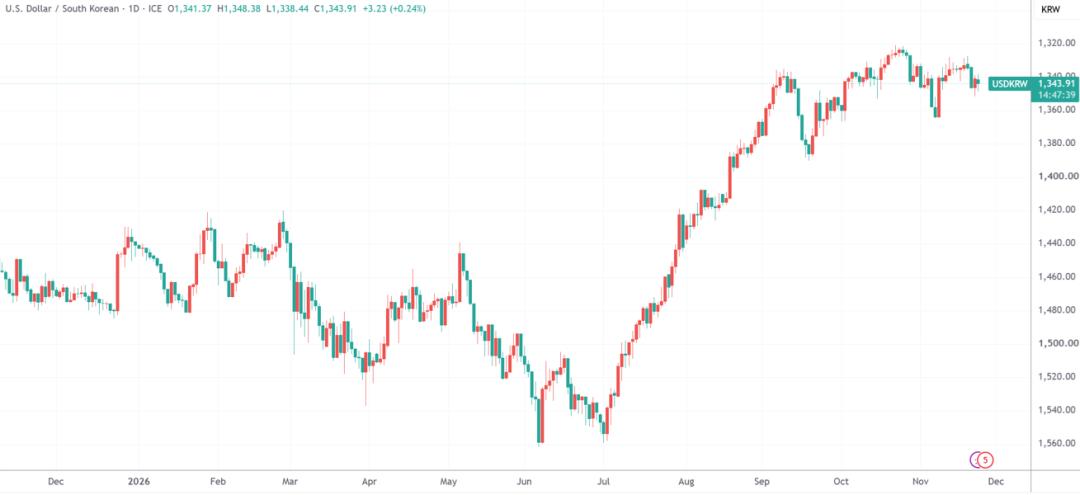
The won has appreciated significantly since July, Source: TradingView
According to convention, the Bank of Korea holds 8 interest rate meetings a year, and the November meeting will be the last one of this year. After the November meeting, the two meetings in the first quarter of next year are scheduled for January 14 and February 25 respectively. If this round of rate hikes ends in the first quarter of next year as expected by the survey, the last rate hike may fall on one of these two meetings.
This article is from the WeChat Official Account CLS, author: Shi Zhengcheng, published with authorization from 36Kr.