Xiaomi: We have climbed out of the pit, but where does our future lie?
Xiaomi Group (1810.HK) released its Q3 2026 financial results (for the period ending September 2026) after Hong Kong stock market trading on the evening of November 24, 2026 Beijing time. The key points are as follows:
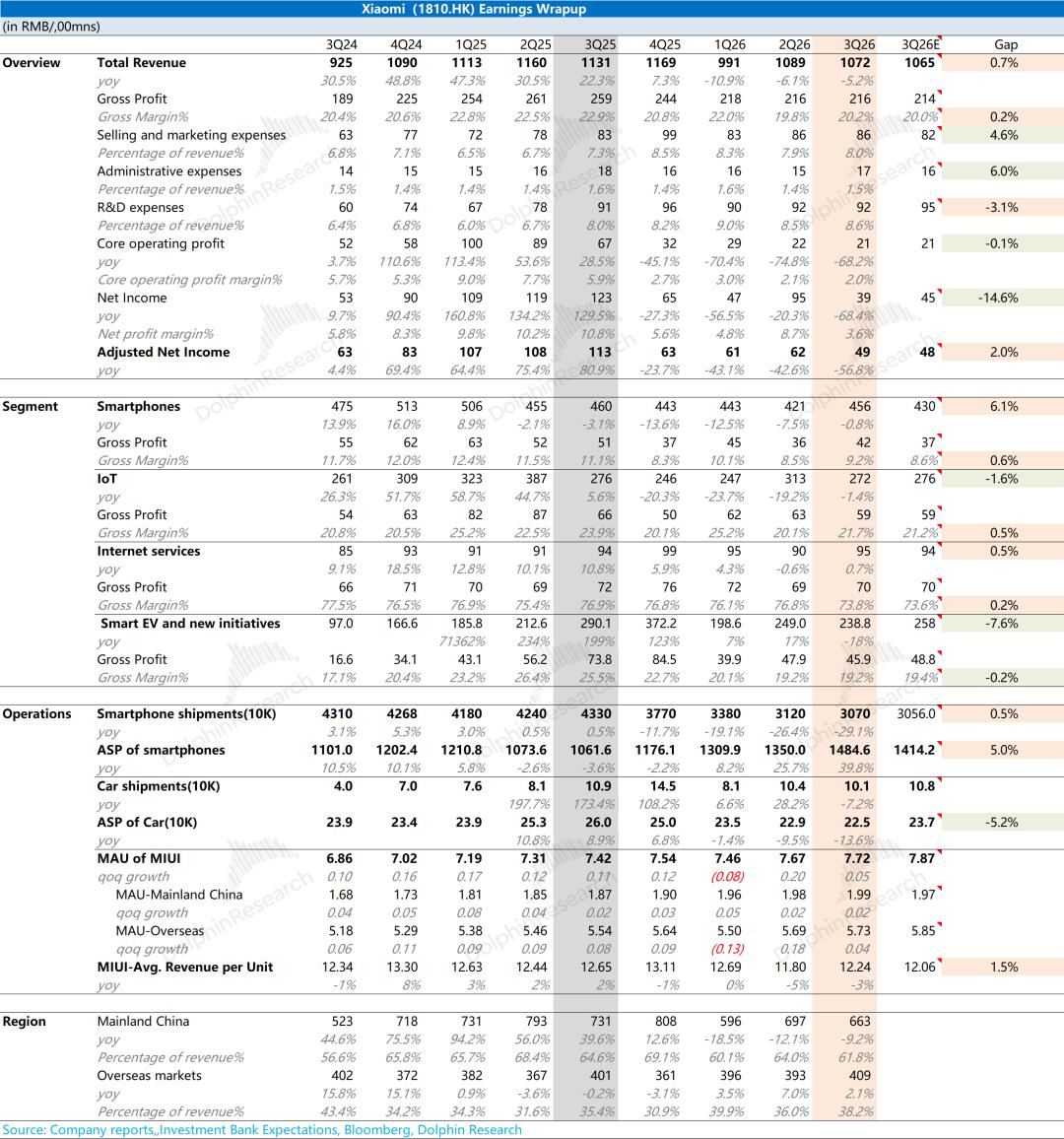
1. Overall performance: Xiaomi's revenue in this quarter reached 107.2 billion yuan, down 5.2% year-on-year, which was in line with the market expectation of 106.5 billion yuan.
Among them, the revenue of traditional business (Phone × AIoT) reached 83.4 billion yuan, down 0.9% year-on-year; the revenue of innovative businesses including new energy vehicles and AI reached 23.9 billion yuan, down 17.7% year-on-year, which was lower than the market expectation of 25.8 billion yuan, mainly affected by the simultaneous decline of sales volume and unit price of vehicles.
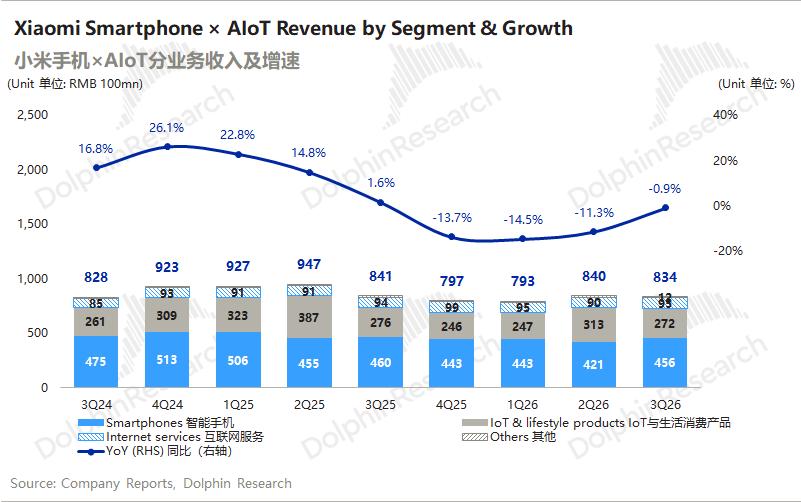
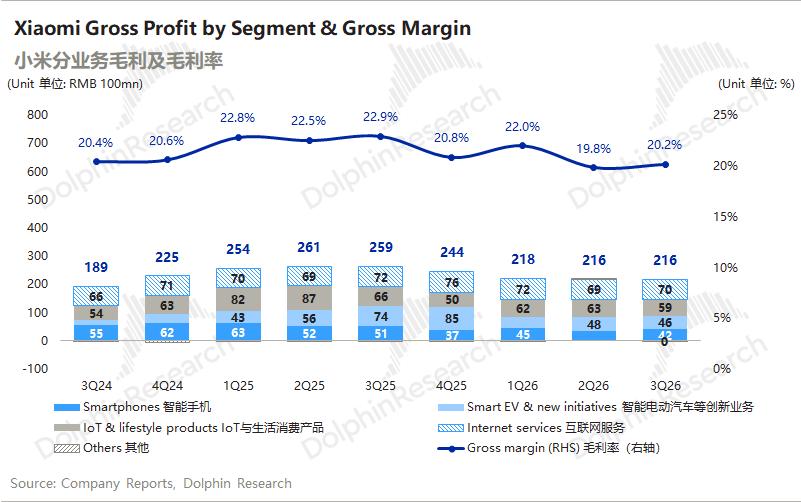
The gross profit margin in this quarter was 20.2%, up 0.4 percentage points quarter-on-quarter, basically in line with the market expectation of 20.0%.
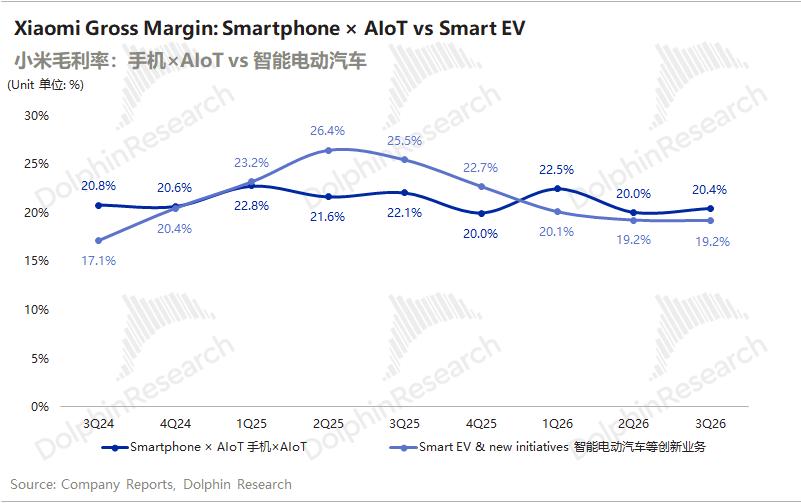
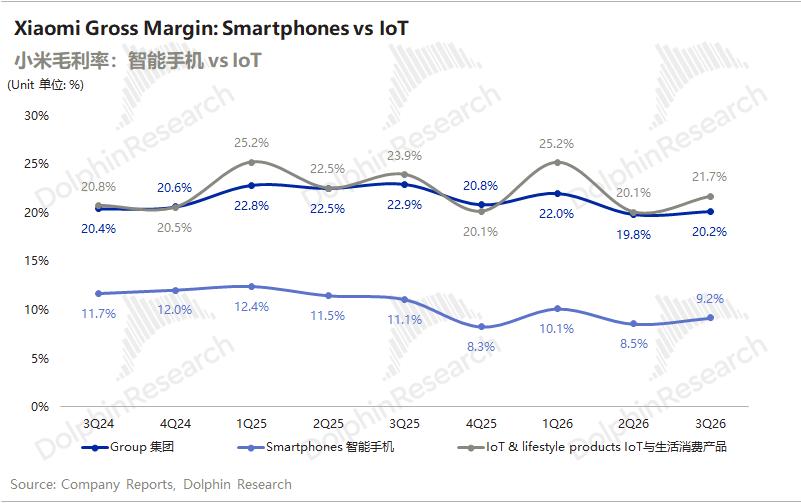
The quarter-on-quarter improvement mainly came from the traditional business: the gross profit margin of mobile phones rose from 8.5% to 9.2%, the gross profit margin of IoT rose from 20.1% to 21.7%, while the gross profit margin of innovative businesses including vehicles and AI remained flat at 19.2%.
2. Automotive business: Vehicle-related revenue in this quarter reached 23.9 billion yuan (of which new energy vehicle revenue was 22.7 billion yuan), lower than the market expectation of 25.8 billion yuan.
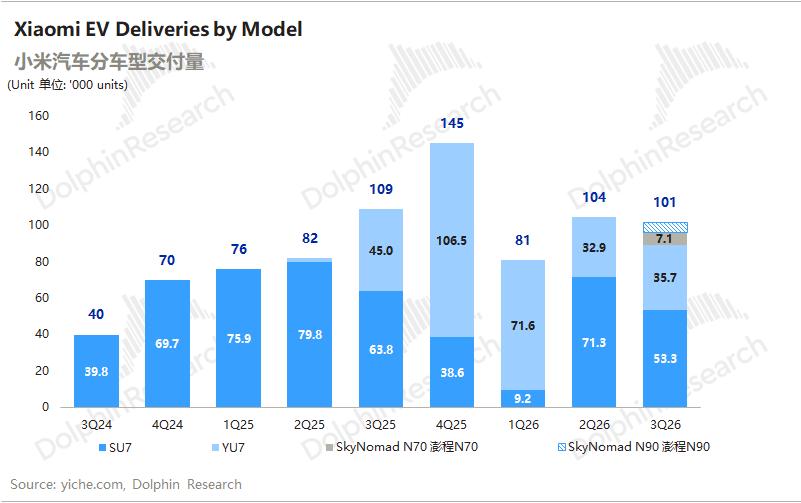
With the addition of the extended-range vehicle Pengcheng, the company has renamed this segment from "Intelligent Electric Vehicles and Other Innovative Businesses including AI" to "New Energy Vehicles and Other Innovative Businesses including AI" starting from this quarter. The company delivered 101,000 new vehicles in this quarter, down 7.2% year-on-year, of which the Pengcheng series launched on September 7 delivered more than 10,000 units.
The average selling price per vehicle is about 225,000 yuan, continuing to decline by about 2% quarter-on-quarter, lower than the market expectation of 237,000 yuan. The decline in average selling price is the main reason why automotive revenue fell short of expectations. Deliveries in Q3 were still dominated by the new generation SU7 and YU7. The high-priced Pengcheng N90 only started delivery in September, and its pull on the average selling price will not be reflected until Q4.
The gross profit margin of the automotive business (new energy vehicles and other innovative businesses including AI segment) in this quarter was 19.2%, flat quarter-on-quarter, slightly lower than the market expectation of 19.4%. The company explained that it was mainly due to the decline in the delivery proportion of SU7 Ultra, the rise in prices of core components and the increase in AI business costs.
In subsequent exchanges, the management stated that after the launch of Pengcheng, Xiaomi Automobile still maintained a "relatively high and healthy" gross profit margin level, and is confident in maintaining the gross profit margin of vehicles in the future.
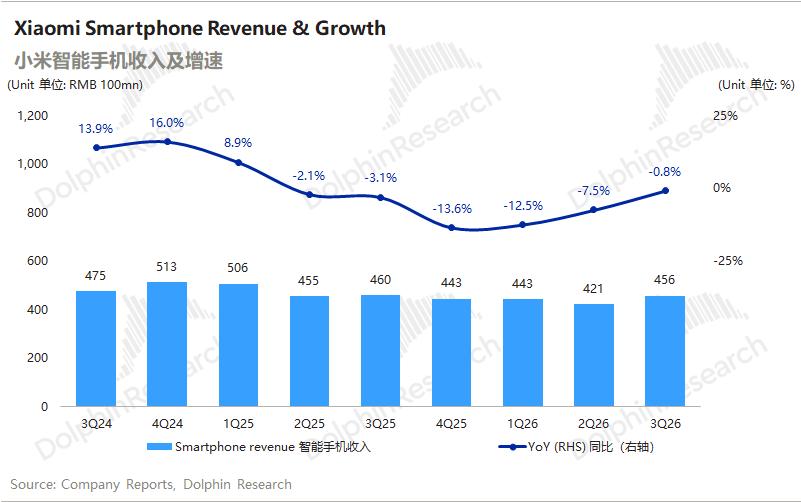
3. Mobile phone: 45.6 billion yuan, down 0.8% year-on-year, up 8.2% quarter-on-quarter, better than the market expectation of 43 billion yuan.
Among them, Xiaomi's mobile phone shipments in this quarter were 30.7 million units, basically in line with expectations. The average selling price of mobile phones was 1,486 yuan, up 39.8% year-on-year, which is the main source of outperformance, and the strategy of "controlling volume to ensure price" continues.
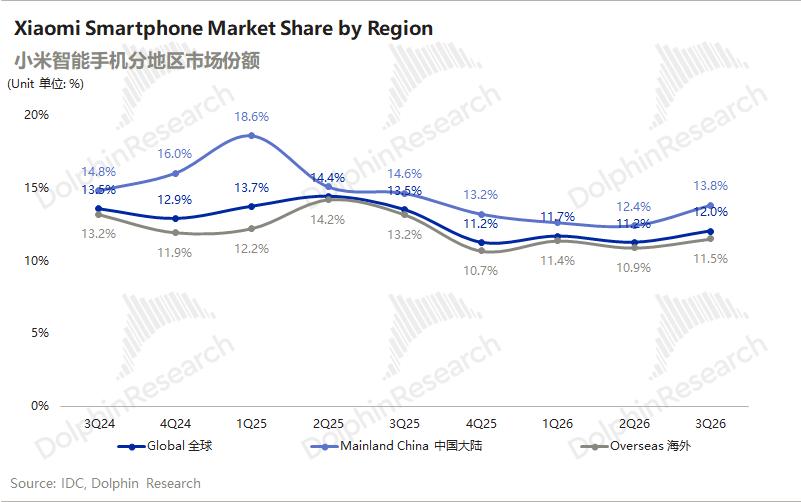
By market, Xiaomi's mobile phone shipments in the Chinese market in this quarter were about 8 million units, down about 20% year-on-year, with a market share of 13.8%; shipments in overseas markets were about 22.7 million units, down about 32% year-on-year, and the overseas share dropped to 11.5% year-on-year. The active contraction of low-cost overseas models is the main reason for the decline in shipments.
The average selling price of Xiaomi's mobile phones continued to rise in this quarter, mainly because ① under the condition of tight storage, the company prioritized allocating storage to high-priced models; ② driven by cost pressure, the company raised prices for mobile phone products.
The gross profit margin of mobile phones was 9.2%, up 0.7 percentage points quarter-on-quarter, higher than the market expectation of 8.6%. The company attributed the quarter-on-quarter improvement to the product structure improvement driven by new high-end domestic products, which was partially offset by the price increase of core components.
The gross profit margin of mobile phones in the first three quarters was about 9.3%, which is consistent with the management's previous guidance of "over 9% for the whole year". The management judges that storage costs will remain relatively high in 2027, and another increase in mobile phone ASP compared with 2026 is a "certain event", and is confident that the gross profit margin of mobile phones will maintain a good performance.
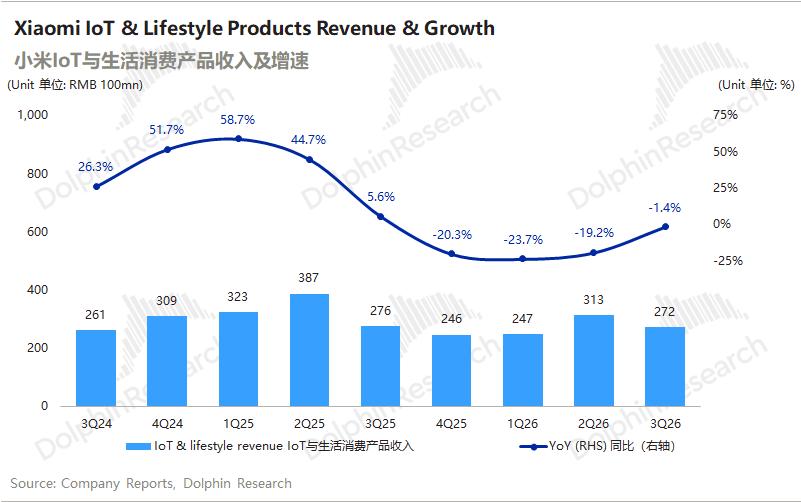
4. IoT: 27.2 billion yuan, down 1.4% year-on-year, slightly lower than the market expectation of 27.6 billion yuan. After the high base brought by national subsidies last year was gradually digested, the year-on-year decline of IoT business narrowed significantly compared with the previous three quarters (around 20%).
The gross profit margin of IoT was 21.7%, up 1.6 percentage points quarter-on-quarter, higher than the market expectation of 21.2%. The quarter-on-quarter improvement mainly came from the increase in gross profit margin of air conditioners and laptops, as well as the rise in gross profit margin of overseas wearable products and the increase in their revenue proportion.
To meet the management's previous full-year guidance of -5%~-10%, the fourth quarter needs to achieve a year-on-year growth of about 13%–38%. The management stated that the IoT business has "come out of the difficult stage and entered a stage of sustained growth".
5. Internet services: 9.5 billion yuan, up 0.7% year-on-year, in line with the market expectation of 9.4 billion yuan. The gross profit margin of Internet was 73.8%, down 3 percentage points quarter-on-quarter, mainly because the decrease in the proportion of pre-installed revenue led to a decline in the gross profit margin of the advertising business — the continuous decline in mobile phone shipments has begun to transmit to the high-margin pre-installed revenue.
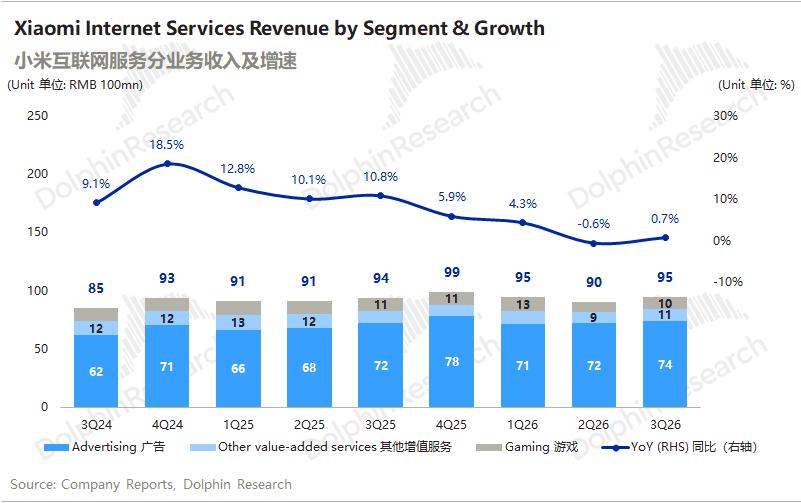
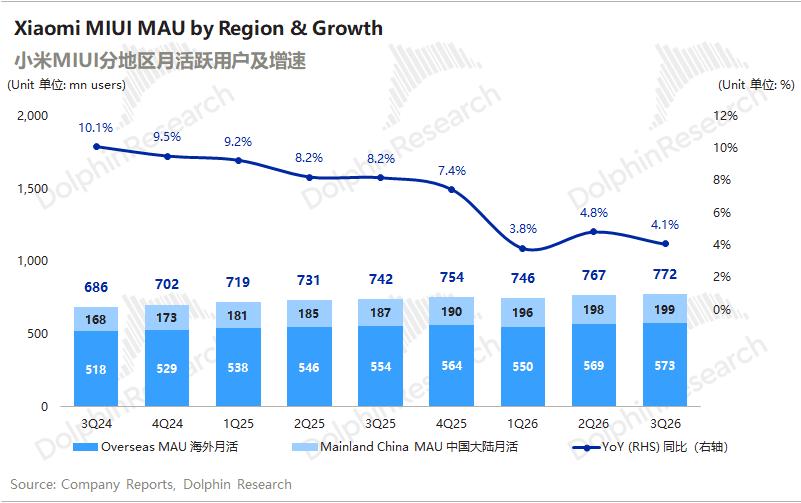
By region: overseas Internet revenue in this quarter was 3.2 billion yuan, down slightly by about 1.5% year-on-year; domestic Internet revenue was about 6.2 billion yuan, up about 2% year-on-year. Among them, the number of domestic monthly active users was 199 million, up 6.4% year-on-year; the number of overseas monthly active users was about 573 million, up 3.3% year-on-year.
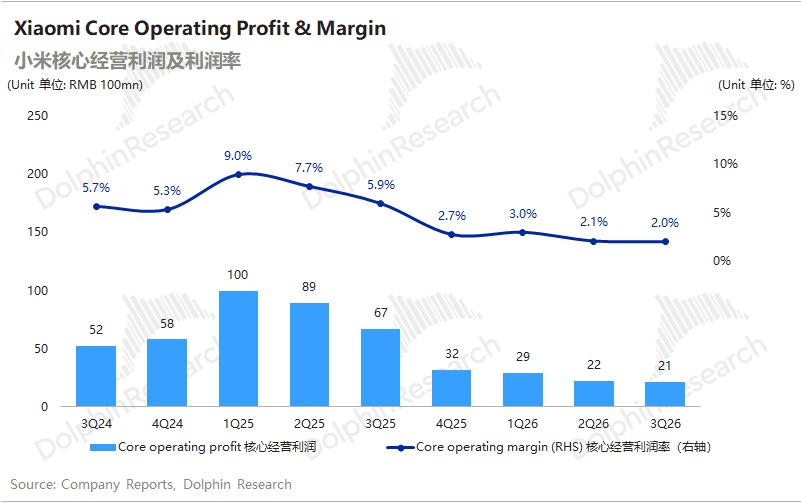
6. Profit side: core profit was 2.1 billion yuan, adjusted net profit was 4.9 billion yuan. According to the Dolphin Research caliber (gross profit - sales expenses - administrative expenses - R&D expenses), the core profit in this quarter was 2.14 billion yuan, down 68% year-on-year, and the core profit margin was only 2.0%. By business segment, the core profit of Xiaomi's traditional business was about 5.5 billion yuan, down about 8% year-on-year; innovative businesses including vehicles and AI recorded a loss of 3.4 billion yuan, with the loss expanding by about 800 million yuan quarter-on-quarter.
Dolphin Research's overall view: Vehicles propped up performance last year, now it's mobile phones' turn to carry the load
Xiaomi's financial results this quarter are generally in line with expectations, but the internal performance differentiation is obvious: mobile phones pull the gross profit margin back to the guidance range through price increases, while the automotive business falls into a situation of simultaneous decline in volume and price and expanding losses.
On the mobile phone side, the entire quarter-on-quarter growth comes from the increase in average selling price, and "controlling volume to ensure price" has changed from a passive response to an active choice. Coupled with the narrowing decline of IoT, price increases have outpaced storage price hikes, the group's gross profit margin rebounded slightly quarter-on-quarter, and the bottom of the traditional business is more solid.
The automotive business is in the gap period between the transition of old and new models. The decline in average selling price per vehicle dragged down revenue to fall quarter-on-quarter and fall short of expectations; the higher-positioned Pengcheng flagship model did not start delivery until the end of the quarter, further expanding automotive losses. The one increase and one decrease kept the group's core profit at a relatively low level of around 2 billion yuan.
Apart from this financial report, the market is paying attention to the following core business progress:
a) Mobile phone business: gross profit margin rebounds first, shipments are still contracting. Global smartphone shipments in Q3 fell 20.9% year-on-year. The rise in storage prices pushed up the price of whole devices and suppressed demand in emerging markets. Xiaomi's year-on-year decline in shipments reached 29.4%, while Samsung (-5.9%) and Apple (-2.2%) were relatively less affected.
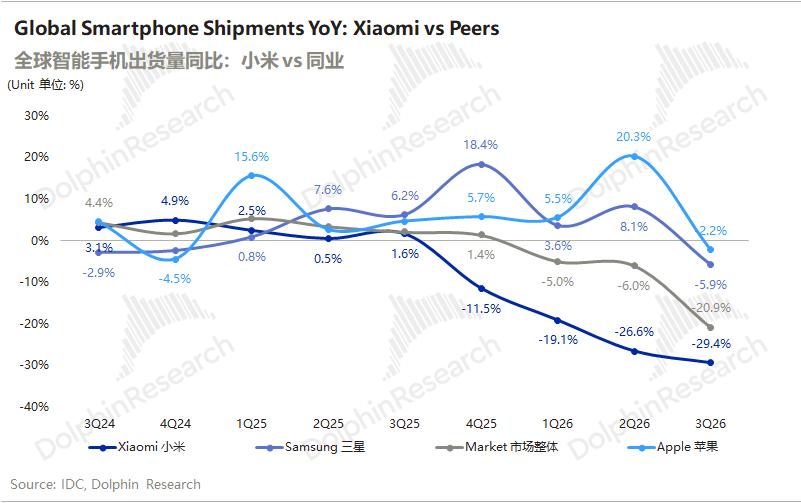
On the price side, under the pressure of storage, the company continued to raise prices in Q3, which is the main factor for the rebound of gross profit margin. The domestic Redmi Note 17 is 20%–30% more expensive than the previous generation, K100 Pro Max increased by 5%–13%, overseas prices increased by about 35% in India, about 34% in France, and about 38%–40% in Spain.
The market has recently begun to anticipate the possibility of an