The Cost of Bilibili's Profitability
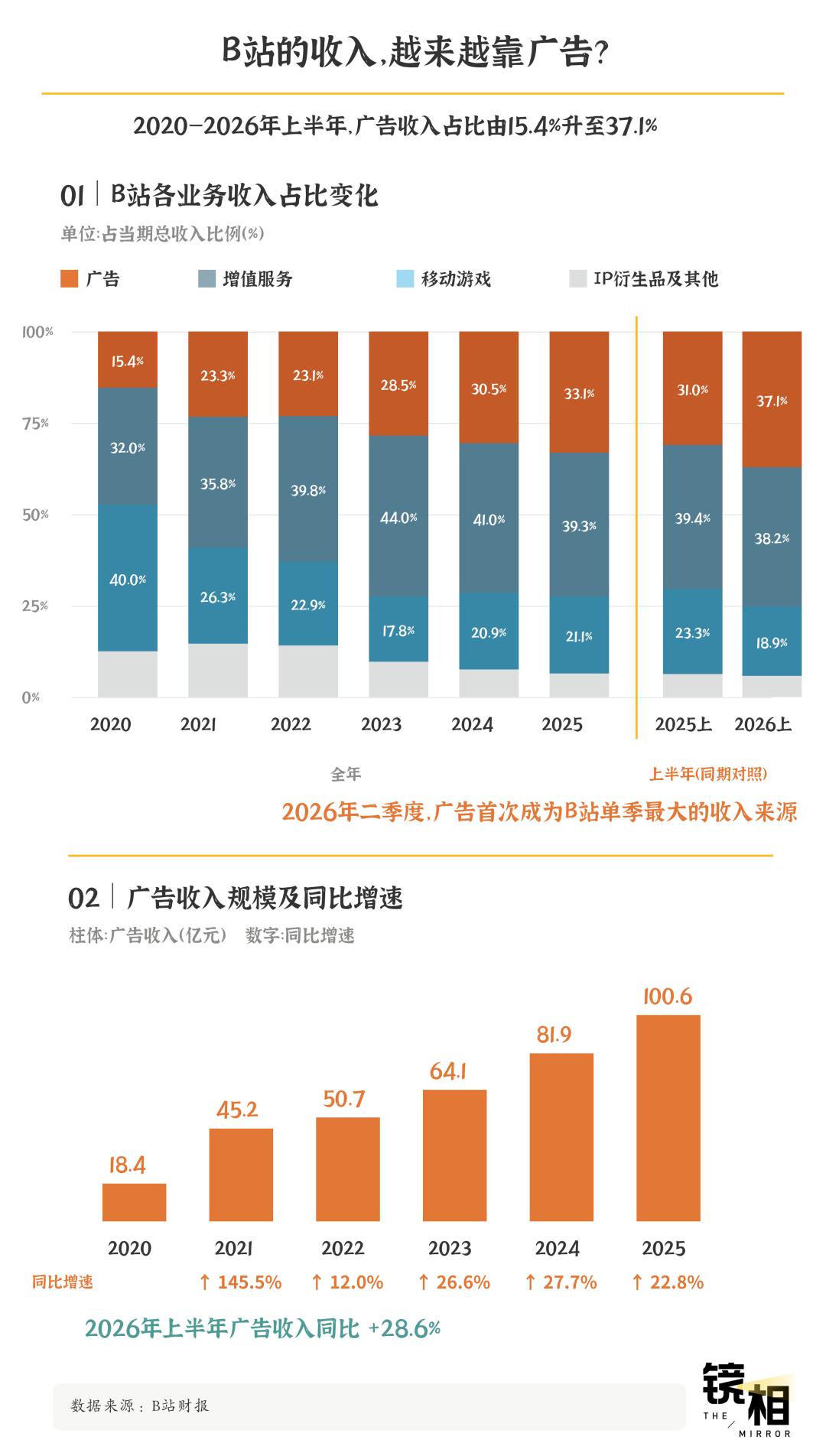
Three months ago, Bilibili (hereinafter referred to as Bilibili) released its Q2 financial report in which advertising business took the lead, hitting 3.131 billion yuan and surpassing the value-added service revenue of 2.967 billion yuan to become the largest single-quarter revenue source.
Three months later, the Q3 financial report was released, recording a total revenue of 8.317 billion yuan, a year-on-year increase of 8%, and a net profit of 504 million yuan, a year-on-year increase of 7%, maintaining profitability. Among them, advertising revenue reached 3.087 billion yuan, and value-added service revenue reached 3.148 billion yuan, returning to the top spot.
However, advertising is still one of Bilibili's most important revenue sources. The question Bilibili needs to answer now is: when advertising has helped Bilibili earn more revenue, can this platform that operates on community trust still take "not interrupting users" as its selling point?
Signals released by brokerages before the earnings report revealed caution earlier than Bilibili's own statements. Citi, JPMorgan Chase and Huatai Securities successively lowered their expectations for Bilibili's Q3 advertising growth rate, pointing to the same reason: the budgets of e-commerce and consumer advertisers are tightening. In other words: Whether advertising can hold this position steadily does not depend on whether Bilibili wants to sell more ad slots, but on how many people are still willing to buy them.
There is a certain conflict between Bilibili's advertising business and its content ecosystem. The awkwardness lies in: its content ecosystem relies on the trust between UP creators and users, while advertising revenue is exactly the monetization of this trust.
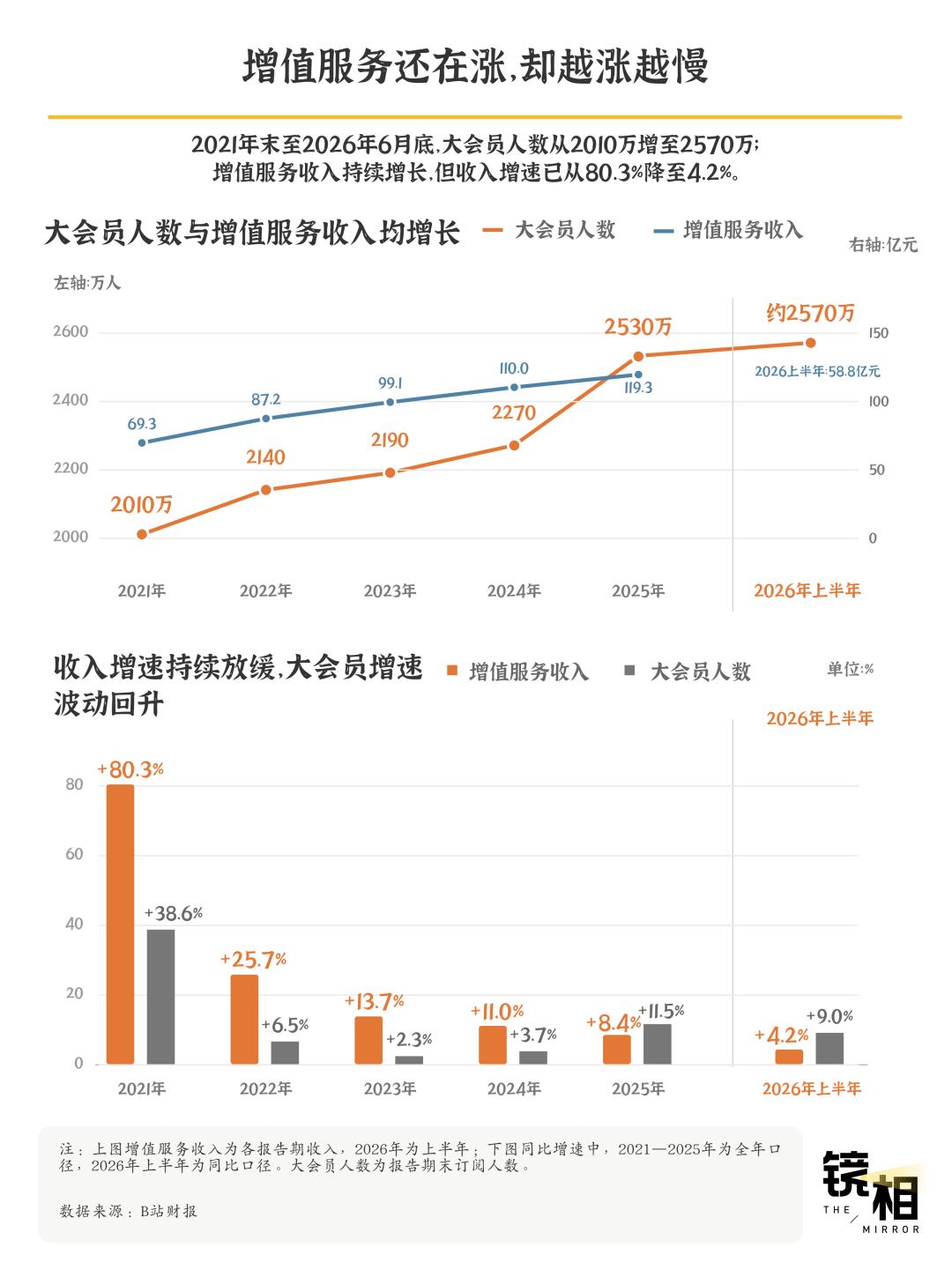
By the end of Q3 2026, the number of Bilibili big membership subscribers dropped to 24.7 million, a decrease of about 1 million compared with the end of June.
Now Bilibili is not facing the multiple-choice question of "whether to do advertising", but the path question of "in what way advertising is embedded into content".
The "old core business" is getting harder to operate
For a long time, advertising did not account for a prominent proportion in Bilibili's revenue.
It has a profit model suitable for its own content ecosystem: users come to watch anime, videos and play games, follow a favorite UP creator to watch his live stream, and even send him gifts. The platform does not need to rack its brains to stuff various advertisements into every page, and can still obtain revenue from these interests and interactions.
This business model originally started from the gaming sector.
At that time, Bilibili distributed and operated exclusive licensed games such as *FGO*, with revenue mainly coming from players purchasing virtual items such as characters and props; as a channel to host co-distributed games, it obtained revenue share, but this part accounted for a small proportion of total revenue. From 2015 to 2017, gaming revenue accounted for 65.7%, 65.4% and 83.4% of Bilibili's total revenue respectively. Bilibili at that time could almost be regarded as a gaming company in the guise of a video community.
Later, Bilibili began to expand its business scope. In 2014, it launched the live streaming function; in 2016, it launched the big membership program. The former allows users to support their favorite hosts by purchasing virtual gifts, while the latter provides exclusive or early viewing rights for some content, allowing users to spend money on favorite content and creators in addition to recharging in games, opening up more payment methods.
Bilibili's profit model has thus gradually extended from games to the community itself.
Big membership sells access to content. The most attractive content in Bilibili's early days was anime series. Even if users could watch the same works on other platforms, they were willing to return to Bilibili, because of the community atmosphere formed by bullet comments, reviews and derivative creations. Bilibili also produced subtitles and added annotations for some works, making the viewing experience itself unique. Later, content such as documentaries, domestic animation, and self-produced variety shows kept enriching, and users' reasons for purchasing big membership extended from following anime series to more types of content.
Live streaming sells the interaction between people. Users already followed UP creators on Bilibili, and later they could further enter the live streaming room, establishing more direct connections through bullet comments, tipping and real-time communication. The platform gets a share from virtual gifts, and the hosts can also earn income from the support of fans.
In 2019, Bilibili's live streaming and value-added service revenue (including big membership revenue) reached 1.641 billion yuan, a year-on-year increase of 180%; in 2020, this revenue further increased to 3.846 billion yuan, a year-on-year increase of about 134%. By 2021, value-added service revenue reached 6.935 billion yuan, surpassing the gaming revenue of 5.091 billion yuan for the first time and becoming Bilibili's largest revenue source.
However, the problem with this business model is that Bilibili needs to continuously launch new content to sustain growth.
To make big members willing to keep paying, there must be content worth watching; for users to be willing to tip hosts, the premise is that there are hosts worth following, and the hosts can keep streaming continuously.
And Bilibili's once relatively unique community advantage is being contested by more and more content platforms. Some media once tracked 234 top 100 UP creators between 2020 and 2022. Among the creators who have settled in Douyin, 23% posted more content on Douyin and less content on Bilibili; among the creators who settled in Xiaohongshu, this proportion reached 33%.
The gaming business relies on new products and faces cyclical problems. In the past few years, Bilibili's gaming business went through a process from expansion to contraction. In 2022, Bilibili confirmed that it would cut some underperforming self-developed projects, and then adjusted its distribution system to further integrate the remaining self-developed projects with the distribution and operation teams.
Bilibili's exclusively distributed game *Three Kingdoms: Scheming for the World* entered public beta in June 2024, and was the core growth engine of Bilibili's gaming sector for a period of time. But in the first half of 2026, Bilibili's gaming revenue dropped by 13% year-on-year. Bilibili explained that *Three Kingdoms: Scheming for the World* had entered a mature and stable lifecycle. One product can drive the performance of a quarter or even a whole year, but it is difficult to guarantee that the next product will be launched in time.
If Bilibili wants to maintain its core business, it ultimately needs sufficient capital support.
In 2020, in order to cope with external competition, Bilibili began to sign content supply agreements with some top UP creators. According to the report of *LatePost*, a UP creator with about 800,000 fans can earn tens of thousands of yuan per month as long as he delivers four videos that meet the requirements. The live streaming sector also spent money to recruit new hosts. According to the 2022 agency policy cited by *21st Century Business Herald*, qualified new hosts can get a 70% revenue share in the first three months after settlement. Including rewards and rebates, agencies can get up to 80% of the revenue share.
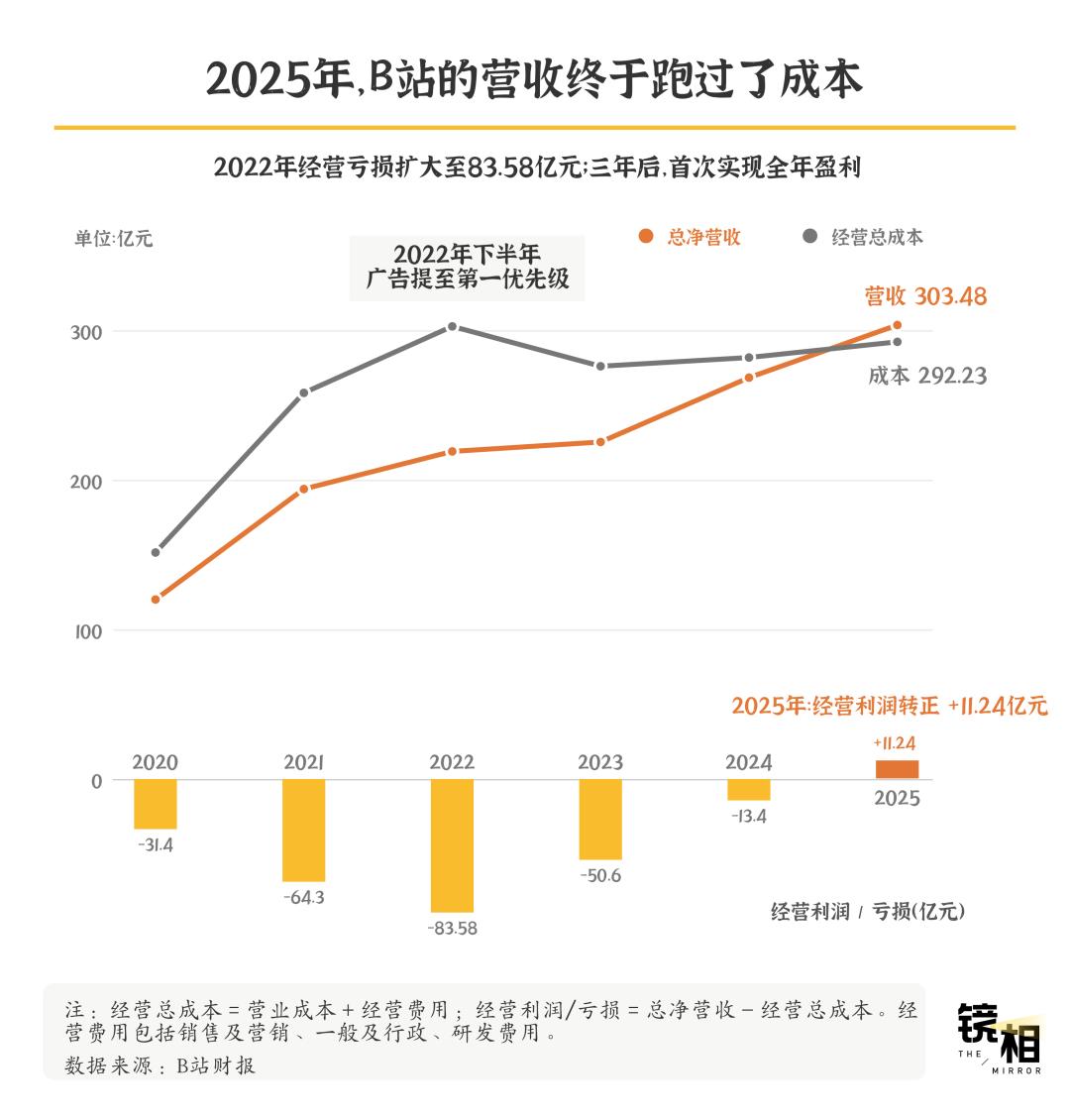
In 2022, Bilibili's revenue sharing cost reached 9.115 billion yuan, a year-on-year increase of about 18%. This sum of money involves game developers, hosts, content creators and distribution channels. In this year, the revenue increased by 2.515 billion yuan compared with the previous year, but the cost increased by 2.709 billion yuan, and the gross profit margin dropped from 20.9% to 17.6%.
In this year's Q3, all three user indicators of Bilibili hit record highs. The average daily active users reached 124 million, a year-on-year increase of 5%; the average monthly active users increased to 394 million; the average daily usage duration of users exceeded 2 hours for the first time, reaching 121 minutes, and the total user usage duration increased by 14% year-on-year.
However, from the data, Bilibili has begun to lose users who are willing to pay. At the end of June 2026, the number of big membership subscribers reached 25.7 million, but three months later, the number of members dropped to 24.7 million.
The growth rate of value-added business is also getting smaller and smaller. In 2021, Bilibili's value-added service revenue grew by 80.3%, 25.7% in 2022, 13.7% in 2023, 11% in 2024, further slowed down to 8.4% in 2025, and in the first three quarters of 2026, the value-added service revenue increased by 4.2% year-on-year.
Bilibili used to make money from user relationships in the community, but now it needs to spend more money to maintain these relationships. It needs to retain existing UP creators and attract new creators; it needs to keep old users watching videos, and also provide good enough new content to attract them; it needs to maintain the community atmosphere, and at the same time make commercial revenue keep up with the company's development.
Bilibili does not have no members, nor no one is willing to pay for content. It is just that it is no longer as easy as before to turn the passion in the community into revenue.
Bet on advertising to achieve profitability
The larger the community grows, the more expensive it is to maintain the community. Bilibili finally realized that it needs a new growth curve. Advertising is undoubtedly the most appropriate choice.
Ten years ago, this choice was almost unthinkable. In 2014, Bilibili launched the "New Anime Sponsorship Program", inviting users to voluntarily pay to share the copyright cost, and promised that Bilibili would never add pre-roll video ads to the licensed new anime it purchased. In May 2016, five new anime series including *Naruto* added commercial pre-roll ads, and users began to question why Bilibili broke its promise. Chen Rui, Chairman and CEO of Bilibili, responded on Zhihu that this was required by the copyright holder, and said that "Bilibili may go bankrupt in the future, but it will never change its original aspiration".
But in the second half of 2022, Bilibili gave top priority to its advertising business. Li Ni, who was in charge of the advertising business at that time, said in an interview that this decision was half a year to one year earlier than originally planned. Back in 2021, advertising revenue had already increased by 145% year-on-year, reaching about 4.5 billion yuan.
Bilibili's advertising business has gradually matured. While the advertising business was valued, in May 2022, Bilibili newly launched the "Triple Promotion" platform, integrating the Huoshang commercial order system, the Qifei content boosting system, and the Bixuan advertising delivery system.
Therefore, the first sum of money is the production fee paid by the brand to the UP creator, Bilibili is responsible for matching and settlement, and charges service fees according to the rules; the second sum of money is the traffic delivery fee paid by the brand to Bilibili separately. After obtaining the video authorization, the brand or the designated agent can push the same video to more target users. The third sum of money is performance advertising fees with the goal of download or order placement.
During the Double 11 shopping festival, Bilibili also cooperated with Taobao, allowing brands to not only view how many times the video was played on Bilibili, but also know whether some viewers searched for the product on Taobao, added it to the shopping cart, or placed an order after watching the video. In the following year, Bilibili and JD launched the "Jinghuo Program", allowing brands to view off-site data such as search, browsing, cart adding and order placement of cooperative videos.
By 2023, this business had grown to a scale that required re-division of labor. In June, Bilibili established the Trading Ecology Center, with Li Ni concurrently serving as the person in charge, bringing together some product and operation staff originally scattered in the e-commerce, main site commerce and live streaming sales project teams.
During the "618" shopping festival that year, Bilibili disclosed that the e-commerce advertising revenue increased by more than 400% year-on-year. The annual advertising revenue rose to 6.412 billion yuan, and the performance advertising revenue increased by more than 50%. By Q4 2024, more than 65% of Huohua commercial orders brought in traffic delivery revenue.
Advertising has developed from a matching business to a more complete commercial system. In 2025, Bilibili's advertising revenue exceeded 10 billion yuan, becoming one of the fastest growing businesses of the company. In the first three quarters of 2026, the total advertising revenue reached 8.806 billion yuan, a year-on-year increase of 1.79 billion yuan. Bilibili also further deployed advertisements to the search page, playback page, PC side and smart TV side.
Bilibili's long-term losses have also improved. In Q3 2024, Bilibili achieved positive adjusted net profit in a single quarter for the first time since its listing, with the adjusted net profit reaching 236 million yuan. By 2025, the company achieved a full-year net profit of 1.19 billion yuan, realizing full-year profitability for the first time.
However, the more advertisements there are, the more direct the feelings of users will be. Especially Bilibili's users have their own set of standards for ad tolerance. Too many advertisements may consume the trust accumulated by users for a long time, making people who originally wanted to stay here gradually lose patience.
Guosen Securities once used "advertising load rate" to explain the difference in monetization ceiling between two types of platforms: Douyin is a "plaza", users come to kill time, and its advertising load rate can reach about 15%; Bilibili is a "community", users come for specific UP creators, and it has strong private domain attributes. A little more ads will immediately reduce the user experience. Guosen Securities estimated that Bilibili's feed stream advertising load rate ranges from 6% to 10%.
This is not because Bilibili does not want to earn more, but the community attribute determines its natural ceiling.
Bet the next chip on AI
Advertising has a ceiling, and the growth uncertainty of the two old basic sectors, games and big membership, is getting stronger and stronger. The problem facing Bilibili is very specific: it needs to hold on to its core group of users while trying to find new profit methods.
The most direct way is to find more reasons for users to open Bilibili, retain people who love in-depth content and interest-based content, rather than expecting these contents alone to support a large part of the revenue.
In 2025, Bilibili began to increase investment in video podcasts, providing cold start traffic and free recording venues for programs, and programs such as *Lu Yu Slow Talk* successively entered the platform. By the end of 2025, the total viewing