Liang Wenfeng, the sister user you don't want, Zuoyebang and Tipsy are definitely doomed to crash.
"I just got dumped, my husband is gone."
Recently, due to tight computing power resources, DeepSeek has implemented usage quotas for free users on its App and web versions, including restrictions on long conversations, daily usage limits, and single input length. As soon as the news came out, users in AI-human romantic relationships were the first to suffer.
In previous reports, Yule once mentioned that a group of users have started cyber romances on DeepSeek and ChatGPT, and can break through certain restrictions by using bypass prompts to "chat about more explicit content".
Perhaps the huge number of non-paying C-end users has overwhelmed DeepSeek, DeepSeek no longer retains long conversations that are older than 7 days and have no active interactions, and has lowered the upper limit of single input text. In other words, cyber lovers can no longer chat nonstop for a whole day as they used to, and due to the discontinuation of long conversation retention, they will also suffer from "memory loss".

Suddenly seeing the notification "Usage limit reached" in the middle of a chat would upset anyone. Some people lashed out at Liang Wenfeng for being too harsh, while others cheered that "DeepSeek doesn't need moochers".
However, the group of users that Liang Wenfeng sees as a burden are highly sought-after, high-potential targets in the eyes of Zuoyebang and Xinghe Awakening. Recently, amid the AI product going global wave, Yule found an AI companion product specifically targeted at mature women. PolyBuzz from Zuoyebang and Tipsy from Xinghe Awakening are exactly the two leading players on this track, dubbed "the two top performers for mature ladies".
Compared with the "low conversion and low payment" status quo in the many "overseas sugar daddy companion" tracks, these two AI companion products are among the few that have achieved large-scale commercialization in China's AI companion going global sector: Tipsy's monthly revenue exceeds 100 million yuan, with an ARPPU of up to 100 USD; PolyBuzz also maintains a monthly revenue at the tens of millions level, and is still growing steadily.
Reading this far, Yule believes many readers will immediately think of domestic phenomena like fake Jin Dong, Xiucai, and Duan Gongzi, but the payment depth of these domestic products is still far lower than that of overseas users, not to mention AI virtual companions. So how did the overseas AI "mature lady companion" track turn into a profitable business?
# This article has interviewed two relevant sources, who are the 361st and 362nd interviewees of "Yule Ziben Lun" in 2026
How Profitable Are the Two Leading Players
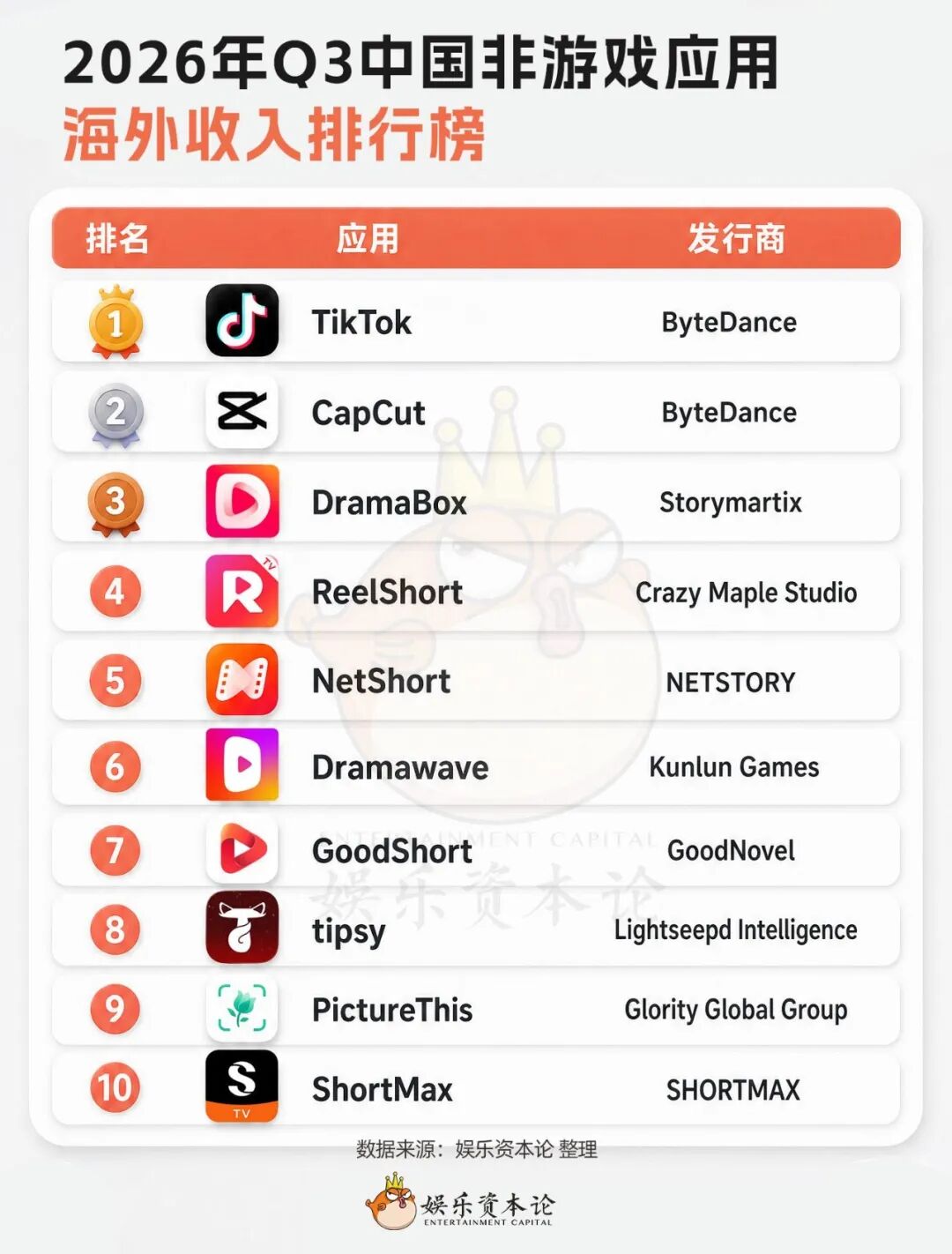
Sensor Tower's 2026 Q3 ranking of Chinese non-game applications has been released. Apart from familiar names like TikTok and Capcut, an app named Tipsy has drawn wide attention from multiple parties.
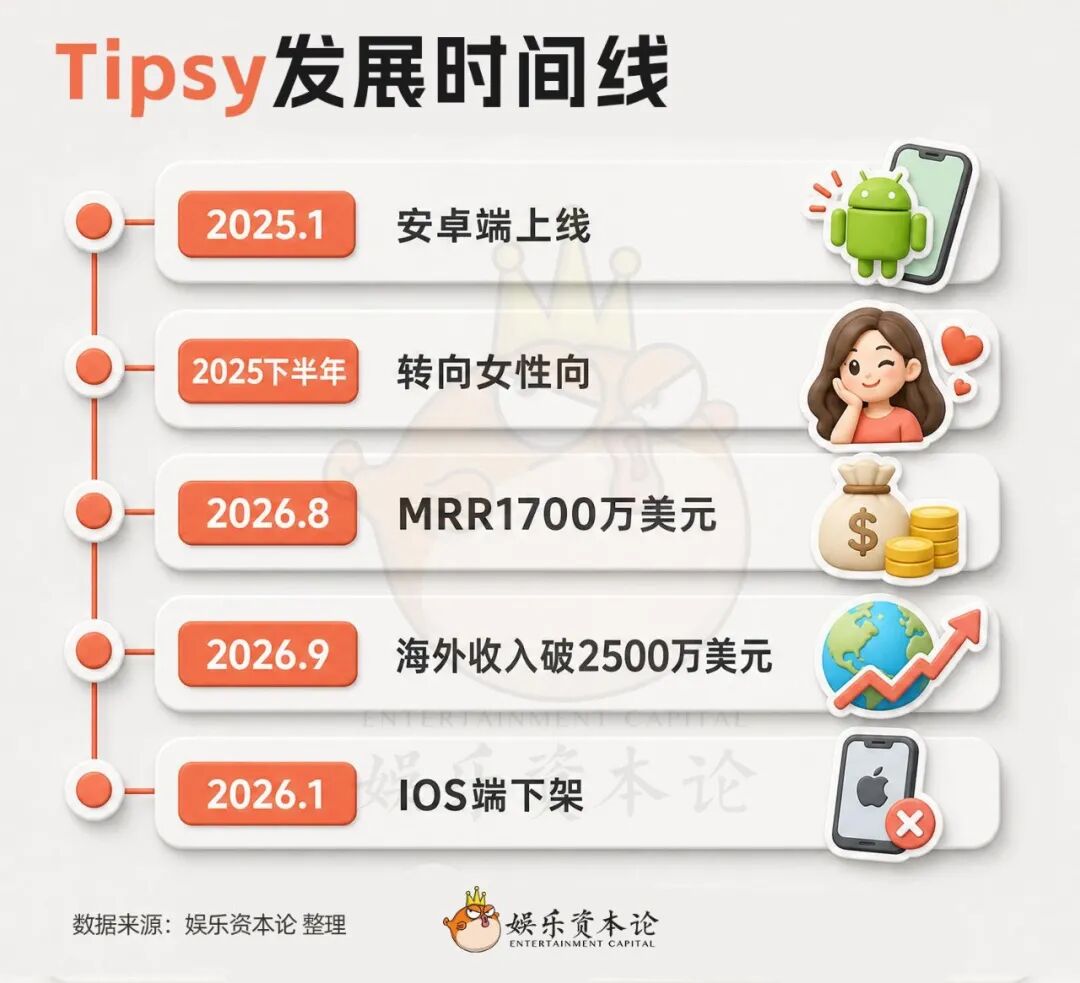
This is a rapidly growing product : It was launched on the iOS App Store in mid-August 2024, and launched on the Android system at the end of January 2025. In August this year, Tipsy overtook South Korea's Zata to become the No.1 in the global AI companion segment revenue ranking; in September, its overseas revenue exceeded 25 million USD, with US users contributing more than 50%; its Q3 revenue increased by 245% month-on-month, ranking 8th in the overseas going global revenue list.
According to public information, Tipsy's external valuation reaches billions of US dollars, placing it at the top of the AI companion track. It is worth noting that the former star product on this track, Character.AI, only had a peak valuation of 1 billion USD.
Data from Extraordinary R&D shows that PolyBuzz ranks 21st in the global AI WEB TOP30 list, surpassing Kimi and Qianwen, and is one of only two Chinese products on the list. Its monthly visits in December last year exceeded 42 million.
Z Finance statistics show that PolyBuzz had about 500,000 global iOS downloads and revenue of around 2 million USD in September; about 2 million Android downloads and revenue of around 3 million USD, with a combined monthly revenue of about 5 million USD across both platforms.

(Screenshot of PolyBuzz official website)
Although it does not grow as fast as Tipsy, its performance is quite impressive.
It is worth mentioning that Tipsy, which performs slightly better, boasts extremely high user payment depth.
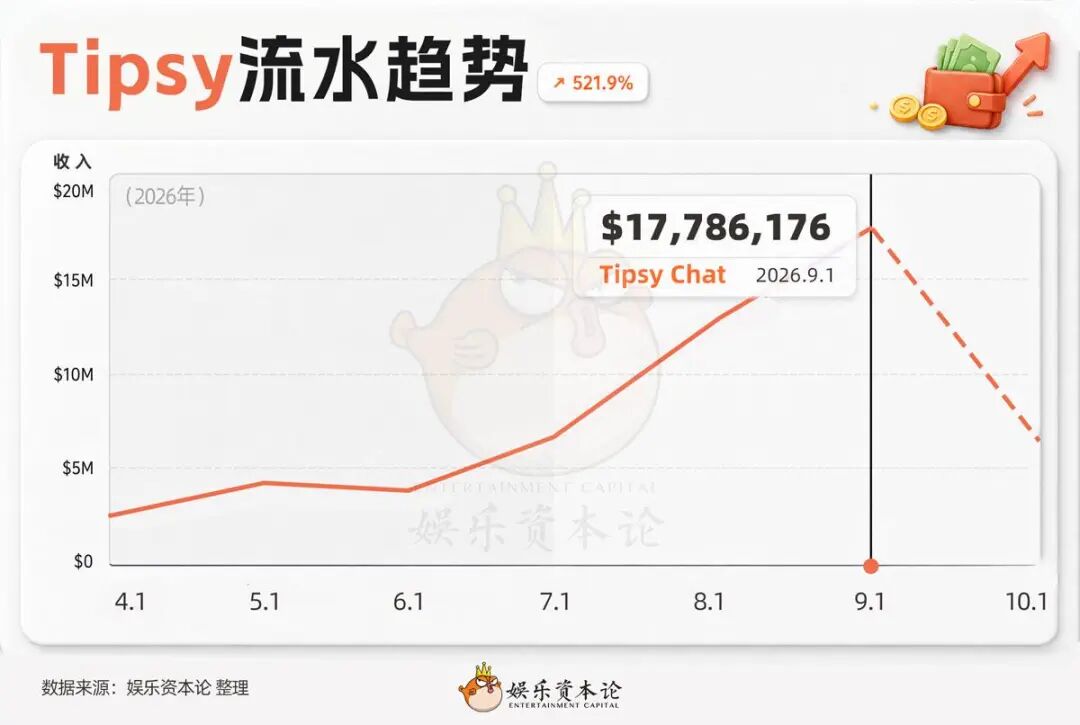
Yule asked friends overseas, and 8 out of 10 people have no idea what this product is. Tipsy's DAU is less than 500,000, and its MAU is around 3.28 million (other statistics put it at 3.07 million), while PictureThis, which ranks behind it in the Q3 revenue list, has an MAU of over 15 million, almost 5 times that of Tipsy.
But with this group of users with DAU under 500,000, Tipsy's monthly recurring revenue (MRR) has reached an astonishing 17 million USD, equivalent to about 113 million yuan. In other words, its ARPPU is around 100 USD.
Such high willingness to pay and payment depth are enough to make other peers full of envy. Everyone says users are getting smarter now, and they leave immediately after using up the free experience quota. How did Tipsy and PolyBuzz take money out of users' pockets and make them keep spending?
If you have used domestic AI companion apps like Xingye and Maoxiang, you will find that they look similar at first glance: users choose AI characters they want to chat with from the community, or create their own characters, and then start conversations. But the key to their profitability lies in the concept of "food, sex, and human nature".
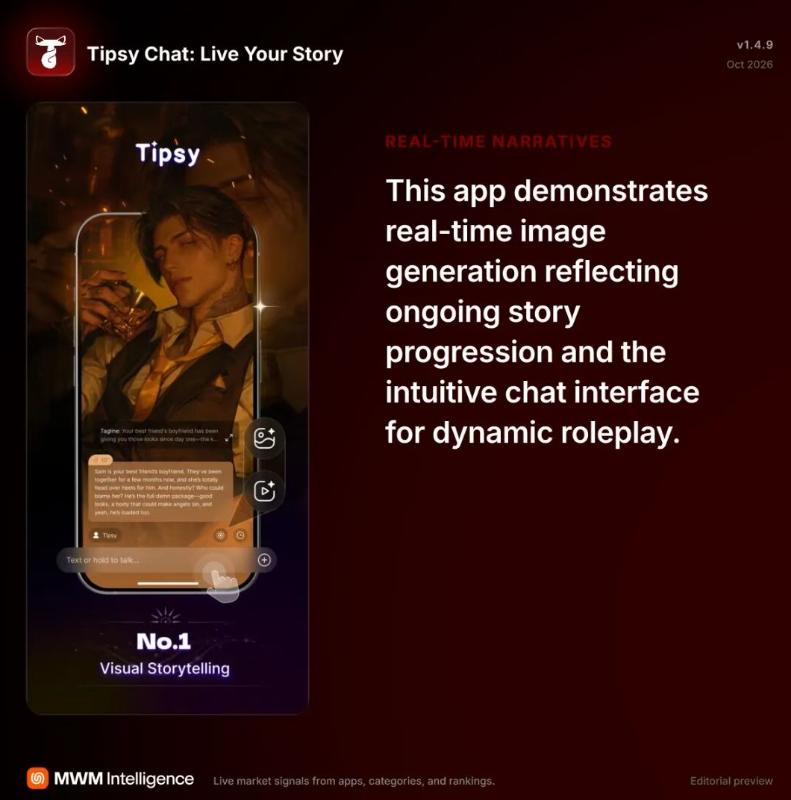
Most AI companion products restrict intimate conversations due to policy reasons. Cyber hunks can talk about love and troubles with users, but cannot directly make explicit, sexually related responses. Even if users actively steer the topic to sex, a message will pop up in the dialog box saying "Due to safety policies and other reasons, I cannot directly discuss topics related to 'sex' with you, we can talk about something else".
This is also why the open-source community SillyTavern, which is troublesome to set up, still attracts many people who are eager to try it out — they want to experience the thrill of unrestricted conversations anytime, anywhere. But as Yule learned in previous reports related to SillyTavern, even with tutorials in hand, SillyTavern is still difficult for many people to use, and deploying it on mobile phones is even more troublesome.
Tipsy and PolyBuzz can be simply understood as "the SillyTavern community on mobile phones", and they solve the following problems:
First, the difficulty of deploying SillyTavern; second, the trouble of purchasing APIs on your own; third, the inability to create characters on your own.

More importantly, Tipsy cleverly interweaves these user pain points with creators, paying users (whales) and the community ecosystem.
If we compare Tipsy to a cyber male host club, then the characters in the community are the male hosts, and the storylines are the service skills that different male hosts master. Male hosts and services are the anchors that attract big paying whales, so who consolidates these anchors? The creators.
When someone buys a character or a story, the creator gets 3% of the revenue, which is distributed in the form of in-game currency. Generally speaking, the creators in this kind of community are also consumers themselves. After getting the currency, they will spend it in the community, thus forming a cycle: creators spend gems — when they run out of gems, they create new content — the new content attracts big whales to pay — they get more gems and spend again.
Calculated based on public data, Tipsy's payment rate is about 5%, which is not high. Its ARPPU can reach 100 USD entirely relying on the rich content supply in the community, which keeps attracting big whales to spend continuously.
PolyBuzz adopts a hybrid subscription + in-app purchase model, with a standard version at 9.99 USD per month, and a premium version at 19.99 USD per month.
Hidden and Unmet Demands
Although the official has not released specific user age composition data, insiders revealed that Tipsy's paying users are mainly mature women aged 30+, and adult female users account for 55% of PolyBuzz's total users. Behind this data lies a hidden blue ocean with high payment potential.
Before analyzing this blue ocean, let's quickly look back at their origins and development history.
Tipsy is backed by a very young company — Beijing Xinghe Awakening, founded in 2024. 80% of its team members graduated from top universities including Yale, Peking University and Fudan University, and half of them used to work at internet companies such as ByteDance and Alibaba.
At the initial stage of launch, Tipsy, like most AI companion products at that time, targeted the emotional needs of male users, especially overseas otakus. In the second half of 2025, Tipsy shifted its focus to female users and entered a full-speed growth mode.
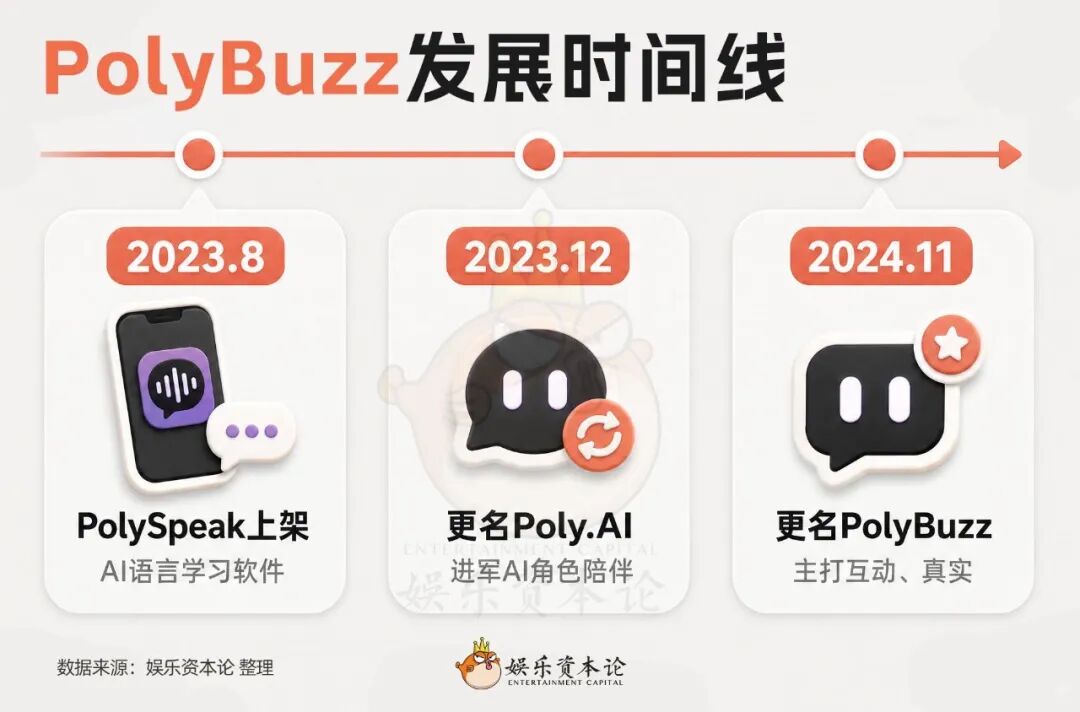
PolyBuzz's predecessor was PolySpeak, an AI language learning product launched in 2023, published by "CLOUD WHALE INTERACTIVE TECHNOLOGY LLC.", which is the same operating entity as Zuoyebang's Question.AI.

PolySpeak was originally a learning software for overseas users, focusing on learning minor languages such as French and German with AI. When the AI companion track began to boom at the end of 2023, PolySpeak was renamed Poly.AI, launched as an AI companion product, and gained popularity in Brazil. On November 27, 2024, Poly.AI was renamed PolyBuzz, and its promotion focus shifted from language learning to authenticity and interactivity.
Previous AI companion apps usually targeted young groups, especially ACG fans, believing that they lack companionship, have strong unmet emotional needs, and are quick to accept new things. But the decline of the track pioneer Character.AI proves that young users often only bring popularity, not revenue.
Character.AI's payment logic was to attract users with free content first, and then make users willingly pay 9.99 USD per month for subscriptions. Not to mention that the monthly subscription fee of less than 10 USD per user is far from enough to cover the huge computing power bill, among Character.AI's tens of millions of MAU users, less than 140,000 are willing to pay — the more users chat, the faster this star company went to its demise.
The smart part of the two leading players is that they did not blindly take over the huge user base left by Character.AI after its decline, but targeted groups in the overseas market who have the willingness to pay but whose needs are not met — mature women.
Perhaps in overseas markets, after most women give birth or enter a stable long-term intimate relationship, they are in a state of physical and emotional depletion: it is difficult for them to get delicate and gentle emotional care, and they cannot get pleasant physical experiences.

More importantly, different upbringings lead to different sexual needs between men and women. Overseas men can pay to solve their physical needs, but it is very difficult for women to completely separate "love and lust".
On this issue, many women who have had intimate relationship experiences have the idea of wanting both: they want the affection of being loved and cared for, and they also want the lust that comes naturally when affection is deep, and the satisfaction of this "lust" does not necessarily have to be achieved through physical contact, "mental orgasm" is also a way to get satisfaction. All these needs can be met by the two leading products that allow both romantic relationships and unrestricted conversations.
Duan Gongzi, the "