Exclusive Bonus | Chen Jie, Head of Reinforcement Learning at XPeng Robotics, has resigned as of the end of October.
"Workplace Bonus" (ID: ZhiChangHongLi)
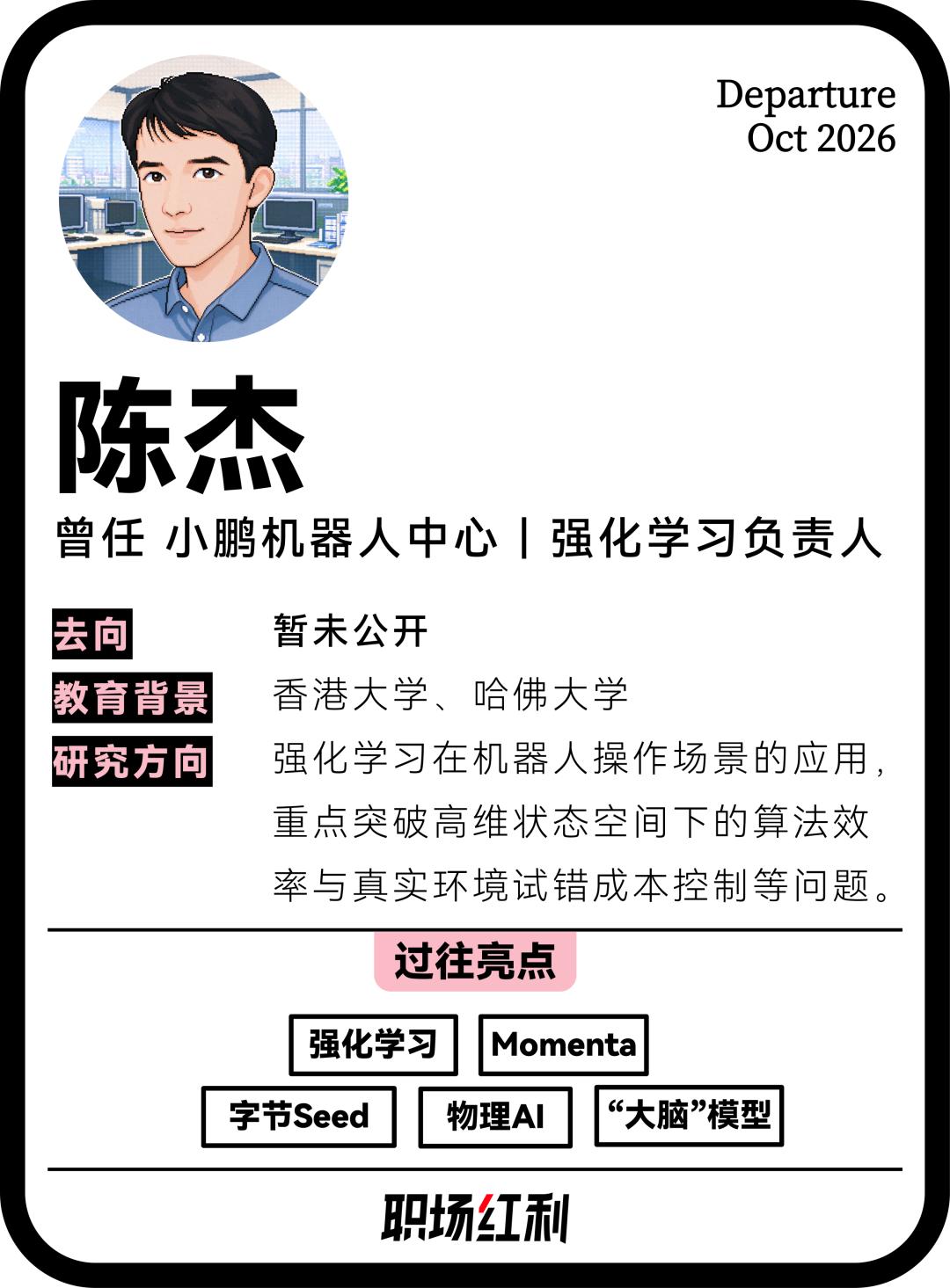
Exclusive information obtained by "Workplace Bonus" confirms that Chen Jie, former head of reinforcement learning at Xpeng Robotics Center, left his position at the end of October 2026.
Chen Jie worked at Xpeng Robotics for around 15 months. He previously served as head of reinforcement learning for ByteDance's Seed team, and joined Xpeng in July 2025 to take charge of robot reinforcement learning. Ge Yixiao, who joined Xpeng at the same time as him, was responsible for multimodal work. The two were the two core technical leads Xpeng recruited to support the "brain" of the IRON robot.
During Chen Jie's tenure, Xpeng Robotics completed a round of organizational restructuring. In June 2026, He Xiaopeng announced that he would personally serve as the CEO of the robotics business. At the end of the same month, the Robotics Center established nine new secondary departments, and the reinforcement learning function and Chen Jie were not mentioned in public reports. Xpeng has not made any public statements about how the original functions were adjusted or whether Chen Jie's reporting line changed.
As of press time, Xpeng has not commented on Chen Jie's departure, and Chen Jie himself has not responded to inquiries.
When Chen Jie left, Xpeng Robotics had already signed its first round of equity financing agreements worth over 900 million US dollars, and its automated production line had been put into use, but the IRON robot was still in the pre-mass production stage. On November 25, the 8th Xpeng Tech Day will be held in Guangzhou with the theme "Origin". The latest version of IRON will make its debut on site and interact with the audience.
Chen Jie's next career move remains unclear at present.
Embodied intelligence has no standard answer
Academia, autonomous driving, large models, embodied intelligence — Chen Jie's resume represents a very typical career path for talents in China's embodied intelligence track.
According to a November 2025 report from QbitAI, Chen Jie studied for his undergraduate degree at the University of Hong Kong, then pursued his doctorate at Harvard University, focusing on artificial intelligence and reinforcement learning. However, according to Chen Jie's own LinkedIn profile, he graduated from Soochow University for his undergraduate studies, obtained his doctorate at the University of Hong Kong, and then went to Harvard University for postdoctoral research. After graduation, he joined Momenta. At that time, Momenta's R&D covered environmental perception, prediction and driving decision-making, and continuously iterated its system through mass-produced vehicle data, data-driven algorithms and closed-loop automation.
After leaving Momenta, Chen Jie joined ByteDance's Seed team to take charge of reinforcement learning. Seed is ByteDance's large model research foundation, and the task of reinforcement learning is to use reward signals to further enhance the capabilities of pre-trained models. Public achievements including Seed-Thinking-v1.5 and DAPO were all developed using this method.
In July 2025, Chen Jie left ByteDance and joined Xpeng Robotics. According to AI Tech Review, before deciding to join Xpeng Robotics, he had contacted many domestic embodied intelligence companies. There were two reasons why he finally chose Xpeng: first, the R&D of robot bodies started early and had accumulated solid technical experience; second, Xpeng Motors sold well and had sufficient cash on its balance sheet.
In April 2025, Xpeng announced that it was developing a 72-billion-parameter world foundation model and building a reinforcement learning training framework. The company stated that this model would serve terminals including automobiles and robots at the same time. One year later, Xpeng released the X-World world model technical report. Official information shows that X-World has been used in closed-loop simulation testing, online reinforcement learning and data generation for autonomous driving, and participated in the R&D and verification of the second-generation VLA model.
Theoretically, these advances can provide reusable methods for robot R&D. However, due to the differences in the body, action space and real scenarios between vehicles and robots, the achievements on the vehicle side cannot be directly equated to the capabilities on the robot side.
In large model R&D, reinforcement learning is often used to improve capabilities such as reasoning and coding, and training results can get feedback through evaluation. When applied to robots, the model also needs to be verified by the robot body, sensors and real environments. Whether a single demonstration can be repeated, whether the actions are safe, and whether hardware loss and cost are controllable will all affect whether it can become a formal product.
Xpeng officially wrote "supporting a wide range of scenario applications and self-reinforcement in the real world" into the product positioning of IRON. From an engineering perspective, this statement refers exactly to the reinforcement learning work that Chen Jie was once responsible for.
Only over one month left before the mass production node
Since 2020, Xpeng Robotics has experienced multiple changes to its core team.
The early team was led by Zhao Tongyang and Peng Xing Intelligence. In September 2023, Zhao Tongyang left and founded Qianting Robotics. After that, Mi Liangchuan, Shi Xiaoxin and Zheng Cunyuan formed the next-generation core team. Mi Liangchuan coordinated the overall business, Shi Xiaoxin was in charge of products, and Zheng Cunyuan took charge of the complete machine. The team successively promoted the debut of the first-generation IRON and the brand-new 2025 version of IRON. Zheng Cunyuan left his post at the end of May 2025, and Ge Yixiao and Chen Jie joined Xpeng in July 2025 at the same time, responsible for multimodal work and reinforcement learning respectively. In June 2026, Shi Xiaoxin and Mi Liangchuan left the company. At the same time, He Xiaopeng personally took the position of CEO of the robotics business, and the Robotics Center set up nine new secondary departments.
Four months later, Chen Jie left. As IRON moves towards mass production, many core leads who participated in the R&D of previous generations have left their original positions one after another. There is no clear public information on which secondary department and which lead will take over the original reinforcement learning related functions.
On August 24, Xpeng announced that its robotics business had signed its first round of equity financing agreement, with a financing amount of over 900 million US dollars and a post-investment valuation of over 6.3 billion US dollars. The round was led by IDG Capital, with participation from Gaorong Ventures, Tencent and Alibaba as strategic investors, while Xpeng Group remains the controlling shareholder.
On September 8, Xpeng Robotics' automated production line was put into use, and the first high-end general-purpose humanoid robot completed automated final assembly and walked off the production line independently. Xpeng stated that the automation rate of core processes on the production line exceeds 80%.
In the same month, Xpeng held its first robotics supply chain partner conference, which was attended by suppliers of core components including actuators, dexterous hands, sensors and AI chips. According to media reports, Xpeng had completed supply chain factory audits and core component designation at that time. Compared with an IRON robot walking off the production line independently, these links are closer to the daily problems that need to be solved for mass production.
On October 28, Gu Jie, Vice President of Xpeng Group, said at an industry forum that the solid-state battery for IRON has achieved small-batch mass production and offline, and the robot is still in the pre-SOP (Start of Production) stage. Xpeng has not yet announced the specific output, yield and delivery status of IRON.
In the third quarter of 2026, Xpeng Group recorded a revenue of 24.28 billion yuan and delivered 118,390 vehicles, both hitting new all-time highs for a single quarter. As of September 30, the total amount of cash and cash equivalents, restricted cash, short-term investments and time deposits reached 45.41 billion yuan. He Xiaopeng once again gave the timetable at the Q3 earnings call: achieve large-scale mass production of hardware by the end of 2026, let the first batch of mass-produced robots enter some Xpeng stores for trial use in the first quarter of 2027, and officially release the product to external commercial customers in the second quarter.
The balance sheet and timetable clearly show Xpeng Robotics' confidence and determination, but from a personnel perspective, the past year has obviously not been very stable.
On November 25, the latest version of IRON will appear on the stage of the "Origin" Tech Day. After that, there will be only over one month left before the end-of-year large-scale mass production node proposed by He Xiaopeng.
References:
1. "Exclusive: Xpeng Robotics Team is Expanding Rapidly, Chen Jie Formerly from ByteDance's Seed Team Has Joined", AI Tech Review
2. "Who is Leading Xpeng Robotics: Four Key Figures Behind IRON", QbitAI
Written by / Fang Tingyu Cover photo by / Fang Tingyu
Follow and star our account to track the trends of "industries, companies and talents" in depth👇
This article is from the WeChat official account "Workplace Bonus", written by Fang Tingyu, and published by 36Kr with authorization.