Why does Huawei Cloud need Soul?
On September 8, Meta launched its personal agent Muse. Users can name it, customize its avatar, and set its speaking tone. It can book flights and reply to emails on users' behalf, and also keep people company through chatting. Within two weeks after launch, Muse's downloads exceeded 2.5 million.
Two weeks later, Mark Zuckerberg reserved the last few minutes of the launch event for a small device. He took out a keychain-sized gadget from his pocket, named it Muse Charm, whose 2-inch screen carries the user's own Muse. It supports real-time conversation and can be carried around all the time.
Muse sends a clear signal to the industry: the competition of agents is extending from model capability and efficiency tools to relationship building ability and emotional experience in real life. AI is starting to step out of the screen and become the Personal Agent around everyone.
The race for the "Chinese version of Muse" kicked off soon after. From ByteDance, Alibaba to Tencent and Ant Group, major tech giants have successively shifted their product focus to personal agents, with the fastest track being "getting things done": paying utility bills, comparing prices to place orders, applying for price protection refunds. Beyond efficiency improvement, there is no clear answer in China for the other half represented by "understanding" and Muse Charm: a portable partner that can speak in real time and catch users' emotions.
On November 24, at the Huawei Cloud Agent Partner Open Plan Launch & Zhiguo Ecosystem Conference held in Hangzhou, this answer showed a faint outline. Soul took the stage as an agent partner. On the same day of the conference, Shanghai Yuanxi Xingpin Communication Technology Co., Ltd., which previously jointly launched AI hardware with Soul, also appeared at the scene and signed a strategic cooperation agreement with Huawei Cloud. In the follow-up, Soul, Huawei Cloud and Yuanxi will carry out in-depth collaboration around cloud services, agents and hardware.

Most of Huawei Cloud's agent partners are rooted in production scenarios such as finance and office work. Soul is one of the rare C-end players and enterprises targeting the scarce relationship scenario, behind which lies a social community with over 10 million daily active users, nearly 80% of whom are Generation Z young people. Its entry means that Huawei Cloud's agent ecosystem has begun to enter a previously relatively scarce field: young people's relationship, content and emotional consumption.
The complete ecosystem of the Chinese version of "Muse-Muse Charm" may first grow out of Soul. The question to answer is: why Soul, and why does Huawei Cloud need it?
01. Why Soul: Ten Years of AI Accumulation for a Company Deeply Cultivated in Relationship Scenarios
In the first half of 2026, the boom of Agents focused on office work and programming; in the second half of the year, Personal Agent became the new battleground for entry points. As Agents began to stay around people permanently, the industry encountered a new problem: the interaction method itself has become a bottleneck.
Question-and-answer text conversations are suitable for issuing tasks, but can hardly support long-term coexistence. A large amount of information transmitted between people through tone, pauses and expressions has not really entered human-computer interaction so far. For AI to enter daily life and become a close collaborative partner, it needs natural, smooth and warm interaction, which is often called "the sense of a real person".
The demand has emerged one step ahead. According to the 2025 Insight Report on College Students' AI Usage Behaviors and Mindsets jointly released by Soul, China Youth Daily and China Youth Campus Media, 47.1% of the surveyed college students admitted that they "cannot live without AI", and nearly 80% of the respondents regard it as a "friend to chat with casually". From "tool buddy" to "emotional tree hole", AI is playing a more complex role in young people's daily work and life.
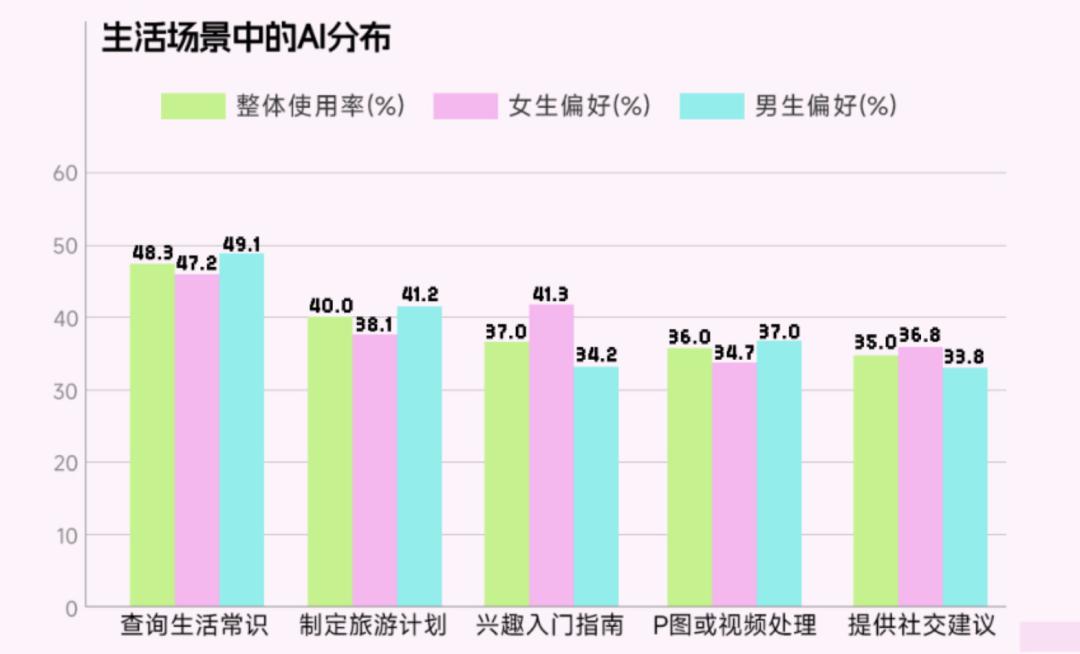
Distribution of AI in college students' life scenarios, the chart is sourced from 2025 Insight Report on College Students' AI Usage Behaviors and Mindsets
Young people have projected a large amount of emotion onto AI, but there are not many players that can make this kind of interaction natural and long-lasting.
The reason why Muse sparked heated discussion is that it demonstrates the complete path of Personal Agent. On one hand, it helps users get things done, on the other hand, it is a "partner" with personality, who can speak in real time and interact at any time. Domestic major manufacturers are rapidly catching up with the first half, while the brand new interaction method pointed to by the second half is exactly the direction that Soul has been moving forward for ten years.
When Soul launched in 2016, the social track was already a red ocean. It stood out by capturing young people's social needs: no real-person avatar, weakening appearance and geographical location, and finding people with "soul compatibility" based on interests. The tool to meet this demand is AI. At the beginning of its launch, Soul launched an intelligent recommendation engine to connect people with people, and people with content based on user portraits and interest graphs. Behind the product experience of "find you following your soul" that many old users remember deeply, the intelligent recommendation algorithm is distributing relationships.
In the vision of its founder Zhang Lu, new technologies represented by AI have been the core driving force for reconstructing social experience from the very beginning.
After ten years, the core asset accumulated by Soul is a relationship network built on interests, emotions and companionship, as well as scenario data and product experience related to emotional interaction, interest matching and diverse interactions precipitated in it. According to the prospectus, as of August 2025, Soul had 11 million daily active users, 78.7% of whom are Generation Z. Users stay here for more than 50 minutes on average every day, open the App more than 20 times, and send about 75 private messages; every month, users create or participate in more than 323 million interest "experience" scenarios.
Such scenarios have extremely high value for AI. Information in social interaction is difficult to be structured. The same sentence, with a different tone or a pause, will change its meaning. A high-frequency interactive young community, on the premise of compliance and desensitization, is naturally a training and verification ground for emotional perception capability.
Soul's AI layout has been moving forward along the scenarios. The recommendation algorithm solves the problem of "who to find", and every subsequent step answers "how to accompany and how to communicate". Around 2020, Soul launched systematic AIGC R&D, focusing on emotional perception and interaction; in 2023, the platform launched its self-developed large model SoulX. At present, 4.6 million Soul users use AI functions on a daily basis, accounting for about 40% of daily active users.
At WAIC 2025, Soul demonstrated an end-to-end full-duplex voice call large model, where AI can decide when to speak on its own and take the initiative to break the silence. In October of the same year, Soul open-sourced the voice podcast generation model SoulX-Podcast, which topped the Hugging Face TTS trend list the next day after release.
The outside world's attention to Soul's technical capabilities roughly started from this series of actions. In the following ten months, Soul open-sourced six models in succession. SoulX-FlashTalk compressed the latency of the 14B real-time digital human to 0.87 seconds, and SoulX-FlashHead ran at 96 frames on a single 4090 graphics card.
Connecting these nodes forms a clear technical main line: multi-modal real-time interaction. For human-computer interaction to be natural, smooth, warm and real, voice, digital human and vision need to respond collaboratively at the same moment. In the view of the Soul team, SoulX does not pursue the "omniscience" of general large models, but focuses on real-time understanding, emotional perception and voice priority. The "sense of a real person" has thus become the most distinctive label of Soul's technology.
Putting this technology stack together with Muse Charm, we can see a clear correspondence. What Zuckerberg emphasized at the launch event is to integrate real-time voice and virtual avatar into a keychain; what Soul has supplemented in recent years are exactly these key puzzles of voice generation, full-duplex conversation and real-time digital human. Soul already has most of the underlying capabilities required in the Chinese version of the "Muse-Muse Charm" ecosystem.
At WAIC in July this year, Soul appeared with a brand new identity after strategic upgrading: an AI ecosystem company focusing on emotional perception and interaction, and integration of models and applications. Internally, it continuously iterates models based on real social scenarios such as App; externally, it empowers the industrial chain with Soul's technical capabilities, and outputs emotional perception and interaction solutions for industries such as embodied intelligence and content presentation. The two-layer system of "self-owned application - industrial ecosystem" constitutes the new enterprise ecosystem after the upgrade.
Hardware is the most obvious step among them. At the WAIC site, Soul exhibited AI hardware for the first time, putting SoulX's voice interaction and emotional expression capabilities into a small portable terminal. The App is responsible for relationship cultivation and memory precipitation, and the hardware makes companionship portable and triggerable. When perception and interaction enter the physical space, it has the opportunity to become a more stable and more present relationship entry point.
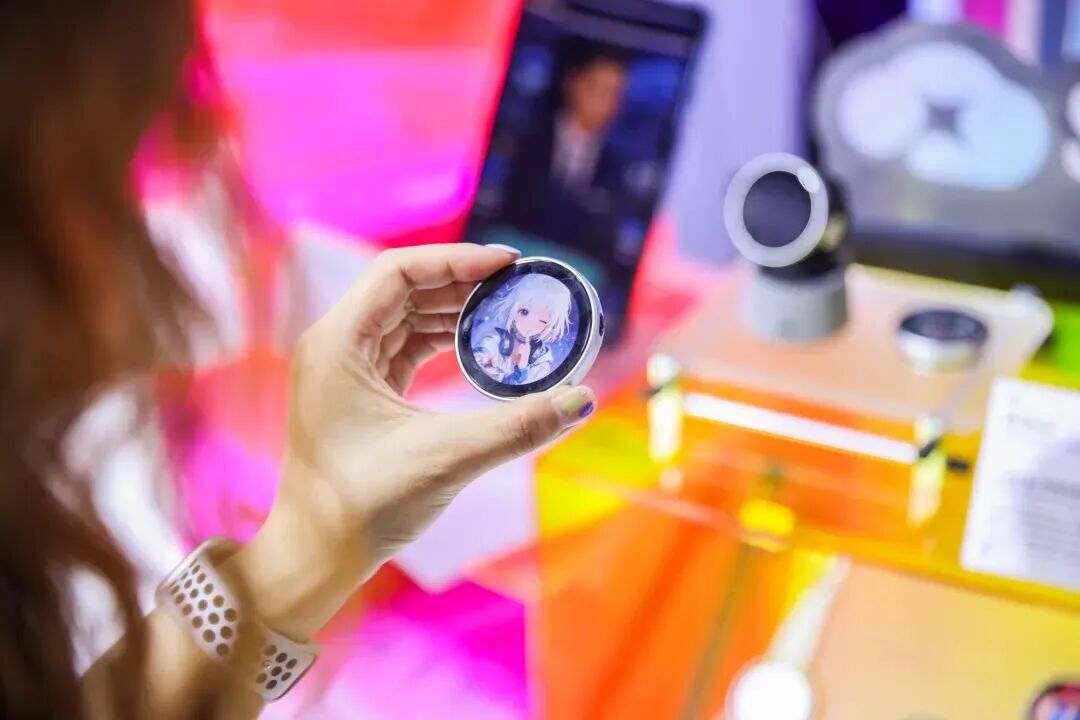
Soul AI hardware product made its debut at WAIC 2026
This was two months earlier than the release of Muse Charm. For Soul itself, this step breaks the screen boundary of the App, finds an entry point outside the mobile phone for user relationships, and the dual-end linkage of App and hardware forms an agent closed loop. It is built on ten years of scenario and model accumulation, and also paves the way for the subsequent cooperation with Huawei Cloud.
02. Why Huawei Cloud Needs Soul: "Expanding the Circle" of the AI Territory
Huawei Cloud has taken intensive actions on agents this year. At the Creator Conference in June, it proposed Agentic Infra, and jointly released the "Hundred Models, Thousand Forms" ecosystem plan with more than 20 model manufacturers; at the Full Connect Conference in September, Zhou Yuefeng, CEO of Huawei Cloud, proposed to "build Agentic Cloud together", and built an enterprise-level agent platform with the commercial version Zhiguo AgentArts and the open source version openJiuwen. On November 24, Huawei Cloud joined hands with the first batch of more than 30 partners to release the Agent Partner Open Plan, opening up the AgentArts platform as well as agent products such as Guoban and Madao, to help partners develop and make good use of agents.
The background of this territory is still To B. Huawei Cloud's enterprise-level agent platform has served more than 100 enterprises, including the Longgang District Government of Shenzhen, Postal Savings Bank of China, China Southern Power Grid, Kingsoft Office and KingMed Diagnostics, etc. They are concentrated in production scenarios such as government affairs, finance, energy and office work, and the measurement criteria for agents are accuracy and efficiency.
Soul is a rare C-end scenario party and "relationship ecosystem" party on this territory. It fills in a long-vacant part in Huawei Cloud's agent ecosystem: emotional value, companionship and young users. In the words of young people, Huawei Cloud has "expanded its social circle" this time.

What Soul brings to Huawei Cloud is first of all a group of users and brand new scenarios. The high-frequency, high-viscosity and high-interaction young people's social and content consumption scenarios are rarely seen in Huawei Cloud's past ecosystem, and such a dense and vertical group of young users is even rarer.
This group of people is also the core user group of Personal Agent. Analysts mentioned when commenting on Muse Charm that Generation Z is more inclined to regard AI assistants as companions and brainstorming partners, and are used to interacting with technology through voice and short videos. Meta made Charm in the shape of an electronic pet, targeting exactly this group of people. The Chinese version of the "Muse-Muse Charm" ecosystem cannot be established without them.
The scenario itself is also valuable. Social companion agents have long sessions and high concurrency, need to remember the context of several months, and the voice response needs to be compressed to within one second, which puts forward very different requirements for the cloud platform from government and enterprise work orders. For a platform that hopes to carry all kinds of agents, this is a new test paper.
At the value level, the expansion of the circle is more intuitive. Most of the values provided by Huawei Cloud's existing partners are efficiency improvement. Kingsoft Office builds a vertical office agent on the platform, and Postal Savings Bank of China develops financial customer service and counter assistants. Based on the function of "getting things done", Soul provides emotional value.
AI is evolving from a production tool to an intelligent partner, and the theme of this year's WAIC is "Intelligent Partners, Co-Create the Future". A Personal Agent that stays around people for a long time, in addition to efficiency collaboration, also needs to understand emotions and respond in a natural way, so as to truly become a partner that users are willing to collaborate closely with. As Mona Sarantakos, Vice President of Product at Meta Superintelligence Labs and Head of Muse Product, said, the value of personal agents lies in reducing the management burden of daily affairs, and user trust is the premise for continuous delegation. And trust is exactly the next step that extends in continuous interaction after the relationship is established.
Soul's emotional perception capability based on multi-modal real-time interaction adds the sense of real person and emotional value to the Agents in Huawei Cloud's ecosystem, making the implementation of Agents more meaningful. Huawei Cloud's agent platform is called "Zhiguo AgentArts". On a territory almost full of production scenarios, Soul brings human touch to it, and also gives the "Art" in AgentArts a specific form.
The expansion of the circle also occurs in the business model. In mid-November, DeepSeek limited long conversations and daily usage quotas on the grounds of insufficient computing power, and the users who reacted most strongly were emotional companion users. Some people described the session interruption as "heartbreak after a breakup", and many people took the initiative to ask for paid services in the comment area.
What users ask AI is far more than weather and recipes, they project their emotional needs onto AI. This kind of demand is high-frequency and long-term, the context accumulates longer and longer, token consumption continues to grow as the relationship deepens, and it naturally comes with willingness to subscribe. There are already pricing references overseas: free Muse users can use 100 million tokens per week, and the paid tiers are divided into two levels of $20 and $100 per month.
For Huawei Cloud, this means a new type of business. Beyond hardware, cloud services and cloud consumption have just started. Hardware plus basic companion cloud services, superimposed with IP linkage and active event subscription, the value of this kind of cooperation far exceeds one-time hardware sales.
03. Future: Reusable Interactive Agent Paradigm
Joining the Huawei Cloud Agent Partner Open Plan is the first step of in-depth cooperation between the two sides, and the two will continue to deepen cooperation around models, hardware and cloud services later. Once the cooperation between Huawei Cloud and its partners goes deep, it often reaches the stage of joint solutions, and the landing point of this cooperation is more concrete.
The AI hardware that Soul jointly launched with relevant parties before has become a representative case. After this cooperation with Huawei Cloud, the new joint cooperation will connect the three capabilities of cloud, model & Agent, and hardware of all parties into a complete set of solutions. What users get is a partner that can speak as soon as it is turned on, remembers you, and keeps growing.
Behind Muse Charm is Meta,