The Invisible Winners Behind Jensen Huang's Reinstatement
In March 1815, Napoleon Bonaparte escaped from his place of exile on the island of Elba, landed at Golfe-Juan in southern France, and marched towards Paris. Along the way, the public cheered and the troops defected, allowing Napoleon to regain the throne in less than a month.
211 years later, a similar scene played out at Nvidia's headquarters in Santa Clara.
On the evening of November 23 Beijing time, Jensen Huang returned to his post. When he re-entered Nvidia's headquarters, hundreds of employees gathered in the lobby and between floors to welcome the founder who had been away for only 12 days.
"Jensen! Jensen! Jensen!" the employees chanted Jensen Huang's English name as they welcomed his return.
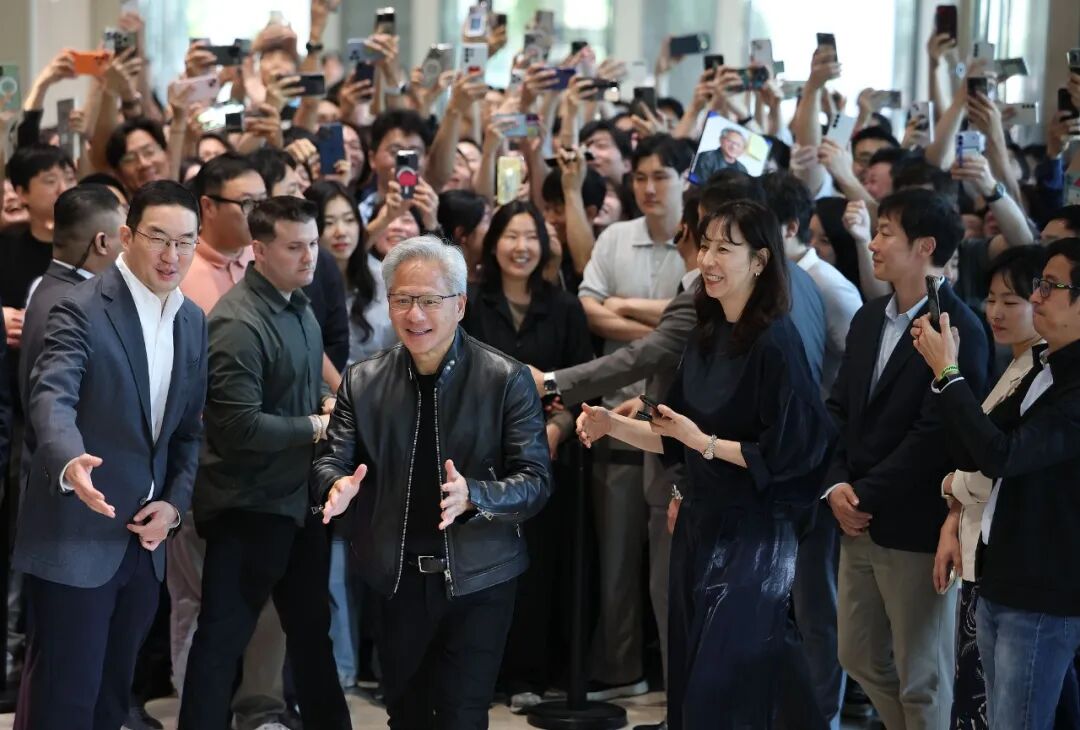
For many people, self-made Jensen Huang is not only a benchmark figure in the global AI industry, but also their idol. The photo shows Jensen Huang in South Korea
The capital market reacted as enthusiastically as Nvidia's employees. On the day Jensen Huang returned to his post, Nvidia's stock price rose by more than 31%, marking its largest single-day gain since 2003; its market value increased by nearly one trillion US dollars, setting a new record for the largest single-day market value increase of a listed company worldwide.
Many technology companies also benefited from Jensen Huang's return.
On the day of his return to post, Tesla, Meta and Google all rose by more than 6%; the Philadelphia Semiconductor Index rose by more than 14%, with all 30 constituent stocks closing higher; optical communications and AI cloud platforms were also sought after by capital, with Marvell Technology up 18.37% and CoreWeave up 22.32%.
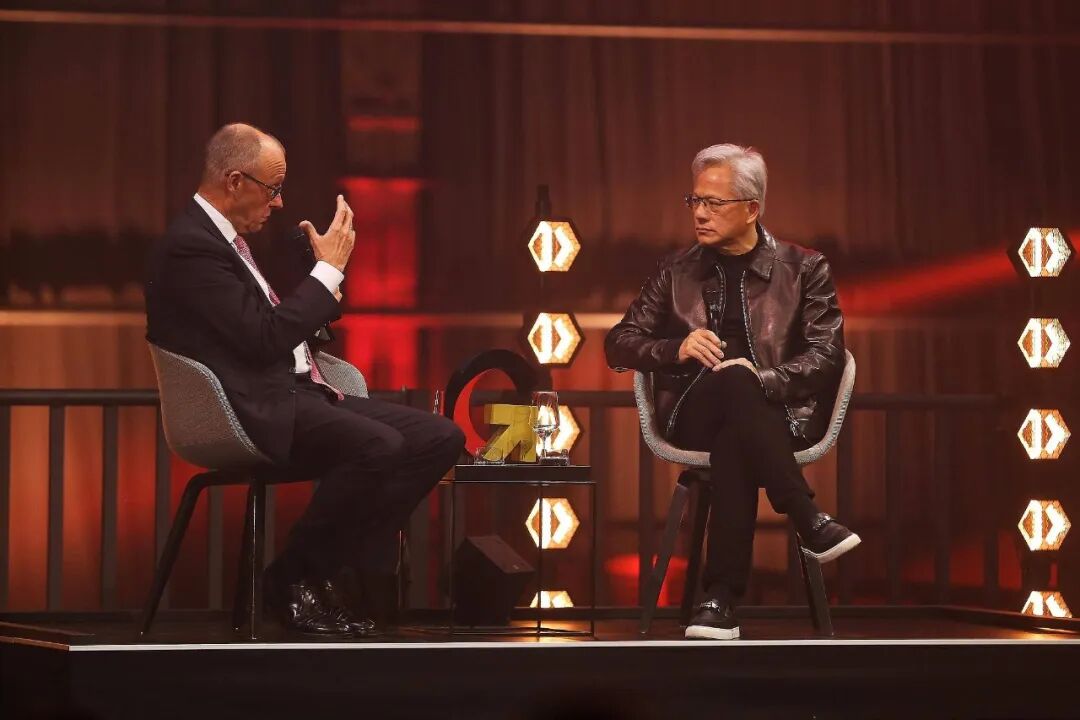
Jensen Huang with German Chancellor Merz
Among these companies, CoreWeave is quite special. It is like Napoleon's elder brother who once served as the King of Spain: its name is not widely known, but its power base is deeply tied to the protagonist, sharing weal and woe.
Founded in 2017, CoreWeave started with digital currency mining and was listed on NASDAQ in March 2025. At present, the company positions itself as an AI infrastructure cloud service provider: it borrows money to purchase chips and build computer rooms, and packages computing power into multi-year long-term leases to Microsoft, Meta and Anthropic.
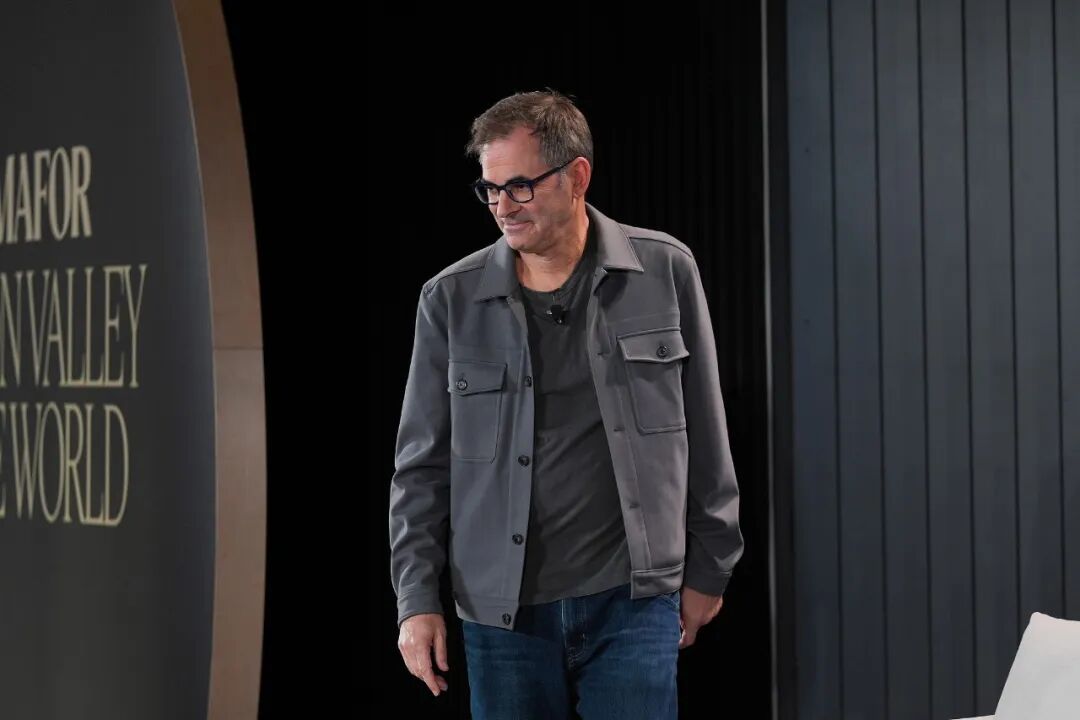
Michael Intrator, CEO of CoreWeave
The relationship between Nvidia and CoreWeave can be described as that of a "biological father and his son".
First of all, Nvidia provides capital. In April 2023, Nvidia participated in CoreWeave's Series B financing with an investment amount of 100 million US dollars; in January this year, Nvidia added a 2 billion US dollar investment at a price of 87.2 US dollars per share. At present, Nvidia holds approximately 11% of CoreWeave's equity.
In addition to capital, Nvidia also gave it exclusive "preference". After the release of multiple generations of chips including Nvidia's GB200 and GB300, CoreWeave has always been one of the first batches of cloud vendors in the world to launch, verify and commercially deploy these chips to the public.
More importantly, Nvidia is willing to underwrite for CoreWeave. Last September, the two parties signed a computing power underwriting agreement with an initial value of 6.3 billion US dollars: under the agreed conditions such as delivery and service availability, if CoreWeave's computing power is not fully leased out by customers before April 13, 2032, Nvidia will purchase the idle part of the computing power.
This underwriting arrangement, to a certain extent, forms the credit foundation for CoreWeave to continue raising financing. According to HSBC's estimation, CoreWeave needs to raise approximately 33 billion US dollars in new financing by 2027.
CoreWeave has another "brother" called Nscale.
Founded in May 2024, this company's business model is "Power-to-Token", which can be understood as finding cheap electricity, then building computer rooms, installing chips, and finally selling computing power.
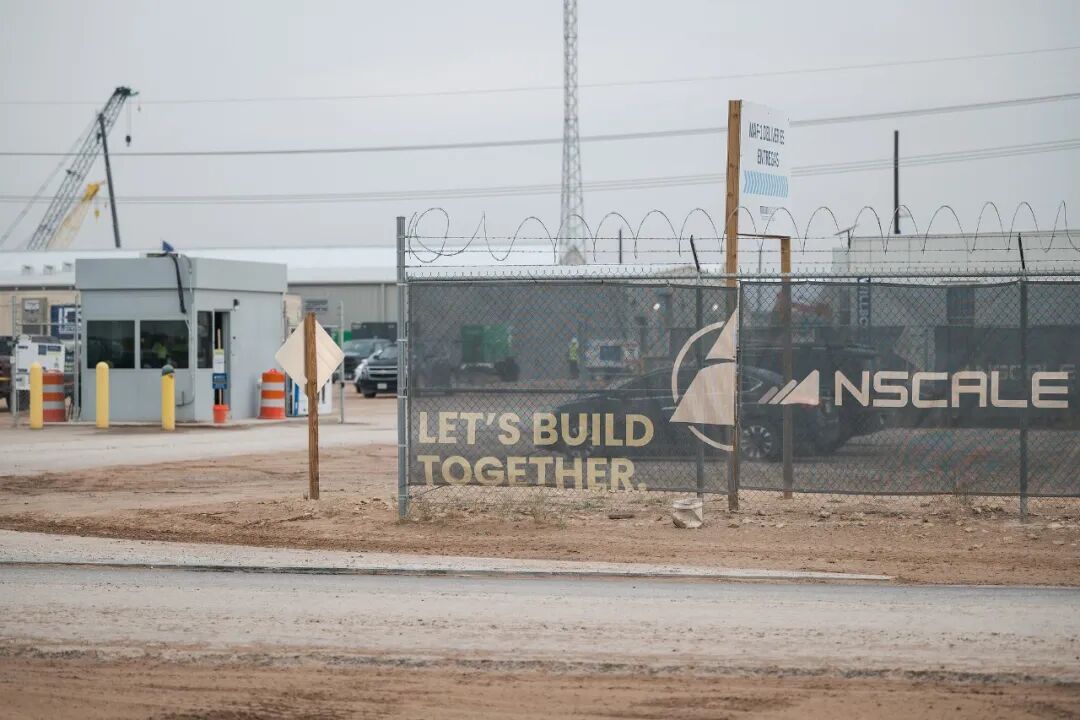
Nscale data center project
Nvidia has made multiple rounds of investments in Nscale. In September this year, Nvidia promised to subscribe for 2 billion US dollars of convertible bonds. Convertible bonds are debt instruments that will be converted into equity only when the share conversion conditions are met, which is different from CoreWeave's direct cash equity investment.
At the same time, Nscale also enjoys priority access to the full line of new products, but its priority level is ranked after CoreWeave.
In terms of underwriting, Nvidia did not sign a long-term computing power purchase underwriting agreement covering the company's entire computing power pool with Nscale as it did with CoreWeave, but adopted a new model of minimum income guarantee plus excess revenue sharing for a single giant computing power project.
It is not difficult to see that Nvidia distinguishes between "closeness and distance" in its treatment of CoreWeave and Nscale.
The reason why Nvidia does not treat the two equally is that they have different divisions of labor. CoreWeave is a general-purpose benchmark test platform responsible for demonstrating the strength of the "family" to the entire AI industry; while Nscale is a customized computing power carrier dedicated to serving the giant client Anthropic.
Even so, the two ultimately belong to the same community of shared interests.
On November 11, Jensen Huang resigned. From then until the trading day before he returned to his post, CoreWeave's stock price fell by more than 35% cumulatively; during the same period, Nscale, which was preparing for its IPO, was reported to be slowing down recruitment, cutting expenses, and streamlining and standardizing its business.
Now that Jensen Huang has returned to his post, market expectations for these two companies have been largely restored.
But this is only a recovery of expectations, not the fundamentals of the two companies.
If we take a broader view, we can also find that although Jensen Huang's return to post has detonated the capital market, it cannot change the general downward adjustment trend of the AI infrastructure track where CoreWeave and Nscale are located.
On November 12, the day after Jensen Huang resigned, well-known consulting firm Semi Analysis cut the 2027 global AI accelerator capital expenditure from 770 billion US dollars to 627 billion US dollars, cut it by another 28% in 2028, and 41% in 2029, with a cumulative reduction of 1.6 trillion US dollars over four years.
There are three reasons: the ARR growth rate of top AI laboratories in the third quarter was lower than expected, the financing environment tightened, and local regulations after the US mid-term election slowed down project progress.
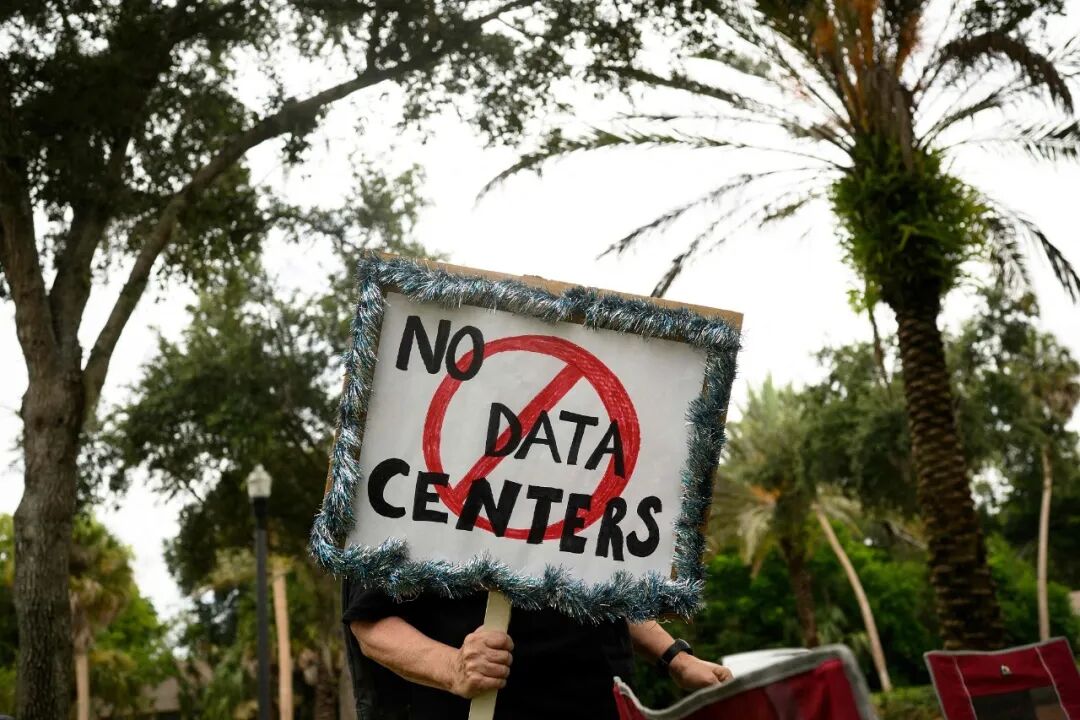
There is a considerable anti-AI and anti-data center crowd in the United States
At the same time, investors' enthusiasm for AI infrastructure seems to be gradually fading. According to a recent survey by Bank of America, 52% of the surveyed fund managers expect that large-scale AI hyperscale manufacturers will announce capital expenditure cuts in the next 6 months, and 38% of respondents believe that enterprises are over-investing.
A duck knows the warmth of the water best. Some large technology companies took actions even earlier. At the beginning of this year, Microsoft canceled the 3 billion US dollar lease of Nscale in the UK; by November, Microsoft gave up the 500 MW expansion option in Texas.
Against this background, to convince investors to continue to invest trillions of US dollars in AI infrastructure, Nvidia, the global AI leader, must continuously inject confidence into the market.
But Jensen Huang himself is also tightening his purse strings. In August, Nvidia cut its guarantee for OpenAI's Ohio campus from 250 billion US dollars to 105 billion US dollars; at the end of August, it suspended revenue sharing with new cloud vendors; at the end of the third quarter, the relevant commitments for new cloud vendors were reduced from 36 billion US dollars to 32 billion US dollars. All these actions took place before he resigned.
This downward cycle of AI infrastructure was not triggered by his stepping down, nor will it reverse because of his return. Perhaps during the 11 days when he resigned, the market reaction was somewhat radical, and the current rebound is only narrowing part of the previously excessive panic pricing.
After all, in essence, all infrastructure has its own cycle.
This article is from the WeChat Official Account "Xinghai Intelligence Agency" (ID: junwu2333), written by Xinghai Laoju, published with authorization from 36Kr.