ByteDance found Ulanqab in Brazil
The US market is currently re-examining the return on investment of AI infrastructure, while data center construction overseas is still accelerating.
In October this year, Brazilian President Lula won re-election. In his victory speech, he specifically mentioned that more data centers should be settled in Brazil. This kind of initiative is still rare in Latin America.
Over the past year, northeastern Brazil has become a busy hub. ByteDance has started construction of an ultra-large-scale data center at the Pecem Port in Ceará State. Alibaba Cloud officially launched services in São Paulo, providing cloud computing services to local enterprises, developers and public institutions. Google also announced that it will double its cloud computing capacity in Brazil by 2030.
At the same time, State Grid Corporation of China has started construction of an ultra-high voltage transmission project in northeastern Brazil, planning to transmit clean energy from this region to power consumption centers in the central part of the country.
Turn wind into electricity on the wasteland, and then convert the electricity into computing power on the spot. This scene is very reminiscent of a place in China: Ulanqab.
Just a few days ago, Ulanqab once again became a trending topic thanks to a set of statistics. In the Chahar High-tech Zone, 22 computing power projects are under construction at the same time, and nearly 30,000 workers are rushing to meet construction deadlines at the sites. On the other side of the ocean, in Ceará State, Brazil, local authorities are carrying out similar efforts, trying to turn sea breeze into power to drive data centers.
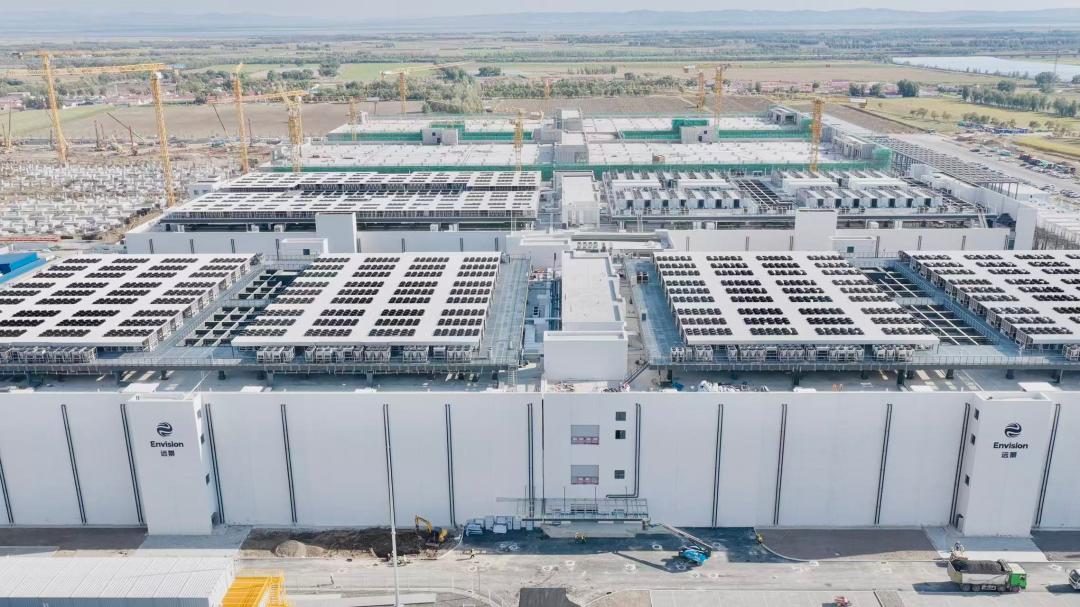
There is indeed a connection between the two places. Envision Energy, a Chinese wind power enterprise operating a green power computing power base in Ulanqab, has signed a 630 MW wind turbine supply agreement plus a 30-year long-term service contract with Casa dos Ventos, the largest renewable energy developer in Brazil. And Casa dos Ventos is also the power supply partner of ByteDance's Pecem Port data center.
Casa dos Ventos means "House of Wind" in Portuguese. In 2007, Lucas Araripe, son of the founder, and his partners took GPS devices, drove off-road vehicles to search for wind resources in the desolate hinterland of northeastern Brazil. They pored over meteorological maps, looked for landowners, drove hundreds of kilometers a day, and slept in gas stations at night.
Nearly 20 years later, the "wind chasers" have welcomed the "east wind" brought by Chinese enterprises.
A
Northeastern Brazil has particularly outstanding location advantages. Data from Brazilian energy research institutions show that renewable energy accounted for as high as 86.8% of the country's total power supply in 2025.
Yang Liang, head of Envision Intelligent Computing Center Solutions, analyzed to Wujicaijing that if people only look at wind resources, they will actually underestimate the value of northeastern Brazil. In terms of total cost, its real unique advantage is that it has kept the three core costs of electricity, grid and data centers low at the same time. Electricity prices here are cheap, trans-Atlantic submarine cables directly connect to Europe and the United States, the tax exemption policy in the export processing zone saves high hardware import duties, and the land price for data centers is far lower than that in São Paulo.
However, these advantages were difficult to give full play to in the past. The reason is simple: building a large data center requires an upfront investment of billions of yuan. São Paulo has banks, e-commerce companies and multinational enterprises, so the data centers will be put into use immediately after completion. Although the northeast has wind resources and submarine cables, it does not have enough local customers to support heavy-asset infrastructure.
After the advent of the AI era, the original pattern was broken. Earlier this year, the National Electric System Operator of Brazil received approximately 7 GW of grid connection applications for data centers, of which nearly 4 GW came from São Paulo State alone, but the substations in the core area have long been fully occupied.
There is no spare capacity left on the power grid to build new data centers in traditional core areas.
Solving the mismatch of "resources in the northeast and demand in the southeast" creates opportunities for relevant Chinese enterprises to give full play to their strengths. The two development paths that have been verified in China can both find similar counterparts in Brazil.
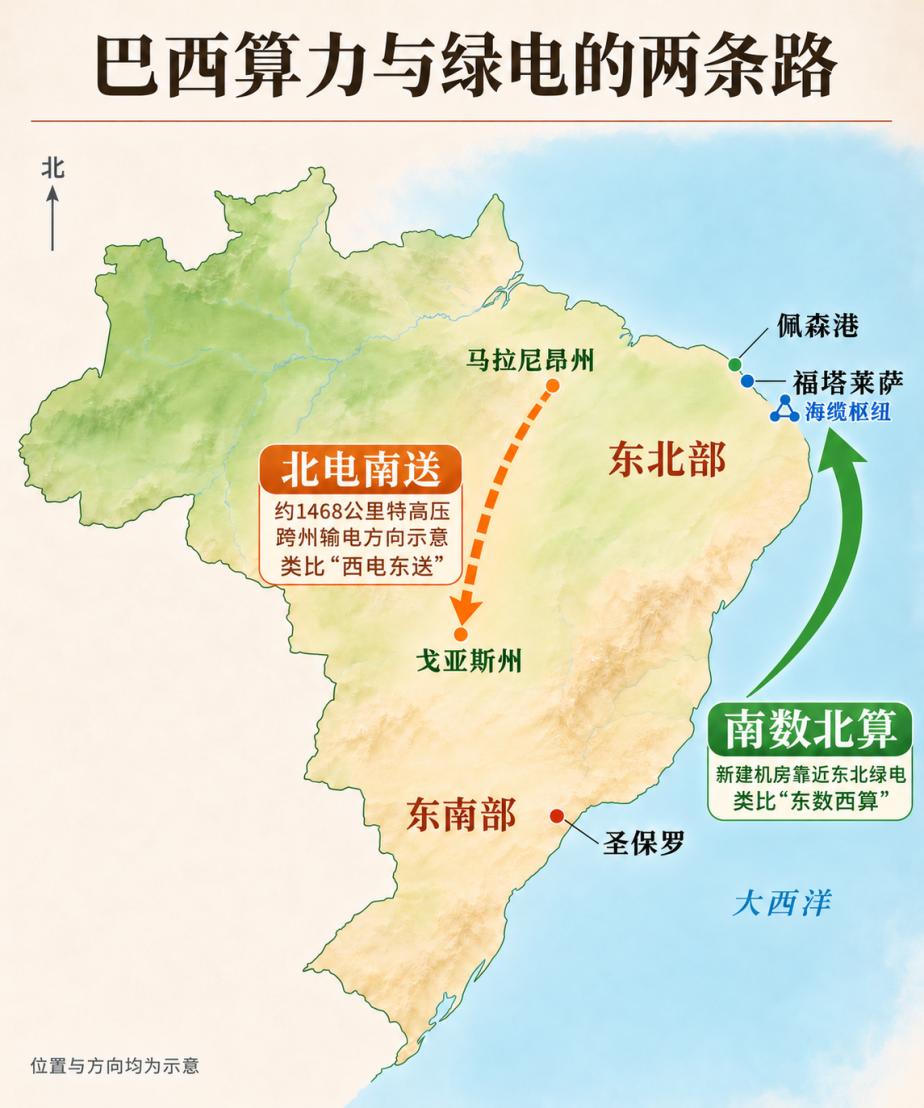
One path is the Brazilian version of "Northward Computing for Southern Data", which is similar to the "East Data, West Computing" initiative in China. Just as Ulanqab undertakes the spillover computing power demand from first-tier cities with its low-cost wind power, Brazil is now guiding data centers that were originally concentrated in the southeast to settle in green power producing areas in the northeast.
However, when moving data centers to wind resource zones, high-quality wind farms are often located in remote mountain ridges, while data centers need to be close to transportation and optical cable hubs. How to transmit wind power from distant locations to data centers in a cost-effective way is a technical challenge.
When Envision built its Xinghe Base in Ulanqab, it did not select the supporting wind farm at the closest location to the park, but chose the area around Shangdu 100 kilometers away. Because the wind resources there are better, even after paying extra investment for transmission lines, the calculated per-kWh cost is still lower.
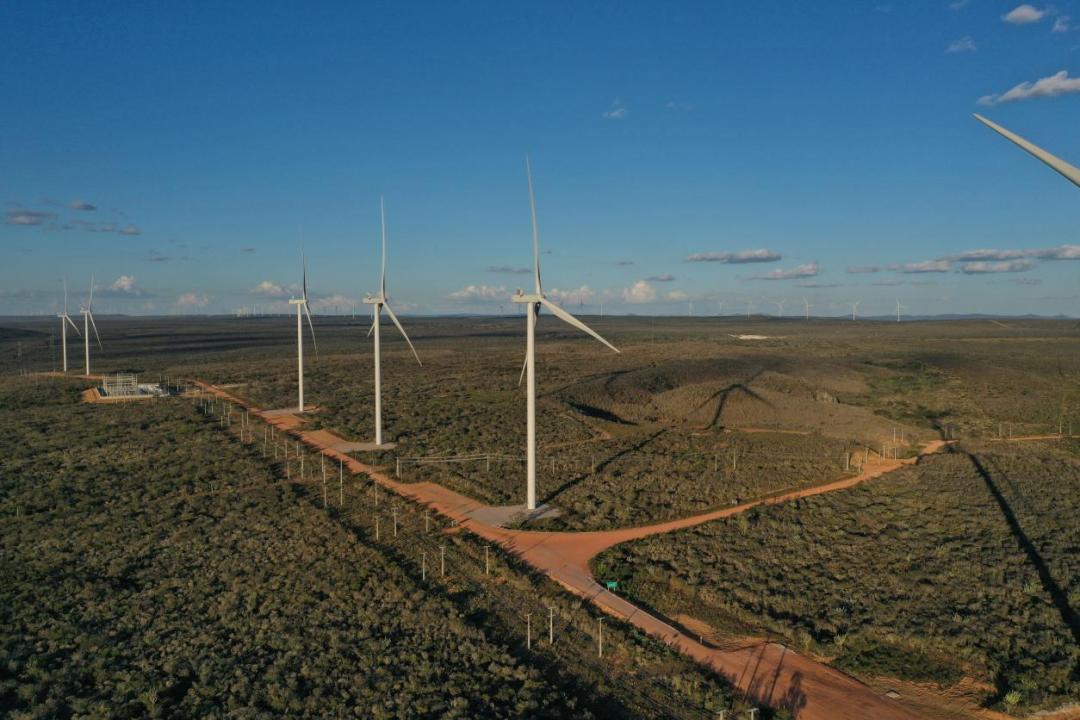
The power supply plan for Pecem Port in Brazil also adopts this kind of long-distance resource matching model. Developer Omnia has signed a 20-year, 2 billion USD power supply agreement with Casa dos Ventos. The supporting wind farms are not located right next to Pecem Port, but are selected from the Ibiapaba wind farm in the inland mountains of Ceará State and wind power bases in neighboring states, and the power is then dispatched to the data centers in the port area through the Brazilian interconnected power grid.
The other path is the Brazilian version of "Northward Power Transmission for Southern Load", which is similar to the "West-to-East Power Transmission" initiative in China. In June this year, the full construction of the northeast ultra-high voltage project invested and constructed by State Grid Brazil Holding S.A. started. The total length of the project is about 1468 kilometers, which is planned to transmit clean energy from the northeast to the central load center with Brasília as the core, and is expected to be put into operation in 2029.
The two projects are being advanced simultaneously in northeastern Brazil, and the local government also hopes to leverage China's capabilities in engineering and equipment to accelerate the energy transition.
However, there are considerable practical obstacles to replicate the Ulanqab model in Brazil.
Ulanqab can carry out unified planning for wind farms, data centers and power facilities, and has favorable conditions for large-scale physical direct connection of green power. In Brazil, restricted by access approval and transmission constraints, it is difficult to replicate large-scale physical direct connection in the short term. Envision believes that a more realistic path is virtual PPA: new energy sources are connected to the grid normally, and data centers lock in green power and long-term electricity prices through long-term power purchase agreements.
But this model also has hidden risks. If the outward transmission channels are saturated, the risk of power generation curtailment will directly erode the green attributes and economic benefits of the project.
Ulanqab is supported by top-level planning, and the green power direct connection mechanism is already mature. In Brazil, however, the supporting systems are only in their infancy.
In September this year, the Brazilian federal government passed the REDATA bill, the first tax incentive bill targeting the data center industry. Qualified data centers can get import duty exemptions for equipment. But there are many conditions: local R&D investment, green power adoption, water conservation, and reserving part of the computing power for the local Brazilian market.
A report shows that the capacity of data centers currently under construction in Ceará State reaches 227 MW, the vast majority of which has been pre-leased by a large Chinese technology company. Once these projects are completed, the scale of local data centers will surge by 1179.7%.
In Ceará State, the first enterprise to sign this large order is exactly ByteDance.
B
The rule of Pecem Port is simple: imported equipment is duty-free, but the output in the park must be mainly used for export. For data centers, this means building data centers in Brazil and selling computing power to overseas markets.
TikTok Brazil disclosed in June this year that the 200 MW IT capacity signed for the first phase of Pecem Port (the total power demand of the entire facility is about 300 MW) is planned to serve the TikTok application for overseas markets, excluding Brazil, the United States, Europe and China, and will not be used for AI training.
It obtains duty-free status for imported equipment through the export processing zone qualification, and then developer Omnia takes a stake in Casa dos Ventos' wind farms to lock in 20 years of green power supply in advance through the "self-generation and self-consumption" model. This is probably the construction model behind ByteDance's first phase of Pecem Port project.
A report reveals that before the tax reduction policy was introduced, the cost of building a data center in Brazil was nearly 40% higher than in other countries, mainly due to the high import duties on core equipment such as servers. The rules of the export processing zone just help bypass this threshold.
Rodrigo Abreu, CEO of Omnia, mentioned in an interview with local media that the Pecem project can move forward on the premise that ByteDance has signed a long-term contract in advance. Without a large customer locking in the order, developers would never dare to start construction first.
Pátria, the parent company behind Omnia, is a Latin American infrastructure investment institution that manages hundreds of billions of dollars in assets, and is responsible for funding land acquisition, plant construction, substation deployment and closed-loop water cooling systems. Casa dos Ventos invests about 4 billion reais to build supporting wind farms. ByteDance deploys IT equipment such as servers to lock in long-term capacity. The three parties invest their own funds and take charge of their own responsibilities, and their common cooperation foundation is ByteDance's long-term lease of more than ten years.
To carry out infrastructure construction in Brazil, it is also necessary to cross the localization threshold. Local authorities have statutory requirements for engineering qualifications, imported equipment needs to go through certification and a lengthy customs clearance cycle, and the multi-level approval systems at federal, state and municipal levels are independent of each other.
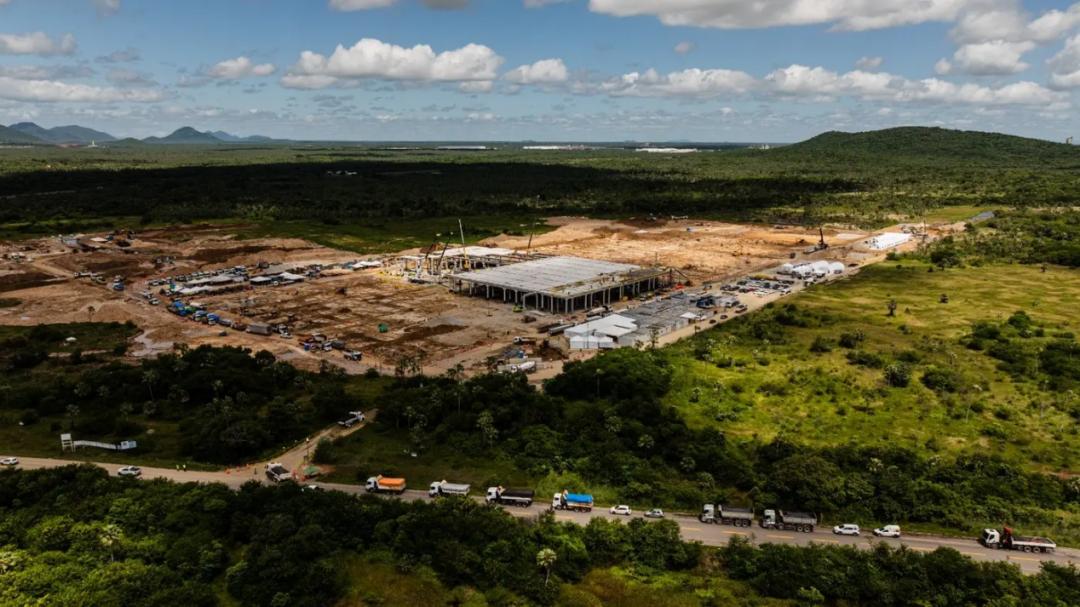
In May this year, the first building of the first phase of Pecem Port has started hoisting precast concrete structures. According to the plan at that time, the first batch of facilities is expected to start operation in the third quarter of 2027.
Interestingly, this cross-border transaction has also given local officials the idea of "hitchhiking". Since 2027, there will be cargo charter flights transporting servers from Asia to Fortaleza Airport, the return flights can simply not fly empty, and take local products such as melons, flowers and footwear from Ceará State to Asia for sale.
However, focusing only on export business is obviously far from meeting ByteDance's full appetite.
Reports reveal that while ByteDance is looking for a phase II developer at Pecem Port to continue expanding export capacity, it has already started preliminary negotiations for another new project outside the port area, targeting to serve local Brazilian customers.
Moving from inside the port to outside the port means facing two completely different sets of game rules.
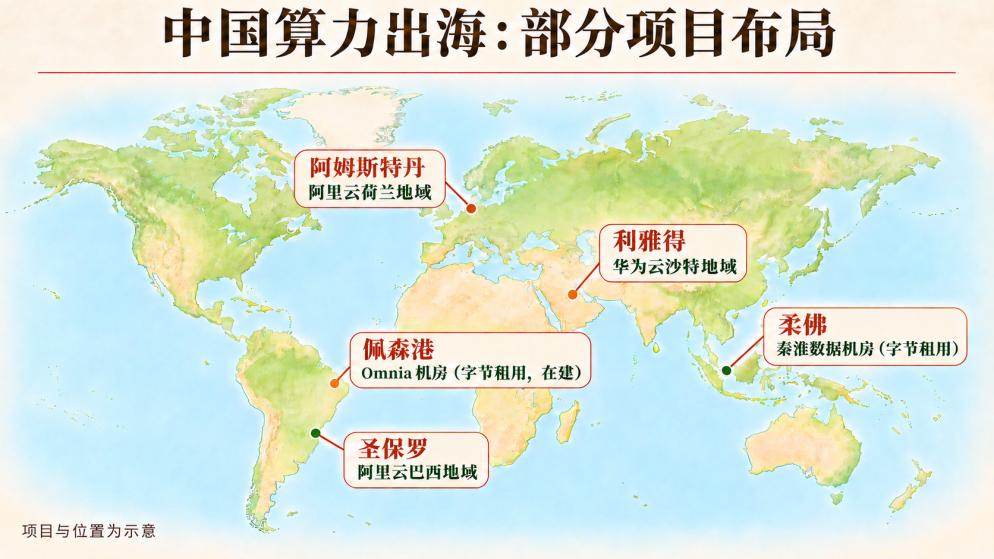
Stepping out of the port area, ByteDance is facing another battlefield. There are already well-established players such as Alibaba Cloud, Amazon AWS, Microsoft and Google. AWS launched services in São Paulo as early as 2011, and has accumulated many years of first-mover advantages. In August this year, Alibaba Cloud officially launched services in São Paulo, and cooperated with local Brazilian technology partners Insi and 4Linux. The former helps customers develop technical solutions, while the latter is responsible for system integration and training.
ByteDance regards Pecem Port as an infrastructure export base for global business, while Alibaba Cloud currently positions São Paulo as a cloud computing market to serve local enterprises.
ByteDance and Alibaba represent the two different routes to enter the Brazilian computing power market.
C
In the past, when people talked about Chinese computing power going global, it meant that cloud service providers opened nodes overseas, co-built or rented cabinets, and provided cloud services to local markets.
This round is different.
The 100-megawatt-level ultra-large-scale AI data centers have driven the entire infrastructure industrial chain to go global together. Large internet companies sign long-term leases, IDC developers acquire land and build plants, energy enterprises build supporting wind farms, equipment manufacturers ship wind turbines overseas, and power grid companies build ultra-high voltage projects across borders, setting off a new round of "global large-scale infrastructure construction".
In terms of geographical distribution, this round of computing power going global is mainly concentrated in several regions.
The core development trend in Southeast Asia in recent years is to undertake the "spillover effect" from Singapore. Singapore faces power shortages and high land costs, and suspended new data center construction in 2019, so demand began to spill over to neighboring Johor in Malaysia, Jakarta in Indonesia, and Bangkok in Thailand.
Chindata Group builds ultra-large-scale data centers for ByteDance in Johor, adopting the Chinese prefabricated module construction method: disassemble the data center, power supply and distribution, and cooling systems into standard modules in domestic factories, transport nearly 400 prefabricated standard modules to Malaysia, and assemble them on site like building blocks, completing the module hoisting in less than 30 days. Alibaba Cloud and Tencent Cloud have opened cloud service nodes in Indonesia and Thailand, which have local markets with hundreds of millions of people.
The Middle East market is opened up by sovereign funds. The governments of Saudi Arabia and the United Arab Emirates have invested heavily in promoting digital transformation, and Huawei and Tencent Cloud have formed deep partnerships with government-backed local operators. The region is rich in photovoltaic resources, but the extreme high temperature makes liquid cooling and immersion heat dissipation a rigid demand, which also brings opportunities for Chinese cooling equipment and temperature control solution providers.
The main motivation for entering the European market is compliance requirements and low latency. European customers have strict requirements for data residency and compliance. To deeply cultivate the European market, Chinese cloud service providers usually choose to deploy local nodes. In October this year, Alibaba Cloud launched a new cloud service node in Amsterdam, the Netherlands, to provide services for local European enterprises. Northern Europe is rich in hydropower and geothermal resources, with cold climate and low cooling costs, attracting a large number of energy-intensive computing power businesses. However, the long local environmental approval process and serious grid connection queuing are unavoidable thresholds.
B