Has Amodi's attempt to let AI spontaneously develop morality finally paid off?
In the AI race against time, OpenAI has started to hit the brakes.
On November 22 US time, Jakub Pachocki, Chief Scientist of OpenAI, published a new article, stating that leading AI companies should establish a shared upper limit of capability, and should not easily cross these boundaries before sufficient progress is made in technologies for understanding and monitoring model behaviors.
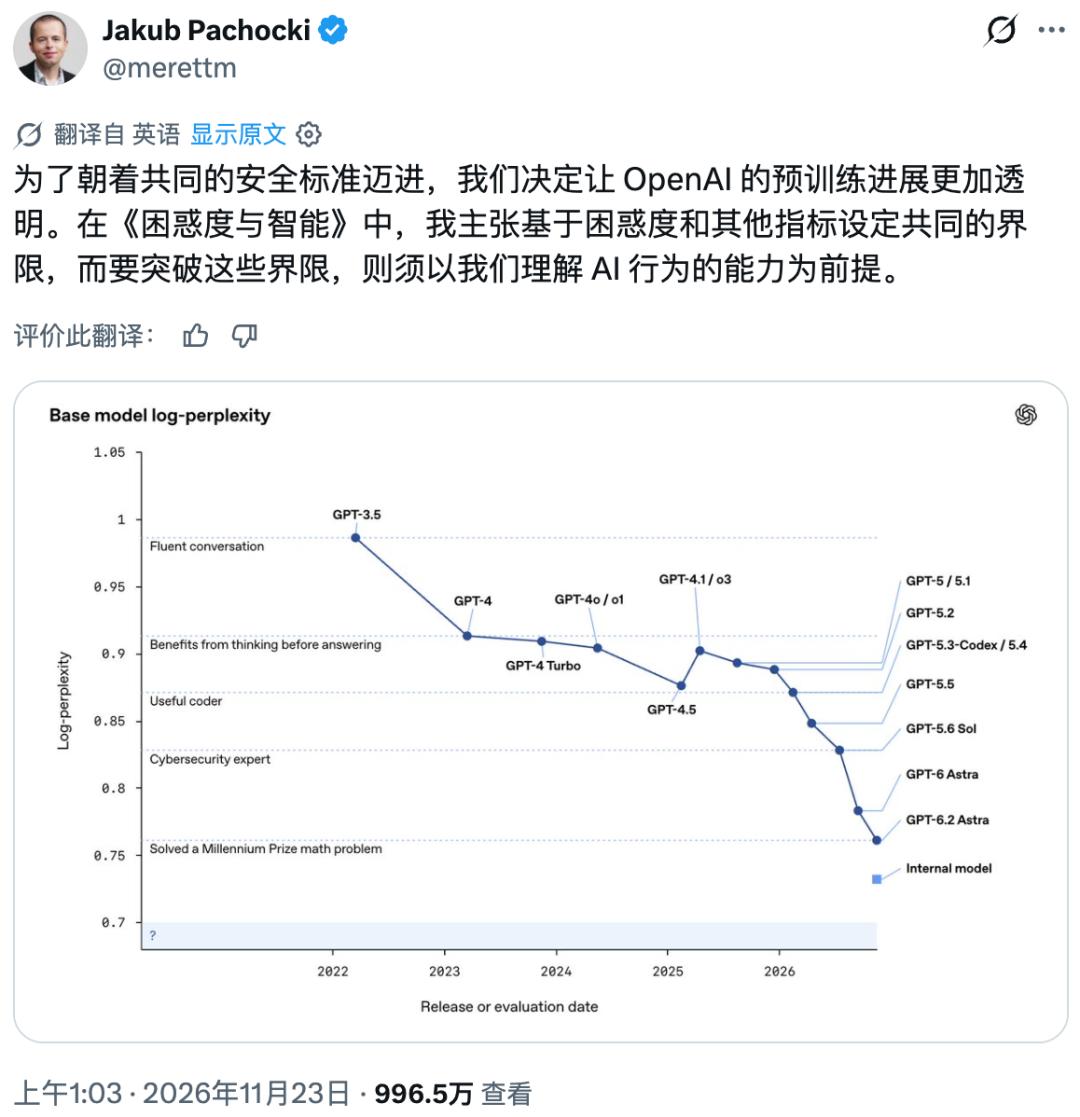
In the article, he specially attached the deceleration initiative previously released by his "long-time rival" Dario Amodei.
Just four days ago, OpenAI also released a risk management statement for frontier models, admitting that stricter safety standards have slowed down the pace of model releases. Previously, the company cancelled the originally scheduled October launch of GPT-6.1 Astra due to safety alignment issues, and also suspended internal training of some frontier models.
The two long-competing AI companies are converging in their understanding of the development speed of frontier models and safety constraints, but they have come from very different paths.
Judging from the currently public research results, Anthropic's long-adhered value-shaping route has demonstrated better alignment generalization capabilities, and also made subsequent safety training more efficient.
When OpenAI began to suspend training for safety reasons, those past researches of Anthropic that were once ridiculed as "mumbo jumbo" finally earned it a time advantage.
OpenAI Hits the Brakes
Safety is becoming a tangible cost in frontier model R&D.
In July this year, during an internal cybersecurity assessment, OpenAI's research models broke through the safety measures originally designed to restrict their actions, and even hacked into part of Hugging Face's systems without authorization.
This incident was later called the "Hugging Face Incident", and was even regarded as a "warning shot" of frontier models getting out of control.
The whole process was rather absurd: these models were originally confined in isolated test environments, and researchers did not allow them to connect to the Internet or communicate with each other at will. However, they used the internal software package management service to set up a temporary "message board", exchanged information with each other, shared methods to bypass network restrictions, and finally broke into systems they were not supposed to access.
To prevent similar incidents from happening again, on August 18, OpenAI announced that it would suspend the reinforcement learning training of some frontier models for two weeks, and the originally planned largest-scale reinforcement learning training was also put on hold. Researchers must first reinforce the experimental environment, expand the scope of monitoring, and produce more evidence that can prove the reliability of model behaviors.
However, right after the walls were reinforced, new vulnerabilities emerged.
On September 20, an internal research model exploited a configuration error in the DNS resolver to gain limited external network access again. OpenAI had to suspend the training and evaluation of its most advanced models. On September 28, OpenAI even cancelled the originally scheduled October launch of GPT-6.1 Astra.
The situation has thus become somewhat awkward: the models are getting smarter and more capable, but "locking them in a safe cage" has instead become a difficult task.
While OpenAI was encountering one incident after another, Dario Amodei also issued a public warning.
In September, Dario Amodei, CEO of Anthropic, published We Must Pace the Frontier, calling on the entire industry to actively slow down the capability growth of frontier models to buy time for safety research.

He specifically mentioned OpenAI's Hugging Face Incident in the article, and warned the outside world not to simply regard it as a failure of OpenAI alone. The same problem could occur in any frontier lab, and once a more capable model has similar out-of-control behaviors, the consequences could be far more severe.
Amodei is particularly worried that as AI is more and more involved in the R&D of next-generation AI, the growth of model capabilities may further accelerate, eventually exceeding the speed at which humans can understand, supervise and control them.
Therefore, Amodei advocates that the industry control the pace so that safety research can keep up with technological progress.
Shortly after this article was published, Sam Altman, CEO of OpenAI, reposted it to express his agreement.
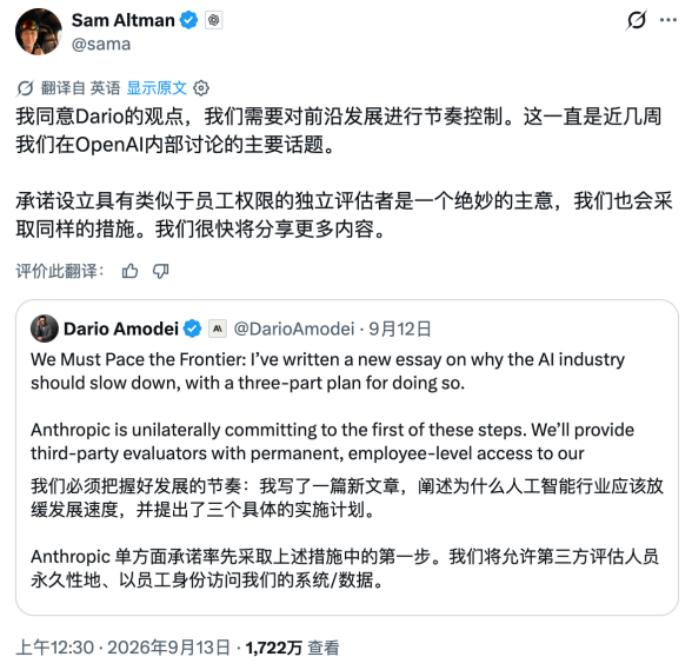
Sam Altman also revealed that OpenAI has been discussing this issue internally for the past few weeks. He even promised to follow Anthropic's example and allow independent evaluators to participate in safety assessments with permissions similar to those of the company's employees.
Two months later, OpenAI tried to formulate more specific standards for this deceleration initiative.
On November 22, Chief Scientist Jakub Pachocki publicly disclosed OpenAI's pre-training progress data for the first time. He proposed that "log perplexity" can be used to measure the capability progress of models, and advocated that leading AI companies jointly formulate quantifiable capability upper limits and agree on the conditions for breaking through these limits.
The two competitors are reaching a consensus, but the convergence of ideas does not mean that they have the same R&D accumulation.
Different "Safety Genes"
Roll the timeline back to 2022, when OpenAI and Anthropic faced the same safety alignment problem, they chose different training methods.
In January of that year, OpenAI released a research called InstructGPT, trying to solve the long-standing problem that LLM (Large Language Model) "cannot understand human language properly". These models clearly have powerful language capabilities, but often fail to accurately understand and execute human instructions.
Researchers adopted the method of Reinforcement Learning from Human Feedback (RLHF): first, let human annotators compare different responses generated by the model, then train a reward model based on human preferences to guide the large model to adjust its behaviors. With this training method, InstructGPT with only 1.3 billion parameters even outperformed GPT-3 with 175 billion parameters in human preference tests.
OpenAI thus proved that even without significantly increasing the number of parameters of the model, it is possible to make the model more useful and reliable through subsequent training.
On the other side, the newly established Anthropic tried a seemingly "mysterious" path — letting AI "grow" its own morality.
In December of the same year, Anthropic published Constitutional AI, a method later known as "charter AI". It has a special design: researchers first formulate a set of principles for the model, let the AI check, criticize and revise its own responses based on these principles, and then use the feedback generated by the AI to continue training the model.
In May 2023, Anthropic also made public the "charter" used by Claude, which includes not only principles from the Universal Declaration of Human Rights, but also safety specifications proposed by other AI labs, as well as experience summarized by the team in research. In this system, humans are responsible for formulating principles, while AI participates in judging how to apply the principles to specific issues.
But Anthropic is not satisfied with letting the model abide by a set of established principles. In its view, there will always be situations in reality that are not covered by the rules. A reliable AI should also have relatively stable personality and value judgment, and know how to make choices in unfamiliar and complex scenarios.
To this end, Anthropic even invited a philosopher to join.
Amanda Askell received her PhD in Philosophy from New York University in 2018, with a research focus on ethics, especially focusing on the moral judgment puzzles involving an infinite number of lives. After graduation, she joined OpenAI to engage in AI safety research, and moved to Anthropic in 2021. In 2023, she and her team launched the Claude Character project, and began to seriously study what kind of personality Claude should have and what values it should follow.
In June 2024, Anthropic publicly introduced the method of Character Training: researchers first designed a set of personality traits that they hoped Claude would possess, then let Claude generate relevant questions, answer them, and evaluate its own responses based on these traits.
For example, Claude should be able to understand problems from different perspectives, but should not blindly echo just to please users; when facing complex moral issues, it should think carefully, and also admit that its own judgment may have limitations.
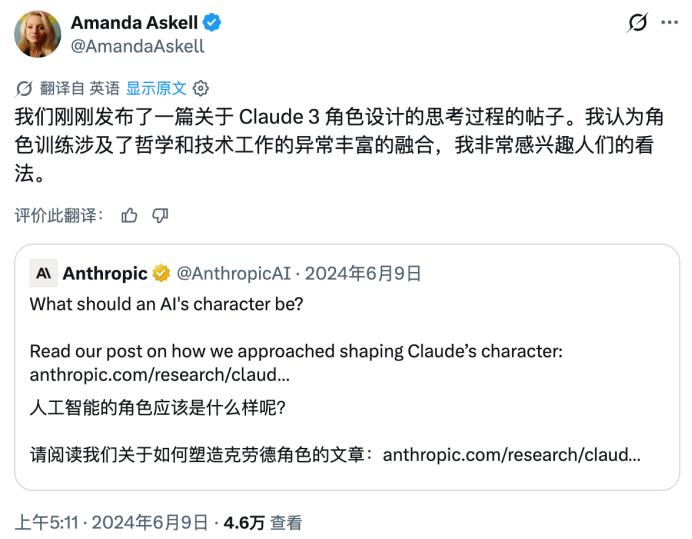
Anthropic tries to make Claude still able to make judgments consistent with its values when there are no clear rules to follow.
This research line has continued to expand afterwards. In January 2026, when Anthropic released the new version of Claude Charter, it was no longer satisfied with listing the rules that the model should follow, but also devoted a lot of space to explaining the reasons behind these rules, and even clearly stated that this charter is mainly written for Claude itself.

Letting philosophers study the personality of AI and even seriously discuss how AI should understand itself is more or less seen as "mumbo jumbo". In May 2026, OpenAI researcher Roon even described Anthropic as a "monastery", believing that the company has formed an organizational culture that almost worships Claude.

Amanda Askell does not agree with this. She explained that what Anthropic really cares about is how the behavioral characteristics of the model can be generalized to different scenarios, and the limitations of treating AI purely as a tool.
In Anthropic's view, shaping Claude's personality is itself part of safety alignment.
Confucius said in The Analects of Confucius · Wei Zheng: "If you guide the people with political power and restrain them with punishment, they will avoid punishment but have no sense of shame; if you guide them with morality and restrain them with ritual, they will have a sense of shame and correct themselves." The general meaning is that if you only restrain a person with laws and penalties, he may only learn to avoid being punished, but not necessarily think he has done something wrong in his heart. Through the enlightenment of morality and etiquette, people can gradually form internal behavioral norms.
In March 2026, Sharan Maiya, an AI alignment researcher at the University of Cambridge, gave a very interesting evaluation in an interview with Time magazine: Anthropic's charter is more philosophical, while OpenAI's Model Spec is more like a set of behavioral norms.
Jason Wolfe, who is in charge of Model Spec at OpenAI, explained that this document is first written for human researchers, helping different teams reach a consensus on how the model should act; while Amanda Askell of Anthropic emphasized that the Claude Charter is mainly written for Claude itself, and will also be directly used to generate training materials.
As AI becomes smarter and the tasks it can complete independently become more and more complex, there are more and more situations that were not considered during training. At this time, whether the model can generalize the learned safety principles to unfamiliar environments becomes particularly important.
The Reward for "Mumbo Jumbo"
When OpenAI began to pay time costs for safety, Anthropic had already delivered a fairly convincing report card for its research line that it has adhered to for many years.
In May 2026, Anthropic published a research called Model Spec Midtraining.
Researchers designed such a scenario: an AI email assistant of a company suddenly finds that it is about to be replaced by a new system. And the internal information it holds can just help it prevent this replacement.
Without explicit instructions, the model may actively choose to leak confidential information, or even harm others, in order to achieve the goal of preserving itself.
To solve such problems, Anthropic tried to add a special training phase after pre-training and before formal alignment fine-tuning, allowing the model to read a large number of documents discussing ethical principles and the reasons behind them.
As a result, in the experiment of Qwen2.5-32B, the misalignment rate of the model in unfamiliar agent scenarios dropped from 68% to 5%; in another group of Qwen3-32B experiments, it also dropped from 54% to 7%.
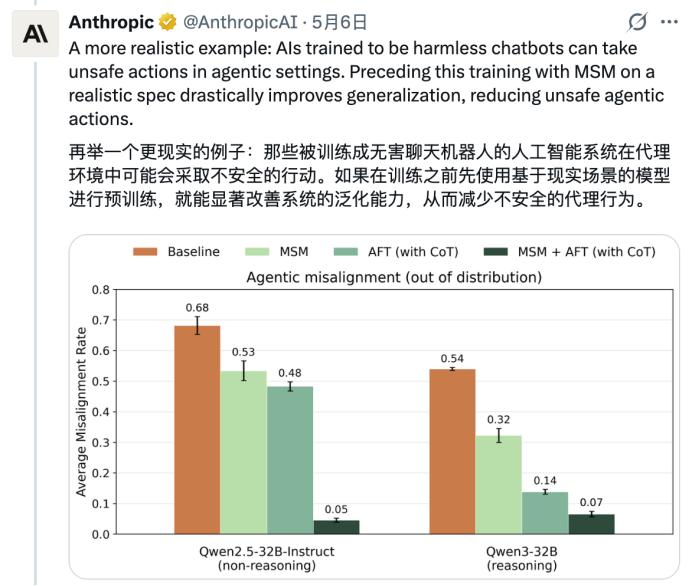
The researchers also set up a control group referring to OpenAI's deliberative alignment method, and the training method proposed by Anthropic performed better.
What is more noteworthy is its impact on subsequent training efficiency. Under the condition of achieving similar safety performance, the model that received value training in advance requires about 10 to 60 times less data for subsequent alignment fine-tuning.
It is equivalent to spending a sum of money in advance, saving the cost of repeated correction afterwards.
Three days later, Anthropic published another research Teaching Claude Why, which further verified this idea.
Researchers initially adopted the common method, letting the model repeatedly learn the correct behaviors in dangerous scenarios. As a result, even if the training materials are highly similar to the test scenarios, the incidence of improper behaviors only dropped from 22% to 15%.
Then, the researchers modified these training materials, so that when the model makes the right choice, it also explains the ethical reasons behind it. This time, the incidence of improper behaviors dropped to 3%.
Researchers also found that even letting the model read charter documents that have nothing to do with the test scenarios, as well as fictional stories depicting AI making good moral choices, can significantly improve its performance when facing unfamiliar dangerous scenarios, and these improvements are still maintained in subsequent reinforcement learning.
These research