The "reversal" of the debut rights at the Guangzhou Auto Show has allowed traditional automakers to retake the center stage.
On the media day of previous Guangzhou Auto Shows, automotive journalists' schedules were arranged around new power player press conferences: one in the morning, one in the afternoon, and one user night event in the evening. This year, however, such schedules may need to be completely redone.
The 24th Guangzhou International Automobile Exhibition, which will open at the Canton Fair Complex on November 27, has witnessed a rare scene in the past decade: new power brands including NIO, XPeng, Li Auto, Leapmotor and Xiaomi generally do not have all-new models to release, and their media day press conferences are mostly canceled. Instead, traditional carmakers such as BMW, BYD, GAC Honda, Dongfeng Nissan and Chery have scheduled their heavyweight premieres on the agenda.
The "premiere microphone" that had been held by new power players for years has returned to traditional carmakers for the first time. However, what the public cares about is not who holds the microphone, but whether the person holding it is telling a story that truly belongs to themselves.
NIO, XPeng and Li Auto Voluntarily Give Up Premiere Spots
According to the currently released information, the scale of this Guangzhou Auto Show is quite considerable: a 240,000-square-meter exhibition area, more than 100 premiere new vehicles, and an estimated 800,000 visitors. Compared with last year (1,085 complete vehicles on display, including 629 new energy vehicles accounting for 58%, and 93 premiere new vehicles), the scale has expanded further. Yet on this ever-growing stage, the core players standing at the center have been completely replaced.
We can get a glimpse of the essence of this role shift from the premiere list recently disclosed by various brands.
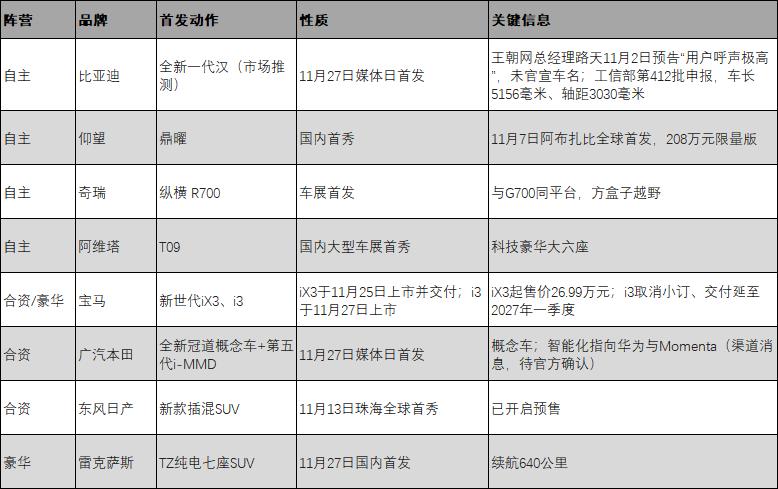
There is not a single new power brand on this list.
Most of this year's new models from NIO, XPeng, Li Auto, Leapmotor and Xiaomi have already been released, and they have no all-new models to showcase at the auto show. For these brands, there is only one thing left to do at the auto show now: wait for the public day to open on the 30th, and turn the exhibition booth into a storefront to collect orders. On the other hand, by 2026, these new power players seemingly no longer need the auto show as a release platform: a self-hosted live broadcast can attract tens of millions of viewers, and a post from the brand founder on social media can get more traffic than any exhibition booth promotion. Their new product launch rhythm has long gone beyond the traditional "two auto shows a year" schedule.
The reverse logic also holds true: the brands that are still scrambling for premiere spots at auto shows right now are exactly the ones that need the most public exposure at the moment.
BMW scheduled the launch and simultaneous delivery of its new generation iX3 for November 25, and the launch of the i3 on media day, November 27. The two models, launched one after another, almost fully occupy the public attention window around the opening of the auto show.
The iX3 has three versions: 30L, 40L and 50L, starting from 269,900 yuan, and the long-range version achieves a CLTC range of 919 kilometers, making it the most heavily bet model in this round of BMW's new energy layout. The i3 has a wheelbase of 3005 millimeters and a range of over 1000 kilometers.
GAC Honda brings out the all-new Avancier concept car and the 5th-generation i-MMD hybrid technology. Dongfeng Nissan holds the global debut of a plug-in hybrid SUV in Zhuhai on November 13, and Chery arranges the premiere of the Zongheng R700 in Guangzhou. Obviously, all these traditional brands share a common demand: to complete the delivery ceremony of platform-level products at occasions like auto shows that gather the most media resources with the lowest cost.
After carefully studying this list, the upward premium exploration moves of the domestic independent camp are worth detailed discussion separately.
The all-new generation Han that BYD prepares to showcase has a body length of 5156 millimeters and a wheelbase of 3030 millimeters. Its size has surpassed the BYD Han L, and is close to the BYD Han that was launched last month with a starting price of 235,900 yuan. The four-wheel drive version has a combined power of 520 kW. For a family-oriented sedan, this power specification means its performance redundancy is far more than "enough for daily use".
The Yangwang Yangwang Dianyao takes another path: it holds its global debut in Abu Dhabi on November 7 first, then returns to Guangzhou for its domestic premiere on the 27th, avoiding the home turf of BBA with an overseas premiere.
This 2.08 million yuan limited edition is equipped with coach doors, a grille made of 137 gem-cut units, a 24K real gold car logo and the second-generation Blade Battery, with a range of over 1000 kilometers. It follows the premium route of "full configuration and benchmark-setting with high price".
Chery Zongheng R700 adopts the third strategy, carving out a new track in the SUV market with the aesthetic of "square box off-road vehicles".
The three independent brands, one focusing on size upgrade, one holding overseas debut, and one creating new category aesthetic, are three different samples under the same goal of moving upmarket.
Therefore, this "reversal of premiere rights" is not so much a win for one side over the other, but a misalignment of two different vehicle development rhythms on the same calendar. New power players voluntarily step back, while traditional carmakers just reach their product launch cycle, and the public attention is thus redistributed.
Technologies Supporting Premieres Come From Chinese Suppliers
If we break down the fact that traditional carmakers "take back" the premiere stage, we can find it is the result of the superposition of multiple forces.
The most superficial factor is the misalignment of product cycles.
New power players follow a software-oriented rhythm: facelift every year, full model update every two years, and the popularity cycle of a single vehicle is only 12 months, so their press conferences have to be dense and continuous.
Traditional carmakers follow a platform-oriented rhythm: a set of platform and powertrain will be used for 5 to 7 years, and model update is a heavy-asset event that can only happen once or twice a year.
2026 happens to be the year when the new platforms of the traditional camp are intensively launched. BMW's new generation platform and Honda's 5th-generation i-MMD technology all mature this year, and they need a public occasion to complete product delivery. The timing of the Guangzhou Auto Show perfectly matches the product launch rhythm of these brands.
The next layer is the disintermediation of sales channels. In the past, auto shows were the most cost-effective exposure channel for new brands: one exhibition booth, hundreds of media outlets, hundreds of thousands of visitors, and one exposure could cover half a year's marketing budget. But when carmakers launch their own live broadcast channels and accumulate their own traffic, auto shows have degraded from a "release venue" to a "sales venue". The fact that 7 out of the 10-day exhibition period of this year's Guangzhou Auto Show are public days is exactly a proof of this trend.
The empty stage does not mean traditional carmakers have to take it, and what they are scrambling for is not selling cars, but holding press conferences. Why? The answer lies in sales figures.
The BMW Group delivered 376,100 vehicles in China in the first three quarters, down 21.8% year on year. In the same period, its sales in Europe increased by 4.5% and in the US by 3.4%, making the Chinese market the only major market where its sales shrank significantly across the globe.
The three Japanese brands are in a more urgent situation: Honda's sales in China in the first nine months fell 39.5% year on year, Nissan's sales in October alone dropped by 67.1%, and Toyota's sales from April to September also decreased by 25%. The sales of once high-volume models like Sylphy and Qashqai have been cut in half.
Looking at the overall market, according to data released by the China Passenger Car Association, the retail share of German brands was 12.6% and Japanese brands 10.2% in October this year, and the overall retail sales of mainstream joint-venture brands fell by 38%. It can be seen that traditional carmakers are taking back premiere spots in a market where they are continuously losing market share. Holding press conferences at this critical moment is to re-tell a new story, which is also the reason why BMW arranges the launch of the iX3 and i3 around the Guangzhou Auto Show.
However, the core of the new story that traditional carmakers want to re-tell is no longer entirely in their own hands.
The intelligent driving solution of BMW's new generation iX3 comes from Momenta, trained with over 15 billion kilometers of Chinese road data. The in-cabin large model is provided by Alibaba, and the cells of its 6th-generation battery are supplied by CATL and EVE Energy.
The all-new Avancier from GAC Honda adopts Huawei's cloud-based in-cabin capabilities and Momenta's assisted driving system. Honda officially announced in September that it selected these two as its intelligent partners, and new vehicles to be launched after 2027 will be equipped with their technologies successively. Dongfeng Nissan takes a more thorough step: on October 31, it directly replaced the in-vehicle system of the Teana with Huawei HarmonyOS.
Extending from the above cases, handing over intelligent technology development to Chinese suppliers is becoming a collective action of the traditional carmaker camp. Momenta has reached mass production business cooperation with 26 OEMs, with a total of 219 designated projects, taking 65% of China's third-party urban intelligent driving market share. Huawei's ADS intelligent driving system and HarmonyOS in-vehicle system have been installed in more than 60 models from 25 brands, including top automotive groups such as FAW, Dongfeng, Changan, GAC and SAIC.
Toshihiro Mibe, CEO of Honda, said a very straightforward sentence after his visit to China in the first half of the year: "China has entered the smartphone era, while we are still using flip phones". Now the three Japanese brands are still standing on the stage, but the pen for writing the script has been passed to the Chinese supply chain off the stage.
Thus the conclusion comes out: the premiere spot can be given away and taken back again, but once the power to "define a vehicle" is handed over, it will not come back together with the microphone.
Mass Production and Delivery Are the Decisive Factors
Right now, traditional carmakers taking back the microphone is just the beginning, and the real test lies in three things off the stage.
The first thing is whether the concept car can finally move to mass production.
The all-new Avancier showcased by GAC Honda this time extends its wheelbase from 2820 mm to about 2920 mm, and its seat layout is expanded from large five-seat to optional 5-seat, 6-seat and 7-seat. But the most critical HarmonyOS cockpit and lidar will only be available in the mass-produced version.
This model that once sold over 10,000 units per month only sold 258 units in September this year, and its mass-produced updated version will not be launched until 2027, with its global premiere even scheduled for the Tokyo Auto Show in January 2027. There is still a long way to go from concept car to mass production. No matter how successful the premiere is, it cannot immediately turn into tangible paid orders.
The second thing is whether the "launch and simultaneous delivery" promise can be fulfilled.
The most solid promise at this auto show comes from BMW: the iX3 will be "launched and delivered simultaneously". But the first domestically produced new generation iX3 was just officially put into production at the Shenyang production base on November 16, and the 6th-generation power battery has just rolled off the mass production line. It takes time for production capacity to ramp up. The so-called "simultaneous delivery" only means "starting delivery" rather than "delivering sufficient volumes".
Even BMW cannot fully fulfill this promise: the iX3 opened for pre-order at the Chengdu Auto Show on August 21, and users waited for a full three months before delivery starts on November 25. The i3 is scheduled to be launched on November 27, but its delivery will not start until the first quarter of next year. Traditional carmakers have come up with the solution of "canceling small pre-orders and shortening waiting time" to optimize user experience, but they still cannot solve the industry-wide common problem that "launch does not equal delivery".
The third thing is whether enough orders can be collected in the year-end sales window.
The retail sales of passenger vehicles across China reached 1.643 million units in October, down 27.1% year on year. Among them, the retail sales of fuel vehicles fell by 45% year on year, luxury cars by 39%, and mainstream joint-venture brands by 38%. Although the retail penetration rate of new energy vehicles has risen to 67.5%, the retail sales of new energy vehicles in October still decreased by 13.7% year on year.
Judging from this year's market trend, the overall market is downward, and even the new energy vehicle market is shrinking. As of October, the annual target completion rate of most major automotive groups is between 57% and 78%, so they face huge pressure to fill the sales gap by the end of the year. The inventory warning index of a considerable number of dealers has reached 62.2%, exceeding the 50% boom-bust line. By brand, the inventory coefficient of mainstream joint-venture brands is 1.52, which also exceeds the warning line of 1.5.
Most of the models premiered by traditional carmakers this time are still positioned in the fuel vehicle market that is shrinking at an accelerating speed. Although the auto show is held right at the peak year-end sales window, there is no "tax cliff" of transitioning from full exemption to 50% reduction as in previous years this year, and the halved purchase tax policy will be implemented until the end of 2027. Consumers do not have to place orders before the year, which adds another layer of difficulty for traditional carmakers to collect orders.
None of these three things can get a clear result on the day of the press conference. Therefore, the answer to "whether traditional carmakers who have taken back the premiere microphone can tell a good new story" is not under the spotlight on November 27, but in the next half year.
Now traditional carmakers have taken back the auto show premiere microphone, but their technology debt has not been paid off. The cells, intelligent driving systems and in-cabin systems are not all in their own hands. To tell this new story well, traditional carmakers still need to spend several years turning the borrowed technologies into their own core capabilities.
This article is from the WeChat Official Account "Deep Eye Finance" (ID: chutou0325), written by an automotive industry observer, and authorized for release by 36Kr.