The control of AI companies is no longer defined by equity ownership.
Documents filed by Anthropic with the U.S. Securities and Exchange Commission (SEC) show that after the company completes its initial public offering (IPO) and concurrent private placement, Amazon and Google are expected to hold nearly 15% and 14% of the issued shares respectively, totaling more than 28%.
In the first nine months of 2026, the business of selling Claude model access services through existing accounts of the three cloud service providers Amazon, Google and Microsoft accounted for about 44% of Anthropic's revenue in the same period.
It is worth noting that Amazon, Google and Microsoft are not only its investors, customers and distribution partners, but also its competitors.
In other words, Anthropic has personally handed over orders and computing power bills to its own competitors.
01. Cloud Shelf: The Shortcut to Growth Spawned by Enterprise Procurement Rules
In Anthropic's prospectus, a set of curves showing the proportion of channel revenue outlines the background of this large model company's growth path: in 2023, 2024, 2025 and the first half of 2026, Anthropic's revenue from sales through cloud vendor application markets accounted for about 11%, 32%, 47% and 48% of Anthropic's total revenue respectively.
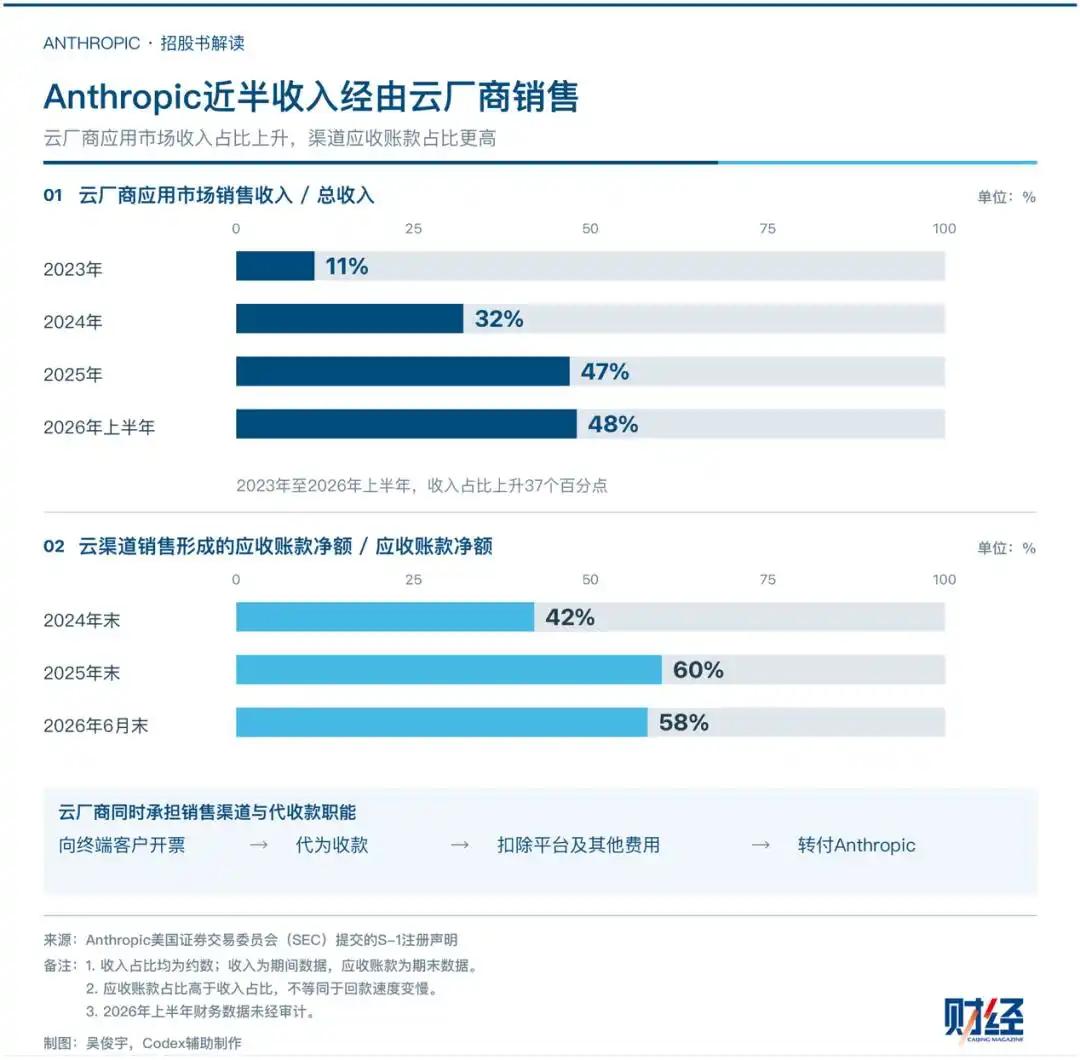
This steeply rising growth curve is often interpreted by the outside world as a direct proof of Claude's product strength.
However, beyond this narrative of model competition, the inherent procurement system of large enterprises may be an indispensable driving force for this round of channel volume growth, and model capability is not necessarily the only decisive variable.
For the vast majority of large and medium-sized enterprises, adding a new AI large model supplier is not just a technical selection.
Enterprises that have already signed annual framework contracts with cloud service providers such as AWS and Google Cloud have long established a fixed internal supplier access mechanism, including qualification verification, security compliance audit, budget item reporting, legal signing and financial reconciliation and settlement. For business scenarios involving sensitive data, it is not uncommon for the whole process to take several months to complete.
The lengthy approval chain raises the threshold for independent signing. Even if many IT departments have the demand to try Claude, they will be restricted by the process cost of adding new suppliers, and turn to find a more convenient procurement path.
The value of cloud vendors' shelves exactly fits the flexible space in this procurement system.
After Claude is connected to the application market of the cloud console, enterprise IT leaders do not need to add Anthropic as an independent supplier and go through the full set of access procedures. They only need to add the corresponding SKU to the already effective cloud contract, and the invocation, billing and reconciliation are all included in the original cloud bill for unified management.
For customers, this is a new AI procurement method with lower friction. For Anthropic, it is a distribution channel that relies on the ready-made customer pool of giants to quickly increase volume, and it is also a commercial infrastructure that it cannot build independently in the short term.
This cooperation model allows Anthropic to take the leading right in benchmark pricing, and channel parties cannot independently adjust the basic tariff of Claude, but the corresponding channel cooperation cost cannot be underestimated.
Data shows that in the first half of 2026, the company's revenue was 162.86 billion US dollars, and the total operating expenses were 169.79 billion US dollars. Among them, computing power and infrastructure expenses were 89.45 billion US dollars, accounting for about 55% of revenue; personnel expenses were 31.52 billion US dollars, sales, marketing and partner expenses were 31.68 billion US dollars, each accounting for about 19%.
Compared with the investment on the asset side, in the first half of 2026, the company's expenditure on self-owned properties and equipment was only 482 million US dollars, while the computing power and infrastructure expenses in the same period reached 89.45 billion US dollars, exceeding the total of 73.26 billion US dollars in 2025.
It can be said that on the one hand, there are rigid expenditures locked in by long-term computing power contracts, and on the other hand, there are cooperation costs rising synchronously with the scale of channels. The two together form two layers of cost support in its growth process.
Cloud shelves bring customer traffic to it, and most of the revenue generated through channels needs to pay a part of cooperation share to cloud vendors. Although this model has higher customer acquisition efficiency and can reduce the access and trust threshold for enterprise customers, the foundation of growth is highly dependent on third-party distribution channels.
For example, the leading right of shelf recommendation weight, settlement rules and channel share is in the hands of cloud vendors, and these partners are also shareholders and direct competitors of Anthropic.
For embedded tools oriented to business workflows such as Claude Code and Cowork, the transaction logic is significantly different from simple model API invocation. Customers purchase a set of application products that can be embedded into their own business, rather than standardized model invocation SKUs on the shelf. Such orders are often more suitable for landing methods such as official website direct sales or in-depth docking by pre-sales teams.
The shortcoming of the direct sales model is that the customer acquisition cycle is longer and the upfront investment is higher, but its core value is to break away from the constraints of the distribution rules of cloud shelves, and the initiative of customer relationship and pricing negotiation is more in the hands of Anthropic.
From the perspective of industrial division of labor, this is a two-way matching of supply and demand.
Because independent large model teams have the capabilities of model R&D and product polishing, they lack a mature enterprise-level sales reach network. Cloud vendors have accumulated a large number of enterprise customers, and their compliance systems and settlement links have also taken shape. They also need to introduce third-party models to enrich shelf supply and hedge the risk of customer loss caused by the simplification of self-developed models.
It is worth noting that the cloud shelf is a growth accelerator, but not a fully controllable private plot.
The peak and fall of channel proportion is more like Anthropic looking for a dynamic balance between the two growth paths. One is to leverage giants to achieve rapid volume growth, which requires continuous bearing of channel costs and acceptance of external distribution rules; the other is to build a direct sales system to precipitate its own customers, and the corresponding cost is slower expansion rhythm and higher front-end sales investment.
This shelf road spawned by procurement rules has helped Anthropic push its revenue scale to a new level in a short time, and also brought it a long-term structural proposition. It can rely on shelves to achieve scale breakthrough, but it is difficult to build a completely independent commercial chassis only by relying on shelves.
The fluctuation of channel proportion is exactly the signal of the continuous evolution of this balance relationship.
02. It handed over the two heaviest links to the same group of people
On November 10, Anthropic's IPO documents show that as of September 30, 2026 and thereafter, the total expenditure of the company's signed procurement commitments and lease agreements is about 9009 billion US dollars, of which 4516 billion US dollars is expected to occur before the end of 2030, and most of the rest is expected to occur from 2031 to 2045.
Among them, in the 12 months before September 2027, the relevant payments that Anthropic needs to pay are about 707 billion US dollars; by 2033, Anthropic will pay at least 1145 billion US dollars to Google; by 2036, it will pay at least 1100 billion US dollars to Amazon; by May 2033, it will pay at least 314 billion US dollars to Microsoft.
All three contracts have agreed on minimum payment obligations. Regardless of the actual computing power usage scale, Google and Amazon additionally require the difference to be made up when the usage does not meet the standard. This "take-or-pay" mechanism, which was originally common in long-term supply contracts for natural gas and electricity, has now been transplanted to computing power procurement.
It can be seen that the bill is decoupled from the actual invocation volume, and the risk caused by insufficient computing power utilization is then tilted to the buyer.
Looking at the revenue side, it is still mainly settled on a pay-as-you-go basis, where customers pay for what they use. On the one hand, there are rigid costs locked in advance, and on the other hand, revenue fluctuates with the invocation volume, and the leverage is pulled to the extreme.
The S-1 prospectus shows that the computing power and infrastructure expenditure in the first half of the year was 89.45 billion US dollars, nearly four times that of the same period last year, exceeding the total of 73.26 billion US dollars in 2025; the revenue in the same period was 162.86 billion US dollars, and the expenditure accounted for about 55% of the revenue.
Overall, Anthropic's sales are highly dependent on the shelves of cloud vendors, and computing power supply relies on the computer rooms and chips of the same group of players, leaving only models, products and brands in its own hands. The former has brought four years of rapid growth, and the latter has obtained cost certainty within the contract cycle, at the cost that the leading right of these two core links is not in its own hands.
From the perspective of the entire AI industry, this is also a common problem for many leading third-party model manufacturers. What determines competitiveness is no longer only the model itself, and the discourse power of supporting resources such as computing power supply and enterprise customer distribution system is mostly in the hands of a few cloud vendors.
Anthropic chose to exchange long-term minimum guarantee contracts for stable computing power supply, and rely on the mature shelves of cloud vendors to reach enterprise customers. This is a relatively easy-to-run growth path, but it is also accompanied by some irreconcilable conflicts of interest.
Customers can reduce or even cut down the invocation scale, but Anthropic needs to pay the computing power minimum guarantee payment on schedule; cloud vendors simultaneously play multiple roles such as shareholders, channels, and competitors, and it is easy for the demands of all parties to be misaligned.
Shelves can be growth accelerators, but it is difficult to turn them into private plots that it can control independently.
Whether this model can go far in the long run depends on two core things. First, whether the enterprise-side AI demand can continue to expand to support the continuously rising computing power minimum guarantee expenditure; second, whether Anthropic can increase the proportion of direct sales customers, reduce its dependence on cloud shelves, and improve its bargaining position on channels.
As long as the two key links of computing power and distribution are still highly dependent on the same group of giants, behind this high growth, the risk brought by rigid costs will continue to exist.
03. Commercial contracts reshape the actual control rights of AI enterprises
Technology media Business Insider reported on November 20 that AI company Anthropic, after going public, adopted a special equity design, allowing 7 co-founders including CEO Dario Amodei to jointly hold 50.1% of the shareholders' voting rights.
The report also pointed out that the core of this arrangement is the special Class F shares. Even if Anthropic continues to issue common shares in the future, the voting right proportion of the founding team will not be diluted.
In addition, the prospectus also mentions that the long-term interest trust and founder entities are expected to jointly have the ability to elect all directors, and ordinary Class A shareholders can hardly change the results of shareholder voting or director election.
From another perspective, the discourse power in computing power procurement and channel distribution agreements is not fixed, and it flows with the renewal of contracts, production capacity scheduling, and the change of shelf recommendation weight.
It can be said that the voting right of equity defines the helmsman and long-term development direction, while the discourse power in the contract affects the order scale and computing power cost, and at the same time frames the growth boundary.
Specific analysis shows that voting right is a static governance chassis, which is difficult to be shaken once implemented; discourse power is the bargaining chip of dynamic game, and the holders of this bargaining chip are exactly the three cloud vendors Amazon, Google and Microsoft, who play multiple roles as investors, channel partners and direct competitors.
In the current AI track, the definition of control is undergoing subtle changes. It is no longer simply determined by the proportion of equity, and shelf entrances, computing power production capacity and settlement channels are becoming new carriers of power.
You know, model companies can rely on special equity governance structures to hold the steering wheel and maintain the independence of R&D routes, but it is difficult to break through the growth boundaries delineated by computing power supply and enterprise distribution channels only by equity.
On the one hand, cloud vendors build application markets and introduce external models such as Claude, which essentially makes up for the supply shortcomings of self-developed models and retains enterprise customers.
If self-developed models such as Google Gemini and Amazon Nova continue to iterate and gradually catch up with external models in capability and pricing, the necessity of retaining third-party SKUs on the shelf will decline. Once cloud vendors turn to promote their own models, Anthropic's channel recommendation priority and share negotiation space will shrink accordingly, and the threshold of this fastest-growing growth channel will continue to rise.
On the other hand, when the computing power supply is sufficient, model manufacturers have more alternative suppliers, and the long-term agreement minimum guarantee clauses have room for negotiation. They can also compare prices among multiple computing power resources to reduce the risk of being unilaterally bound.
Once computing power returns to a shortage cycle, the long-term take-or-pay contract will switch attributes. The tool originally used to lock computing power and stabilize costs will become a rigid expenditure under continuous pressure. Customer invocation volume can fluctuate with demand, but the computing power minimum guarantee bill will not shrink synchronously with revenue, and the mismatch between revenue elasticity and cost rigidity will be further amplified.
In this light, the demand expansion rhythm of AI enterprises, the landing speed of computing power infrastructure and the self-development progress of cloud vendors are all full of uncertainties.
Even if Anthropic holds strategic leading right, its distribution channel and computing power foundation are still built on the infrastructure of competing products. That is to say, although it has the right to define products, it is difficult to control shelf traffic, computing power quota and contract negotiation results.
From the perspective of the entire AI industry, this is also a proposition that independent model manufacturers have to face at present. Model R&D is no longer the only barrier, because resources such as computing power supply and enterprise customer distribution network are highly concentrated in a few cloud platforms.
Independent model teams have the capabilities of model R&D and product polishing, but lack mature enterprise sales networks and stable computing power bases; cloud vendors hold customers, compliance systems and computing power resources, but need third-party models to enrich shelf supply to avoid customer loss due to single model selection.
The two sides form a short-term supply and demand match, but there is a natural conflict of interest.
In general, the control at the capital level is only the first half of the game, and what really determines the long-term survival space of the enterprise is the discourse power in the contract.
This article is from the WeChat Official Account "Silicon Carbon Variable", written by Hu Yidao, and authorized for release by 36Kr.