China's accelerated progress in brain-computer technology brings it one step closer to cyber ascension.
The implantable brain-computer interface (BCI) developed in China has entered formal clinical diagnosis and treatment. The same hand function compensation device has been prescribed, implanted and post-operatively debugged in hospitals outside Shanghai. Some patients with cervical spinal cord injury can now use it to complete grasping movements that previously required assistance from others. The speech BCI is still in the experimental stage, and Chinese teams have integrated Mandarin tones and syllables into actual decoding tasks. There is now a measurable scale to evaluate how close these two applications are to patients' daily lives. After the function of making fingers grasp a cup as instructed and accurately outputting a spoken sentence in text is realized, it still needs to be verified how long the device can operate stably.
From Clinical Trials to Hospital Prescriptions
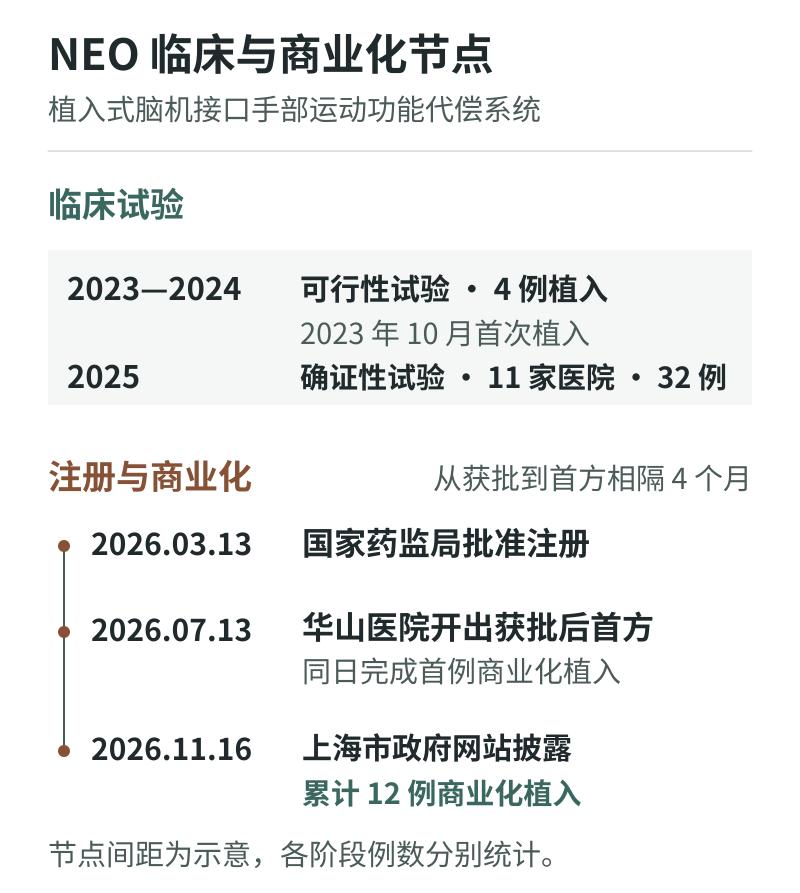
On March 13, 2026, the National Medical Products Administration (NMPA) approved the marketing of the implantable BCI hand motor function compensation system developed by NeuroRegen. According to the official statement released by NMPA, this is the world's first invasive BCI medical device that has been approved for marketing. Named NEO, the device is applicable to eligible patients with tetraplegia caused by cervical spinal cord injury, including those aged 18 to 60, who have been diagnosed for more than one year and have had stable condition for at least six months after standardized treatment. The patients can no longer complete grasping movements with their hands, but still retain partial function of their upper arms.
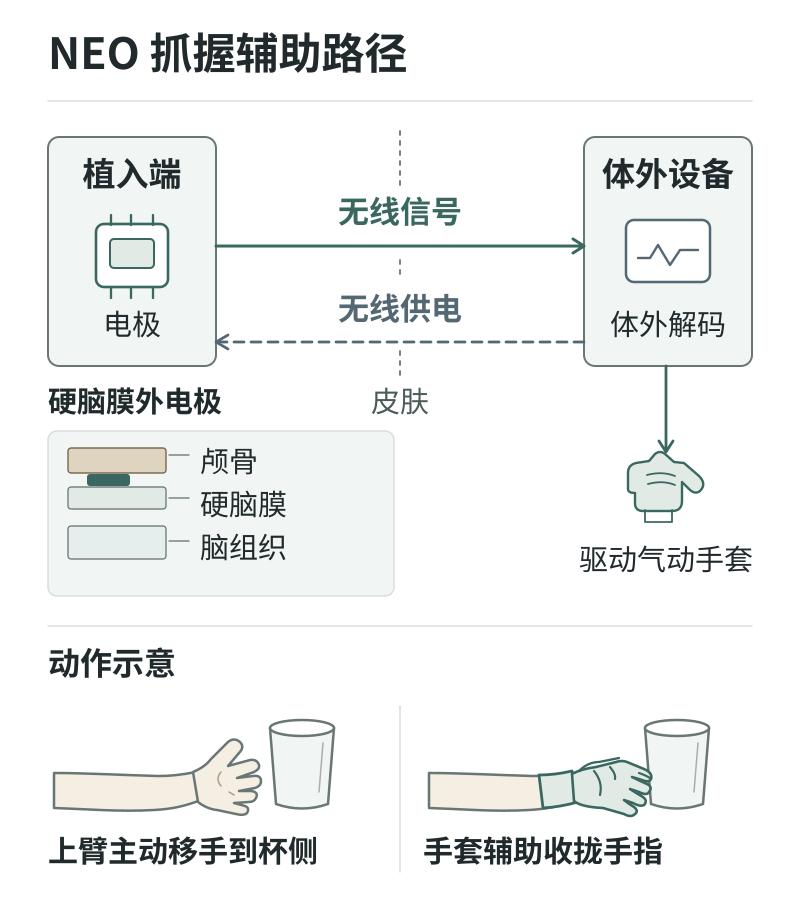
When the patient intends to grab an object, the electrodes attached to the outside of the dura mater collect EEG signals related to movement intention and transmit them wirelessly to the external device. The external device decodes the signals and then drives the pneumatic glove. The implanted terminal is also powered wirelessly, so no battery needs to be placed inside the body. When picking up a cup, the patient first moves their hand to the edge of the cup, a movement that relies on the remaining upper arm function of the patient, and the glove assists in closing the fingers after receiving the instruction. The test personnel will respectively observe what movements can be completed with the glove, and whether the patient can perform better grasping movements without the glove after a period of training.
Tsinghua University disclosed that NEO first completed 4 feasibility implantations, and then 11 hospitals finished 32 confirmatory trial implantations. According to the draft prospectus submitted by NeuroRegen, three months after the operation, the 32 subjects all met the improvement standards specified in the trial when tested for grasping with the assistance of the device using the Upper Extremity Motor Function Research Scale. The trial also used this scale to test the subjects' unassisted performance. Six months after the operation, 22 of the 32 subjects had a single-hand unassisted score that was at least 6 points higher than that at the start of the trial. The scores of the later test came from the unassisted movements completed by the subjects during that follow-up visit.
To get the device that passed the trial into the hospital, Huashan Hospital also had to promote price filing, device admission and patient screening. On April 28, the hospital completed the medical insurance price filing. On July 13, Huashan Hospital issued the first prescription for this device after it was approved, and completed the first commercial implantation on the same day. During the operation, the doctor confirmed that the system successfully collected the epidural EEG signals. The first patient lost the ability to grasp with hands due to a car accident, and after years of standardized rehabilitation, the improvement of hand function had entered a plateau period.
Four days after the first prescription was issued, Huashan Hospital took the second commercial implantation as a teaching case. Doctors from the departments of neurosurgery and rehabilitation medicine of 42 tertiary A hospitals across the country participated. The live broadcast of the surgery explained how to locate the motor cortex and how to verify the quality of EEG signals after the device was implanted. There were also special courses for work outside the operating room. Doctors from the rehabilitation department explained how to evaluate the upper limb function of patients and when to conduct reexaminations. Engineers from NeuroRegen demonstrated how to use the follow-up software and calibrate the device. These tasks need to be continued even after the patient is discharged from the hospital.
The First Affiliated Hospital of Shandong First Medical University completed three BCI surgeries in less than half a month. According to the report of Jinan Daily, the two surgeries on July 30 and August 5 used another device, and the patients joined the registered clinical trial as required. On August 10, this hospital used the approved NeuroRegen system to issue the first clinical BCI prescription in Shandong, and completed the implantation on the same day. For eligible patients, doctors can evaluate whether the device is applicable in the diagnosis and treatment process, which gives patients an additional access to medical services outside the trial recruitment.
Two days later, Weihai Municipal Hospital Affiliated to Shandong University also completed an implantation of this product. The local municipal government announced in April that the hospital had opened a BCI and neuromodulation clinic, where patients can receive multidisciplinary evaluations from departments of neurosurgery, neurology and rehabilitation medicine. By September 8, the hospital completed the power-on debugging for this patient. The hospital records show that the system was able to recognize the patient's movement intention on that day, and drive the supporting pneumatic glove to open and grasp.
When the surgery is completed, the hospital needs to confirm that the device is in the predetermined position and can collect signals stably. When the device is powered on, it is also necessary to check whether the EEG signals can be converted into the movements that the patient intends to perform. The next step given by the Weihai hospital at that time was individualized rehabilitation training, gradually practicing movements such as picking up objects. As of mid-November, according to the report of Shanghai Science and Technology, there have been 12 commercial implantations of NEO, covering 7 provinces. The device is being used in more regions, and local teams need to take over the work of device debugging and rehabilitation training after the operation.
The Machine Needs to Distinguish Tones When Reading Mandarin
The pneumatic glove receives instructions to grip and release. When the BCI is intended to output Mandarin, the number of alternative results increases sharply. The pronunciation of "buy" and "sell" in Mandarin share the same initial consonant and vowel, but different tones completely change the meaning of the sentence. Even if the tone is pronounced correctly, when encountering homophones such as "book" and "lose" in Mandarin, the system still needs to combine the context to select the correct character. Recognizing pronunciation from brain signals is only the first step, and the system also needs to select characters according to the meaning of the sentence.
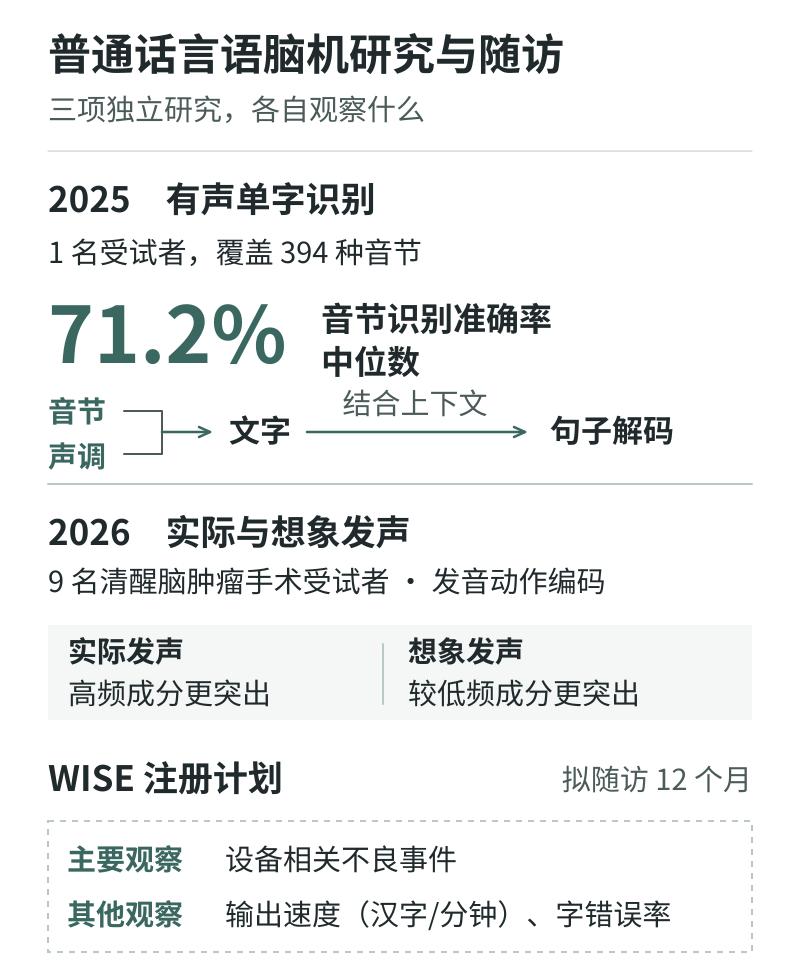
In 2025, Huashan Hospital and its collaborative team published a study in *Science Advances*. They recorded brain signals from a subject undergoing epilepsy monitoring, and asked the subject to pronounce single characters as prompted, to test how many of the 394 covered syllables the decoder could recognize. The median syllable recognition accuracy in the single-character task was 71.2%. The researchers extracted the clues of syllables and tones respectively, combined them with the context, and completed the real-time sentence decoding.
To apply the tool to people who cannot speak normally, it is necessary to find out what other clues are contained in the EEG signals when the patient imagines pronunciation in the brain. In September this year, teams from Huashan Hospital, ShanghaiTech University, the Second Affiliated Hospital of Zhejiang University School of Medicine and other institutions published a paper in *Nature Neuroscience*, comparing the brain activities of 9 awake subjects undergoing brain tumor surgery when they pronounced as prompted and imagined pronunciation. The two tasks share common features in the preparation of pronunciation movements. When encoding pronunciation movements, high-frequency components are more prominent in the task of actual sound production, while lower frequency bands are more important during imagined pronunciation. For the system to recognize the sound that the patient intends to make, it is necessary to re-identify useful signals according to specific tasks.
The Mandarin speech BCI trial separately registered by Jieti Medical plans to follow up for 12 months, mainly tracking device-related adverse events. The measurement of communication effect includes how many Chinese characters the subject can output per minute, and how many characters are wrongly replaced, omitted or extra written compared with the reference text. If characters are output quickly but errors have to be corrected by others, the conversation will be interrupted. For patients, the next step is to enable them to initiate a sentence on their own and correct typos by themselves.
The Next Stage of BCI Development Is in the Patient's Home
When the glove is taken out for use every day, the movement may not be smooth sometimes. According to the report of Shanghai Science and Technology, Xiao Xu, the first patient who received commercial implantation, arranged about three hours of training in the afternoon and evening every day after discharge. At first, he could make the pneumatic glove grip, but the releasing movement was not smooth. Engineers from NeuroRegen cooperated remotely for calibration every month, and adjusted the intention recognition model with newly collected EEG signals. On November 11, Huashan Hospital used the device that Xiao Xu practiced with at home to conduct upper limb motor function test. He completed the action of pouring water between two cups with the help of the glove, without the assistance of others.
These daily uses will also leave records of different natures. The device will score the matching degree between movement intention and actual action, which can be used to help arrange subsequent training and calibration. When returning to the hospital, the Upper Extremity Motor Function Research Scale will require the patient to grasp and release building blocks and wooden balls of different sizes, and try to pour water. The smooth recognition performance of the device helps patients to continue the training. To figure out what movements the hand can perform, it is still necessary to actually test those movements under the clear condition of whether the glove is used or not.
Another patient, Xiao Dong, participated in the clinical trial in 2024 at the same hospital. On the second anniversary of the implantation, Shanghai Science and Technology reported that he used NEO at home for about one and a half hours of training every day, and then did unassisted grasping movements. The objects for practice gradually changed from easy-to-grasp wooden blocks and cylinders to small glass beads. The team will conduct regular reexaminations, and also provide door-to-door follow-up visits. The device has been implanted in this subject for two years, and records such as how long he has used it, what training he has done, and under what conditions he can grasp what objects can be continuously recorded along with the follow-up visits.
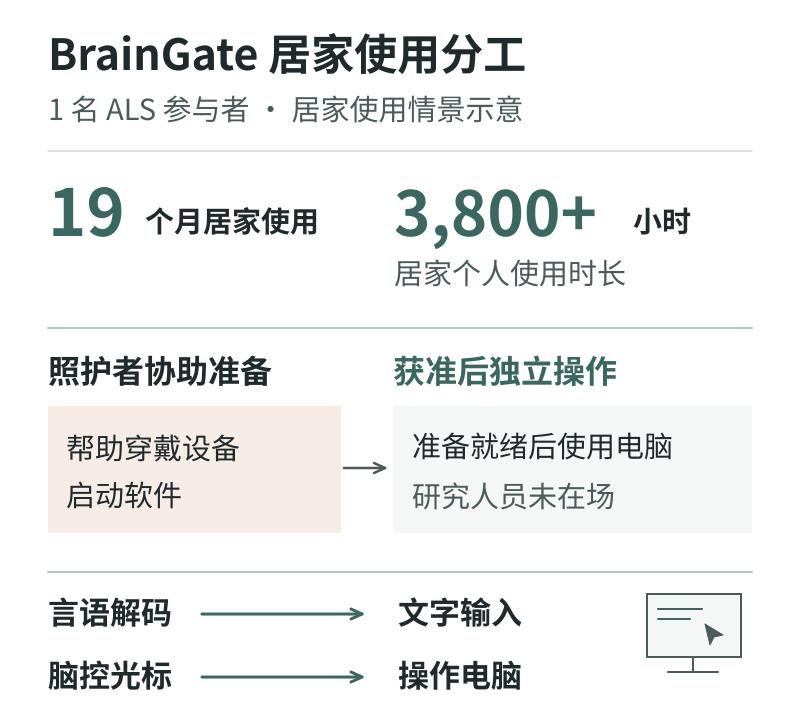
BCIs used for communication and computer operation also have home use records. In the study published by the US BrainGate team in *Nature Medicine*, a participant with amyotrophic lateral sclerosis and severe dysarthria accumulated more than 3800 hours of personal home use within 19 months. After being allowed to use the device independently, caregivers can assist in wearing the device and starting the software. When everything is ready, he can input text and operate the computer by himself without the on-site help of researchers, maintain communication with others, and continue to work full-time. The study recorded the actual usage time respectively, and which things were assisted by people around him.
Enable Another Hospital to Complete the Same Verification
Sometimes the post-operative work needs to be handed over to another hospital. In June, Huashan Hospital and Lanhai Rehabilitation Hospital launched a BCI research-based co-constructed ward, to explore how to connect patient transfer, post-operative function evaluation and training. When the rehabilitation team receives the patient, they need to know what movements the patient completed last time, whether the glove was used during the test, and how many months after the operation the doctor conducted the test. Only by conducting the next reexamination under the same conditions can we find out which movements have improved and which links need training adjustment or device inspection.
The key points for clinical trial review of the hand motor function compensation system released this year list the post-operative performance of this type of epidural device as the content that needs continuous observation. After marketing, it is still necessary to continue to track the subjects of pre-marketing trials, record unassisted grasping performance, quality of life, long-term signal changes and adverse events, and submit follow-up reports when applying for renewal of registration. For a patient, these records are related to how to continue the treatment at the next visit. When the records are collected across multiple hospitals, the cases will have results that can be tracked according to the unified standard.
Different collection methods and devices require that the brain signal files can be correctly processed by other teams. The national standard for BCI multimodal data format implemented this year provides a unified way to organize records. In October, Tongji Hospital Affiliated to Tongji Medical College of Huazhong University of Science and Technology took the lead in launching the construction of high-quality datasets. The participating hospitals will collect data such as EEG according to unified specifications, and the project is scheduled to be put into use in 2027. To verify whether the algorithm can be used in other hospitals, the data of one hospital can be set aside first, so that the model faces signals that it has never seen during training, and then we can check whether it can recognize what the patients there intend to do. Only when the records can be read correctly after changing to another set of devices, and the tasks and populations can be compared, can the conditions for such cross-hospital retest be met.
From screening to surgery, patients and hospitals also need to clarify the charging standards for each item. Last year, the National Healthcare Security Administration set up medical service price items for invasive BCI implantation, removal and other operations, and completed the medical insurance coding for NEO in March this year. The rules implemented on a trial basis in Shanghai allow public hospitals to charge according to the corresponding items, and the relevant medical service items are not included in the local basic medical insurance payment for the time being. Implant materials and functional components have also been included in the medical consumables catalogue of Shanghai, and basic medical insurance marks both items as "non-payable". The 2026 version of Shanghai Hu Hui Bao, which is purchased separately by insurance participants, has added protection for specific self-paid materials for inpatient BCI surgery that meet the policy conditions.
Prefecture-level hospitals have already had complete records from implantation to device power-on. In subsequent follow-up visits, doctors need to know which movements the patient can complete independently, and which stuttering situation requires re-calibration. If the receiving hospital can take over these tasks, patients can find help to deal with problems encountered during home training at a place closer to their home.
This article is from WeChat Official Account "Feng Wei Feng Dabai", written by Feng Dabai, published with authorization from 36Kr.