New car launches haven't decreased? It seems that everyone is still anxious.
Since the relevant authorities began to strictly crack down on "rush-to-market vehicles", this unhealthy trend in China's auto market has started to abate. However, the apparent calm does not mean there is no undercurrent beneath the surface. Right before the Guangzhou Auto Show, industry experts noted that as of November 20, 191 all-new and facelifted car models have been launched in 2026, approaching the historical high of 197 in 2024, and the full-year figure is very likely to hit a new record.
"What has decreased are minor model updates, which dropped 39.1% year-on-year since May, while new derivative models increased by 59.5% in the same period. In 2027, it is more likely that derivative versions will see a reduction, rather than genuine all-new vehicles."
If we look at the Guangzhou Auto Show, it is said that the number of debuting new cars has reached 115, 93 of which are global debuts. That means many people subconsciously assumed that this year's Guangzhou Auto Show might be reduced to a promotion-focused exhibition, but that is not the case at all, and automakers have not lowered their level of emphasis on the event.
Their attitude may also illustrate that the anxiety lingering over all automotive brands may not disappear completely. This anxiety has been amplified again with the arrival of the Guangzhou Auto Show week, even the entire auto show month of November, which is also a critical month before the year-end sprint.
The Chinese auto market has seen countless "Crazy Thursday" events in the past, where dozens of automotive brands held new car launch events on the same day. Not long ago, from November 12 to 13, within just 48 hours, China's automotive industry held 12 consecutive new car launch conferences, rolling out 17 new models in one go.
This speed has hit a new high recently, and it also exposes the huge pressure between year-end sales targets and brand building.
It is worth noting that according to statistics, none of the newly released cars this time come from new energy startup brands. The new car launches of NIO, XPeng, Li Auto and Xiaomi this year have basically come to an end. In other words, the pre-auto-show new car launch boom mainly comes from traditional local Chinese brands and joint ventures, but this centralized launch pattern ultimately reflects the situation that automakers are facing.
According to industry conventions, the Guangzhou Auto Show has always been the peak period for new car launches at the end of the year. After the "Golden September and Silver October" sales period, automakers only have one and a half months left to sprint for their annual sales targets.
For reference, in 2025, many automakers chose to stagger their schedules, spreading out pre-auto-show new car launches over several weeks, while this year almost all brands have compressed their launch activities into a mere 48 hours. It seems that they avoided the launch peak at the auto show venue, but in reality they collectively hit a new peak before the show.
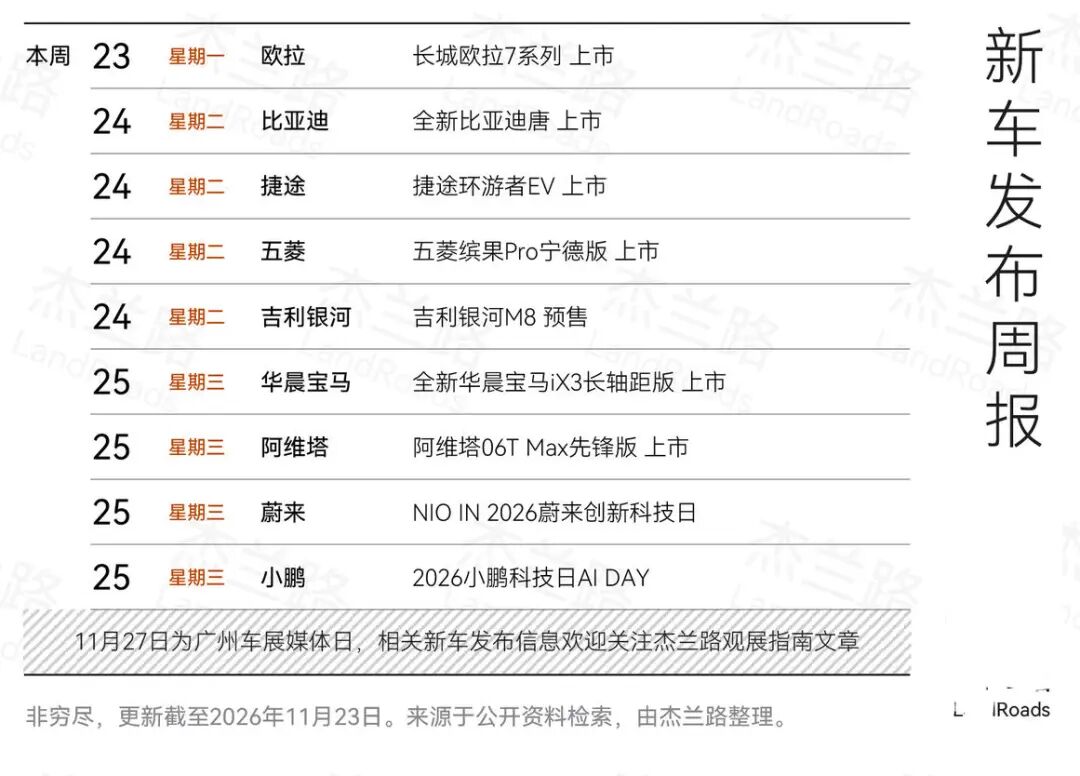
This choice of rushing to launch new cars at all costs is essentially an inevitable result of the heavy-asset nature of the automotive industry. For a brand new model, the normal cycle from the official approval of the project to the final market launch takes two to three years.
Large automotive groups have numerous sub-brands and R&D teams under their umbrella, and they also need to balance resources and competitive relationships among different internal product lines through orderly new car launches. Meanwhile, the relatively flexible product iteration pace of new power brands further amplifies the sense of urgency of traditional automakers.
However, this outcome has also aroused the industry's vigilance, under the strict crackdown on "rush-to-market vehicles" by regulators and the requirements for comprehensive testing. New model filing data submitted to the Ministry of Industry and Information Technology of China in the second half of the year shows that more and more automakers are intentionally reducing the launch of all-new models, and shifting their focus to defending existing market share.
Nevertheless, the slowdown in product launch rhythm by no means indicates a reduction in the intensity of industry competition. The real problem is that years of price wars have continuously lowered the industry's technical perception threshold, directly leading to the shrinking living space for brand premium.
When Yin Tongyue, Chairman of Chery, announced that Chery's global cumulative sales exceeded 20 million units, he stated on the spot that "we will no longer only pursue sales volume, but pursue brand upgrading and value creation". He repeatedly emphasized that "pursuing sales volume alone will not work", but the reality is that the entire industry is still mired in the quagmire of price wars, and endless involution to compete for traffic has become the norm.
This contradiction is most clearly reflected in financial data. Take XPeng Motors as an example. Its total revenue in the third quarter of 2026 reached 24.28 billion yuan, a year-on-year increase of 19.1%, but the net loss attributable to shareholders expanded to 868 million yuan, and the gross margin of the automotive business remained at 13.1%, basically flat with the same period last year.
XPeng Motors' third-quarter deliveries reached 118,400 units, a year-on-year increase of 2.1%. Its October deliveries hit a single-month record of 50,237 units, of which overseas deliveries stood at 13,326 units, up 166% year-on-year. This indicates that sales are recovering, but whether car sales can become a profitable business remains to be verified.
Similar dilemmas in brand upgrading are ubiquitous in the industry. Exeed, a brand under Chery, has been developing for many years, but has still not established solid user recognition in the high-end market. The WEY brand of Great Wall Motors transformed from the initial VV series to the Coffee series, and did not gain a firm foothold in the segment market until it launched MPV models, before carrying out a complete restructuring of its marketing team.
The market recognition of a new brand cannot withstand repeated adjustments. If you focus on performance and luxury today, shift to family intelligence tomorrow, and adjust to personality expression the day after tomorrow, all trial and error costs will eventually fall on the assessment of terminal sales.
Of course, there are also some positive examples. For instance, NIO is one of the few companies that can maintain consistent brand tonality. But this comes at a cost: to protect the high-end positioning of its main brand, NIO has independently incubated two new brands, Leidao and Firefly, targeting different mass markets, while continuously investing in improving the national battery swapping ecosystem to ensure that the service experience of main brand users is not diluted.
This path of brand upgrading requires an independent channel network, strong full-cycle service capabilities, a refined user operation system, and more importantly, years of continuous profit feedback and investment. In an industry environment where quarterly financial reports are strictly scrutinized and investors generally take sales growth as the core assessment indicator, unrealistic slogans of brand upgrading will easily end up as empty talk.
Therefore, in this low-level cycle, the trend of the market returning to brand value is particularly precious. The *2026 McKinsey China Auto Consumer Insights* report points out that a turning point has emerged this year: among the key purchasing factors for electric vehicles, brand has jumped from the long-stagnant fifth place to the second place, second only to range and charging time.
The report also points out that the real winners in the future industry will inevitably be those enterprises that can precipitate technological innovation into stable user experience, translate brand commitments into consistent services, and transform cross-industry collaboration into systematic competitiveness.
Nowadays, the gaps in the former core differentiated selling points such as range, advanced intelligent driving capabilities, and intelligent cockpit interaction are narrowing rapidly with the popularization of technology across the industry. Brands have begun to play the final role of value judgment, helping consumers make purchasing decisions in a highly complex market.
For automakers, the real high-end transformation can never be achieved by just shouting a few slogans. In essence, it is a kind of long-term restraint, to settle down and solve the real long-term pain points of users.
When other brands are rushing forward driven by short-term sales targets, enterprises that are willing to slow down and polish brand value can instead find a viable path to get rid of the price war. Of course, there are no shortcuts on this path, but it may be the only correct solution for China's automotive industry to move towards high-quality development.
This article is from the WeChat Official Account "Auto Commune" (ID: iAUTO2010), written by Yang Jing, authorized for release by 36Kr.