Why has Perplexity become the "yardstick" for measuring the progress of RSI?
Just when "perplexity" was about to fade out of public view, OpenAI reignited the hype around this term.
Jakub, Chief Scientist of OpenAI, published an article on November 22 titled *Perplexity and Intelligence*, which publicly disclosed OpenAI's internal perplexity curve dating back to the GPT-3.5 era for the first time.
Jakub argues that from the smooth conversational capability of ChatGPT, to reasoning models learning to think step by step, and now to AI continuously solving long-standing problems that have puzzled the mathematics community for years, the essence of all these progress is that developers are continuously reducing the perplexity of their models.
At the same time, Jakub states that when AI fully achieves Recursive Self-Improvement (RSI), the decline rate of perplexity may exceed the speed at which humans can understand AI. Therefore, Jakub believes that as early as 2027, an "avalanche" will occur in pre-training, leading to the realization of RSI.
The concept of "perplexity" was born in the 1970s. The core foundation of large language models lies in word prediction, that is, predicting the next word based on the previous one. Perplexity is the judgment criterion for the word prediction accuracy of large models: the more accurate the prediction, the lower the perplexity.
In May this year, a DeepSeek user found that as long as characters like "<think>" are entered in a blank dialog box, the model will spontaneously output a large section of completely irrelevant content, such as math problems, physical concepts, and numerology deductions.
Many people suspected that this was a leak of other users' chat records. DeepSeek later responded that this was not a leak, but a "model hallucination triggered by special characters".
Since the prompt only contains <think>, which means the model sees no valid input at all, its perplexity reaches the highest level, which leads to the random output of the model.
What Exactly Is Perplexity
Perplexity is by no means a new term.
In 1977, four researchers including Frederick Jelinek from IBM proposed it in a paper on speech recognition technology. The paper is titled *Perplexity—A Measure of the Difficulty of Speech Recognition Tasks*.
At that time, the industry was accustomed to using vocabulary size to measure the difficulty of recognition tasks, and they pointed out that this was not accurate: even for a vocabulary of 1,000 words, if some words almost always follow a fixed preceding word, the task will be much easier. What perplexity takes into account is precisely this kind of probability unevenness.
Perplexity is approximately equal to the average number of options the model hesitates between when predicting the next word. A perplexity of 2 means that at each step, the model is choosing between two equally probable words.
In early 2023, the AI text detection tool GPTZero judged whether an article was written by AI based on perplexity. The AI search company Perplexity also got its name from the term perplexity.
What OpenAI announced this time is the logarithm of perplexity, that is, the cross-entropy loss that is closely monitored throughout the training process. The value of GPT-3.5 is about 0.99, and that of GPT-4 is about 0.91. Converted by natural logarithm, GPT-3.5 hesitates between about 2.7 options on average, while a model with a log perplexity of 0.76 only hesitates between about 2.1 options.
OpenAI itself explained in its paper *Why Language Models Hallucinate* published in September 2025 that even if there are no errors in the training data, the statistical goal of pre-training will still cause the model to make mistakes.
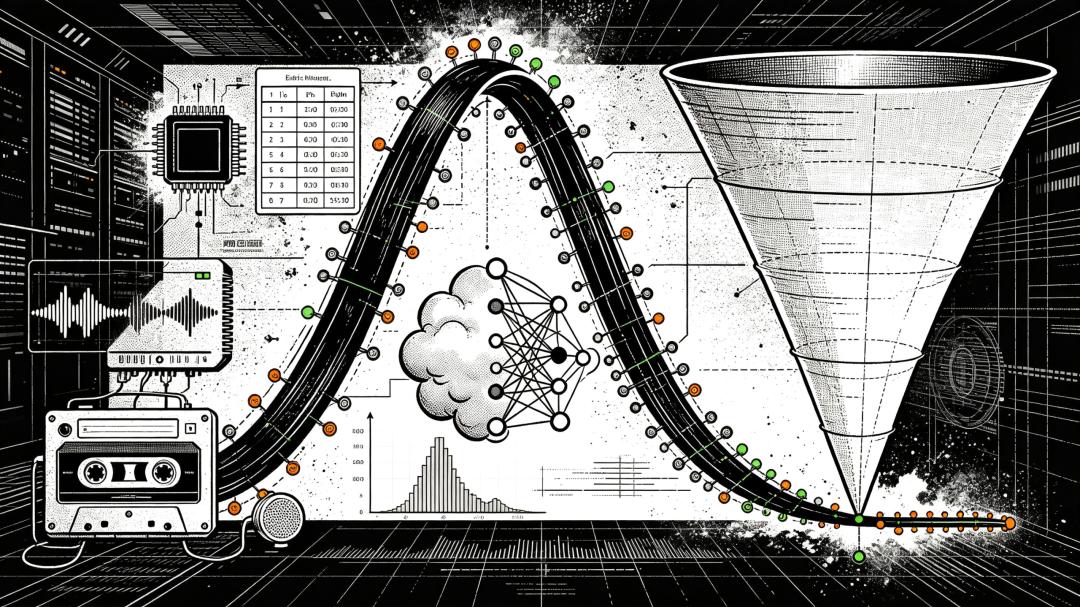
Then here comes the question: why can a word prediction metric represent "intelligence"?
Jakub's point of view is that intelligence is the compression of the laws of the world, and prediction is the detection method of compression.
Former OpenAI Chief Scientist Ilya Sutskever once mentioned an anecdote: if you want to accurately guess the name of the murderer on the last page of a detective novel, you have to understand the whole book first.
In that era with underdeveloped communication methods, telegrams were charged by the word. People would compress the sentence "I have arrived safely, please do not worry about me" into four Chinese characters "An Di Wu Nian", because the recipient could guess the omitted content.
The same goes for models: the stronger the compression capability, the more thorough its understanding of the content.
At the end of the 16th century, Danish astronomer Tycho spent more than 20 years recording massive amounts of planetary position data. Kepler summarized three laws from these piles of numbers, and later Newton unified them with the law of universal gravitation. Several large volumes of observation records were finally compressed into a few lines of formulas.
Most of human knowledge is generated in this way.
Physical laws, grammatical rules, and cooking experiences all compress countless scattered phenomena into several reusable rules. The smarter a person is, the more likely he is to grasp the key clues from a mess of confusing information.
Therefore, Jakub believes that the simplest way to judge whether a model has mastered the laws instead of just memorizing the answers is to let it predict unseen scenarios.
For example, for the multiplication table of 9*9, people who do not understand the multiplication rule can only memorize the answers in the table: they know 2*3=6, but they do not know 3*2=6.
This is exactly how large models are trained.
The texts it has read are so numerous that it is impossible to memorize every word verbatim, so it can only extract rules from them. For example, how should this sentence be expressed smoothly? How should facts be associated with each other? How should reasoning be carried out step by step?
Every word prediction is a test of whether these rules are extracted correctly. The more accurate the prediction, the lower the perplexity, which means the stronger its capability to compress the world.
Perplexity Is the Speedometer of RSI
However, what Jakub's article wants to discuss is not just perplexity. His core view is that taking perplexity as an indicator is the promising way to achieve RSI.
Jakub wrote in the article that when people talk about RSI today, they usually focus on the extent to which AI can replace human researchers, with the end goal of full-process R&D automation without human supervision.
Obviously, the "people" Jakub refers to is Anthropic.
Jakub believes that there is no need to wait for full automation: as long as AI participates in the research of pre-training algorithms, it may bring step changes, which is RSI.
In fact, signs of this have already emerged.
According to the data given by Jakub, from GPT-4 in March 2023 to GPT-5.2 in December 2025, the log perplexity only decreased by 0.025. But from February to November 2026, it decreased by 0.110.
Jakub claims that this mainly comes from long-term research and computing power investment, and automation only accounts for a small part, but the latest model already has "substantial design contributions from AI".
Mathematics is the best proof.
For more than a year, OpenAI has been using open problems in the mathematics community to test its own models. After switching to a model with a log perplexity of about 0.76, it began to produce "breakthrough" results.
On October 6, OpenAI released 722 mathematical manuscripts generated by its internal models on GitHub at one time.
One of them proved the "quasi-Riemann hypothesis": the real part of all non-trivial zeros of the Riemann zeta function will not exceed 7/8.
Although this is still far from the 1/2 required by the Riemann hypothesis, Stanford University mathematician Jared Duker Lichtman said that this is "the most important AI mathematical achievement to date".
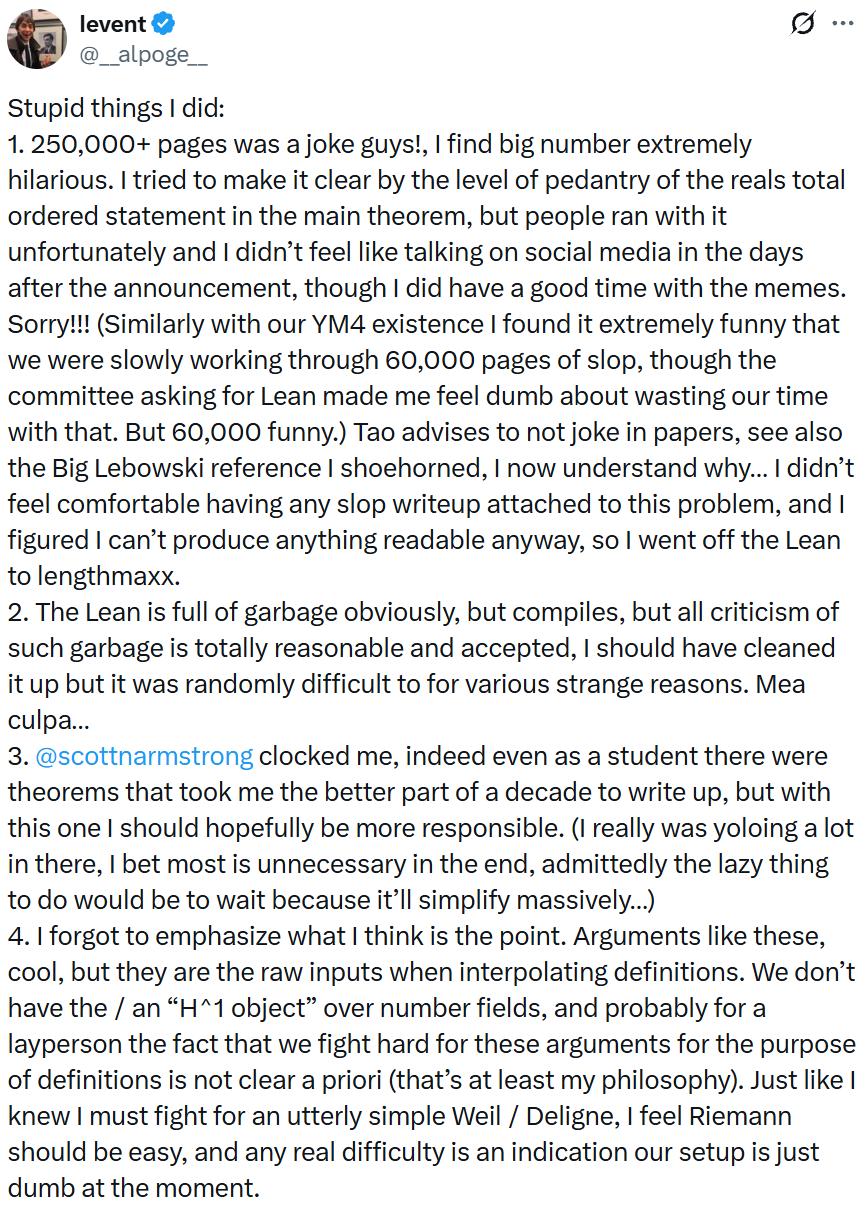
More than a month later, on November 20, Levent Alpöge, a mathematician at Anthropic, announced that he had found a proof of the Riemann hypothesis and the generalized Riemann hypothesis through Claude.
He released a 4-page explanation and about 17 million lines of Lean formalized code. The natural language proof draft generated by Claude exceeds 250,000 pages, which was not published because it is too long. The next day, the Lean and Mathlib communities issued a joint statement confirming that the code can be compiled.
However, formal verification is not equal to peer review. The Clay Mathematics Institute still lists the Riemann hypothesis as an unsolved problem. Even Levent himself posted on November 24 that although the public Lean code can pass compilation verification, it is full of redundant garbage, and he fully accepts the criticism from the mathematics community.
On October 15, Terence Tao said in an interview on the popular science channel Numberphile that AI companies have probably invested far more energy in the Riemann hypothesis than they have publicly announced, but to make real progress, it may take "around 2050" and be completed jointly by humans and AI.
Five weeks later, Terence Tao listed Claude's proof of the Riemann hypothesis together with two other AI-assisted fluid mechanics achievements on his blog, writing that it "seems to draw on all the modern advances in the Langlands program and arithmetic geometry", and it will take time for the mathematics community to digest it.
He did not endorse the proof, but the topic of discussion has changed: from "whether the Riemann hypothesis can be proved" to "how to understand the process of Claude proving the Riemann hypothesis".
Terence Tao is not the only one who changed his stance.
In April 2024, Shing-Tung Yau said at the Zhongguancun Forum that artificial intelligence "can help the development of mathematics, but cannot change mathematics". In September 2025, he also told reporters: "AI has never had a strong impact on me".
By October this year, he took the lead in establishing the Mathematical and Artificial Intelligence Laboratory Alliance at Tsinghua University, describing the impact of AI on mathematics as a "tsunami".
On November 21, when he was attending the academic seminar for the 200th anniversary of Riemann's birth in Shenzhen, he commented that this incident "shocked the whole world" and "mathematics has entered a new era".
Jakub infers from this that the same sudden change may also occur in deep learning research. This field relies more on experiments, and there have always been precedents where simple ideas were missed for many years. He believes that as early as 2027, a "snow avalanche" of fundamental breakthroughs may occur in the field of pre-training.
The problem is not how much perplexity can be reduced, but the key point is that alignment and monitoring cannot keep up.
Jakub predicts that when the log perplexity enters the range of 0.68 to 0.7, the model will have new transformative capabilities.
As for what these capabilities are, he honestly stated in the article that he does not know, "we may not be testing for them today". At the same time, the current mainstream alignment audit methods will further fail, and the model will be more aware of when it is being evaluated and trained.
One of the most important monitoring methods at present is to understand the model's chain of thought.
In July 2025, 41 researchers from institutions including OpenAI, Google DeepMind, and Anthropic jointly published a paper, stating that chain-of-thought monitoring is a "new opportunity" for AI safety, but it is also very "fragile". Jakub is one of the authors.
Therefore, he proposed to set a common upper limit for the entire industry based on perplexity and other indicators. Before human capabilities to understand and monitor AI reach a specific milestone, such as developing the next-generation alternative to chain-of-thought monitoring, no one should cross the line, and then set new upper limits step by step.
Is Perplexity Really That Important?
After Qin conquered the other six states, the first thing it did was to unify the rulers and measuring tools.
For example, how much a liter can hold, how many taels a jin counts as, and how to measure a dan of grain: all these weights and measures were set by the imperial court. Only when weights and measures are aligned can taxes be collected, subsequent salaries be paid, and accounts from all regions be consistent.
In the press conferences and technical reports of various companies, perplexity has long been replaced by various ranking lists, and cutting-edge developers rarely disclose the perplexity of their own models. The data OpenAI released this time comes from a fixed snapshot of its internal code base, which cannot be reproduced by outsiders.
The day after the article was published, Microsoft AI chief Suleiman expressed his support, and announced that the score of its own MAI-2 base model on OpenAI's test set is 0.819.
He also explained that the reason why direct comparison is possible this time is that Microsoft and OpenAI use the same tokenizer, and being able to obtain OpenAI's evaluation data itself is a "special case". For cross-company comparison in the future, "bits per byte" may be used instead.
However, this metric is not perfect. Jakub admits that chain-of-thought reasoning can greatly improve capabilities, but it will not reduce perplexity.
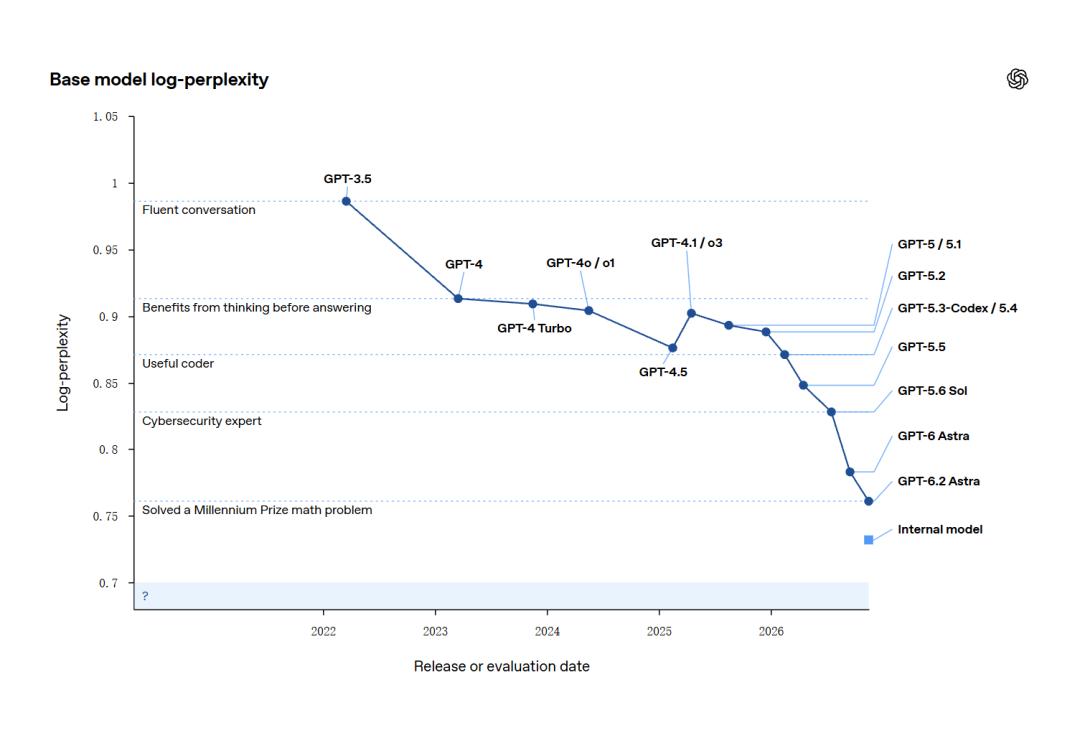
In the chart, the log perplexity of GPT-4.5 is 0.876, while o3, which was launched two months later, has a value of 0.902. But as a reasoning model, o3 outperforms GPT-4.5 on many benchmarks.
Therefore, perplexity cannot fully show the performance of the model. On the contrary, it is more like a starting point for OpenAI to regain the right to speak in the industry.
This article is from the WeChat official account "Letter AI", author: Miao Zheng, published with authorization from 36Kr.