The watershed moment of CAR-T
In November 2026, Breyanzi was included in China's National Reimbursement Drug List (NRDL). This marks the first time that CAR-T therapies have been covered by China's basic medical insurance, five years after the first CAR-T product was launched in the domestic market. "The price drops from millions of yuan to around 300,000 yuan", with the patient's out-of-pocket cost suppressed to less than 100,000 yuan. This type of drug, which is produced based on one patient's own cells and a customized process for each individual, has finally reached the inflection point for commercial volume growth.
A few months earlier, Eli Lilly acquired a company named Kelonia for a whopping 7 billion US dollars, while the leading CAR-T product under its pipeline had only completed data collection for a dozen or more cases. Looking further back, Carvykti recorded 1.964 billion US dollars in sales this year, heading towards the annualized 3 billion US dollar milestone. It is also the world's first drug that has truly made the CAR-T business model commercially viable.
With the business model proven workable, payment barriers broken, and next-generation technologies getting clear valuation, three waves are surging from west to east, pointing to a clear logic: The watershed moment for the CAR-T track has arrived.
01 Commercialization Breakthrough and Industry Clear-out: Carvykti Hits 2.7 Billion USD in Sales, Abecma No Longer Disclosed Separately
The autologous CAR-T business, looks like a pharmaceutical product from a distance, but is essentially a manufacturing industry up close. Production cost, capacity ramp-up, and treatment centers are all bottlenecks restricting its development.
Carvykti is the only sample that has successfully run through the entire industrial chain so far. It posted 710 million US dollars in sales in Q3 2026, representing a 36% year-on-year increase; the cumulative sales in the first three quarters reached 1.964 billion US dollars, up 47.4% year on year. At this momentum, its full-year sales are expected to exceed 2.7 billion US dollars, approaching the 3 billion US dollar annual outlook given by Johnson & Johnson.
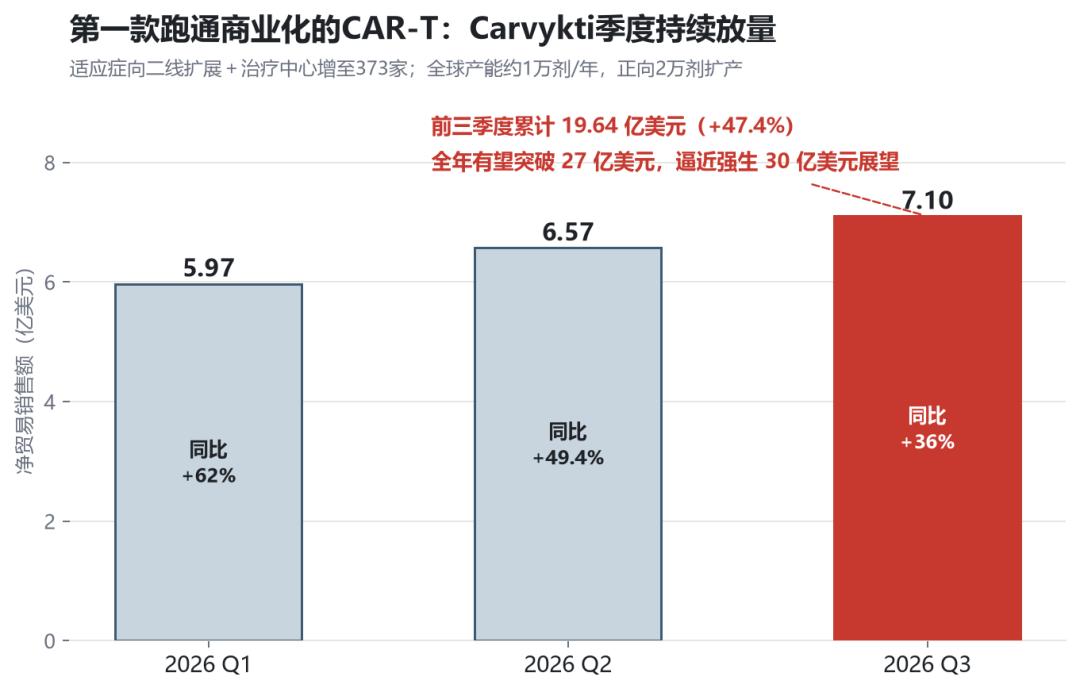
Figure: Quarterly net trade sales and year-on-year growth rate of Carvykti. Source: Johnson & Johnson financial report, Legend Biotech announcement and 6-K filing (October 13, 2026)
The production side can better illustrate the progress. After the expansion of Legend Biotech's Raritan site in New Jersey, the production success rate reaches 99%, with a median turnaround time of about 29 days. The manufacturing bottleneck that constrained the industry two years ago has been basically resolved. The gross margin in the third quarter hit 58%, which is higher than the management's previous expectation of "just over 50%". For a business that has long been burdened by high manufacturing costs, this is a signal that large-scale profitability has begun.
The current annual production capacity is about 10,000 doses, and Johnson & Johnson has launched the expansion to 20,000 doses. Two phase III frontline trials (CARTITUDE-5 and CARTITUDE-6) are in progress, targeting newly diagnosed patients who are ineligible for transplant and eligible for transplant respectively. If the data is positive, the applicable patient pool will expand from late-line treatment to frontline treatment.
The differentiation in the same track is already very clear. The world's first approved BCMA CAR-T is BMS's Abecma. Its sales in Q1 2026 fell 21% year on year to 81 million US dollars; starting from Q2, BMS no longer discloses its quarterly data separately. A drug is often phased out of the market starting from no longer being mentioned.
In China, ZKHC's Sakezi recorded sales of about 62 million yuan in the first half of the year, while Immune Therapeutics' Fucosy did not disclose specific figures. The anito-cel product that Gilead obtained by acquiring Arcellx for 7.8 billion US dollars at the beginning of the year has had its marketing application accepted by the FDA, with a PDUFA date of December 23, making it the next variable in the BCMA track.
The first CAR-T for solid tumors has emerged. ZKHC's CLDN18.2 CAR-T Kailimei was approved in China on June 22 for advanced gastric/gastroesophageal junction adenocarcinoma after at least two lines of treatment, making it the world's first approved CAR-T for solid tumors. 64 certified supporting treatment centers have been announced. Not every hematology department is capable of handling CLDN18.2 testing and gastric cancer infusion procedures.
Preliminary data on perioperative expansion was presented as a poster at ESMO 2026: no recurrence or metastasis occurred in patients receiving post-operative adjuvant consolidation treatment as of the data cutoff date. This is an investigator-initiated trial with limited sample size and follow-up time, and the value of perioperative application needs to be confirmed by registration studies.
There are already 10 CAR-T products approved in China, with the price range concentrated between 899,000 yuan and 1.29 million yuan per patient. The latest one is Saibohua (IM19) approved on November 5: in the confirmatory study involving 101 infused patients, the best objective response rate was 71%, the best complete response rate was 41%, the incidence of grade ≥3 cytokine release syndrome was 1.0%, and no grade ≥3 neurotoxicity occurred. Its core selling point is high safety.
Among the 10 products, the vast majority are concentrated on the two targets CD19 and BCMA. The industry reshuffle has already begun.
02 Payment Breakthrough: Breyanzi Included in NRDL, The Ceiling of Price Reduction Depends on Cost Side
Payment has been the most daunting barrier for autologous CAR-T in the past few years. The million-level pricing, coupled with the one-person-one-production manufacturing mode, has locked the patient pool within the dual upper limits of payment capacity and production capacity.
Now, this barrier is being dismantled from both ends.
In December 2025, the first version of the innovative drug catalog for commercial health insurance included 5 CAR-T products, marking the first time this type of product had an institutionalized payment channel outside basic medical insurance; the 2026 catalog expanded to 28 drugs, including Kailimei, and two products from HengRun Bio and Legend Biotech.
The real milestone lies in basic medical insurance. Less than a year after Breyanzi was included in the commercial insurance catalog, it was added to the National Reimbursement Drug List in November 2026. Estimated based on the negotiated price cut superimposed on the reimbursement ratio, the product price may drop to around 300,000 yuan, and the patient's out-of-pocket cost will be less than 100,000 yuan (the specific implementation shall be subject to the official caliber).
The National Healthcare Security Administration confirmed that two drugs from the commercial insurance catalog were transferred to basic medical insurance this year. The connection path of "entering commercial insurance first, then basic medical insurance" has been proven feasible.
However, the calculation of exchanging price for volume cannot only focus on the negotiation table. The sustainability of price reduction does not only depend on the negotiation side, but more importantly on the cost side.
Tian Feng, Chairman and CEO of JW Therapeutics, put it plainly: expanding accessibility relies on continuously reducing production costs.
The cost allocation of autologous products is inherently limited — when producing for the next patient, the entire process has to be restarted from scratch. Bio-Hero has suppressed the price of autologous CAR-T to more than 200,000 yuan, which is another approach to reduce cost from the production end, but this model has not been verified by large-scale commercial application.
Here is a set of background figures: the demand of China's CAR-T market has risen from 568 doses in 2023 to 1392 doses in 2024. The demand is growing, and price is still the primary filtering condition at present.
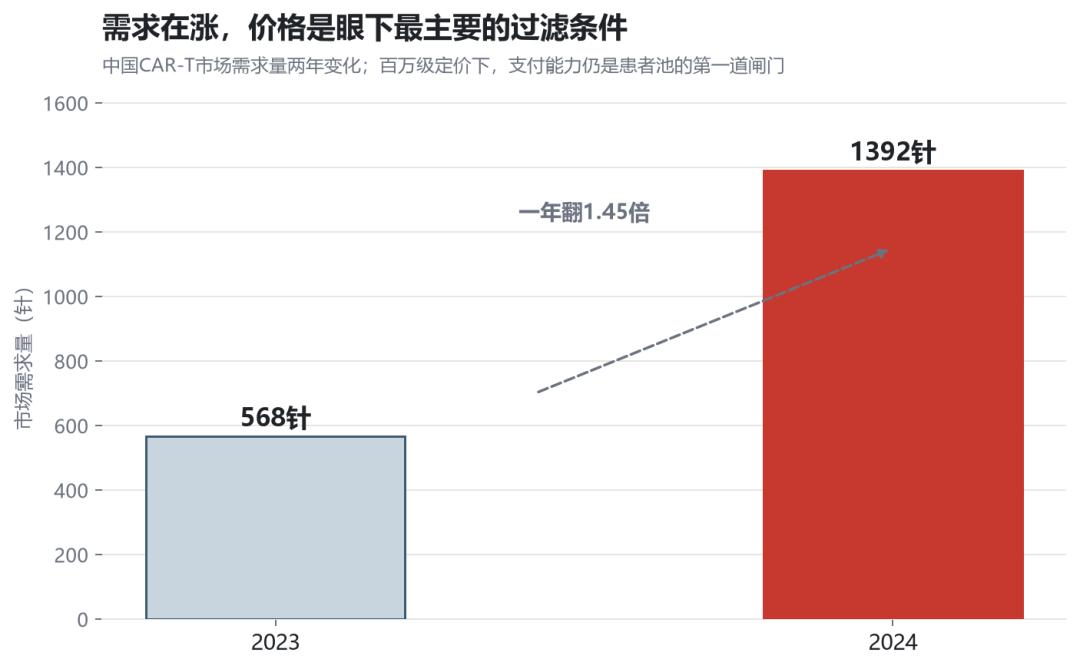
Figure: China's CAR-T market demand (2023-2024). Source: Compiled from public industry data
03 What 20 Billion USD Pays For: Delivery Platform
Since 2024, the frequency of MNCs' moves in in-vivo CAR-T is unprecedented in the history of cell therapy.
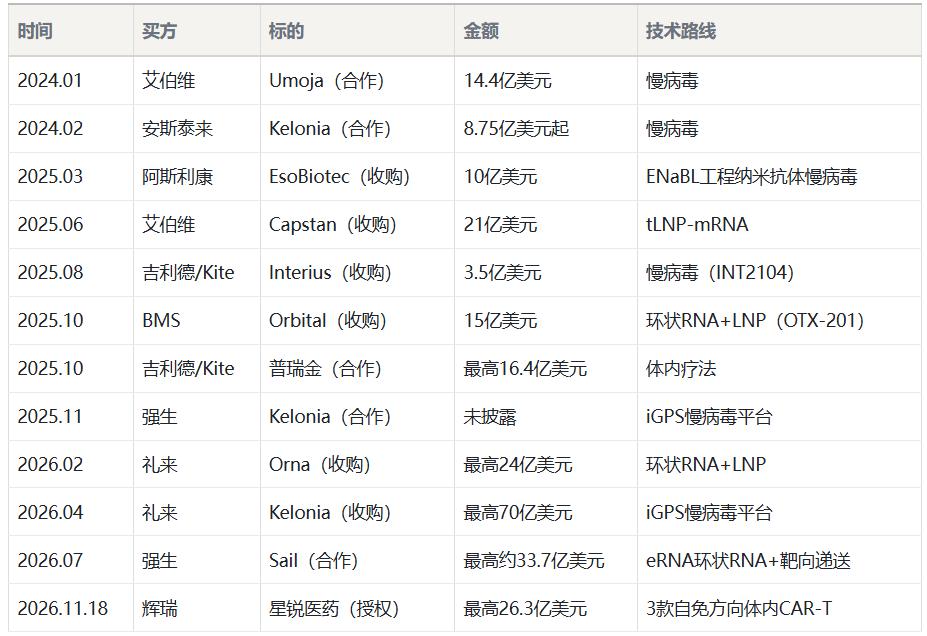
Figure: Panorama of MNC transactions around in-vivo CAR-T (January 2024 - November 2026, the amount is the upper limit of the total potential value). Source: Compiled from announcements and public reports of various companies
Nearly all the targets of these 12 transactions are technology platforms. EsoBiotec's ENaBL, Kelonia's iGPS, and Umoja's VivoVec are lentiviral envelope engineering platforms; Capstan, Orna, Orbital and Sail focus on LNP-mRNA and circular RNA technologies.
It is worth noting that most targets are still in the preclinical or investigator-initiated trial stage at the time of acquisition, with no registrational data available.
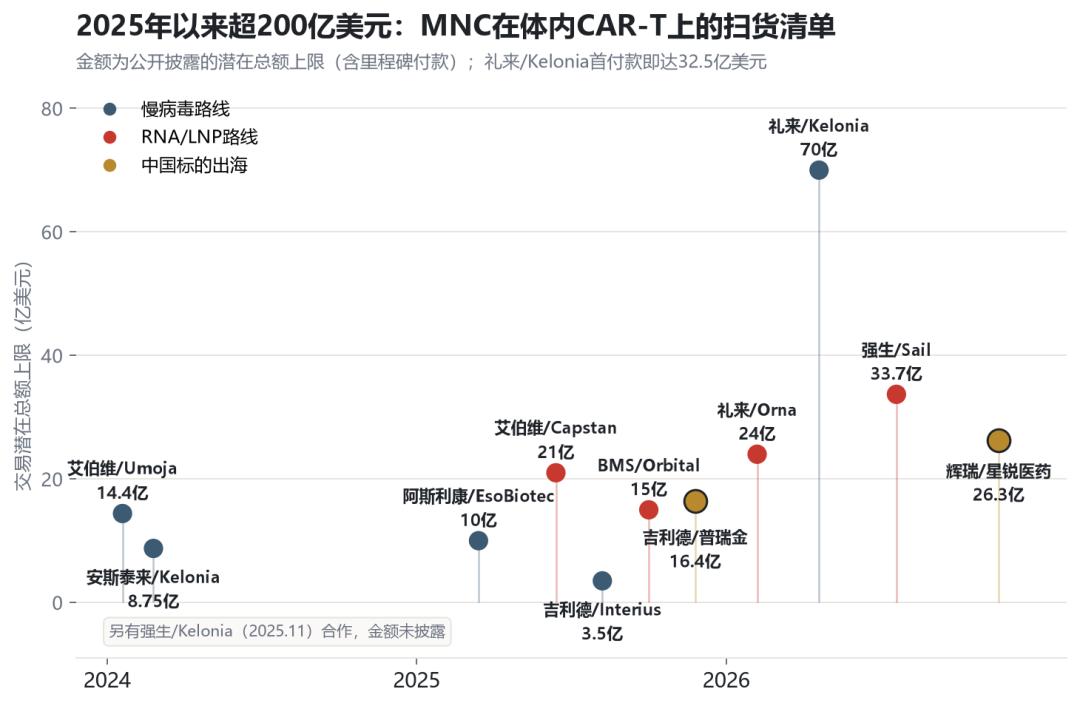
Figure: MNC's acquisition list for in-vivo CAR-T since 2025.
MNCs pay billions of dollars for such assets, with the consideration anchored on the underlying capabilities of delivery efficiency and cell selectivity; the peak sales expectation of any single indication alone cannot support such a high valuation.
In other words, the core of the giants' bet on next-generation CAR-T technology is the process of "delivering drugs into T cells".
Eli Lilly is the only company that has bet on both routes at the same time, with two acquisitions totaling up to 9.4 billion US dollars in the first half of 2026. The lentivirus can integrate into the genome and support long-term expression, with the most concentrated bets in the oncology field; LNP-mRNA and circular RNA enable transient and controllable expression, which is theoretically more suitable for autoimmune diseases that require periodic B cell clearance. Eli Lilly has made layouts on both routes and two types of indications.
Chinese companies have begun to appear in the seller list. The 1.64 billion US dollar cooperation between ProJIT and Kite (120 million US dollar upfront payment), the 2.63 billion US dollar licensing deal between StarRise Pharma and Pfizer (330 million US dollar upfront payment), plus the previous licensing of lentiviral platform from Senlang Bio to Tempest, and the cooperation between WestVac Biopharma and Cartesian to develop mRNA in-vivo CAR-T, have formed a clear track record of Chinese domestic delivery technologies going global.
The boom has also spread to China's primary market. Since 2026, there have been more than 18 financing events for domestic projects focusing on in-vivo CAR-T, with the total amount exceeding 3 billion yuan, and financing events of over 100 million yuan accounting for more than 60% of the total.
03 In-vivo CAR-T Performance: Impressive Remission Rate, Uncertain Durability
Capital moves first, while clinical development is still in the early stage. The data released intensively in the past six months show consistent development direction.
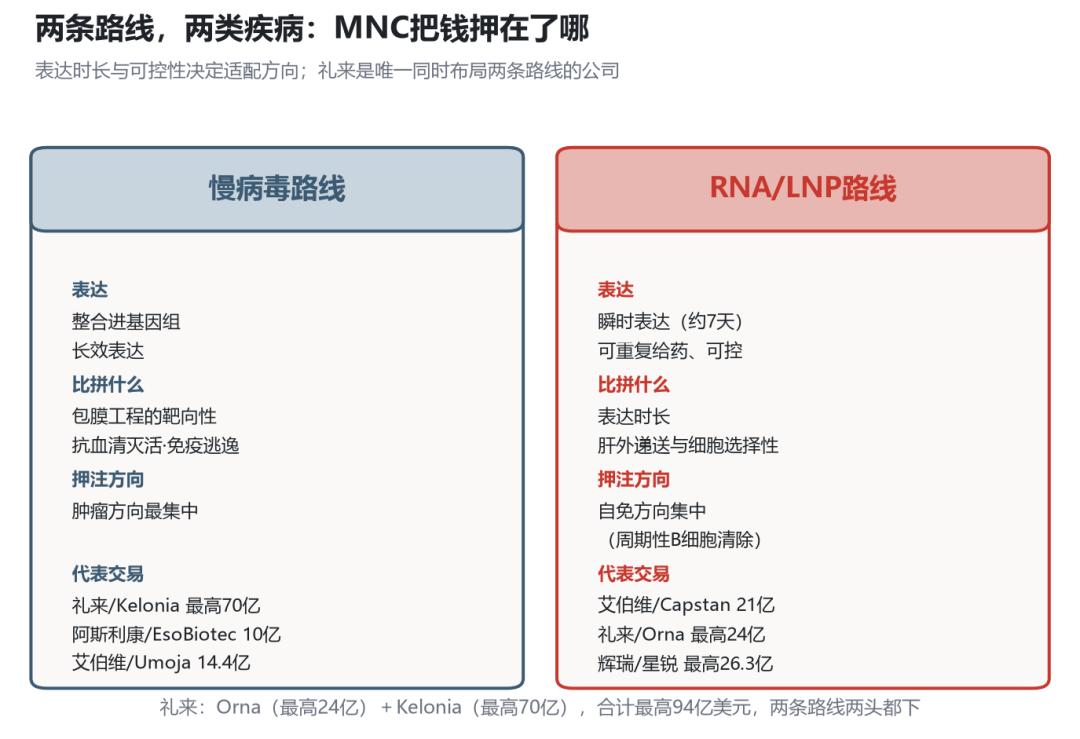
Figure: Comparison between the two in-vivo CAR-T technology routes of lentivirus and RNA/LNP. Source: Compiled based on public disclosures and announcements of various companies
The oncology field is dominated by the lentivirus route. Eli Lilly/Kelonia's KLN-1010 (CD19/BCMA dual-target) updated data of 18 cases at ASCO 2026: one month after treatment, all 18 patients achieved MRD negativity in bone marrow, with an objective response rate of 100%; among the 6 patients with more than 4 months of follow-up, 4 achieved stringent complete response. The safety profile is acceptable: no grade ≥3 CRS, 2 cases of neurotoxicity including 1 manageable grade 3 case.
However, 1 case of MRD turned positive and 1 case of disease progression at 4 months have already been observed during follow-up. How long the efficacy can last is the biggest unresolved issue in this dataset.
Legend Biotech's LB2501 (CD19/CD20 dual-target) obtained FDA IND approval in October 2026, which is the first known dual-target in-vivo CAR-T that requires a single infusion and does not require lymphodepletion. In the first-in-human data released at EHA, the 6 patients in the DL2 dose group had an objective response rate of 100% and a complete response rate of 83.3%, with no reported dose-limiting toxicity.
Domestic progress is concentrated in November. Immune Therapeutics' IASO208 (CD20) obtained the CDE clinical implied permission on November 11, and with the FDA IND approval in September, it became the first in-vivo CAR-T approved for clinical trials in both China and the US. The path is more noteworthy than the data: its US IND was directly approved based on data from Chinese investigator-initiated trials. 11 patients have been dosed so far, and the company plans to directly carry out phase 1b studies in the US, skipping the traditional dose escalation process. The 1-2 year time gap between domestic pipelines and overseas leading platforms is being shortened by this path.
The BCMA product IASO206 on the same platform released data of 10 relapsed/refractory myeloma cases at the IMS annual meeting: the objective response rate was 90%, and both the objective response rate and MRD negative rate in the high-dose group reached 100%; on November 10, it was included in the biomedical new technology clinical research filing list under the framework of Decree No. 818, making it the first in-vivo CAR-T project under this framework.
On November 22, ZKHC's CT1182 (CD19/CD20, CARvivo platform) released data of 6 relapsed/refractory B-cell lymphoma cases: 3 cases achieved complete response, 2 cases achieved partial response, only grade 1 CRS occurred, no dose-limiting toxicity or neurotoxicity was observed, and the company plans to submit registration clinical application in the first half of 2027.
The autoimmune field is dominated by LNP-mRNA and circular RNA. Preclinical data of BMS's OTX-201 shows that the expression of circular RNA in mice is more than 11 times higher than