Neither speculating in stocks nor making reckless all-in bets, how do young people of this generation build up their own safety net for the future?
Peach, a post-95s generation young woman, works as an e-commerce customer service specialist in Hangzhou. When we met for dinner last week, she took out her phone and showed me a screenshot: the holding page of a certain dividend index fund, with a total position of just over 50,000 yuan, but a line of small text below shone brightly — "Total dividend distributed: over 2,100 yuan".
Peach said excitedly that on the day the money arrived in her account, she immediately went to have a Haidilao hot pot meal, and transferred all the remaining money to Yu'E Bao. "In the past, I checked the K-line of the fund every day, fussed over every rise and fall, and felt exhausted. Now I only worry about one thing: when will they transfer the money to me next time."
Peach's choice is not an isolated case.
With the evolution of multiple factors such as the macro environment, investment concepts and business forms, the narrative logic of young people's wealth management is quietly shifting.
The restlessness of "taking a gamble to turn a bicycle into a motorcycle" and the gambling mentality of "going all in at one go" in the past are gradually replaced by simple, specific things even with the mindset of "living a down-to-earth life" — accumulating stock dividends, hoarding gold beans, and purchasing insurance have become the new favorite of contemporary young people in wealth management.
Dividend Chasers: Let the money "come in a little every month"
31-year-old Lily works a busy 9-to-5 job in Beijing. Once upon a time, she was a typical "deposit special forces", comparing interest rates one by one on banking apps, taking high-speed trains across cities on weekends to open new bank accounts, and snatching large-denomination certificates of deposit at the exact time of release, just to get a little extra percentage point of interest.
Later, the interest rate of 3-year time deposits kept falling all the way, from over 3% to 2.2%, then to 1.4% and 1.5%, no matter how far she traveled, she could no longer get a yield above 2%.
Lily decided to change her way of life — keeping up with the wealth management trend of young people, she joined the "dividend chasers" group and bought dividend index funds.
Dividend index funds are mostly invested in large-cap blue chips in sectors such as banking, public utilities and energy, which are suitable for investors like Lily who pursue steady returns and prefer defensive allocation.
Lily searched for "high dividend low volatility" on Alipay, and finally selected three funds according to indicators such as index dividend yield, dividend distribution times and rate of return, putting a total of 200,000 yuan in them one after another.
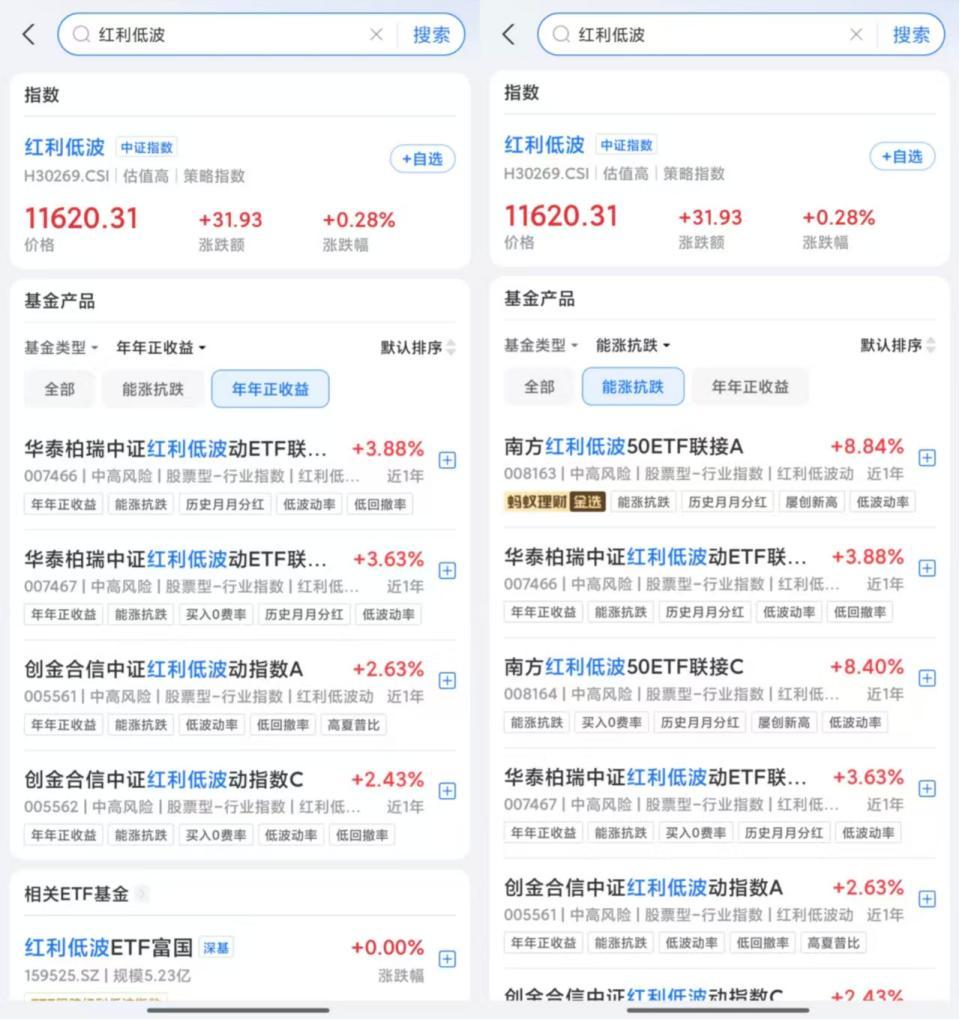
Image source: Alipay
Since the second half of this year, bank stocks have performed strongly, which perfectly matches the products Lily holds, bringing her quite impressive returns.
As of November 20, 2026, among the 42 listed banks, 13 have seen their share prices rise by more than 20% during the year, and 6 have risen by more than 30%. City commercial banks such as Bank of Chengdu, Bank of Jiangsu and Bank of Hangzhou have increased by more than 30%, and Bank of Qingdao leads the growth with a rise of nearly 54%; the share prices of large state-owned banks such as China Construction Bank, Industrial and Commercial Bank of China and Bank of China have also repeatedly hit new all-time highs.
"My goal is not high, as long as the dividend can cover my utility bills." Lily highly recognizes this cash flow outside her salary.
Wang Qing, a post-00s young man, has made an even clearer calculation. He invested 80,000 yuan in full position in high-dividend assets, and received more than 3,000 yuan in dividends last year. Although the stock price fluctuated halfway, it rebounded after one year, and the floating profit on the book is very considerable.
Talking about this investment, Wang Qing said: "Compared with the 1% time deposit interest rate in banks, I am really satisfied. More than 3,000 yuan does not seem like a lot, but now it is equivalent to the total interest of depositing 80,000 yuan in a bank for three years."
Chen Mo, also a post-00s, decisively divided his matured deposit into two parts: one part was put into a money market fund as liquid cash, and the other part was used for regular investment in dividend index funds.
His statement is very straightforward: "I don't expect the stock price to soar in the short term. The most important thing is safety. I hope the dividend can be sustained in the long run, flowing little by little and accumulating a large sum over time, just like guarding my own small piece of land in my hometown."
The data from Ant Fortune confirms this consensus among young people.
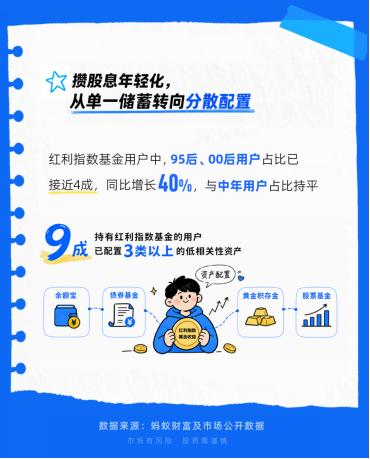
Among the holders of dividend index funds on the platform, post-95s and post-00s account for nearly 40%, with a year-on-year increase of 44%, making them the fastest growing group. 90% of the holders have allocated more than three types of low-correlation assets at the same time, including Yu'E Bao, bond funds, gold accumulation products, equity funds and so on.
Wang Zengwu, Director of the Wealth Management Research Center of the National Institute for Finance and Development, said that under the macro background of continuously declining interest rate center, dividend index funds, with their defensive attributes of high dividend yield and low valuation, have become the equity base position for young investors to build a "barbell strategy". "In a volatile market, it is very important to hold the assets steadily. Stable cash flow can bring greater value to the life cycle of young people, or they can choose to reinvest the dividends to pursue long-term appreciation and amplify the compound interest effect of time."
Hoarding Gold Beans: Even if you don't like it one day, gold is still money
26-year-old Ye Zi works as a new media operation specialist in Shanghai, with a monthly salary of 8,000 yuan. After deducting rent and food expenses, the remaining money used to be spent mainly on games and clothes. She tried regular fund investment, bought an aerospace-themed fund, and lost 20% in three months. "At that time, the first thing I did after opening my eyes in the morning was to check the net value of the fund, and I didn't even want to get out of bed after seeing it."
After this "tribulation", she chose a different path. Every month after her salary arrives, she spends more than 1,000 yuan to buy one gold bean, and now she has saved 26 of them. In Ye Zi's opinion: "I take a look at it every day, and the price is basically in a state of slight rise or slight fall. My heart no longer jumps up and down like riding a roller coaster."
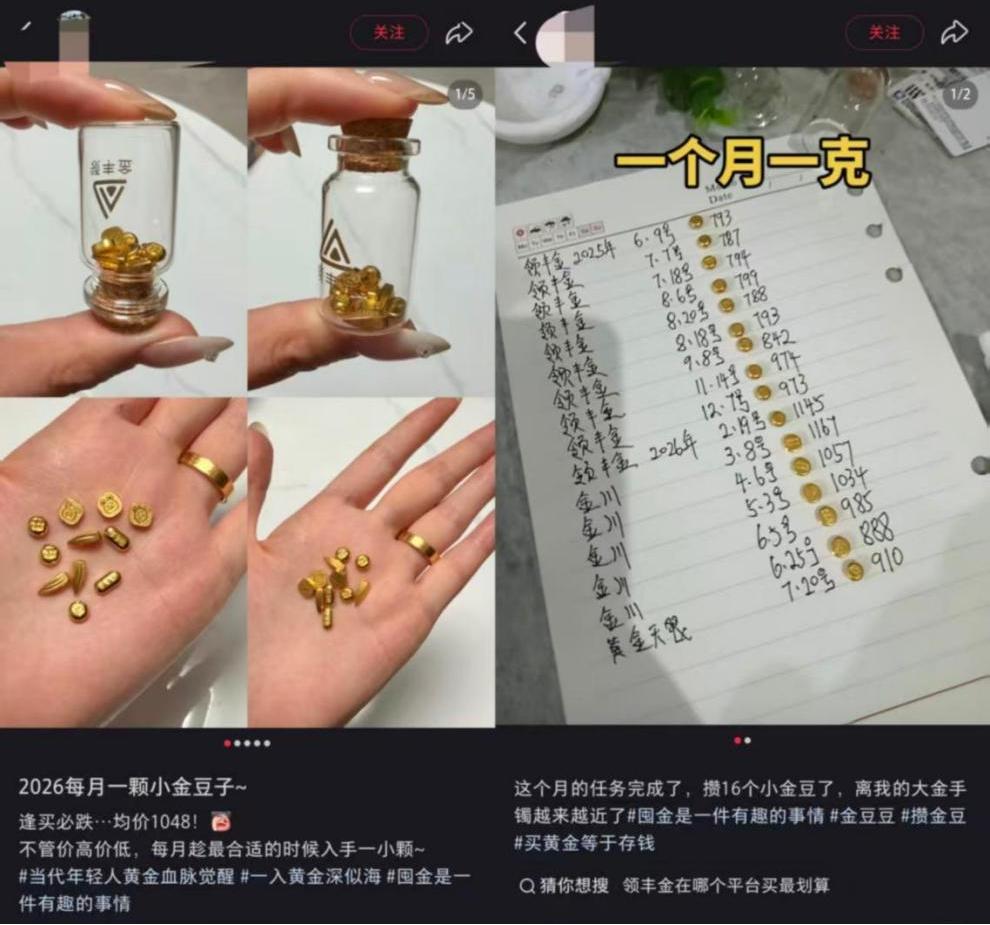
Image source: Xiaohongshu
What really surprised me was Qiqi, a post-00s manager of a women's clothing store. She started regular investment in gold accumulation products on Alipay in 2025, and by August 2026, she had accumulated 95.62 grams in her account, with a total investment of nearly 100,000 yuan.
Qiqi once said a sentence that left a deep impression on me: "Every gram in the glass jar is the sense of security I save for my future small family." But she also admitted that she had suffered losses at the beginning: she followed the trend to buy gold when she first started, and lost money. Later, she posted on Xiaohongshu to ask other users for advice, plus did a lot of homework in private, and finally figured out the tricks little by little.
A questionnaire survey conducted by Nandu Big Data Research Institute in January 2026 shows that 70% of the interviewed young people bought gold in the past year, among which the post-90s generation is the main force, accounting for 53.80%. Their gold buying behavior is characterized by small amount, monthly purchase, and gold beans as the main product.
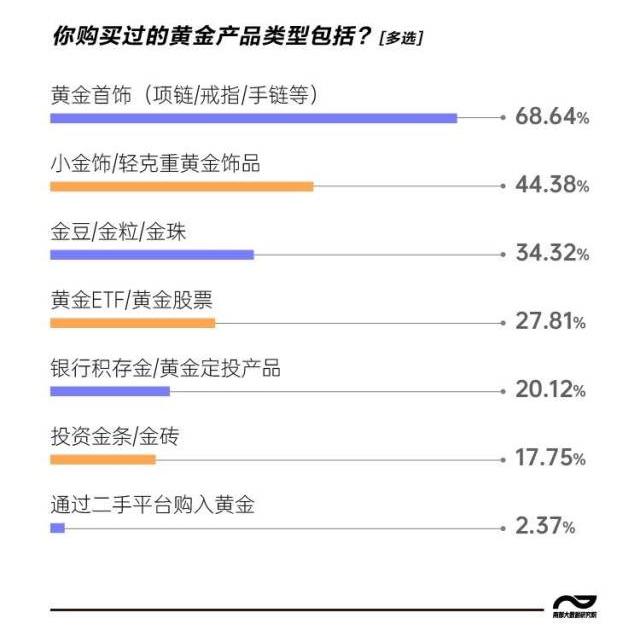
In the same survey, more than 50% of respondents spend less than 5000 yuan on a single gold purchase, and "saving 1 gram of gold every month" has become a new savings ritual. In terms of specific categories, traditional gold jewelry still accounts for the mainstream (68.64%), and the proportion of gold beans, gold grains and gold beads reaches 34.32%.
For the deep pullback of gold price this year, Ye Zi and Qiqi still maintain a certain degree of optimism, and have not stopped their gold saving plan: "Investment is bound to have fluctuations, but the value preservation attribute of gold will not disappear. When the gold price falls, the number of grams I hold does not decrease. Anyway, I only save a small amount every month. When the price falls, I can get a few more milligrams with the same amount of money."
The subtlety of the behavior of Ye Zi, Qiqi and other young people is that it meets two seemingly contradictory needs at the same time.
From the consumption side, the money to buy one gold bean is almost the same as the cost of having a nice meal or buying a piece of clothing. The psychological burden and the financial burden are both very low, and it even brings the pleasure of "rewarding myself".
From the savings side, gold is gold. Even if the gold price falls in the short term, the physical object is still in your hand, and it will not evaporate out of thin air like the numbers in a stock account.
A 28-year-old respondent put it bluntly: "Even if I don't like it one day, gold is still money, unlike bags that depreciate sharply when they go out of fashion and are hard to resell."
Of course, young people have not completely rejected more "financialized" gold products. On the Ant Fortune platform, as of the beginning of October 2025, more than 8.9 million users have started regular investment in gold ETFs, and the proportion of post-95s exceeds 40%.
But even when buying funds, their approach is very cautious — investing in batches, with small amounts, for a long term, and never going all in at one go.
The role of gold here is between consumption and investment, more like a kind of "physical form of forced savings". If the gold price rises, it is an unexpected surprise; if the gold price falls, the physical gold is still in the drawer, and you can even wear it out the next day.
Purchasing Insurance: Using a few hundred yuan to protect yourself against risks
Ten years ago, young people were totally averse to insurance. Sales calls, personal relationship pressure, and complicated terms, every single part of it was enough to make people stay away.
But times have changed. In addition to regular investment in dividend index funds and hoarding gold beans, insurance, especially savings-type participating insurance, has quickly entered the vision of young people's wealth management.
27-year-old Shen Lin works as a brand planning specialist in Beijing, with a monthly salary of 15,000 yuan. Compared with dividend index funds and hoarding gold beans, she is more keen on participating insurance.
In February this year, a 30,000-yuan time deposit of Shen Lin matured. The renewal interest rate popped up by the banking app made her stunned: 1.25%. She checked the previous records, and the interest rate was 2.6% when she deposited the money three years ago, while the guaranteed interest rate of participating insurance products of insurance companies on the market is generally 1.75%.
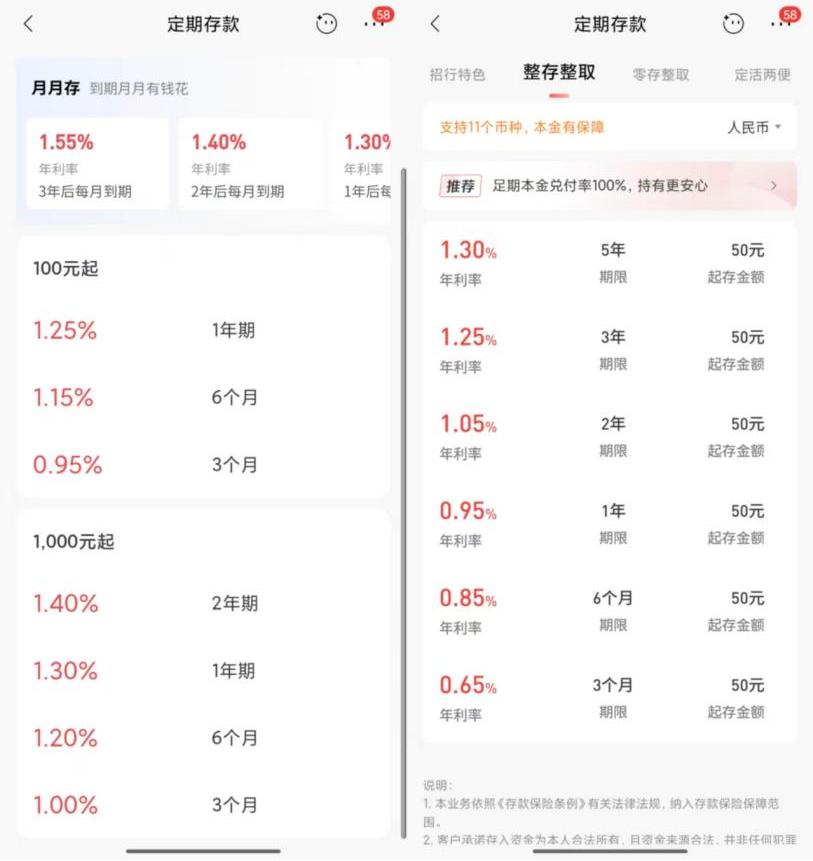
Image source: China Merchants Bank App
She pressed the calculator: with the guaranteed return of 1.75% plus floating dividend, even if only half of the floating dividend is realized, the total return is much higher than that of 3-year time deposit.
Without too much hesitation, Shen Lin used the 30,000 yuan to buy a participating insurance product from an insurance company. "I can't control whether the fund will rise or fall, and the deposit interest rate is obviously going down. I have to find a middle ground. After comprehensive comparison, participating insurance is very suitable."
"I can't control the rise and fall of funds, and the deposit interest rate is clearly going down. I have to find a middle ground, and participating insurance is very appropriate," Shen Lin said.
The financial statements of major insurance companies have already confirmed the wealth management preference of people like Shen Lin.
In 2025, the proportion of participating insurance in the first-year recurring premium of the individual insurance channel of China Life Insurance jumped to nearly 60%, becoming an important support for new policies; Ping An of China achieved 91.887 billion yuan of participating insurance premium in 2025, with a year-on-year increase of 41.28%.
In 2025, the proportion of participating insurance in the new recurring premium of China Pacific Insurance rose to 50%, and the proportion in the agency channel even reached 61.4%; in the fourth quarter of 2025, the proportion of participating insurance of New China Life Insurance in the overall recurring business expanded to 77%.
Entering 2026, the trend is even more obvious. From October 2025 to February 2026, among the newly listed life insurance products, the proportion of participating products soared from around 40% to more than 70%.
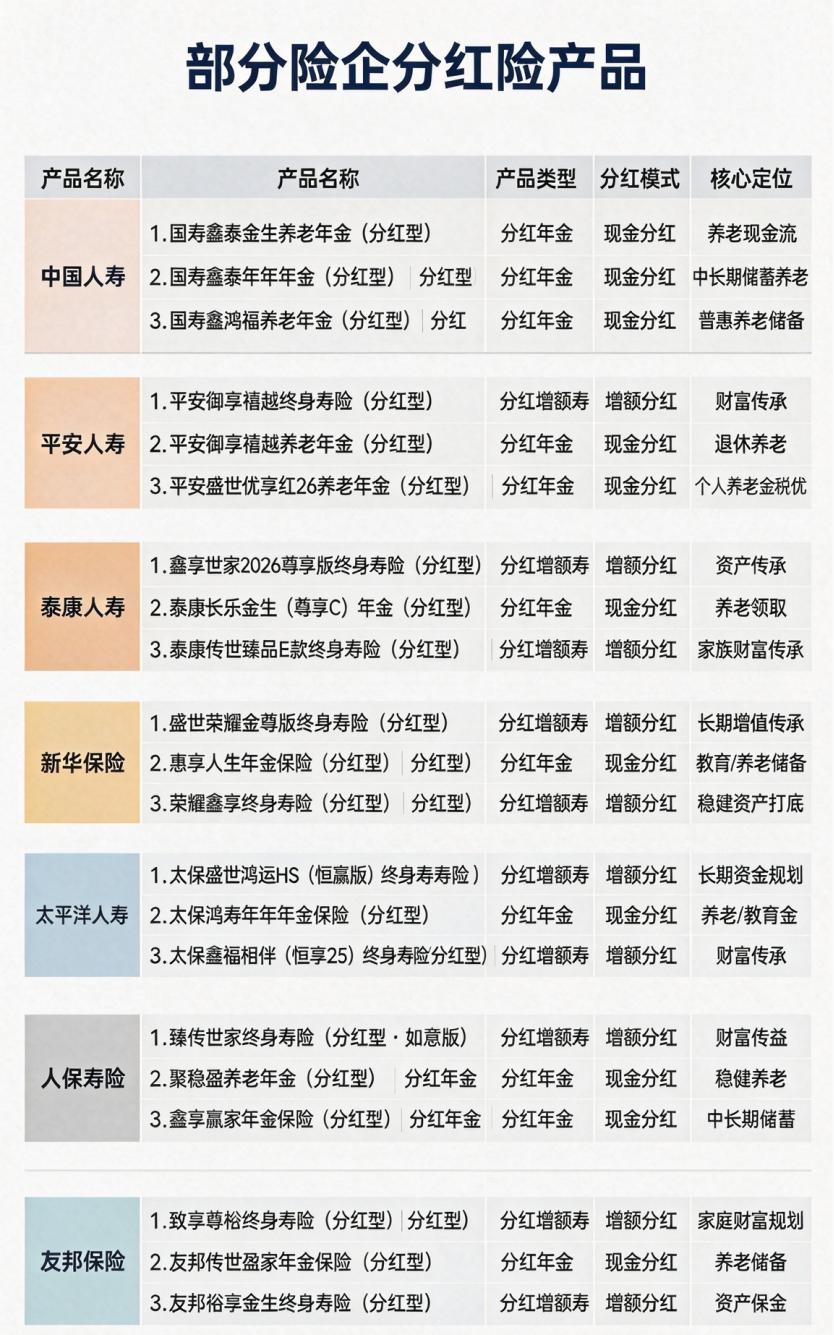
Figure: Produced by AI
Compared with Shen Lin, more young people favor insurance because it has both savings and risk protection functions.
25-year-old Zhou Ran has been purchasing insurance for himself for six years. He is the supervisor of a chain restaurant in Shenzhen, and the only child in his family. Since he started working and paying social security at the age of 19, he has been planning for insurance, and keeps adding insurance