Can the ever-faster developing AI help people age more slowly?
One day in the AI era equals a full year in the human world.
As large models are increasingly approaching the intelligence of top human experts, the time scale in the digital world has been rewritten. To seize the dividends of this AI wave, people are chasing new technologies day and night, for fear of becoming the "outdated" ones.
But humans are human after all, and the body follows its own biological clock. Staying up late takes time to repair, and exhaustion cannot be cleared with one click.
This autumn, "drink plenty of water, sleep well, build lean muscle" has become a popular slogan among young people. People show off their large water bottles and discuss sleep seriously. Taking good care of the body is placed at the very center of their life coordinates.
Although it carries a hint of self-mockery and internet meme culture, the wish it conveys is very real: through easy-to-control, minimal and self-disciplined health preservation, to save up "physical currency" for the future. So that health is no longer just the normal indicators on the physical examination report, but also the full of energy when you wake up in the morning, and the peace of mind when you get off work in the evening.
On the other side of the ocean, Silicon Valley tech billionaires also have a strong desire to take control of their bodies. Wealth gives them more choices, but aging and death will take everything away. Compared with the low-cost body management of ordinary people, they have invested heavily in longevity technology, inviting the smartest brains around the world to jointly study how to extend high-quality life.
At present, AI4S has become the key investment focus of tech giants. Letting AI and human scientists join hands to crack a large number of poorly understood laws in life sciences, helping humans fight aging and extend healthy lifespan, may be one of the most worthy investments from a human perspective.
Understanding life is undoubtedly a complex task.
On November 20, at the 3rd Hyaluronic Acid Industry Conference & Longevity and Aging Verification Science Conference hosted by Bloomage Biotech and Jigao Holding, Thomas Südhof, the 2013 Nobel Prize in Physiology or Medicine laureate, reminded that humans are not machines to be repaired by engineers, and one's health is also affected by mental state. Medicine is always individualized, and AI cannot replace the humanistic care in medical practice.
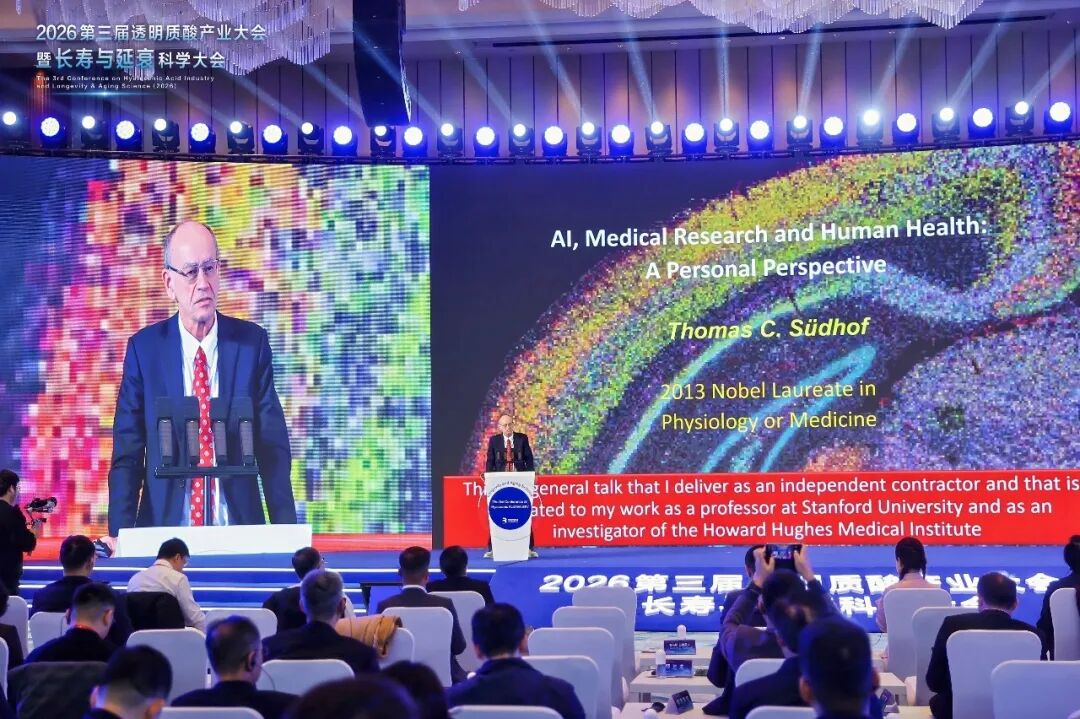
Keynote Speech by Thomas Südhof
In an era where instrumental rationality is paramount, longevity technology needs to be more rooted in the value of every individual, responding to the ordinary people's expectation of "living longer and living better".
Now, with the support of technologies such as AI and synthetic biology, the capacity for early scientific discovery and verification in longevity technology is accelerating. Next, from developing bioactive substances with clear efficacy to stable mass production and cost reduction, long-term accumulated engineering experience is still required in the whole process.
"Inclusive technology means that advanced life science achievements should not only stay in the laboratory, nor only serve a small number of people. On the contrary, through scientific verification, stable manufacturing and industrial application, they should benefit more ordinary people," said Zhao Yan, Chairman and President of Bloomage Biotech, in her speech at the conference.

Start aging slower when you are still young
As early as 2021, Sam Altman invested 180 million US dollars in longevity technology company Retro, with the goal of "adding ten healthy years to human life". This May, the company completed a new round of financing, and announced at the same time that its oral drug for improving autophagy (the process of cells cleaning up and recycling internal substances) has entered Phase I clinical trials.
Mark Zuckerberg and his wife, Jeff Bezos and other figures are all keen on life science research. Altos Labs, backed by Bezos, received 3 billion US dollars in funding commitments at its launch, and invited Nobel Prize laureate Shinya Yamanaka as a scientific advisor, focusing on research on cellular rejuvenation.
In the view of Qu Honglin, founding partner of Pantec Capital, behind the global boom of "longevity technology" is the encounter of ideology, science and capital. A group of entrepreneurs who are used to solving top-level problems with technology are taking aging intervention seriously. They are organizing resources to promote the emergence of the "Penicillin Moment" for anti-aging intervention therapies.
To find the answer, humans also humbly "learn from" other life forms.
The oddly cute naked mole-rat has become the object of repeated observation by scientists. This wrinkly animal is about the same size as a mouse, but can live up to 40 years, which is ten times the lifespan of an ordinary mouse. Moreover, even at an advanced age, its physical state remains active and healthy. Perhaps the rhythm of life's aging is not so uniform and inevitable?
Although the secret of the naked mole-rat's longevity has not been fully revealed so far, researchers have found that it has extremely strong anti-cancer ability, and this "special ability" is closely related to the high-molecular-weight hyaluronic acid in the naked mole-rat's body.
In 2023, a study published in *Nature* introduced the gene responsible for synthesizing hyaluronic acid in naked mole-rats into mice, and made it overexpressed. Mice that accumulated more hyaluronic acid in their tissues had reduced tissue inflammation during aging, and the incidence of tumors also decreased. In the past two to three years, many well-known universities such as the University of Cambridge and Stanford University are also actively exploring the value of hyaluronic acid in tissue regeneration, corneal repair, cancer resistance and other fields.
Hyaluronic acid, also known as "Hyaluronan", is widely known in China as a medical aesthetic filler and cosmetic raw material. Interestingly, while hyaluronic acid is being re-understood in scientific research, the consumer market once labeled it as "outdated".
From a marketing perspective, the exit of old ingredients is undoubtedly the best prelude for new ingredients to take the center stage. But medical aesthetics, skin care, medical devices and other products ultimately act on the human body, and different substances have different effects in the human body, which are not in a substitution relationship. Only by conforming to scientific laws can products play their expected efficacy.
"Cells and skin are living tissues and organs, and we cannot rely on a single ingredient to solve systematic problems," Zhao Yan once said in a media interview. Known as the "Queen of Hyaluronic Acid", she once worked hard to justify the name of this substance, but Bloomage's research on tissue regeneration and longevity has never stopped at hyaluronic acid.
At this conference, Zhao Yan said bluntly: "I don't want to promise a substance that can reverse aging, nor do I want to overdraw science with concepts."
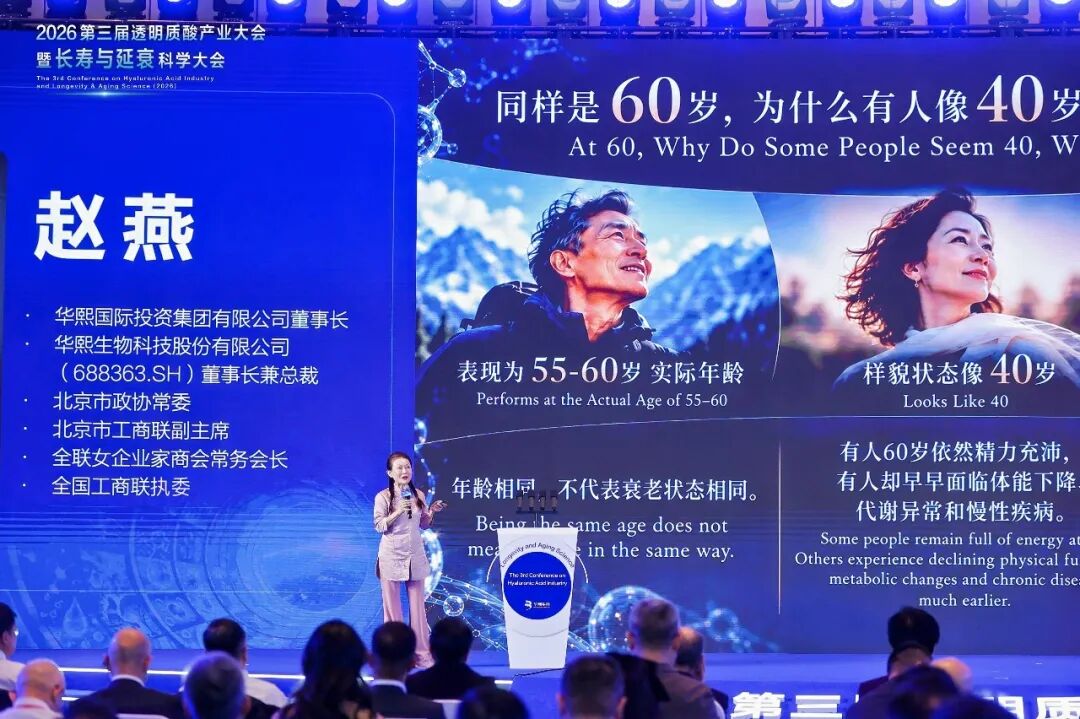
Speech by Zhao Yan, Chairman and President of Bloomage Biotech
Therefore, they chose a more systematic R&D path: extracellular matrix, intercellular communication, and intracellular health. The microenvironment where cells live affects how they perceive stress, how they communicate with surrounding cells, and whether tissues can maintain homeostasis and regenerative capacity.
Zhao Yan compares cells to "seeds", and the extracellular matrix (ECM) is exactly the "soil" for their survival. Molecules such as hyaluronic acid and collagen together form this layer of environment, undertaking tasks such as support, water retention and signal transmission, directly affecting the homeostasis and age of tissues such as the skin.
Dr. Wang Ruiyan, Vice President of Bloomage Biotech, once introduced that focusing on the cutting-edge direction of extracellular matrix, Bloomage is exploring the establishment of a digital ECM evaluation system integrating proteomics, two-photon imaging, AI and other technologies, to analyze skin aging from multiple dimensions such as composition and structure, so as to identify key anti-aging targets and support raw material development.
In addition to researching hyaluronic acid, chondroitin sulfate and other substances at the extracellular matrix level, Bloomage Biotech has developed heparin-based, PDRN and other ingredients in the field of intercellular communication; for intracellular health, it studies bioactive substances such as ergothioneine and PQQ around cell metabolism, mitochondrial function and other directions.
Perhaps on the marketing side, packaging a certain ingredient as a "magic pill" for anti-aging is easier to gain traffic and short-term revenue. But aging is a scientific problem that requires patient research: finding a molecule worthy of research, verifying its scientific mechanism, finding a way to mass-produce it stably, and then developing it into a product accessible to the public, every step takes time.
People are looking forward to the arrival of the "longevity escape singularity": in the future, the speed of medical breakthroughs may be one step faster than the speed of human aging. AI is delivering confidence to the longevity belief in the Silicon Valley tech circle.
AI accelerates synthetic biology research for longevity technology
On November 19, Anthropic went public. Before the bell-ringing ceremony, co-founder Dario Amodei talked about his father: the disease that took his father's life had a curable drug just a few years later.
The "few years earlier" in technological progress may mean the weight of life for a family.
Anthropic's investment in the life science field can be described as radical. This spring, they formed a new life science research team and built their own laboratory, letting Claude analyze DNA data, find protein families worthy of research, and then scientists carry out experimental verification. Also last week, Isomorphic Labs, a company spun off from Google DeepMind, completed a 5 billion US dollars Series C financing, investing in AI drug design and pipeline development.
The life science field contains a large number of laws to be deciphered, but the number of scientists in the past and the time they can devote to research are very limited. Dario believes that the cooperation between powerful AI and human scientists has the potential to compress the time for medical progress from a hundred years to ten years.
At this conference, Thomas Südhof, the Nobel Prize laureate in Physiology or Medicine, also pointed out that AI is good at processing massive, high-quality data, and has shown great value in target identification, molecular screening and other aspects.
Specific to longevity research, the first difficulty is that aging involves too many mechanisms. AI can identify patterns in life data of different scales, propose potential mechanisms of action, and then screen candidate molecules that may affect the aging process. This allows scientists to examine and evaluate more clues at the same time, and invest limited wet lab resources in directions that are more worthy of tracking.
After finding the target molecule, another problem immediately arises: how to obtain it?
Once hyaluronic acid could only be extracted from cockscombs, which was more expensive than gold; salidroside, ginsenoside and other substances could only be obtained from rare plants. But now with the development of synthetic biology, high-purity, low-cost bioactive substances can be mass-produced on a large scale and enter the homes of ordinary people.
The synthesis of a substance often requires multiple enzymes to work in relay. With the help of AI screening and prediction, combined with experimental feedback, the process of finding enzymes, modifying enzymes and optimizing synthetic pathways has been greatly improved in efficiency. It can be said that AI has made rational design of cell factories and accelerated iterative optimization of the DBTL (Design-Build-Test-Learn) closed loop a reality.
As Zhao Yan described, in the past it was more about "we look for whatever exists in nature"; now we are gradually moving towards "whatever life needs, we will research it, design it, and manufacture it".
Bloomage's research and development of PDRN is a specific attempt among them.
According to Wang Ruiyan, the Bloomage team took the salmon genome as the blueprint, constructed a library of more than 1000 gene sequences, developed recombinant PDRN with a single sequence through AI-assisted high-throughput screening, recombinant expression of engineering bacteria, and then carried out cell tests and human tests. With the help of AI, they tried to decrypt: which DNA fragments exactly help skin cells repair damage.
Once PDRN could only be extracted from salmon, this exploration makes directional biomanufacturing of recombinant PDRN possible.
Zhao Yan summarizes the process of AI applied to synthetic biology R&D as "computational prediction, experimental verification, data feedback, continuous optimization". In her view, relying on the long-term accumulated data and platform capabilities of the Bloomage platform, part of the innovation processes that originally took "years" as units may be shortened to "months".
In the future, with the further integration of AI and automated experiments, the unit of iteration speed may be compressed to "days".
Part of her confidence comes from the synthetic biology pilot platform built by Bloomage with an investment of 3 billion RMB, and the continuous stream of wet experiment data it can generate.
Crossing the "Valley of Death" in biomanufacturing, no need to reinvent the wheel
Four or five years ago, synthetic biology was once a hot track in the primary market. However, the grand dream of "biology makes everything" was doused by the reality of the market. Many companies that are good at laboratory R&D failed at the pilot process scaling and mass production stage, and failed to cross the dual "Valley of Death" from laboratory to factory, and then to the market.
"Being able to make it in the laboratory does not mean being able to manufacture it stably in the factory; being able to produce it in the factory does not mean being able to maintain consistency across different batches; a product with biological activity does not mean that its health value to the human body has been proven," Zhao Yan sharply pointed out at the conference.
As one of the six future industries in the 15th Five-Year Plan, the biomanufacturing chain is extremely long. In the years when capital poured in, many companies wanted to complete the whole process from the initial strain design all the way to end product development and marketing. However, after going through this process, many companies realized that the core capabilities required for each link are significantly different, and the "technology stack" of most startup teams is concentrated in the front-end R&D.
Take the pilot stage as an example. One step further from small-scale R&D, the scientific research team has to face engineering personnel recruitment, pilot equipment procurement, factory construction, process development and quality management. Repeated construction of pilot bases not only consumes capital, but also restricts R&D progress. The strain technology that was originally leading the market may lose its first-mover advantage while waiting for the construction of the pilot factory.
As the industry matures and becomes rational, more refined division of labor is inevitable. Let those who are good at front-end R&D focus on strain design, so that scientists do not have to rebuild a factory for every new molecule, and cooperate in an open ecosystem, so that innovation can run faster.
Bloomage Biotech spent more than 20 years to get through the complete industrial chain of hyaluronic acid. Now, Zhao Yan is trying to transform this complete "model" from basic research, applied research to product development and brand building into capabilities that other scientific research teams can leverage, to accelerate the development of many substances such as sugars, proteins and polypeptides.
The Tianjin synthetic biology pilot platform built with an investment of 3 billion RMB is exactly the key hub connecting all parties.
It is understood that the platform is equipped with 64 flexible pilot production lines, adopting a modular design. According to the requirements of different strains, culture conditions and reaction processes, the platform can adjust equipment configuration and production conditions to support the process verification needs of a variety of target products.
When it was completed in 2024, the Tianjin pilot platform already had the ability to collect and store production data in real time. The command center can monitor production indicators, analyze data and give early warnings, and the fermentation process can also be automatically controlled by the system. That is to say, while the