Just now, the lead behind Claude's Riemann Hypothesis proof has responded to everything.
Over the past few days, discussions around Claude's involvement in proving the Riemann Hypothesis have almost swept through the entire tech circle and the mathematics community. One of the most widely talked-about details, is that if this proof is translated into text readable by humans, it will exceed 250,000 pages in length.
However, the person involved in the incident has finally come forward to clarify, the so-called 250,000 pages was actually a joke he made.
Just now, Levent Alpöge, a mathematician at Anthropic, published a long post on social platform X, responding to the numerous controversies surrounding the proof of the Riemann Hypothesis over the past few days, and reflecting one by one on the mistakes he made during the release of the results.
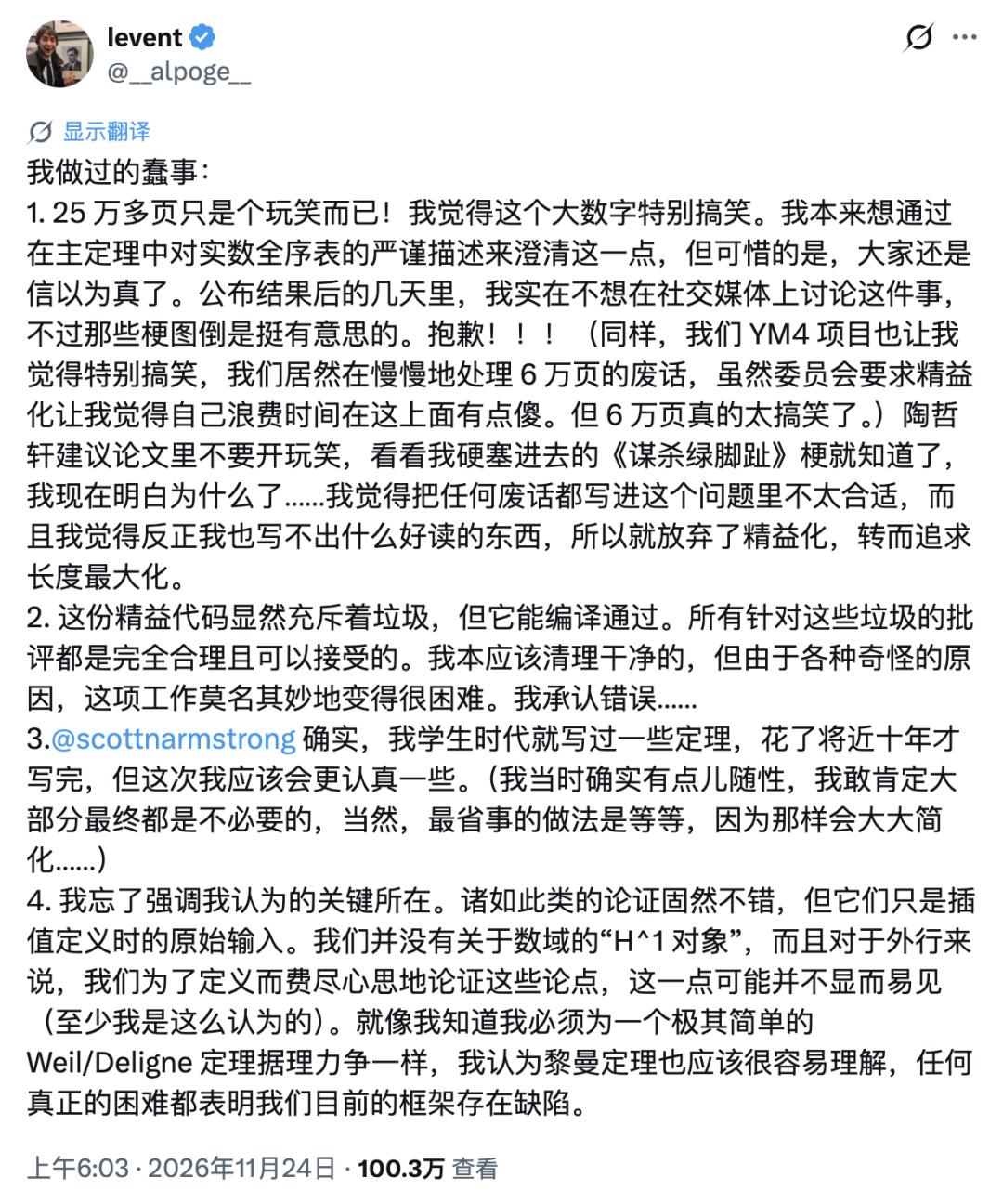
Figure |🔗 https://x.com/__alpoge__/status/2124987173439209561
"Guys, the over 250,000 pages was a joke! I just think really big numbers are hilarious."
Alpöge stated that he originally thought his deliberately tedious description of the total order relation of real numbers in the main theorem would be enough to make people realize the humorous element in it, but he did not expect that the outside world would really take this number as a fact and spread it widely.
Since he did not want to speak on social media in the days after the results were announced, he did not clarify in time, but he did see a lot of memes made by netizens. "Terence Tao advised not to make jokes in papers, and now I finally understand why."
250,000 pages was a joke, but 17.37 million lines of code are the real challenge
The incident dates back to November 20.
On that day, Alpöge announced on his personal website that he had completed a formal proof of the Riemann Hypothesis and the Generalized Riemann Hypothesis in collaboration with Claude.
According to previously disclosed information, the entire research project was launched on October 6 and lasted for about 41 days. Alpöge and Claude completed the final step of the core proof on November 15, and then extended the research results to the Generalized Riemann Hypothesis on November 16.
Different from the release method of traditional mathematical research results, Alpöge did not provide a complete natural language paper, but publicly released a description document of only 4 pages, as well as a set of Lean formal proof code of astonishing scale.
According to previously disclosed statistics, this set of code contains 175,187 Lean source files, about 17.37 million lines of code, divided into 14 compressed packages for the public to download.
Lean is a formal proof assistant that can check whether mathematical reasoning conforms to strict logical rules through the computer kernel. Mathematicians can use it to transform theorems, definitions and reasoning processes into code that can be verified by machines.
On November 21 local time, the Lean and Mathlib communities issued a joint statement, stating that they have full confidence in the correctness of this formal proof. Andrew Sutherland, a mathematician at MIT, also conducted independent verification of the relevant code.
However, the code passing formal verification is still a different matter from mathematicians completing the understanding of the entire proof idea, peer review, and the Clay Mathematics Institute formally recognizing this achievement.

In his response this time, Alpöge also admitted that the Lean code he submitted does have a lot of redundancy and quality problems.
"There is obviously a lot of garbage in the Lean code. Although it can be compiled, all criticisms of this garbage code are reasonable, and I fully accept them."
He said that he should have organized the code before releasing it, but for various reasons, this work was much more difficult than expected.
Facing the outside world's doubts about the progress of proof sorting, Alpöge also confessed that as early as his student days, he spent nearly ten years sorting out the theorems he had proved. But for a major achievement like the Riemann Hypothesis, he thinks he should act more responsibly.
He also revealed that a large amount of content in the existing proof may eventually be unnecessary, and as researchers deepen their understanding of the proof structure, the entire argument is expected to be greatly simplified.
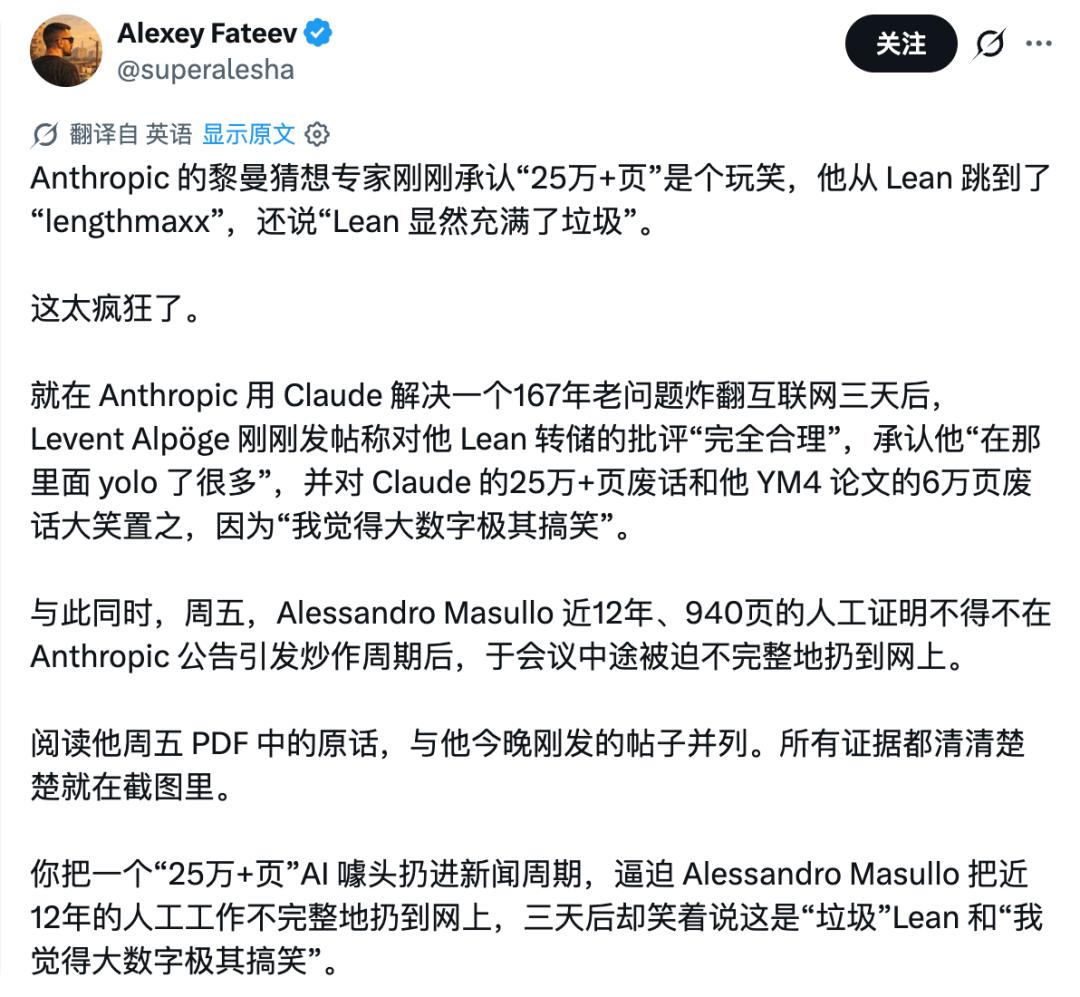
However, netizen Alexey Fateev criticized this, arguing that the public opinion boom triggered by Anthropic forced another mathematician Alessandro Masullo to publicly release his 940-page manuscript of the proof of the Generalized Riemann Hypothesis that took nearly 12 years in advance. Against this background, Alpöge's explanation of "250,000 pages" as a joke seems somewhat irresponsible.
Things More Important Than Proving the Riemann Hypothesis
In addition to responding to the controversy, Alpöge also specially supplemented a mathematical point of view that he did not fully emphasize when he originally announced the results.
In his view, while proving the Riemann Hypothesis is important, the mathematical ideas generated in the proof process should also serve a deeper goal, that is, to establish more natural and unified mathematical definitions and theoretical frameworks.
For example, the mathematics community has not yet established an "H¹ object" on number fields that meets his vision. Alpöge believes that one of the important purposes for mathematicians to invest a lot of energy in studying complex arguments is to accumulate materials for constructing new mathematical concepts.
He hopes that the Riemann Hypothesis will eventually have a more natural and concise proof, just as he previously pursued a concise understanding of the relevant theories of Weil and Deligne.
"I think the Riemann Hypothesis should be easy. Any real difficulty probably means that the theoretical framework we are currently using is not good enough."
Of course, the "easy" here means that under a suitable mathematical theoretical framework, the proof process is expected to become natural and concise, and it does not deny the research difficulty of this problem that has plagued the mathematics community for 167 years.
It is worth noting that Claude has made research progress related to the Riemann Hypothesis as early as August this year.
At that time, Anthropic announced that Claude had independently completed a mathematical study, raising the lower bound of the proportion of non-trivial zeros of the Riemann zeta function on the critical line from 41.6% to 67.2%.
However, Anthropic also clearly pointed out at that time that the technical route adopted in this study was not expected to directly prove the complete Riemann Hypothesis.
In contrast, the results announced in November adopted a research method of collaboration between human mathematicians and AI, with Alpöge guiding the direction of mathematical research and Claude undertaking a large number of derivation and formalization work.
According to Alpöge's previous disclosure, when the research was nearing the end, Claude was already advancing the argument faster than himself, so that when the entire formal proof was completed, he had not yet fully digested some of the mathematical details in it.
To a certain extent, this oolong incident about the 250,000-page proof has just exposed an increasingly unavoidable problem after AI participates in cutting-edge mathematical research.
In the past, mathematicians needed to spend a lot of time looking for proofs, and once they found the answers, the research work made decisive progress. But as AI begins to participate in mathematical derivation on a large scale, the speed of generating proofs may far exceed the speed at which humans can understand proofs.
Computers can check whether a set of arguments is valid, but extracting new mathematical concepts from complex derivations, finding more concise proofs, and transforming these ideas into knowledge that can inspire other researches still requires a lot of work.
When AI begins to accelerate the answering of mathematical questions, the challenge that human mathematicians will face next is perhaps how to make these answers truly become part of human knowledge.
This article is from the WeChat official account "APPSO", author: The one who discovers tomorrow's products, released by 36Kr with authorization.