Beijing will renovate no less than 1,000 old residential communities, and ensure that elevators are installed in all buildings that meet the installation conditions!
Over the five years starting from this year, the pace of installing elevators in old residential buildings in Beijing will be accelerated, if all residents of the old building reach a consensus on the willingness to install elevators, the principle of "installing elevators wherever possible" will be fully implemented.
At the same time, for residential compounds already equipped with elevators, if the elevators have been in use for more than 15 years, the government will also support the renewal of old and outdated elevators.
This good news comes from the *Beijing Urban Renewal Plan for the 15th Five-Year Plan Period* newly released by the Beijing Municipal Government. It also puts forward that, during the 15th Five-Year Plan period, Beijing will start the renovation of no less than 1000 old urban residential compounds, and at the same time push forward the renovation of municipal-owned old residential compounds completed from 2001 to the end of 2005 in a sequential and seamless manner.
1
What is "urban renewal"? Simply put, it does not mean demolishing and flattening all old blocks for reconstruction, but "renovating, upgrading and fixing problems" for old urban areas, so that the old places can continue to be functional and adapt to modern life. It covers not only the renovation of old residential compounds, the renewal of old streets, but also the reuse of old factory buildings and other related sectors.
The Plan proposes that by 2030, major progress will be made in the urban renewal initiative, with the annual investment in urban renewal reaching 300 billion yuan. By 2035, a modern people-oriented city that is innovative, livable, beautiful, resilient, civilized and smart will be basically completed.
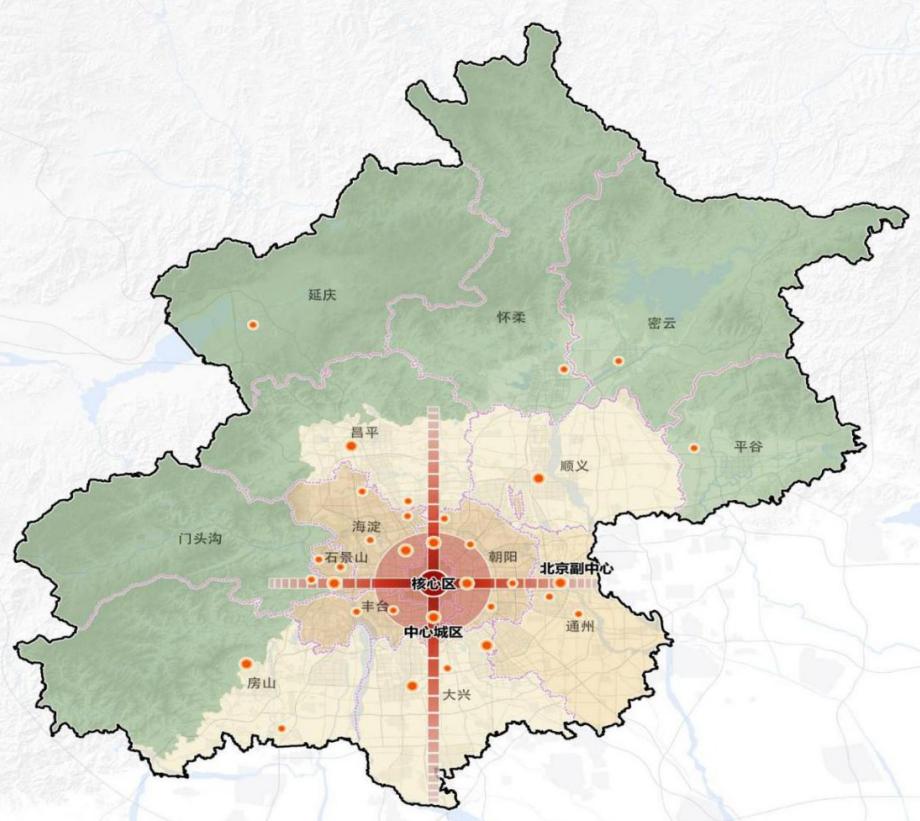
Despite the huge investment in urban renewal, it will not be spread out in an unplanned sprawling manner. In accordance with the spatial structure of "one core, one main urban area, one sub-center, two axes, multiple points and one ecological zone" defined by the Master Plan of Beijing, 33 municipal-level key urban renewal areas are designated in this urban renewal plan.
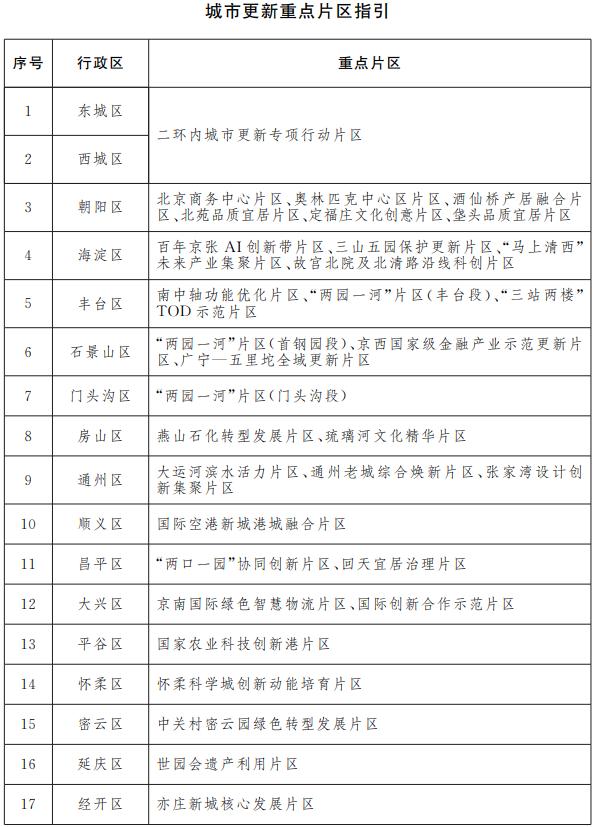
These 33 key areas are all priority regions with urgent needs for people's livelihood improvement, strong development momentum and remarkable driving effect. They will aim to build high-quality, modern vitality centers, with the renewal orientation of balancing work, residence and commercial services, integrating industry, city, transport hubs and urban functions, and combining culture, business, tourism and sports.
2
The renovation of old residential compounds and the installation of elevators are issues that residents pay close attention to.
The Plan proposes that during the 15th Five-Year Plan period, Beijing will focus on carrying out special physical examinations for urban residential compounds that have been completed for more than 20 years.
A few days ago, when we released the *Beijing Housing Development Plan for the 15th Five-Year Plan Period*, we informed everyone that the scope of Beijing's old residential compound renovation will be expanded. It is no longer limited to compounds completed in 2000 or earlier, and the municipal-owned residential compounds completed from 2001 to 2005 will also be promoted for renovation.
The newly released urban renewal plan also clearly states that it will continue to promote the renovation of old residential compounds completed before the end of 2000 with strong willingness of residents, make greater efforts to push forward new progress in the renovation of old residential compounds owned by central government and military entities, push forward the renovation of municipal-owned old residential compounds completed from 2001 to the end of 2005 in a sequential and seamless manner, and further strengthen the whole-process quality control of renovation projects.
Please note the expression "sequential and seamless" here: when used in work and policy scenarios, it means that before the previous phase is fully completed, the next phase will be launched in succession, with each phase closely connected to the next, no waiting and no gap between phases.
That means, while wrapping up the renovation of old residential compounds completed before the end of 2000, Beijing will successively launch the renovation of residential compounds completed from 2001 to 2005.
The Plan reveals that during the 15th Five-Year Plan period, Beijing will start the renovation of no less than 1000 old urban residential compounds, including promoting the new renovation projects of old residential compounds owned by central government and military entities.
Many followers left messages before saying that some old buildings do not need to be renovated and should be reconstructed instead. In fact, Beijing also has relevant policies: for dilapidated old buildings that meet relevant conditions, on-site reconstruction is allowed. In the past two years, a number of dilapidated old buildings have been reconstructed, and residents have moved into new homes at the original sites.
The Plan also puts forward that the implementation of independent renewal projects for dilapidated old houses will be encouraged. Dilapidated old houses that meet the requirements of plans and policies and have unified willingness of the masses will be supported to be renovated through reconstruction. The implementation mode of "the property right subject remains unchanged, and the implementation subject acts as the construction agent" will be optimized, and researches will be carried out to reduce the reconstruction cost of dilapidated old houses. Adhere to the financing principles of "the owner pays" and "the payer benefits", and encourage to meet residents' reasonable housing financing needs through methods such as provident fund withdrawal, reconstruction loans, and reconstruction with existing mortgages.
3
Regarding the installation of elevators in old residential buildings, the Plan clearly states that efforts will be made to vigorously promote the installation of elevators in old residential buildings and the renewal of old residential elevators. For old residential buildings where all residents reach a consensus on the willingness to install elevators, the principle of "installing elevators wherever possible" will be implemented.
This includes two scenarios: the first is old buildings that are not equipped with elevators at all, where elevators can only be installed later. Of course, elevator installation involves the rights and interests of all residents in the building, so a unified willingness of all residents is required. For old buildings with unified resident opinions, during the 15th Five-Year Plan period, as long as the engineering conditions permit, elevators will be installed for all eligible buildings.
The other scenario is old buildings that already have elevators, which are very common in Beijing. The elevators in these buildings have been in use for many years and are already outdated. For this scenario, the Plan also puts forward the measure of "replacing elevators", supporting the renewal of old residential elevators that have been in use for more than 15 years. Make full use of the support from ultra-long-term special treasury bonds to promote the renewal of more than 20,000 old residential elevators.
This article is from the WeChat Official Account "Jingfangzi", author: Jingfangzi, published by 36Kr with authorization.