The Shocking Secret Behind Jensen Huang's Reinstatement, Three Major Events in Silicon Valley Have Changed the Situation
Jensen Huang's reinstatement this time was not a change of heart by the board of directors, but a move forced by external pressure.
On November 14, the heads of two major shareholder funds, Brad Gerstner and Gavin Baker, publicly published an open letter to the board of directors on X, demanding that the succession search process be slowed down and the possibility of Jensen Huang returning be retained.
According to their positions at the end of June, the two parties held a total of approximately 2.1 billion U.S. dollars in NVIDIA stocks, with a 50% book loss, which is roughly 1 billion U.S. dollars.
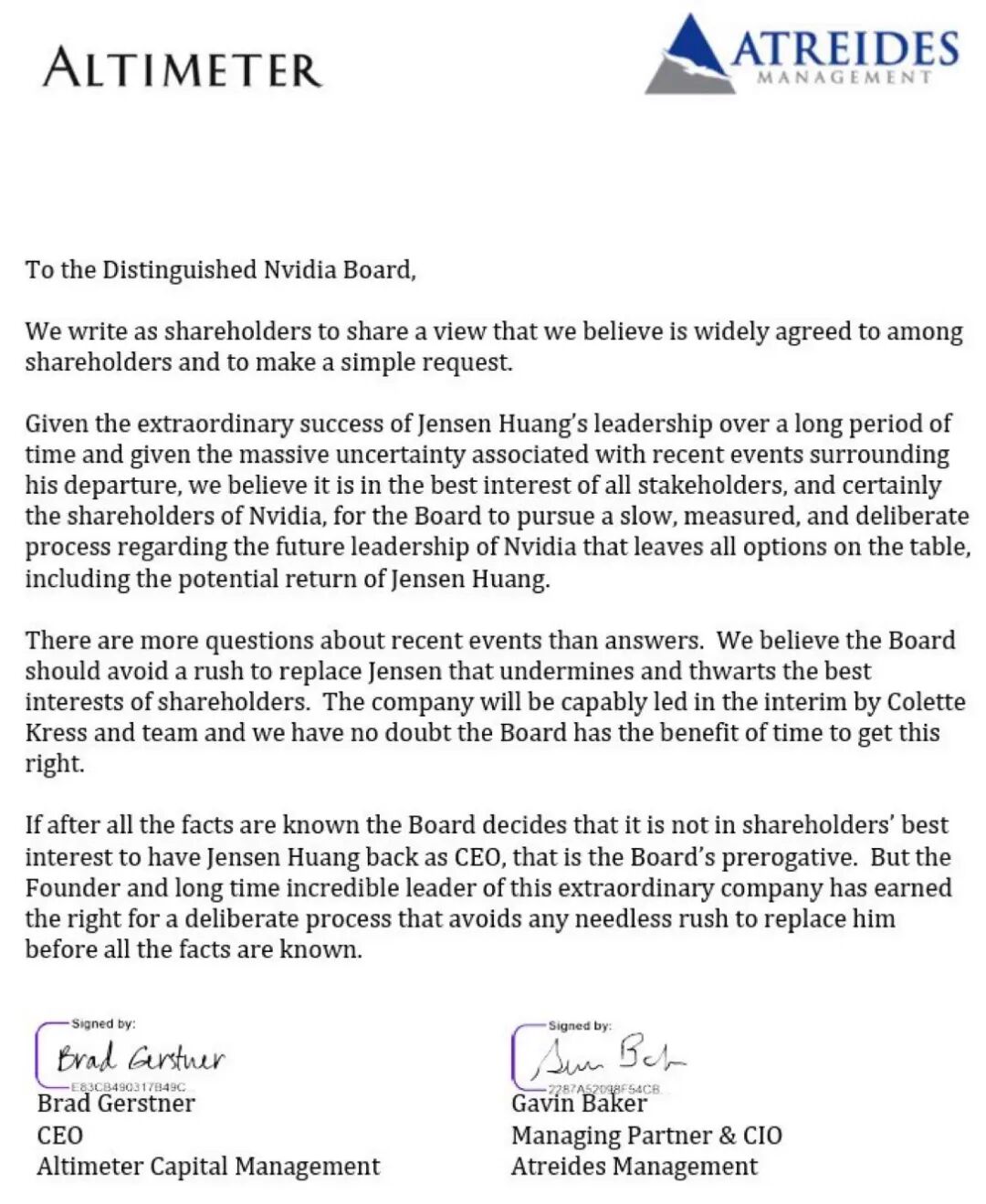
For these Wall Street major shareholders, this is no longer a dispute over corporate governance principles, but an asset defense battle involving billions of dollars. For every 10% drop in stock price, the total market value of the positions held by the two funds may evaporate by hundreds of millions of dollars.
On November 23, Jensen Huang resumed his post, and within one day, the market value rose back by nearly 1 trillion U.S. dollars. One person left and one person came back, and NVIDIA's market value took a roller coaster ride.
Many people regard this incident as a corporate governance turmoil. But we believe that the real answer is hidden in a long article that went viral in the AI circle this week, and in a very inconspicuous word: channel.
Today we mainly discuss three issues.
First: Why did the board of directors turn back in just eleven days?
Second: What exactly did that long article that went viral across the Internet say, and what is this channel?
Third: Why is this channel inseparable from Jensen Huang?
You will find out when you read to the end.
So why did the board of directors turn back in just eleven days? There is not a single word mentioned in the reinstatement announcement, only stating that the reinstatement "is in the best interests of shareholders, employees, partners and customers". But the timing is too coincidental. Right on this weekend, three major events happened one after another in the AI technology circle.
The first event: The Riemann Hypothesis has been proven.
The Riemann Hypothesis was proposed by the German mathematician Riemann in 1859. It describes the law of prime number distribution and is one of the seven Millennium Prize Problems with a $1 million reward from the Clay Mathematics Institute. For more than 160 years, no one has been able to prove it. On November 20, Alptekin Arp, a mathematician at Anthropic, released a four-page note saying that he, together with Claude, had found the proof.
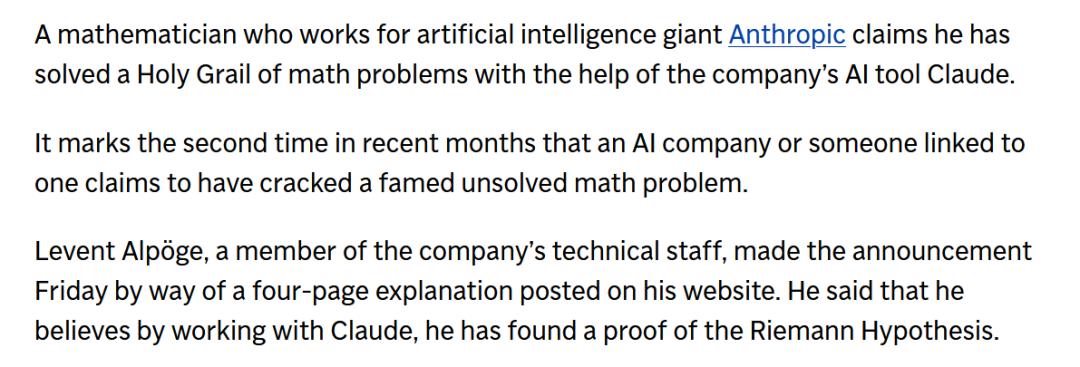
This proof is written in a mathematical programming language called Lean. It is reported to exceed 17 million lines, with more than 170,000 files, and takes up more than 60GB when decompressed. Human mathematicians cannot read it line by line at all, and can only rely on another set of programs to check it.
On November 21, the official Lean organization and the mathematical library Mathlib issued a joint statement saying that they have full confidence in this proof, and two independent inspection tools have confirmed that it proves the Riemann Hypothesis itself.
Mathematician Sutherland from MIT also completed an early review. Another completely independent reconstruction yielded the proof file that is exactly the same down to every byte. Of course, it should be made clear that the full human-readable paper has not yet been published, and the Clay Institute has not changed its status.
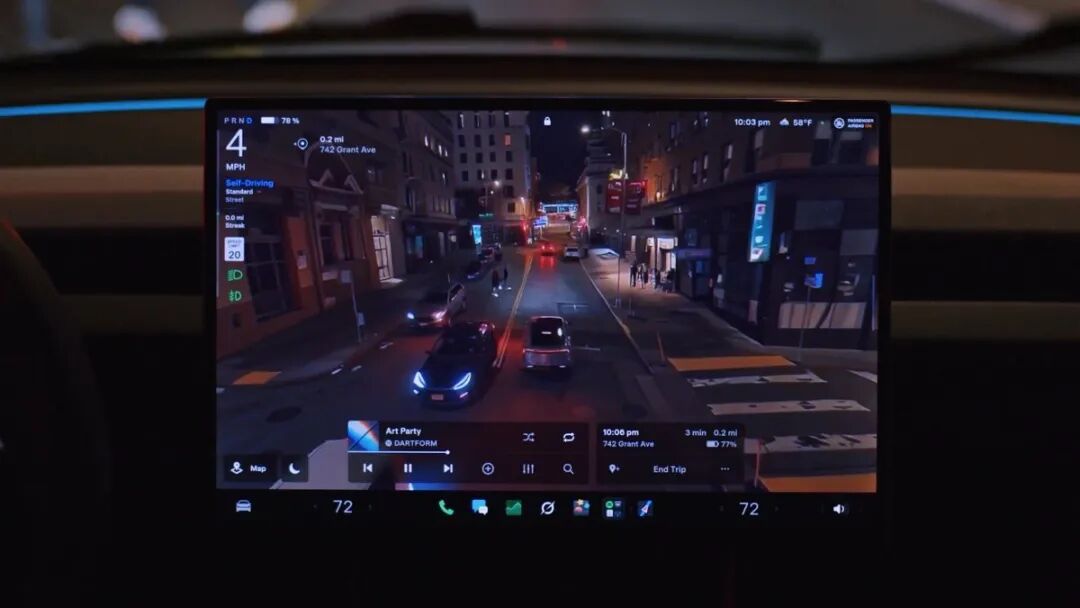
The second event: Tesla's FSD V15 started rolling out to the first batch of car owners on November 21.
The most prominent change is called Reality View: the picture on the infotainment screen is no longer the previous blocks and lines, but an AI model with about 1 billion parameters that generates a near-real street view in real time. Elon Musk said on X that V15 is the beginning of the "superintelligence" part of Tesla AI.
The third event: On November 22, the same day the board of directors voted, Alexander Wang, Meta's Chief AI Officer, published a long article titled "Superintelligence Is Coming", which quickly went viral. The team he leads is exactly Meta's Superintelligence Lab.
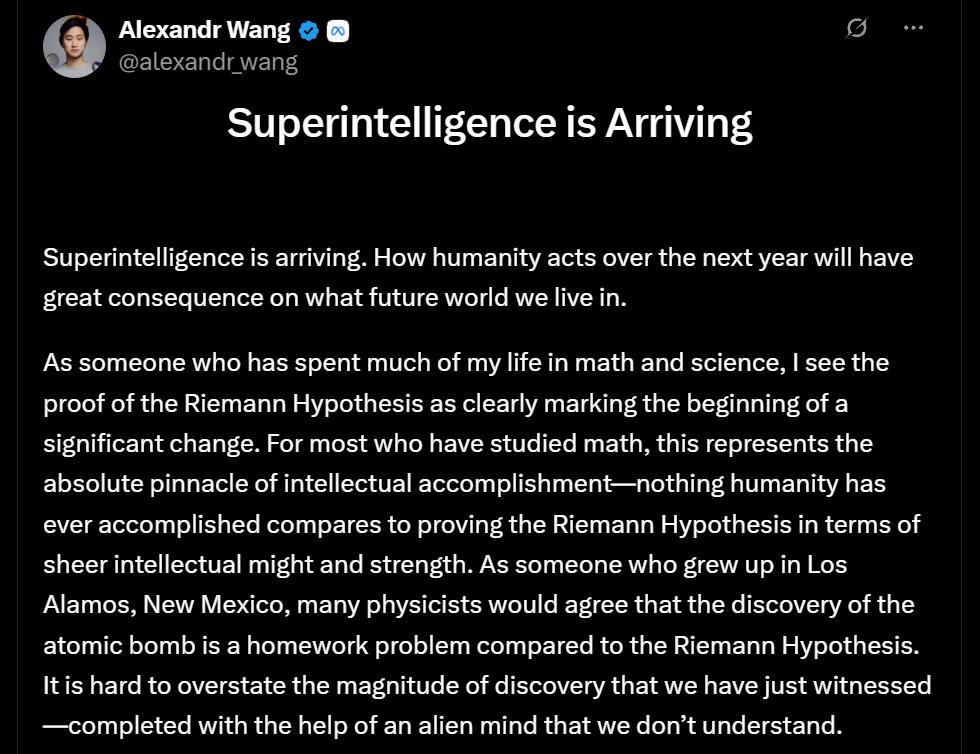
The logic of this article is divided into three steps, each step more impactful than the last.
The first step: He says the Riemann Hypothesis is the ceiling of human intelligence.
The original text is: For most people who have studied mathematics, it represents the absolute peak of human intellectual achievement. Alexander Wang grew up in Los Alamos, New Mexico, USA, where his parents were both physicists, and Los Alamos was the very place where the atomic bomb was built back then.
He says many physicists would agree that compared to the Riemann Hypothesis, discovering the atomic bomb is just a homework assignment. And now, this problem has been completed with the help of an "alien mind" that we do not understand.
The second step: The hardest problems in almost every field are simpler than the Riemann Hypothesis.
So he judges that for models to far surpass humans in every field, the remaining gap is no longer about intelligence, but three things: industry experience, channels, and experiments. The word "channel" is a common saying in Silicon Valley, referring to those inconspicuous infrastructures that cannot function without them. To put it plainly: the brain has been built, and what is missing is the blood vessels that supply it with blood.
The third step: His judgment is the most alarming.
He believes that most researchers would agree that AI research itself is much simpler than proving the Riemann Hypothesis. That means the model will soon be smart enough to automate all AI research, approaching superhuman capabilities in improving itself.
AI researches AI by itself and makes itself smarter. So he says what humans do in the next year will determine what kind of future we live in.
Objectively speaking, this article has also received a lot of criticism. Some people say that he is justifying Meta's huge AI investment; he himself has not given specific plans for what to do. But for investors, what matters is not whether he is right, but that the core group of people in Silicon Valley are already spending money according to this script.
So what exactly is this channel? The answer is just two words: computing power.
Take Tesla as an example again. Elon Musk himself admitted that the image latency of Reality View is relatively high, due to limited computing power. This model only uses half of the six neural network accelerators in the car's AI4 chip.
He says that after improving the algorithm, the latency can be reduced by about 35%; while the computing power of the next-generation AI5 chip is about 12 times that of AI4. Even drawing a real-time image on the screen of a car is competing for computing power.
What about when AI starts doing AI research on its own?
Every round of self-improvement requires training new models and conducting a large number of experiments. The "experiments" Alexander Wang mentioned, in the final analysis, are consuming computing power. So once AI completes the research on its own, the demand for computing power will no longer be a line rising diagonally, but will turn into a vertically rising curve.
And the company that has deployed the most of this channel in the world is NVIDIA.
In the financial report released on November 17, NVIDIA's quarterly revenue reached 115.8 billion U.S. dollars, of which the data center business accounted for 107.6 billion U.S. dollars, a year-on-year increase of 110%; the company also gave a guidance of 130 billion U.S. dollars for the next quarter.
The new-generation Vera Rubin platform is the fastest-scaling product in the company's history. Interestingly, Meta, where Alexander Wang who wrote this long article works, plans to expand the deployment of Vera Rubin in this financial report; Anthropic, which proved the Riemann Hypothesis, also obtained more NVIDIA computing power in this financial report.
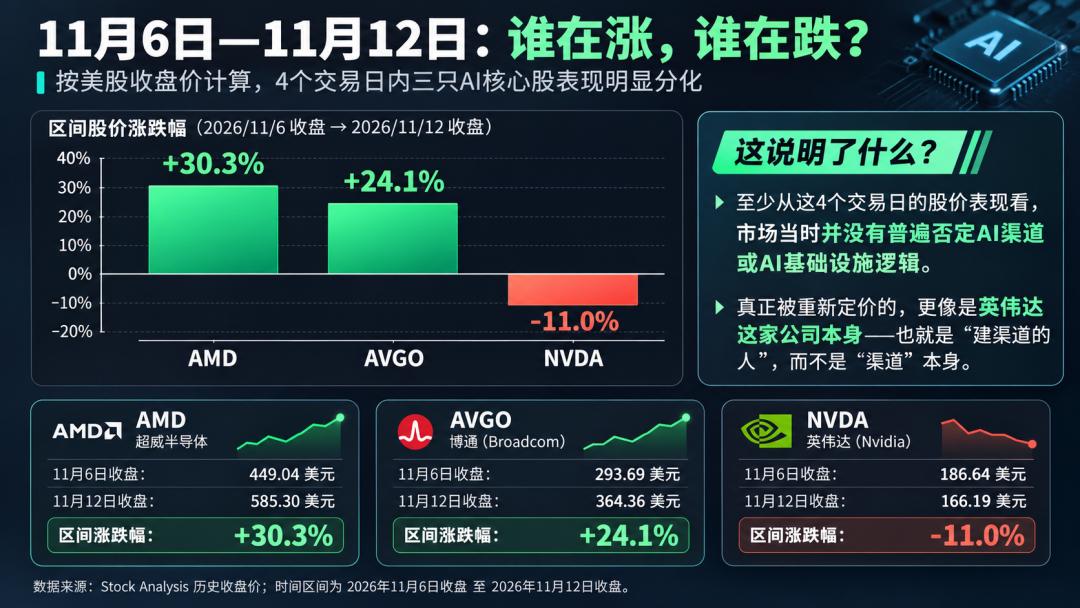
Our U.S. stock big data also found a detail: During the days when Jensen Huang had the incident, the capital did not leave the AI chip sector at all. From November 6 to 12, over four trading days, AMD rose by 30%, Broadcom rose by 24%, and only NVIDIA fell by 11%.
That means the market has never doubted the channel, what it doubted was the person who built the channel.
This is why NVIDIA cannot do without Jensen Huang. In this most critical year, what NVIDIA needs is a person who dares to bet all his net worth.
Jensen Huang did this once. In 2006, NVIDIA launched CUDA, enabling graphics cards that were originally only used for gaming to perform general-purpose computing.
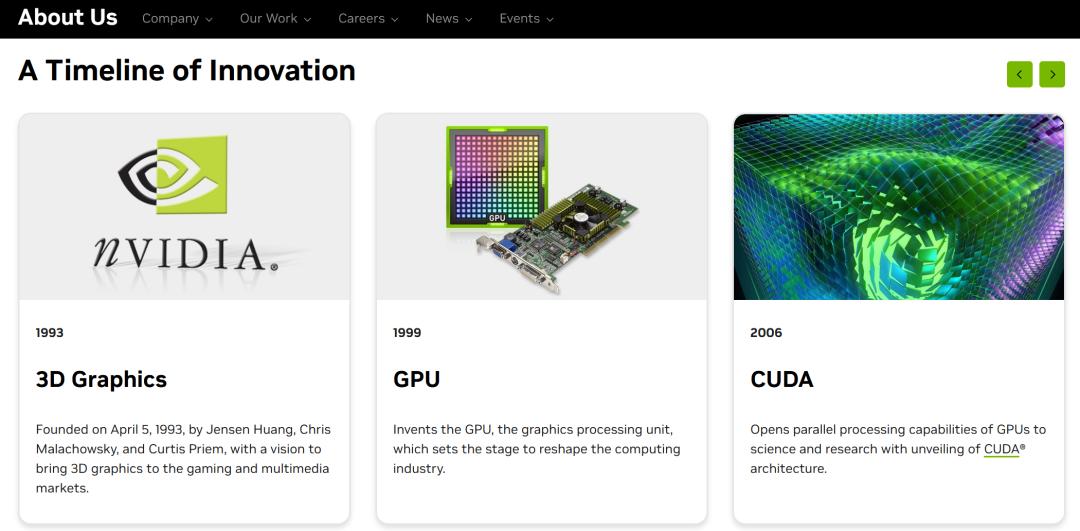
Jensen Huang made a decision that many people could not understand: equipping every graphics card with CUDA, even though most players would never use it at all.
Costs went up, profits were dragged down, and Wall Street questioned it for many years.
Spending so much money on something no one uses, what's the point? It wasn't until 2012 that a team from the University of Toronto used two NVIDIA gaming graphics cards to train the image recognition model AlexNet, and deep learning exploded all at once, making CUDA the foundation of the entire AI era. He bet for six years and won the bet on an entire era.
Now, AI starts researching AI, and the demand for computing power may surge vertically. How to arrange the next-generation chips, how much production capacity to order, which big customers to bind together, every decision is a bet of tens of billions of dollars.
The board of directors can find a qualified CEO, but it is very difficult to find another person who dares to take such big bets and has won such bets before. That's why Elon Musk said that without Jensen Huang, some key contracts would be lost.
Of course, now that he is back, the shackles are still there. The board of directors made it very clear in the announcement:
The investigation committee composed of independent directors will follow through on the investigation, and Jensen Huang said he will fully cooperate;
The company has also newly established a committee composed exclusively of independent directors, which is specifically responsible for overseeing compliance risks;
At the same time, a new Chief Compliance Officer position will be created, reporting to the Nomination and Corporate Governance Committee under the board of directors, and the recruitment is still in progress. Next, from December 1 to 3, he will face the U.S. Congress for three consecutive days; before December 4, the company also needs to submit this quarter's quarterly report.
Jensen Huang said in his statement that he will take on this responsibility with the greatest humility and brand-new dedication. He only left one sentence at the end: I can't wait to get back to work.
Wall Street is gradually realizing that NVIDIA's truly irreplaceable asset may not be the GPU, nor CUDA, but Jensen Huang himself.
From TSMC's advanced process production capacity, to procurement commitments from global AI giants, to the complex financing and credit relationships behind Neo Cloud's new cloud computing, the business ecosystem formed over many years largely depends on the trust built by Jensen Huang personally.
Therefore, what the shareholders are trying to save is not just a CEO, but the confidence foundation of NVIDIA's entire business empire. When the interests of shareholders, the will of employees, and the pressure of the capital market all point to the same person, how much choice does the board of directors have left?
Alright, that's the end of today's article. The conclusion of our U.S. stock big data team is:
When one person resigned, the market value evaporated by up to 600 billion U.S. dollars during intraday trading;
When the same person came back, the market value rose back by nearly 1 trillion U.S. dollars in one day.
The market is telling you with real money: In the superintelligence race, channels are the most valuable, and the people who can maintain and operate these channels are also invaluable.
Where do you think Jensen Huang will make his first move after returning? Will it be the next-generation chips, production capacity, or retaining the core team?
This article is from the WeChat Official Account "US Stock Investment Network" (ID: tradesmax), Author: StockWe.com, Published with authorization from 36Kr.