In the race to hit the "two-trillion" milestone, this provincial capital in central China has finally caught the "light".
"Stand in the light, don't just stand there." This time, the "light" falls on Nanchang.
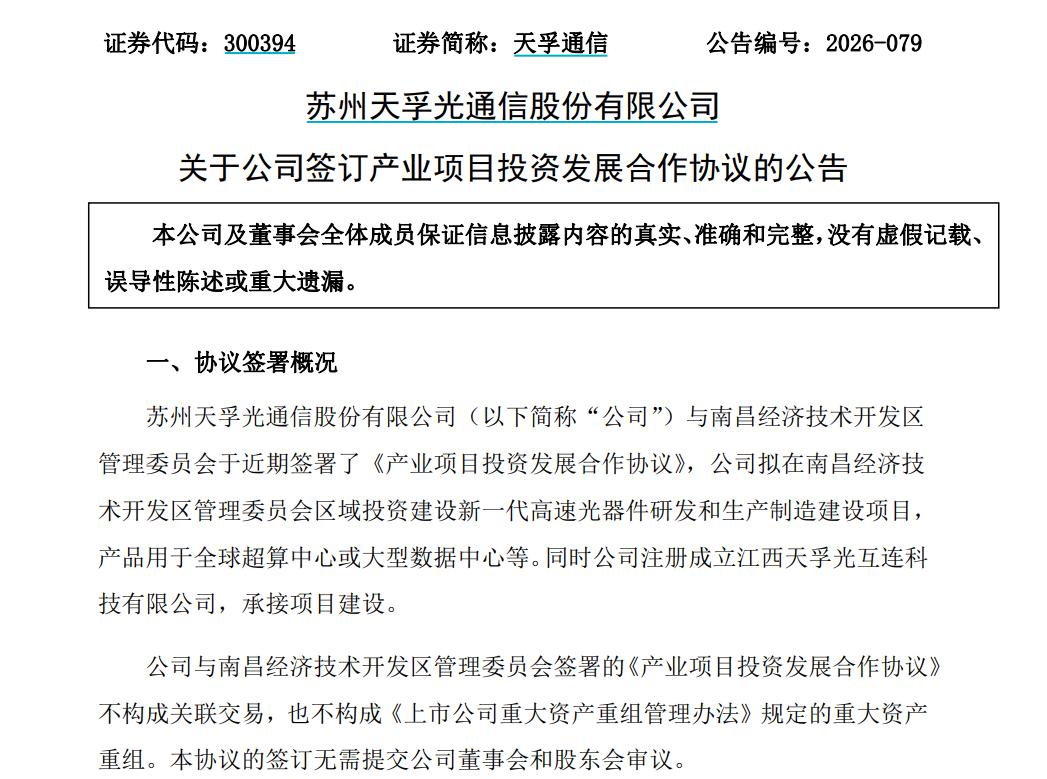
On November 22, Suzhou TFC Optical Communication Co., Ltd. (hereinafter referred to as "TFC Optical Communication"), a leading enterprise in the optical communication industry chain, issued an announcement stating that the company has signed an agreement with the Administration Committee of Nanchang Economic and Technological Development Zone, planning to invest in and build a R&D, production and manufacturing project for new-generation high-speed optical devices in Nanchang, whose products are mainly targeted at global supercomputing centers and large-scale data centers.
One question arises: why Nanchang? Some people may not know that 1 out of every 3 smartphones worldwide uses LED phone flash with silicon substrate technology, and Nanchang is the original birthplace of this technology. In September this year, the 13th Congress of the Communist Party of China in Nanchang clearly proposed to accelerate the construction of an optoelectronics city with important national influence and distinct characteristics.
Behind the goal of building an "optoelectronics city" lies Nanchang's determination to accelerate the "provincial capital leadership" strategy. Previously, Nanchang's official authorities frankly acknowledged when reviewing its own development: with increasingly fierce regional competition, the "pace-setters" are gradually moving further away, while the "pursuers" are getting closer and closer, and we are facing a severe situation where "no progress means regression, and slow progress also means regression".
At present, the "dual trillion" of GDP and industrial output value is becoming a symbol of economically strong cities. Nanchang proposes to raise its total GDP to the ranks of trillion-yuan cities in the next five years, while building an aviation city, an automobile city and an optoelectronics city, to push the operating revenue of industries above designated size to exceed one trillion yuan.
However, there are many outstanding players in the national optoelectronics industry landscape, including Suzhou which has a "optical corps" of A-share listed companies, Wuhan which is well-known for its "Optics Valley", and Xi'an which is home to foreign-funded enterprises such as Samsung and Micron...
With so many strong competitors, what advantages does Nanchang have to stand out from the siege?
Making Another Strategic Move
TFC Optical Communication, together with Eoptolink and Innolight, forms the core three leading enterprises known as "Yi Zhongtian" in the "AI computing power + optical module" track of the A-share market.
Compared with the fierce competition between Eoptolink and Innolight in the field of complete optical modules, TFC Optical Communication focuses on upstream optical devices. According to the data from Frost & Sullivan, calculated by external sales revenue, the global optical device industry reached a market size of 6.1 billion US dollars in 2025, and TFC Optical Communication ranks first in the world with a market share of 11.7%.
The first cooperation between TFC Optical Communication and Jiangxi can be traced back to 2010. At that time, the domestic optical communication industry was booming, and TFC Optical Communication established a wholly-owned subsidiary, Gao'an TFC, in Gao'an with a registered capital of 45 million yuan, as a production factory outside its Suzhou headquarters. With the subsequent expansion of business scale, the company registered and established Jiangxi TFC Technology in 2016, investing 1 billion yuan to build a production base in Gao'an.
Nowadays, the Gao'an base has become a key part of TFC Optical Communication's production capacity layout. The global production system built with dual production bases in "Gao'an, Jiangxi, China and Chonburi, Thailand" is one of its core competitiveness. In the first half of this year, the production building of the second phase project of the Jiangxi production base has also been delivered and put into use, further driving the improvement of local production capacity.
Since the beginning of this year, the construction of global data centers and AI supercomputing centers has driven the growth of demand for high-speed optical devices. TFC Optical Communication, which holds a high market share, realized a net profit attributable to shareholders of 2.083 billion yuan in the first three quarters of 2026, a year-on-year increase of 42.18%, which also drives the enterprise to further expand its production capacity.
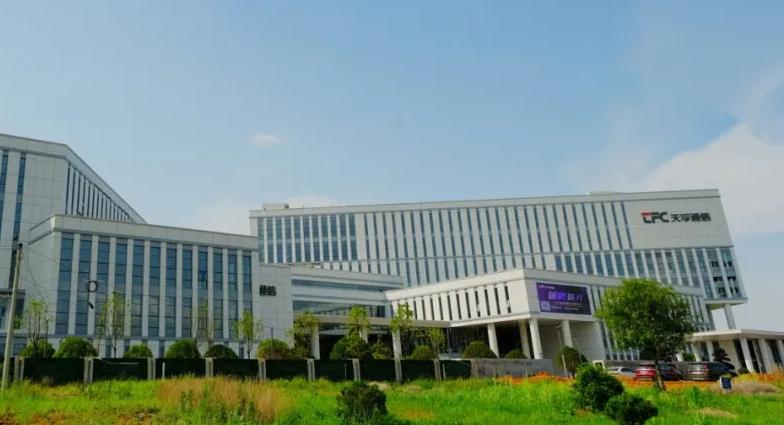
Image source: Official website of TFC Optical Communication
Just half a month ago, the leading officials of the Nanchang Municipal Party Committee led a team to Suzhou for investigation, and stated during the period that TFC Optical Communication is highly compatible with Nanchang's industrial system, and hopes that the two sides will strengthen cooperation, deploy more advanced technologies and high-end products in Nanchang, and strive to seize the opportunity in the new round of scientific and technological revolution and industrial transformation.
According to public information, the planned site for this high-speed optical device project to be invested and constructed in Nanchang covers an area of about 210 mu, equivalent to about 140,000 square meters, and the final area shall be subject to the actual transfer. As the cooperation partner, the Administration Committee of Nanchang Economic and Technological Development Zone will provide assistance and element guarantee for project construction approval, site leveling, temporary water and electricity access, smooth roads, etc., and complete relevant pre-work within 3 months after the two sides negotiate and confirm.
From the map, although Gao'an is under the administration of Yichun City, it is only about 42 kilometers away from the urban area of Nanchang. For TFC Optical Communication, the close layout of dual factories in "Gao'an + Nanchang Economic Development Zone" in Jiangxi is conducive to the collaborative management of overall production capacity. Regarding the signing of the Nanchang project, the company said that it is "conducive to improving the company's overall production capacity and delivery capacity, and further improving the company's global production layout".
Pursuing Upgrading
The partnership with TFC Optical Communication is also a high-end layout of Nanchang's electronic information industry.
In 2025, the operating revenue of Nanchang's electronic information industry above designated size reached 262.74 billion yuan. Although the industrial volume is large, it has long been concentrated in middle and low-end links such as assembly and OEM.
Data shows that more than 70% of the output value of Nanchang's electronic information industry comes from low-end assembly and OEM links. Especially since the beginning of this year, the skyrocketing price of memory chips has further compressed the profit margin of a large number of mobile terminal manufacturing enterprises in Nanchang.
"Optoelectronics" is regarded by the local government as the direction for the high-end breakthrough of the electronic information industry.
CCTV previously reported that a local enterprise in Nanchang focused on mobile phone filters and traditional optical devices as its main business before 2020. Forced to transform due to the impact of the international situation and market fluctuations, after entering the optical module track, its communication optical business revenue increased by 118.25% in the first half of this year, and almost completed the profit of the whole year of last year half a year in advance.
To lay out new tracks and complete the industrial chain, the Three-Year Action Plan for the Capacity Improvement and Upgrading of Nanchang's Industrial Clusters (2026-2028) clearly proposes that by 2028, efforts will be made to build two provincial-level advanced manufacturing clusters of optoelectronics and aviation. In terms of establishing and improving the full-cycle service management mechanism for key projects, it is proposed to promote 300 key construction projects, and the "Jiangxi MTC Opto Nanchang High-tech Zone Optical Device and Optical Module Product Production Base Project" is placed in the first place.
As one of the leading optical communication enterprises in Nanchang, MTC Opto can mass produce more than 10 million optical devices per month, but most of them are 100G optical module products. In July this year, the construction of MTC Opto Jiangxi Nanchang Optical Communication Industrial Base started, which is regarded as a key step for MTC Opto's 800G and higher-speed optical module products to transition from small-batch shipment verification to large-scale mass production, providing production capacity guarantee for the technical iteration of Nanchang's high-end optical devices and optical modules.
From the perspective of urban energy level, optoelectronics is becoming one of the most recognizable characteristic business cards of Nanchang, carrying the mission of promoting Nanchang to sprint for higher industrial energy level.
In the first half of this year, the added value of Nanchang's industries above designated size increased by 6.5% year-on-year, 2.7 and 1.1 percentage points higher than that of the whole province and the whole country respectively; by product, among the 144 major industrial products under key monitoring in the city, 73 achieved growth, with a growth rate of 50.7%, of which the output of optical fiber, cables for communication and electronic networks, and optoelectronic devices increased by 303.7%, 27.9% and 15.1% respectively. Optoelectronics-related products are the most eye-catching group in this round of growth.
Not long ago, the 13th Congress of the Communist Party of China in Nanchang proposed that by 2030, the manufacturing industry will maintain a reasonable proportion, the construction of aviation city, automobile city and optoelectronics city with important national influence and distinct characteristics will be accelerated, the modern industrial system reflecting Nanchang's characteristics will be basically formed, the total economic volume will exceed the trillion-yuan mark, the function of leading the development of the whole province and supporting the rise of central China will be significantly enhanced, and Nanchang will become an important central city in the middle reaches of the Yangtze River and the central region.
The Trend of Chasing "Light"
Not only Nanchang, "optoelectronics" is becoming a new competition track for cities.
In terms of top-level design, in September this year, the Ministry of Industry and Information Technology and the National Development and Reform Commission jointly issued the "15th Five-Year Plan" for the Development of Electronic Information Manufacturing Industry. Under the goal that the operating revenue of enterprises above designated size will exceed 30 trillion yuan by 2030, "consolidating the foundation for the development of the photon industry" is listed separately.
Looking across the country, the optoelectronics industry has become a strategic track that all regions are competing to lay out. Many regions are striving to build "Optics Valley", and policy support, project competition and scenario competition are becoming increasingly fierce.
Wuhan is the earliest defender. It was approved as "China Optics Valley" in 2001. By the end of 2025, it has gathered 16,000 optoelectronic information enterprises, with an industrial scale exceeding 660 billion yuan. The popular "Seven Stars of Optics Valley" this year, including Yangtze Optical Fibre and Cable, Huagong Tech, Accelink, FiberHome, Yangtze Memory, Wuhan Guide Infrared, and CICT Mobile, once had a total market value exceeding one trillion yuan.
Suzhou is also in the leading position. Under the trend of AI computing power, Suzhou is known as the "city standing in the light". The output value of Suzhou's photon industry exceeded 430 billion yuan in 2025. In the past year, the "photon corps" of Suzhou listed companies such as Innolight and TFC Optical Communication have further confirmed the strength of the local photon industry with the popularity of the capital market...
While leading cities form a density moat with their scale advantages, some cities take a different approach to break through with hard scientific and technological strength:
Changchun relies on the advantages of universities and research institutes such as Changchun Institute of Optics, Fine Mechanics and Physics of the Chinese Academy of Sciences, Jilin University, and Changchun University of Science and Technology to promote the construction of "China Optoelectronics City", striving to make the scale of the optoelectronic information industry exceed 160 billion yuan by the end of the "15th Five-Year Plan" period;
Xi'an, relying on the platform of Xi'an Institute of Optics and Precision Mechanics of the Chinese Academy of Sciences and the Pilot Institute for Optoelectronics, is moving towards the goal of a 100-billion-level photon industry cluster by 2030, striving to build a "city chasing light"...
With so many light chasers, how can Nanchang establish its own position? Nanchang bets on its VR characteristic advantages, builds an "optoelectronics city", and aims to "rely on the world's leading LED light source technology to open up the whole chain from chips, packaging to applications, and build a world-famous 'World VR Capital' with important influence".
Taking Nanchang High-tech Zone, one of the core areas of the city's optoelectronic communication, as an example, in the next three years, its optoelectronic industry will focus on optical lighting, optical display and optical communication, and accelerate the construction of the future display industry production base with the largest scale, the highest technical level and the most complete industrial chain in China.
On this basis, we will simultaneously seize the opportunity of the AI computing power outbreak, lay out the complete chain of optical chips - optical devices - optical modules - optical terminals, and focus on making up for the shortcomings of chips. By 2028, the cluster will achieve an operating revenue of 230 billion yuan.
However, as the local media said, in the face of opportunities, Nanchang also needs to face up to its shortcomings: "there is still room for improvement in the supply of high-end supporting facilities, there is a gap in top talent reserves, and the innovation capability in some segmented fields still needs to be strengthened."
This article is from the WeChat official account "City Evolution Theory", written by Liu Xuqiang, and authorized for release by 36Kr.