Goldman Sachs: Memory chip prices may drop by 20% in 2028
While AI demand continues to drive strong growth in the global memory chip industry, Goldman Sachs projects that with the gradual release of new supply and weak demand for consumer electronics, the industry's prosperity in 2028 will be significantly lower than that in 2027, and the prices of traditional DRAM and NAND may both fall by about 20%.
Goldman Sachs released a global memory chip industry research report on November 22, sharply lowering its average selling price forecast for traditional DRAM and NAND in 2028, and simultaneously cutting earnings forecasts and target stock prices for Samsung Electronics and SK Hynix.
However, the bank still maintains a buy rating for the two companies, arguing that current stock prices may have already reflected downside risks to the industry that are more severe than the baseline forecast.
Goldman Sachs' stress test shows that judging from the scenarios implied by the current stock prices of Samsung and SK Hynix, they are close to the assumptions of zero growth in AI capital expenditure in 2028 and an additional 40% drop in the average selling price of memory chips from the baseline forecast. Even if there is a price drop similar to the severe downturn cycles in 2019 and 2023, the two companies may still maintain a relatively high level of absolute profitability.
Goldman Sachs believes that long-term supply agreements (LTAs) and high shareholder returns are expected to provide additional support for the two companies, and historically, memory chip stock prices usually bottom out earlier than corporate earnings.
The supply-demand gap will narrow significantly in 2028, and memory chip prices may drop by about 20%
Goldman Sachs predicts that the global DRAM market in 2027 will experience one of the most severe supply shortages in the past 15+ years, but by 2028, the tension between supply and demand will ease significantly.
According to the latest model, the global DRAM supply gap from 2026 to 2028 is expected to be 4.1%, 5.1% and 1.2% respectively. Among them, the 2028 supply gap forecast has been sharply revised down from the previous 3.9%.
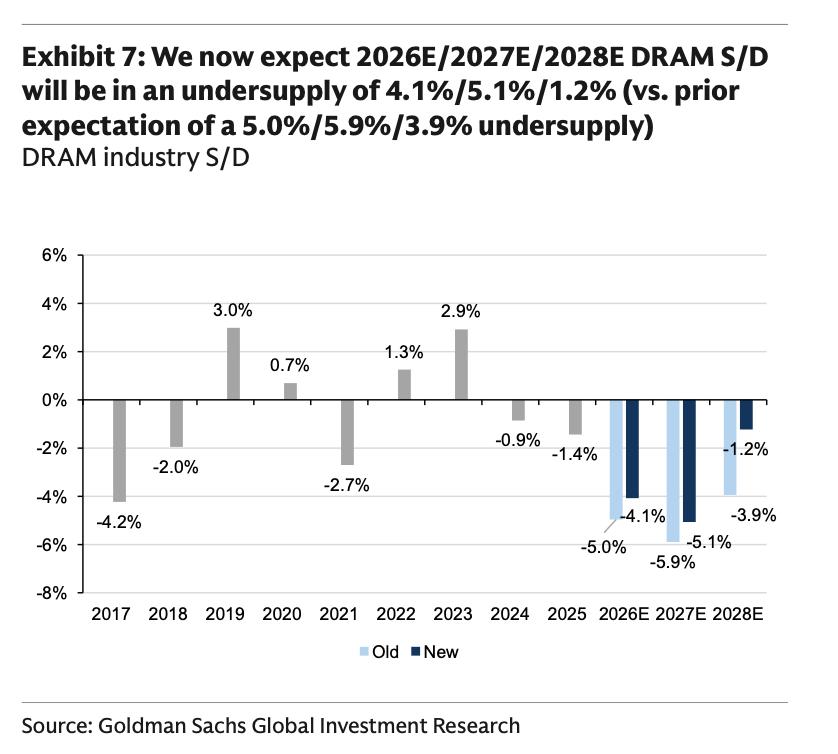
(Goldman Sachs expects the global DRAM supply gap to reach 5.1% in 2027 and narrow significantly to 1.2% in 2028)
Similar changes will occur in the NAND market. Goldman Sachs predicts that the NAND supply gap from 2026 to 2028 will be 3.3%, 2.2% and 0.3% respectively, of which the 2028 forecast has been revised down from the previous 3.0%, meaning the market will be close to supply-demand balance.
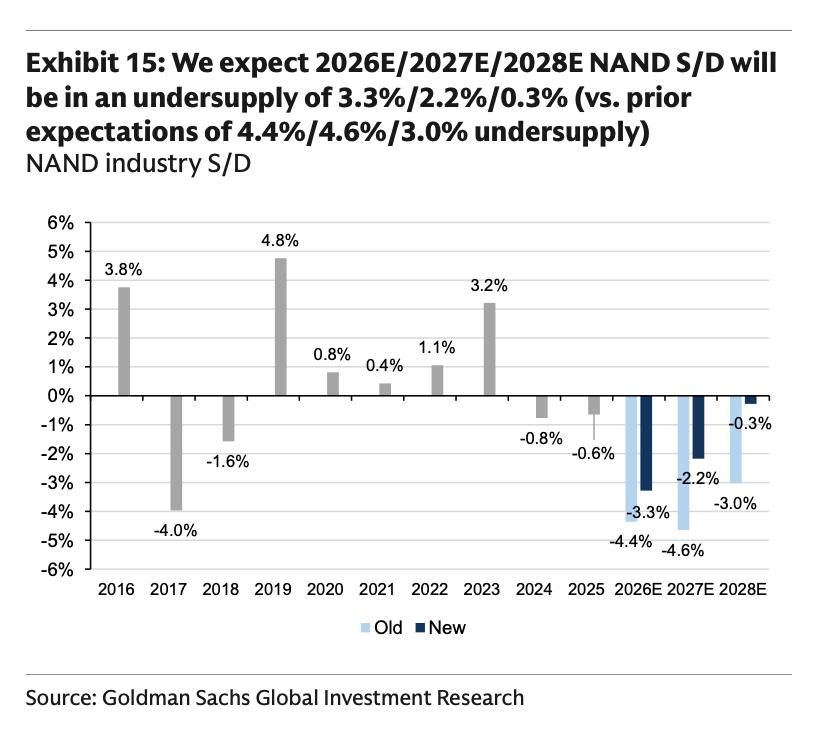
(Goldman Sachs expects the global NAND supply gap to shrink from 2.2% in 2027 to 0.3% in 2028, bringing the market close to supply-demand balance)
Goldman Sachs believes that the memory chip market in 2027 will still benefit from strong AI server demand, limited capacity growth and healthy supplier inventory levels. But by 2028, new supply from Chinese manufacturers, the growth of global memory chip supply, and weak demand for smartphones and PCs will jointly push the supply-demand relationship to loosen.
It is worth noting that this does not mean that memory chip demand will shrink. Goldman Sachs still expects global DRAM and NAND demand to grow year-on-year by 17% and 19% respectively in 2028, but the supply growth rate in the same period will reach 22%, exceeding demand growth.
Changes in supply and demand have prompted Goldman Sachs to sharply lower its price forecasts. The bank predicts that SK Hynix's traditional DRAM average selling price will rise by 32% in 2027 and fall by 19% in 2028, while the previous forecast for 2028 was only a 5% drop; the corresponding forecast for Samsung Electronics is a 31% rise in 2027 and a 20% drop in 2028.
The NAND price outlook has also weakened. Goldman Sachs adjusted SK Hynix's 2027 and 2028 NAND average selling price forecasts to a 20% rise and 21% drop respectively, compared with previous forecasts of a 30% rise and 14% drop.
An important factor driving changes in the demand structure is the divergence between the AI server and consumer electronics markets.
Goldman Sachs raised its forecasts for server DRAM demand excluding HBM in 2027 and 2028 by 17% and 18% respectively, expecting its demand to grow by 32% and 21% respectively in the next two years on the high base of 63% growth in 2026.
In contrast, rising memory chip costs may curb smartphone and PC sales, and prompt end manufacturers to slow down the increase in storage capacity per device. Goldman Sachs predicts that demand for PC DRAM and PC NAND will drop by 2% and 3% respectively in 2027, and smartphone NAND demand will also drop by 2%.
At the same time, enterprise SSDs are becoming an important source of growth for NAND demand. Goldman Sachs expects enterprise SSD demand to reach 819EB and 1021EB in 2027 and 2028 respectively, up 48% and 25% year-on-year, accounting for 53% and 55% of global NAND demand respectively.
On the supply side, Goldman Sachs expects ChangXin Memory Technologies' DRAM bit supply to grow year-on-year by 48%, 36% and 32% respectively from 2026 to 2028. The bank also expects Chinese NAND suppliers to continue expanding capacity compared to non-Chinese manufacturers that are constrained by cleanroom space and mainly invest in DRAM and HBM.
The HBM market may reach 2000 billion US dollars next year, but growth may slow sharply
Despite lowering its traditional memory chip price forecast, Goldman Sachs has sharply raised its expectation for the high-bandwidth memory (HBM) market size.
The bank raised its global HBM market size forecasts for 2026 to 2028 by 7%, 72% and 41% respectively to about 60 billion US dollars, 200 billion US dollars and 237 billion US dollars, corresponding to year-on-year growth rates of 78%, 236% and 18% respectively.
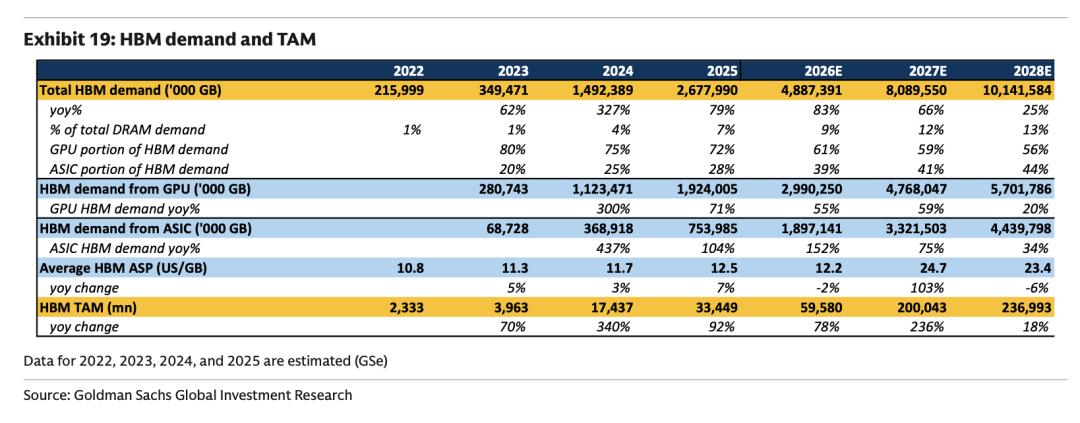
(Goldman Sachs expects the global HBM market size to reach about 200 billion US dollars in 2027, up 236% year-on-year, and the growth rate will slow to 18% in 2028)
Among them, the sharp upward revision of the 2027 market size forecast not only comes from the growth of AI accelerator demand, but more importantly, Goldman Sachs has significantly raised its assumption of HBM average selling price.
Goldman Sachs expects global HBM capacity demand to grow 66% year-on-year in 2027, but the average selling price will rise from 12.2 US dollars per GB in 2026 to 24.7 US dollars, an increase of 103%. By 2028, the capacity demand growth rate is expected to slow to 25%, and the average selling price will drop 6% to 23.4 US dollars per GB.
The bank believes that the easing of HBM supply-demand tension in 2028 will put pressure on prices. The selling price of HBM products of the same specification may drop by more than 20% year-on-year, but with the increase in the proportion of new-generation products such as HBM4E and HBM5, the decline in the industry's overall blended average selling price is expected to be controlled at a single digit.
According to Goldman Sachs' latest forecast, the HBM supply gap from 2026 to 2028 will be 6.0%, 7.0% and 2.3% respectively. At the same time, the global monthly HBM wafer capacity is expected to increase from about 700,000 pieces at the end of 2027 to 810,000 pieces at the end of 2028.
Goldman Sachs also pointed out that as memory chip costs rise, customers are stepping up efforts to optimize memory usage, coupled with potential delays in data center construction, which may further weaken HBM demand in 2028.
The structure of HBM demand is also changing. Goldman Sachs expects the share of AI application-specific integrated circuits (ASICs) in HBM capacity demand to rise from 28% in 2025 to 41% in 2027 and 44% in 2028.
This may reshape the industry competition pattern. Goldman Sachs expects that with the expansion of supply to NVIDIA and business layout in ASIC customers such as Google TPU, Samsung Electronics' HBM revenue market share will rise to 43% in 2027, exceeding SK Hynix's 32%. Micron Technology's share in the same period is expected to be 20%.
In addition, Goldman Sachs expects ChangXin Memory Technologies to start generating HBM revenue in 2027, mainly involving HBM2E and HBM3 products, and achieve about 5% and 6% of the global HBM revenue share in 2027 and 2028 respectively.
If AI capital expenditure stops growing, how much will memory chip profits shrink?
As market concerns about the sustainability of AI investment rise, Goldman Sachs has specifically analyzed the possible impact of cloud computing giants cutting capital expenditure.
Under the baseline scenario, the bank expects capital expenditure of hyperscale cloud computing vendors to be about 1.1 trillion US dollars in 2027, and further grow to 1.2 to 1.3 trillion US dollars in 2028, with a year-on-year increase slightly higher than 10%.
Goldman Sachs estimates that the proportion of memory chips in these capital expenditures will drop from about 44% in 2027 to 40% in 2028, mainly reflecting its expectation of falling memory chip prices in 2028.
To assess potential risks, Goldman Sachs set three scenarios for 2028 where capital expenditure remains flat year-on-year, falls by 10% and falls by 20%. Compared with the baseline forecast, memory chip spending under these three scenarios will decrease by 55 billion US dollars, 99 billion US dollars and 144 billion US dollars respectively.
Based on the assumption that Samsung Electronics and SK Hynix account for 39% and 30% of the relevant memory market respectively, Goldman Sachs estimates that the three scenarios will reduce Samsung's memory business revenue by 27 trillion won, 48 trillion won and 70 trillion won respectively, and SK Hynix by 20 trillion won, 37 trillion won and 54 trillion won respectively.
But falling demand could trigger a more serious chain reaction. Goldman Sachs believes that after cloud computing customers reduce procurement, additional memory chip supply will flow into other markets, further pushing down prices, so it is necessary to consider the price shock beyond the decline in sales volume.
Under the scenario of zero growth in AI capital expenditure in 2028 and an additional 20% drop in the average selling price of memory chips from the baseline forecast, Goldman Sachs expects Samsung's memory business operating profit and SK Hynix's operating profit to decrease by 23% and 26% respectively compared with the baseline forecast.
If capital expenditure falls by 20% while the average selling price drops an additional 40%, the operating profit decline of the two companies will expand to 45% and 48% respectively.
Goldman Sachs further combines the earnings under the stress scenario with the P/E ratio multiple implied by the target stock price to calculate the stock value corresponding to different scenarios, arguing that the current stock price may have already reflected a relatively pessimistic outlook.
Under the scenario of zero growth in AI capital expenditure and an additional 40% drop in memory chip selling prices, the implied stock prices of Samsung Electronics and SK Hynix are about 183,000 won and 1,077,000 won respectively, close to the reference stock prices of 183,100 won and 1,113,000 won listed in the Goldman Sachs report.
Under the most severe combination of 20% drop in capital expenditure and an additional 40% drop in selling prices, according to the valuation multiple adopted by Goldman Sachs, the implied stock prices of the two companies are about 172,000 won and 1,005,000 won respectively, about 6% and 10% lower than the stock prices on November 20.
Goldman Sachs thus believes that the market may have already priced in a considerable degree of AI investment slowdown risk in advance.
However, the bank also pointed out that the stress test deliberately adopted conservative assumptions, directly regarding the reduced procurement volume of cloud computing customers as the shipment loss of suppliers, without considering that manufacturers may resell products to other customers. Therefore, the actual revenue and earnings impact may be smaller than the model results.
With memory prices falling sharply, how much protection can long-term contracts still provide?
In addition to the risk of AI capital expenditure, investors are also worried that when memory chip prices fall sharply, customers may abandon signed long-term supply agreements and switch to purchasing at lower market prices.
To address this issue, Goldman Sachs established a traditional DRAM long-term agreement default model, assuming that by the fourth quarter of 2028, long-term agreements cover 65% of traditional DRAM capacity shipments, the lower limit of the contract price refers to the level of the second quarter of 2026, the upper limit refers to the level of the third quarter, and the advance payment is equivalent to 30% of the expected contract revenue.
Goldman Sachs further assumes that once default is more economically beneficial, 50% of long-term agreement customers may choose to default.
According to the above conditions, Goldman Sachs calculates that in the next two years, the traditional DRAM market price of Samsung Electronics needs to fall by more than 32% to 51% further from the baseline forecast before customers may have obvious economic motivation to default; the corresponding decline threshold for SK Hynix is more than 38% to 54%.
This means that even if traditional DRAM prices fall by about 20% in 2028 as the baseline forecast, it does not necessarily mean that customers will abandon long-term agreements.
Goldman Sachs also tested a more severe scenario: traditional DRAM prices fall 60% from the baseline forecast, and half of eligible long-term agreement customers default.
The