China's digital music market has surpassed 230 billion yuan, and the value boundaries of the industry are being opened up.
In 2025, China's digital music industry delivered a remarkable performance report.
On November 20, at the 2026 China Digital Music Industry Conference held in Xiamen, Ao Ran, Director of the Digital Music Working Committee of China Audio-Video and Digital Publishing Association, officially released the *China Digital Music Industry Report (2025—2026)* (hereinafter referred to as the "Report").

The Report shows that the total size of China's digital music market reached 2.3185 trillion yuan in 2025, a year-on-year increase of 9.7%. The cumulative number of songs in the libraries of digital music platforms reached 337 million, with the market size and content supply continuing to expand. However, a close breakdown of the more than 230 billion yuan reveals an interesting phenomenon: the scale of the online music business is 31.64 billion yuan, accounting for 13.6% of the entire market; music live streaming and music short videos reached 134.25 billion yuan and 58.38 billion yuan respectively, together accounting for more than 83%.
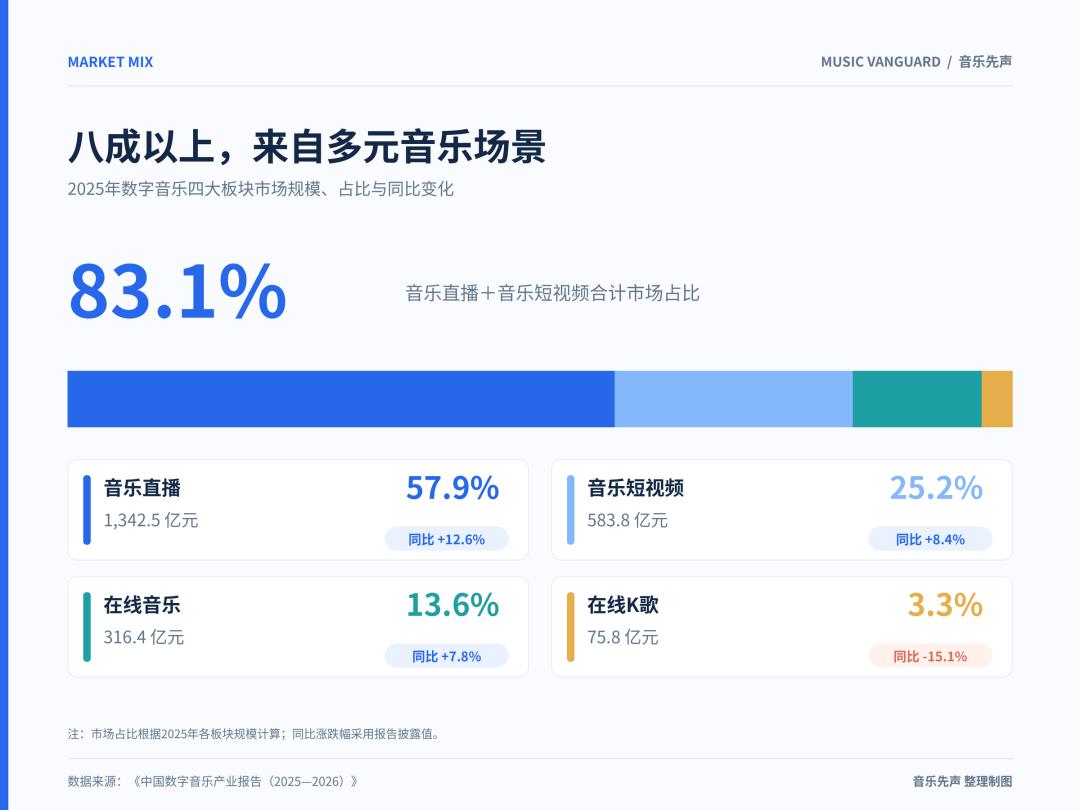
In other words, most of the current market size of the digital music industry no longer comes from the traditional online music listening, but from the deep integration of music with digital entertainment forms such as live streaming and short videos. At the same time, AI is accelerating its entry into music production and dissemination links, which not only improves efficiency and enriches content supply, but also promotes changes in copyright management, work discovery and commercial operation modes.
When the digital music market exceeds 2.3 trillion yuan, what is worth paying attention to is not only how much the market size can grow, but also how music enters more consumption scenarios, and how the expanding industrial scale can be transformed into richer and more sustainable commercial value.
The 230-billion-yuan music business is increasingly making money not by "listening to music"
Over the past decade, China's digital music industry has gradually completed the transformation from rampant piracy to authorized operation, from free music listening to the establishment of business models such as membership subscription, digital albums and copyright licensing. In this process, online music platforms have become an important entry point for users to access music, and also laid the foundation for the commercialization of the industry. However, with the in-depth integration of the mobile Internet into daily life, music consumption scenarios are no longer limited to music players.
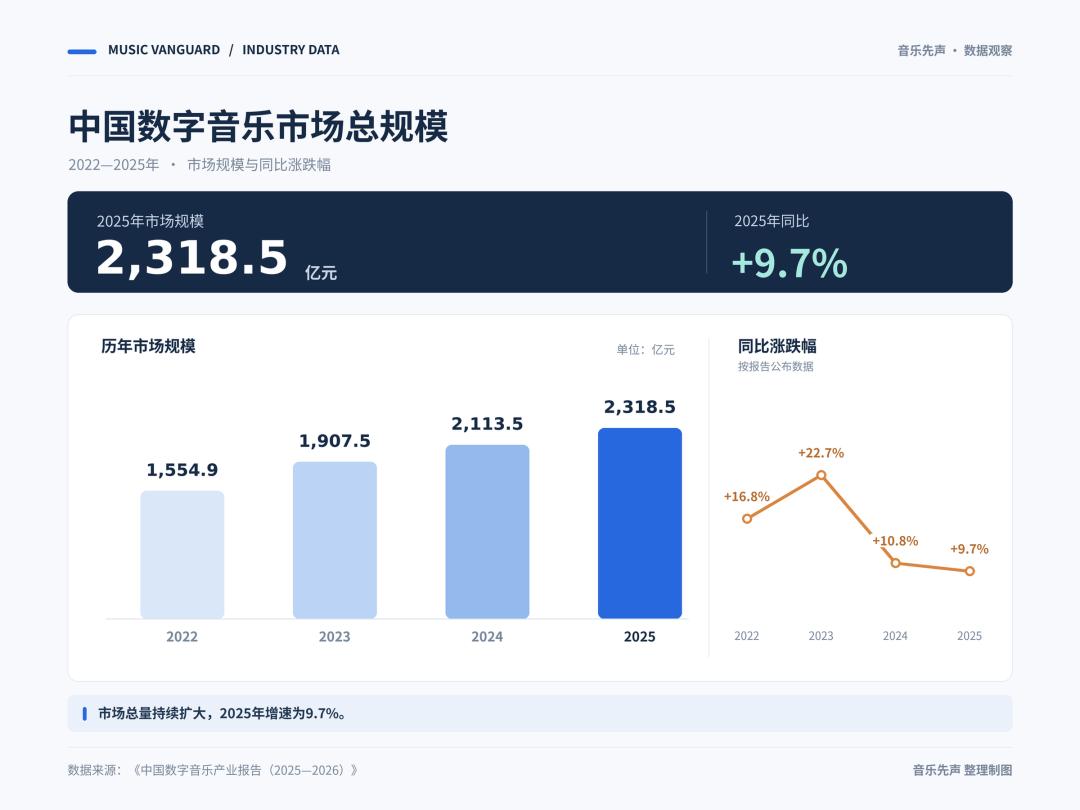
The Report shows that from 2022 to 2025, the size of China's digital music market grew from 155.49 billion yuan to 231.85 billion yuan, with a cumulative increase of about 49.1% in three years. Although the 9.7% growth rate in 2025 is slower than before, the overall market still maintains steady growth under the market volume of more than 2.3 trillion yuan.
What is more worthy of study is the structural changes between different sub-sectors.
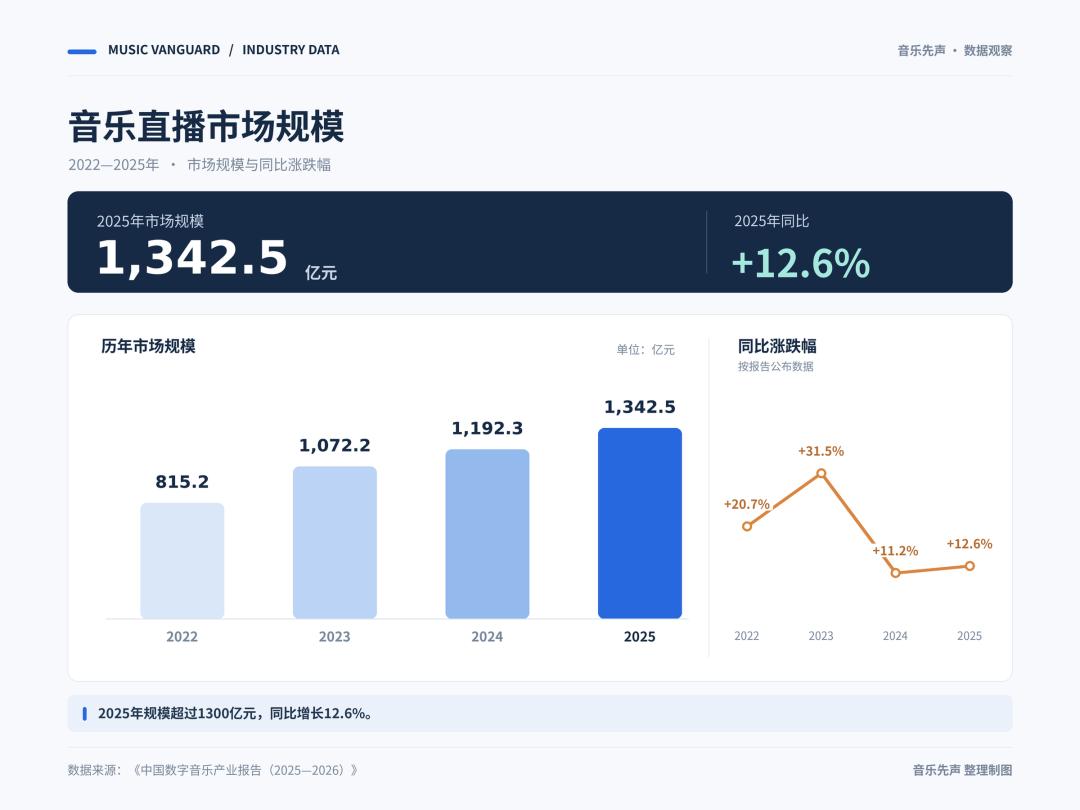
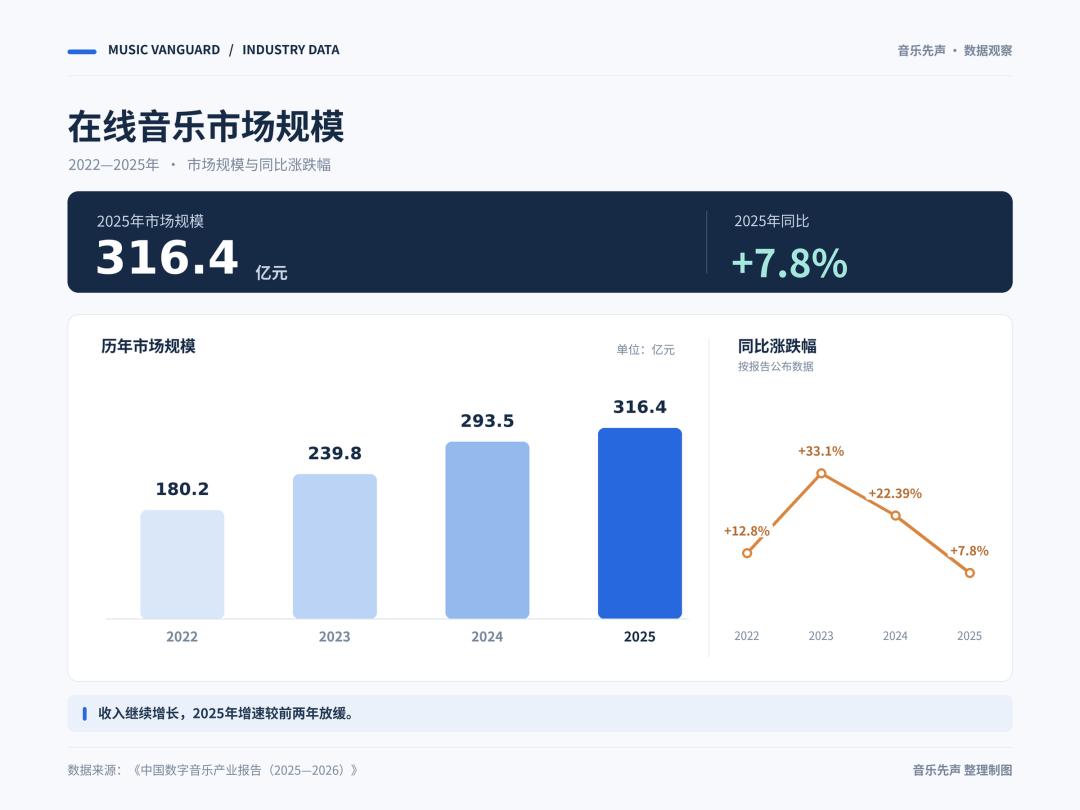
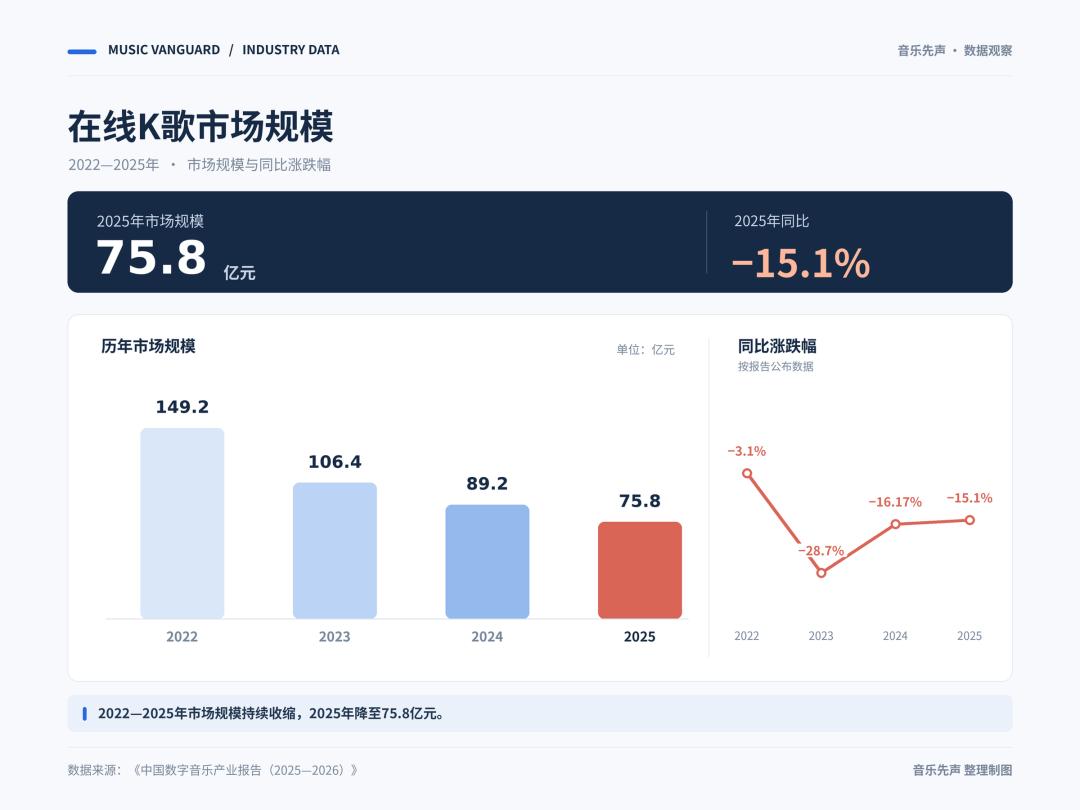
In 2025, the market size of music live streaming reached 134.25 billion yuan, a year-on-year increase of 12.6%; music short videos reached 58.38 billion yuan, a year-on-year increase of 8.4%; online music revenue was 31.64 billion yuan, a year-on-year increase of 7.8%; online KTV revenue dropped to 7.58 billion yuan, a year-on-year decrease of 15.1%.
Among them, music live streaming not only has the largest scale, but also is the fastest growing one among the four types of businesses. Calculated based on the data of the Report, the digital music market added about 20.5 billion yuan in net new value in 2025, of which music live streaming contributed about 15.02 billion yuan, accounting for about 73% of the annual net new scale.
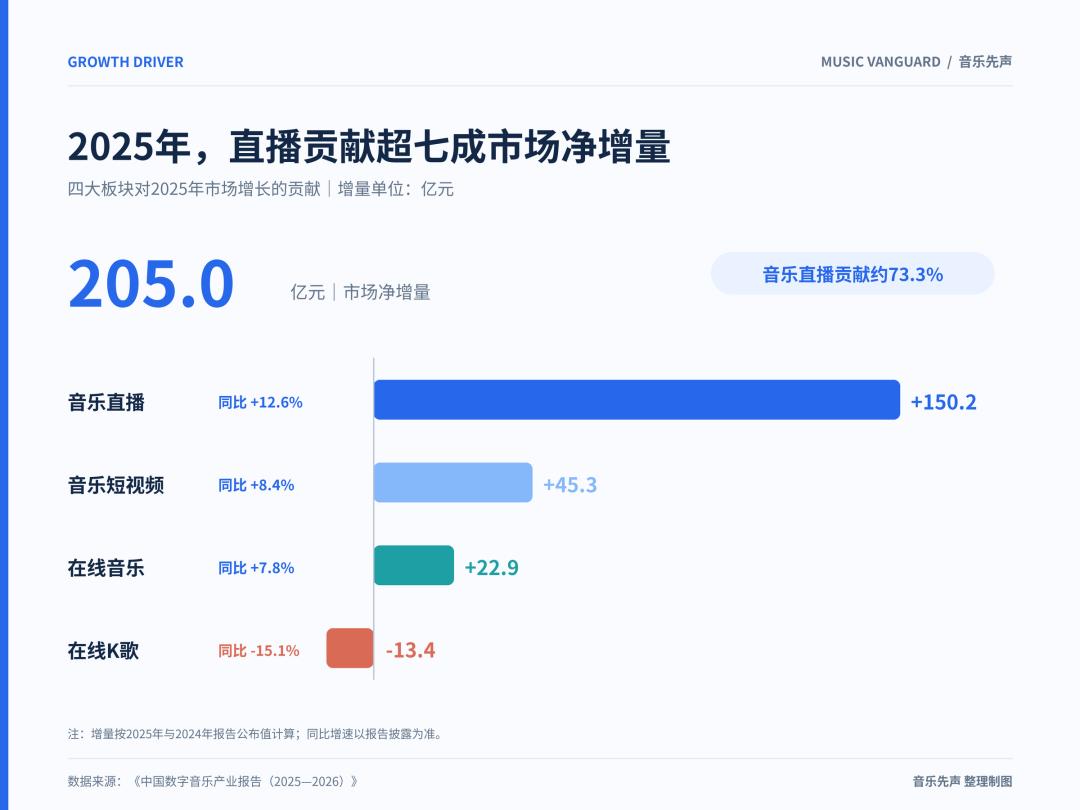
That is to say, music live streaming has become the main driving force for the growth of the digital music market.
However, to understand this phenomenon, it is necessary to distinguish two different music business logics.
One is consumption centered on music works. Users pay for the content itself and related services through forms such as membership subscriptions and digital albums. The other is scenario consumption with music as an important part, where music combines with demands such as social interaction, entertainment experience and emotional companionship to jointly create commercial value.
For example, when listening to the same song, on a music platform, users mainly consume the work and its listening experience; in the live streaming room, music performances may form a consumption experience together with host interaction, fan relationships and real-time feedback. Both modes can create commercial value, but their income generation mechanisms are not completely the same.
In this regard, Ao Ran specially emphasized when releasing the report: "The relevant market size certainly cannot be directly equated with the revenue from music copyright."
This is an important premise for understanding the 2.3 trillion yuan digital music market size. The statistical scope of music live streaming and music short videos is not limited to the direct sales or licensing revenue of music works, but includes related businesses that take music as the main material, content or background. Therefore, the expansion of the pan-music entertainment market is correlated with the development of the music copyright market, but they cannot be simply equated.
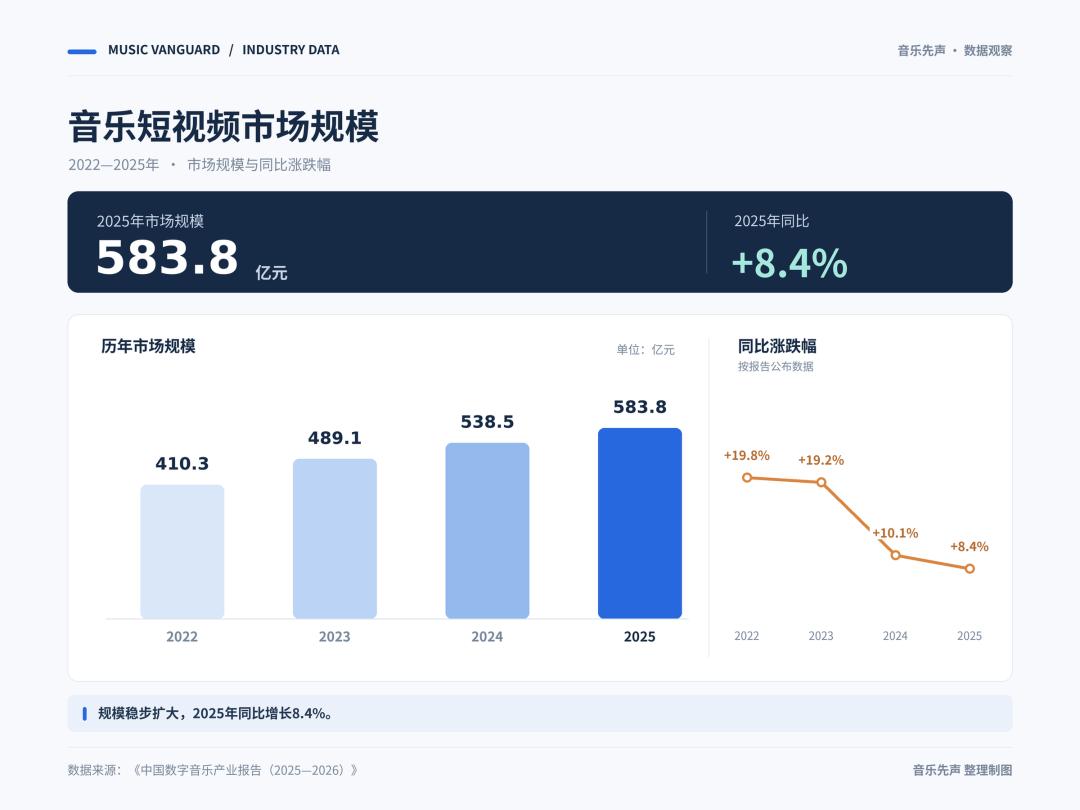
But from another perspective, these ever-expanding application scenarios precisely reflect the unique value of music in digital cultural consumption. Music is no longer just a passive listening object, but also a tool for users to express emotions, participate in interactions and create content.
However, the expansion of communication scope still needs to be further transformed into the long-term value of the works themselves. Ao Ran pointed out: "But how to convert the attention brought by fragment dissemination into the listening and continuous use of complete works is a problem that needs to be further solved in this field. Work identification, authorization connection and revenue feedback should also keep up with the changes in communication methods."
This points out a key problem of music dissemination in the short video era.
From fragment dissemination to complete listening, from a single hit song to the long-term development of artists, the transformation still requires the joint efforts of music platforms, record companies and content operation institutions. Therefore, short videos and online music are not simply in a traffic competition relationship, but also have the opportunity to form complementarities in links such as new song discovery, complete work consumption and artist operation.
The 31.64 billion yuan market size and 7.8% growth of online music also show that traditional music consumption still has a stable commercial foundation. With the gradual maturity of the membership payment model, platform competition is shifting from copyright library reserve to content operation, user relationship and differentiated services.
In contrast, the online KTV market dropped from 14.92 billion yuan in 2022 to 7.58 billion yuan in 2025, shrinking by about 49% in three years, reflecting the adjustment faced by traditional music social products.
This does not necessarily mean that users have lost interest in singing, but that various expression methods such as short video covers, live singing and social sharing may be meeting part of the demands originally carried by KTV products. It is obvious that the increasingly diverse ways of music interaction have put forward new requirements for traditional products.
It is not difficult to see that China's digital music industry has not simply shifted from "listening to music" to "not listening to music", but the consumption methods and commercial value of music are constantly extending. The value of music as independent content still exists, and the value it creates in a wider range of digital life scenarios is also becoming an important part of industrial growth.
From scale expansion to in-depth value cultivation, how much room for imagination is there?
If 2.3 trillion yuan reflects the commercial scale of the digital music market, then 337 million songs present the other side of the digital music industry on the content supply side.
The Report shows that the cumulative size of the music library of China's digital music platforms was 132 million songs in 2022, and reached 337 million songs in 2025, with an increase of about 155% in three years. Behind this is the combined effect of multiple factors including the continuous improvement of the digital distribution system, the continuous popularization of music production tools, and the gradual integration of AI technology into the creation process.
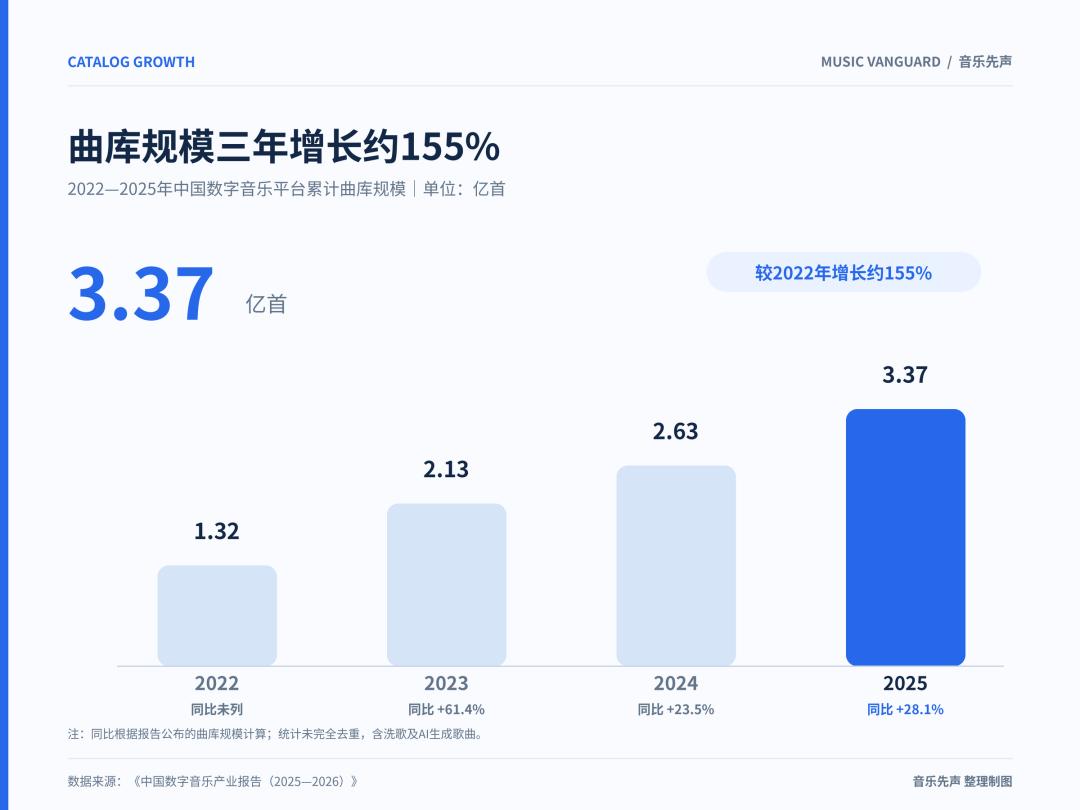
Nowadays, whether it is professional production institutions, independent musicians, or ordinary users without production experience, they have more convenient conditions for music creation and distribution.
However, it should be noted that the expansion of the music library scale is not completely equivalent to the increase in the number of original works. As Ao Ran specially explained when releasing the report, "This number reflects the cumulative scale of the platform's music library, and cannot be directly equated with the number of de-duplicated original works". The Report also clearly points out that the relevant statistics have not completely eliminated duplicate authorizations, and include rehashed songs and AI-generated songs.
Nevertheless, this change still has important industrial significance. When the thresholds for music production and distribution are continuously lowered and content supply continues to increase, the focus of industry competition will also change accordingly.
In the past, producing and distributing a song required high cost, and obtaining distribution channels itself was an important threshold for music commercialization; today, it is easier for works to enter the market, but to be discovered, remembered and continuously consumed still requires professional capabilities. As Ao Ran said: "Making high-quality works discovered and obtaining reasonable returns has become a problem that needs to be continuously solved after the expansion of the music library."
This means that the music industry is moving from focusing on content production and reserve to further focusing on work discovery, operation and value development.
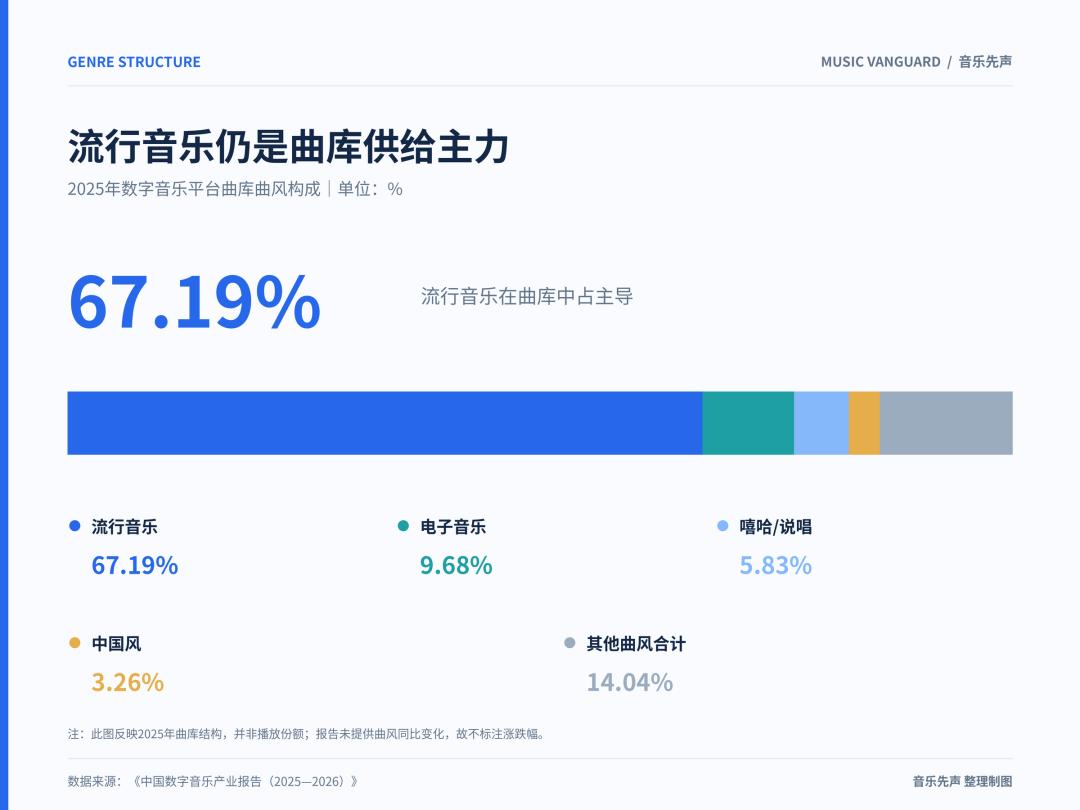
The Report shows that in the music libraries of digital music platforms, pop music accounts for 67.19%, electronic music accounts for 9.68%, and hip-hop/rap and Chinese-style music account for 5.83% and 3.26% respectively. These proportions reflect the content structure of the music library, and are not equivalent to the actual listening share of users. In the massive content environment, platforms not only need to enrich the music library, but also help different types of works find appropriate audiences through algorithm recommendation, professional editors, music communities and user feedback.
For music companies, work distribution is increasingly not the end of commercial development. A song can build an initial audience group through music platforms, expand its dissemination scope through short videos, gain new attention through variety show performances, live streaming interactions and offline performances, and also obtain more commercial usage opportunities in scenarios such as film, television, games and advertisements. The collaboration between different channels and scenarios has the opportunity to continuously extend the commercial life cycle of a song.
This also shows that the core competitiveness of music companies is extending from simple content production and copyright reserve to more comprehensive work operation capabilities.
Correspondingly, copyright operation also needs to develop towards more refined management. The same song may appear in different scenarios such as streaming media, short videos, live streaming and advertisements, and the authorization relationship, usage records and revenue mechanisms corresponding to different usage methods are also different. How to effectively identify the usage of music works and accurately connect copyright information with actual dissemination scenarios has become an important foundation for the coordinated development of the industry.
This is also the important reason why the Report emphasizes improving the data foundation and perfecting the value feedback mechanism. At the report release session, Ao Ran proposed that data standards should be unified, cross-platform information exchange should be strengthened, work authorization records should correspond to actual usage, so that the settlement results can be fed back to specific works and right holders, providing a basis for reasonable income distribution.

The significance of this direction is