Cerebras: Hit the jackpot by sheer dumb luck, did this "paranoid" really pull off a massive success?
In the previous article about Cerebras, Dolphin Jun elaborated in detail that Cerebras, adhering to its original aspiration of "since chips have to be cut and then spliced together, why not skip the cutting process and form the whole chip in one go?", has been pressing forward unswervingly, overcoming every obstacle encountered along the way.
Eventually, the company took full charge of every step from chip design, testing, assembly to integration, and finally developed the "extremely unconventional" behemoth product shown in the figure below.
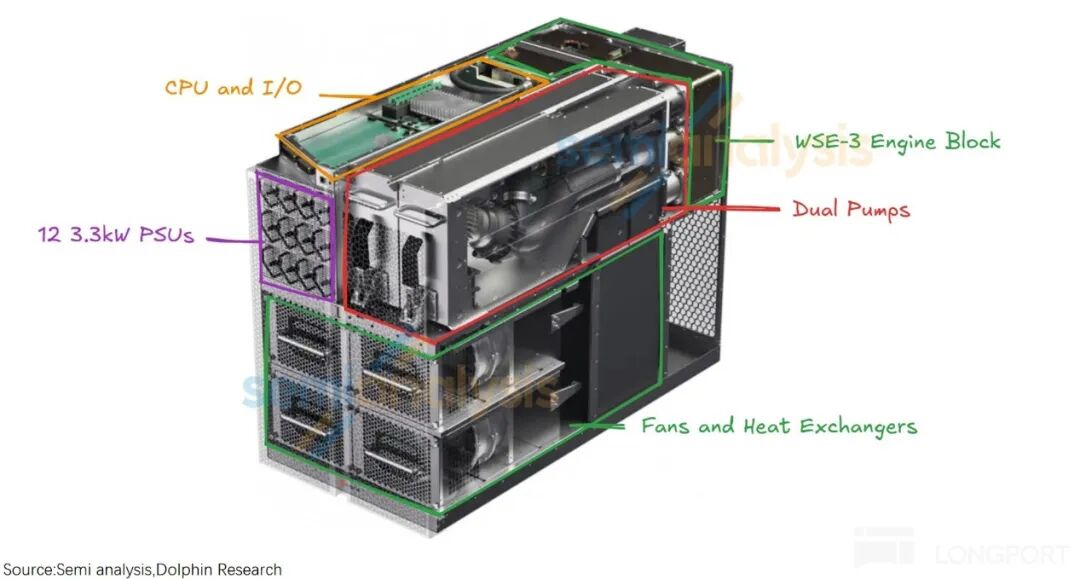
Dolphin Jun will focus on the following questions in this article:
a) To what extent has Cerebras iterated its products? Who on earth is using its products, and in what way do they cooperate?
b) What is Cerebras's operating performance, especially how the company adjusts its revenue;
c) How much value does Cerebras actually have?
Below is the detailed content
I. The unconventional behemoth: How does Cerebras iterate its products?
Founded in 2015, Cerebras did not release its first WSE product until 2019. For more than three years in between, the company kept tackling tough problems including yield improvement, power supply, heat dissipation, reticle-crossing wiring and packaging.
After solving the product-related challenges, the company started product iteration from the first generation to the third generation:
①WSE-1->WSE-2: Upgraded from TSMC's 16nm process to TSMC's 7nm process. The corresponding number of transistors, cores, SRAM and bandwidth have all doubled;
②WSE-2→WSE-3: Upgraded from 7nm to 5nm, the number of transistors increased by 50%, while the number of cores only increased by 6%. The extra transistors are not used to stack more cores, but to make each core more powerful (stronger tensor instructions, more multi-threading, and better sparse processing capability).
However, note that starting from this generation, SRAM only increased by 10%, which means the 44GB capacity ceiling has been locked since WSE-3.
③WSE-3→WSE-3 Turbo: The process, number of transistors, number of cores and SRAM remain unchanged, and the silicon wafer is basically the same. The company did not name it WSE-4, which is quite honest. The doubling of SRAM bandwidth comes entirely from the doubling of main frequency, rather than architecture improvement (bandwidth = number of cores × read bit width per core per cycle × main frequency).
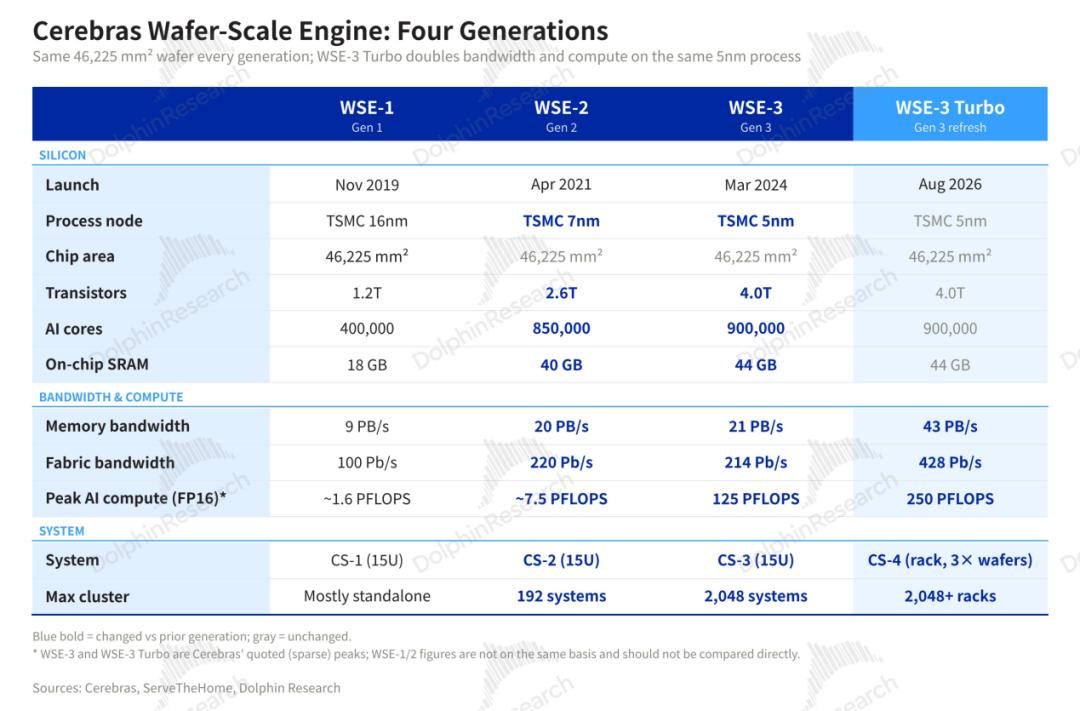
Cerebras used to release a new generation of products every 2 to 3 years on average, and more than 2 years have passed since the last new product release. If the R&D of WSE-4 goes smoothly, the product released in August 2026 should be WSE-4 instead of WSE-3 Turbo. Using "overclocking + rack reconstruction" to maintain the iteration rhythm indicates that the next-generation silicon wafer has encountered difficulties.
Under current demand, the maximum value of WSE lies in on-chip SRAM. However, when upgrading from 5nm to 3nm, SRAM has hardly shrunk.
Data released by TSMC at IEDM (International Electron Devices Meeting) shows that the SRAM cell area of N3E is 0.021µm², which is basically the same as that of N5.
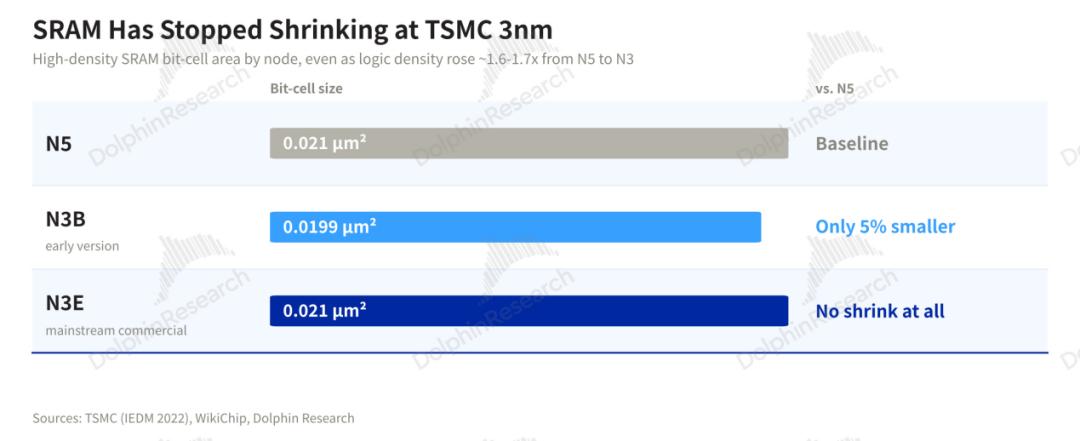
Assuming that half of the WSE area is logic and half is SRAM: after upgrading to 3nm, only the logic part area is reduced by 40%; since the SRAM part does not shrink, the overall area can only be reduced by about 20%.
Since the area of 1b storage unit of SRAM remains unchanged, even if the area saved by logic is allocated to SRAM, the on-chip capacity can only be increased from 44G to 60GB, which cannot solve practical problems at all.
Essentially, the storage part cannot be miniaturized, and large models still need to be moved off-chip or connected to external storage. Continuing to upgrade silicon wafers in this way is "more pain than gain": huge costs are invested, but the most desired SRAM improvement cannot be obtained.
Therefore, by the fourth generation, Cerebras shifted its R&D focus from "silicon wafer process upgrade" to "power supply and rack architecture innovation in data centers", and WSE-3 Turbo/CS-4 is the product of this shift.
CS-4 aims to achieve four core changes:
1) Chip layer: Double the power supply tolerance, and fully increase the main frequency and bandwidth
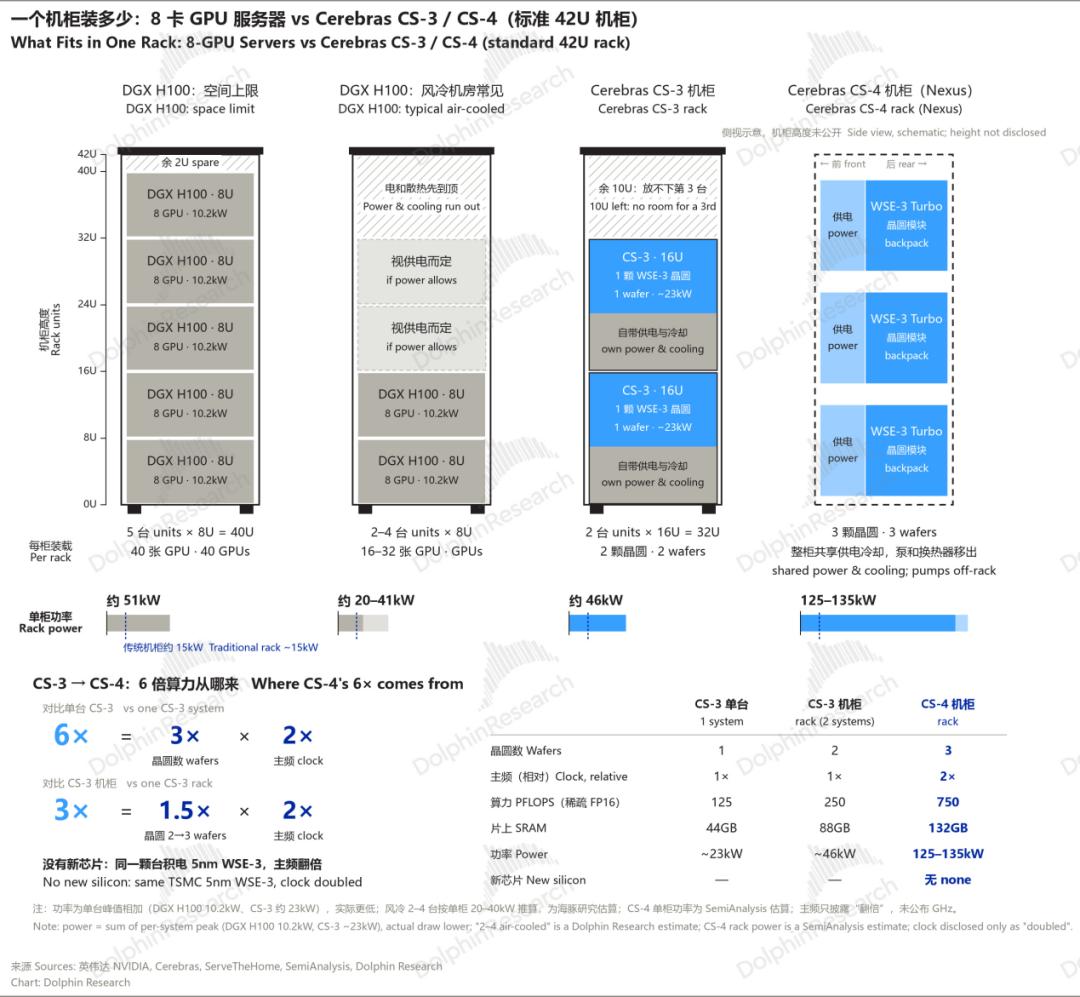
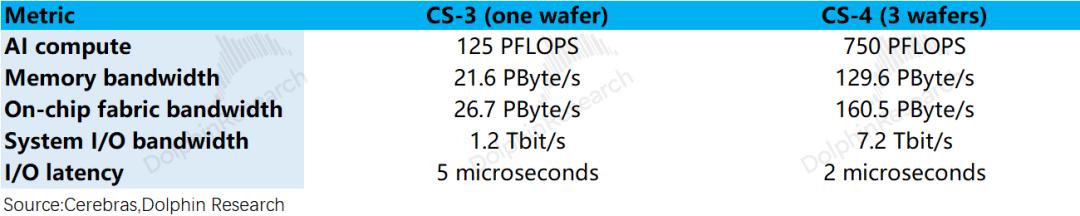
The new power module of CS-4 (Nexus Power Array) can output more than twice the current. With the 5nm wafer and 900,000 cores completely unchanged, the main frequency is doubled from about 1.4GHz to about 2.8GHz.
2) System layer: From "single chassis drawer" to "high-density rack-scale system"
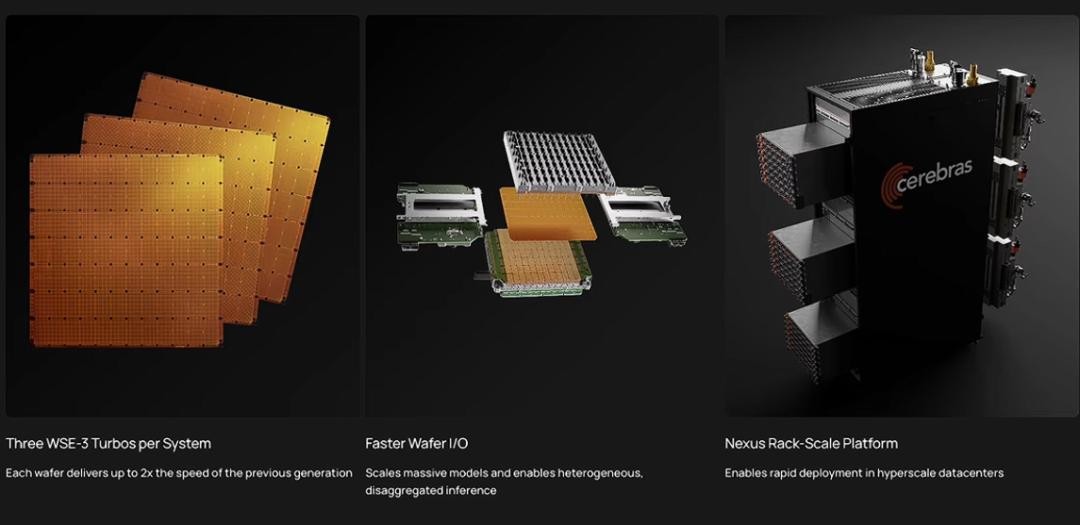
CS-3 is a 15U-high single chassis equipped with 1 WSE-3 wafer (vs DGX H100, 8U per server). CS-4 is a rack-scale (Nexus) platform, and one rack directly integrates 3 WSE-3 Turbo wafers (standard 42U rack).
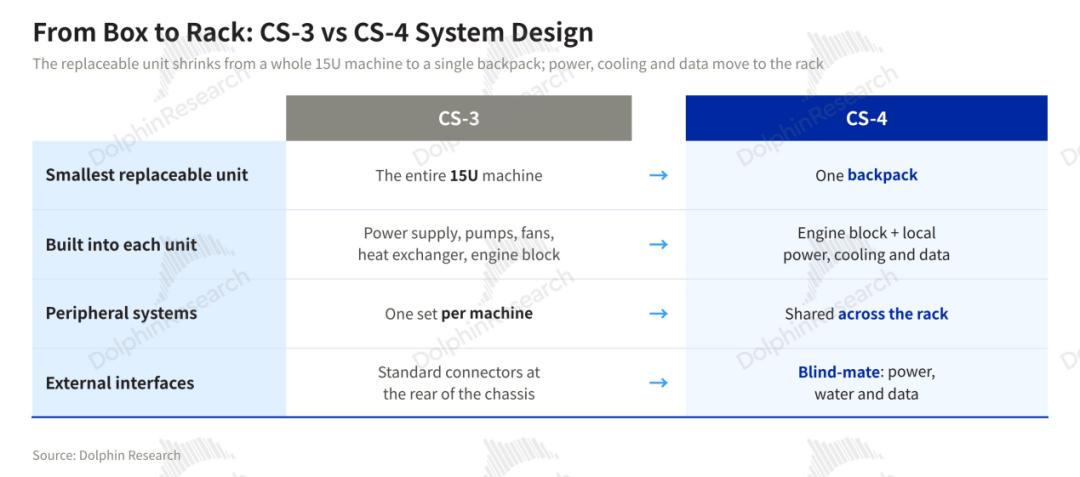
3) Packaging and engineering layer: "Backpack-style" hot-swap design
The wafer, water cooling plate, power supply and controller of CS-3 are tightly sealed in the chassis, which makes disassembly, assembly and maintenance very complicated; CS-4 packs the wafer, water cooling and micro power supply into an independent "computing power backpack", which can be directly inserted into the public power array and liquid cooling diverter at the back of the cabinet, and peripheral systems such as power supply and fans are shared by the entire rack.
In this way, maintenance is as easy as replacing the battery pack of a power tool: pull out the broken backpack as a whole and replace it with a new one.
4) Interconnection layer: "Direct wafer-to-wafer connection" inside the rack
Cross-cabinet transmission of CS-3 needs to go through an external switch; CS-4 integrates Nexus low-latency interconnection in the cabinet, and 3 wafers communicate directly through the rack backplane, reducing the inter-chip transmission latency in the cabinet from 5 microseconds to 2 microseconds.
II. From chip company to computing power company: Changes in customer orders
Cerebras is a chip company, but almost no big customer is willing to buy its chips just for the chips themselves. Because its chips and machines are too unconventional, the deployment friction cost is very high — customers need to renovate the computer room, configure customized 21°C water cooling, and equip peripheral systems such as hosts.
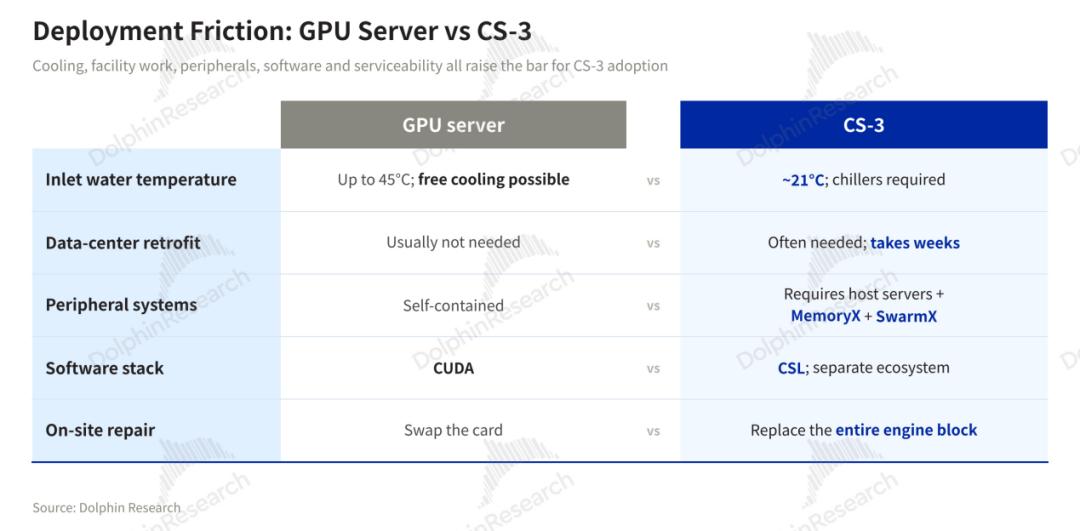
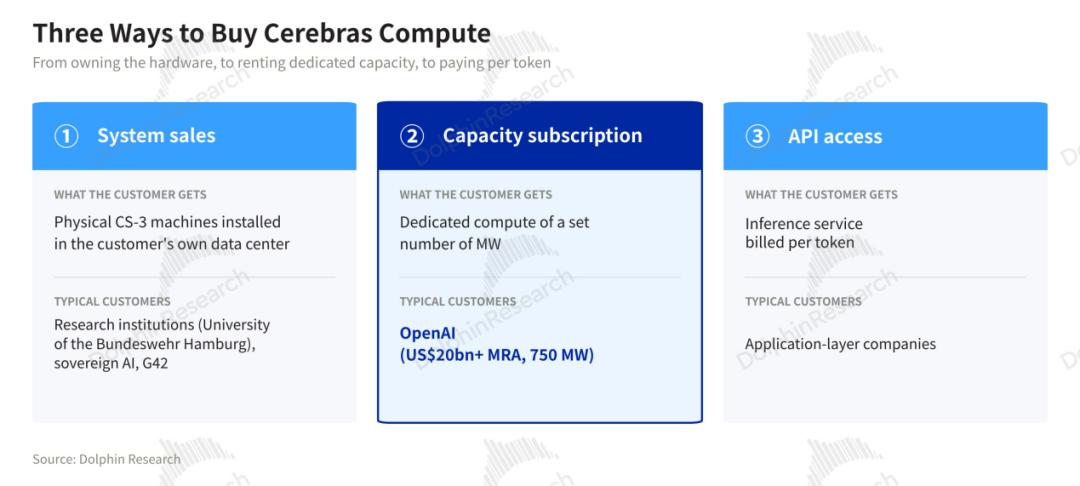
In the past, only scientific research institutions purchased its products, and it was difficult to expand the market; big customers like OpenAI were also unwilling to buy the whole machine. Cerebras can only place the machines in its own computer room and bear these costs by itself, making it more and more like a neocloud with self-developed chips. Its business with OpenAI is actually selling computing power priced at $/MW.
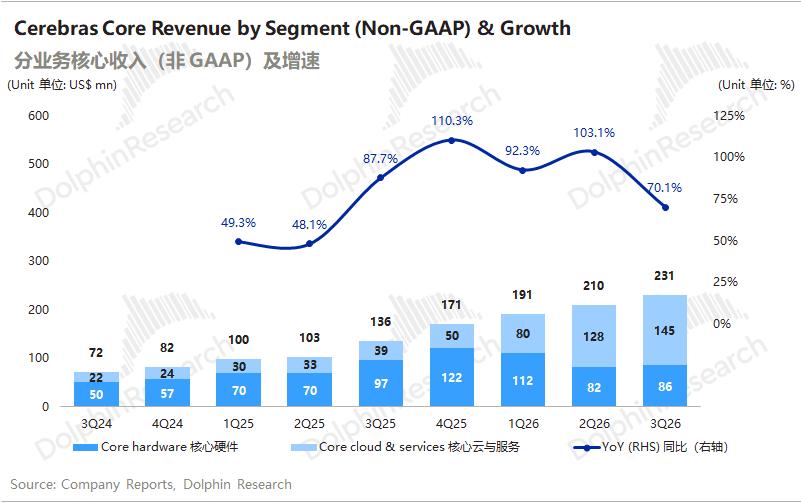
Now, whether in terms of revenue or profit, Cerebras is more and more like a new cloud computing power company:
A. Cloud revenue of the company in the second quarter has exceeded hardware revenue.
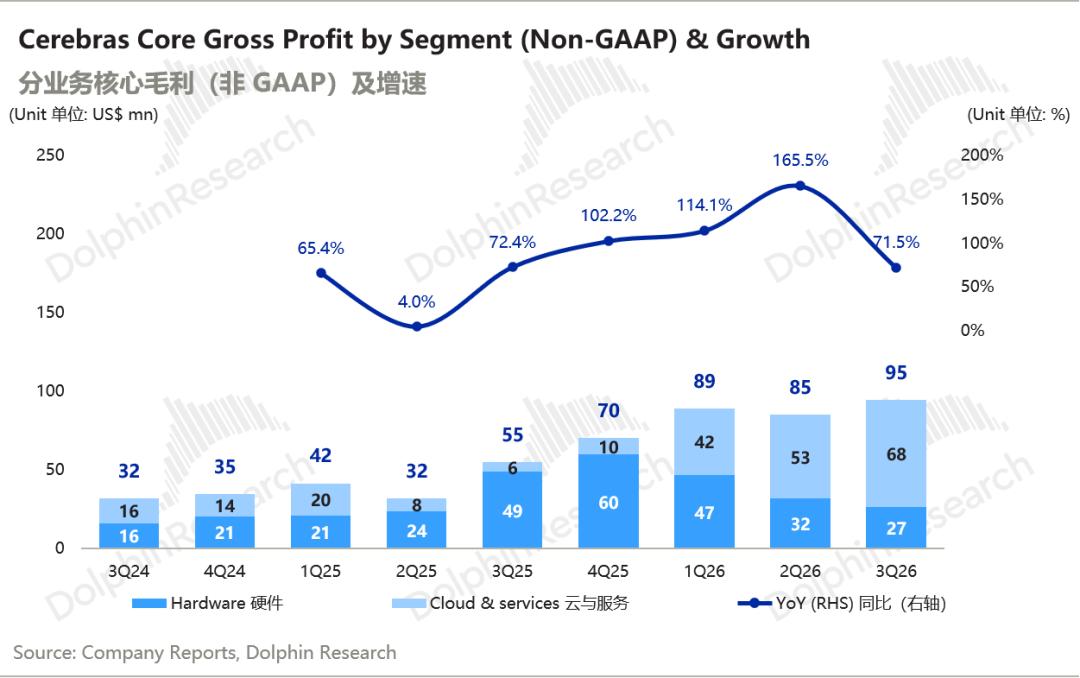
b. In terms of gross profit contribution, cloud leasing service exceeded hardware service in the third quarter. There may still be fluctuations in the short term due to the production and delivery progress of cloud computing, but Dolphin Jun estimates that in the long run, the gross profit elasticity mainly depends on the scale and utilization rate of cloud services.
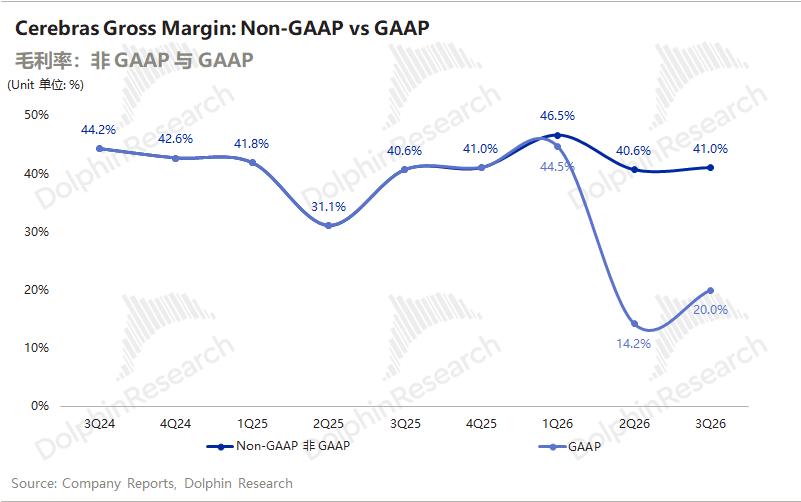
First of all, the gross profit margin of hardware depends on the yield, but the actual yield of Cerebras is the 7% redundant design mentioned before. As long as the defects do not fall on the key routes, the compiler can bypass the bad cores, which depends on manufacturing engineering and software design, and there is little room for improvement.
As for the cloud business, its gross profit margin depends on scale effects such as rental price and occupancy rate.
Among several major customers, OpenAI purchases computing power, Middle Eastern shareholders purchase whole machines, and Amazon purchases whole machines in the form of financial leasing. Specifically:
1) Open AI: Purchase computing power
First of all, similar to many chip companies with weak bargaining power in the industry, Cerebras sells computing power to customers and gives equity as a gift:
a. It has issued warrants to Open AI, which can purchase a total of 33.445 million shares of Class N common stock (without voting rights) at the exercise price of USD 0.00001 per share.
The warrants vest in batches. At present, Open AI has been granted 10.03 million shares, accounting for about 30%. The conditions include working capital loans, market value or payment thresholds, committed production capacity and additional production capacity, etc. Specifically:
①Working capital loan in place: Open AI provides a USD 1 billion secured promissory note (6% annual interest, maturing at the end of 2032) for relevant infrastructure construction. If it is repaid by delivering computing power, the interest can be waived. After the funds are in place in January 2026, 4.46 million shares (about 13%) will vest to Open AI.
②Market value or payment threshold: 5.57 million shares will vest when Cerebras's "market value reaches more than USD 40 billion" or "receives specific fees from Open AI".
The closing market value of Cerebras on its first day of listing (May 14, 2026) has exceeded USD 70 billion, meeting the condition, and these 5.57 million shares (about 17%) vested to Open AI in June 2026.
③Committed capacity and additional capacity are delivered in batches: The remaining about 23.41 million shares (about 70%) vest in batches according to the delivered computing power.
Based on the fair value of USD 82 per share on the grant date, the 10.03 million shares granted correspond to USD 823 million in warrant assets. The company will reduce revenue according to the proportion of relevant revenue recognition, which is called "warrant amortization".
