Where has SMIC's gross profit gone?
Author | Liang Fan
Editor | Fan Zhang
On November 12, SMIC released its 2026 Q3 financial report.
This is a financial report that far exceeded the previous performance guidance, but it did not gain recognition from the capital market at the beginning.
Calculated in US dollars, the company's operating revenue in the third quarter increased by 33.9% year-on-year and 6.1% quarter-on-quarter, while the previous guidance was 2%-4% quarter-on-quarter.
In addition, SMIC's gross profit margin in the third quarter reached 29.9%, up 4.6 percentage points quarter-on-quarter and 7.9 percentage points year-on-year, exceeding the gross profit margin range of 26%-28% in the previous guidance.
Driven by the better-than-expected revenue and gross profit margin, SMIC's net profit attributable to shareholders in the third quarter doubled directly year-on-year.
However, in the two trading days after the release of the financial report, SMIC's stock price fell by nearly 5% cumulatively. While this is partly due to the general correction of technology stocks, the fourth-quarter performance guidance given by the company also raised market concerns:
Although revenue remains strong (expected to grow 4%-6% quarter-on-quarter), the gross profit margin may decline (guidance is 26%-28%).
TSMC has also seen a similar trend. Its gross profit margin in the third quarter of 2026 fell to 66.4% quarter-on-quarter, and it gave a median gross profit margin guidance of 66% for the fourth quarter.
Gross profit margin is an important momentum indicator reflecting the supply-demand relationship of the industry. The core of market concern is whether the prosperity cycle of this round of the semiconductor industry has begun to show an inflection point.
However, the trend soon took a new turn. The tightening of penetrating regulation on AI chips overseas is expected to accelerate the alternative demand for domestic computing power chips. As the "shovel seller" at the local wafer foundry terminal, SMIC is also expected by the market to maintain high prosperity continuously by virtue of this trend.
However, if you dig deep into SMIC's financial report, the key to determining the quality of its future performance actually lies under a constraint line: with limited capacity expansion and the superimposed depreciation period, whether the company can stabilize performance growth by raising prices.
Similar selling price, different gross profit margin
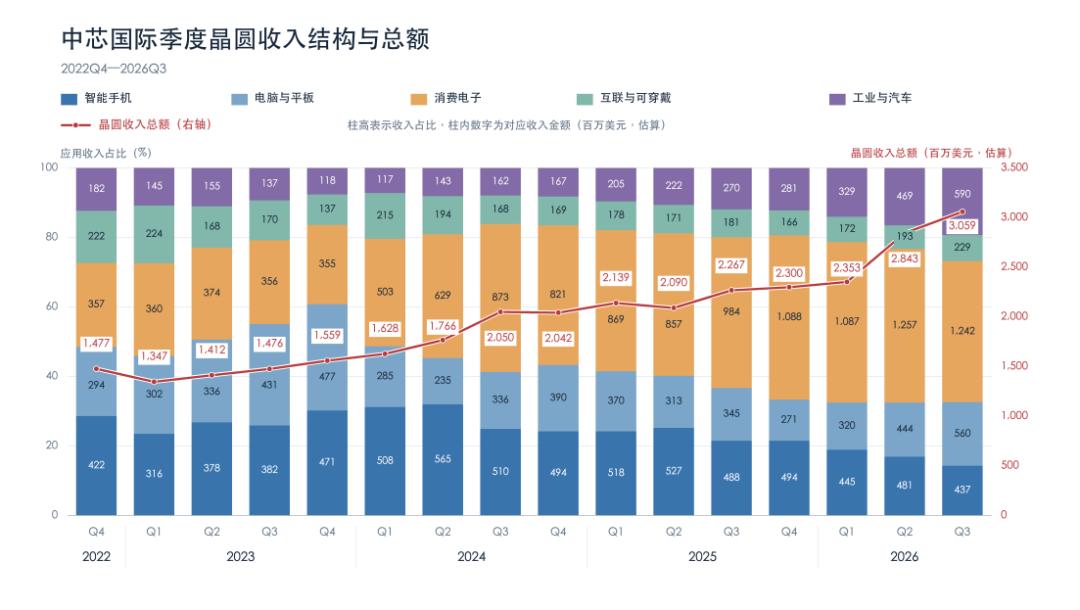
On the revenue side, the changing trend under the disclosure caliber of SMIC's financial report can be summarized in one sentence: the smartphone industry is shrinking, the consumer electronics industry is basically stable, the computer and tablet industry is obviously recovering, and the industrial and automotive industry continues to improve.
However, this disclosure caliber of SMIC actually conceals the real changes of the industry. In the third quarter, the shipments of domestic consumer electronic products such as mobile phones, tablets, laptops, and TWS headphones all declined year-on-year. The reason why the company's revenue under the corresponding caliber can still achieve year-on-year growth is that the foundry revenue of computing power and AI supporting chips is scattered and included in it, which conceals the change of total volume.
In other words, SMIC's current revenue and performance growth are mainly driven by computing power and AI-related demand, while the past core large consumer electronics business (mobile phones, computers and tablets, headphones, etc.) is actually under considerable pressure under the background of shrinking demand faced by downstream customers.
Source: Wind, company announcement, 36Kr collation
Understanding this differentiation of "AI structural pull and traditional basic disk under pressure" is the premise to understand why SMIC's profitability is lower than the high point of the previous cycle and why it gives a relatively conservative fourth-quarter gross profit margin guidance.
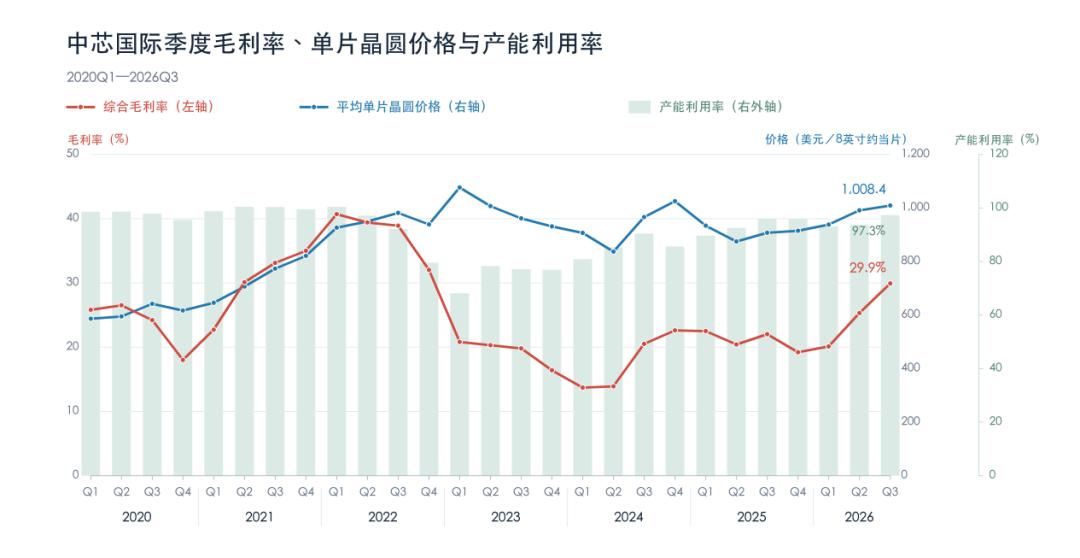
Since 2025, SMIC's wafers have shown a trend of rising in both volume and price. By the third quarter of 2026, the average price of a single wafer (equivalent to 8-inch) has exceeded 1000 US dollars, and the capacity utilization rate has also reached a high level of 97.3%.
Compared with historical data, the last time SMIC had the combination of "high unit price and high capacity utilization rate" was from 2021 to the first half of 2022. At that time, it was also in the RMB appreciation cycle, and the company's comprehensive gross profit margin once rose to about 40%.
However, when the same combination reappeared in 2026, the gross profit margin was only 29.9%.
The gross profit margin gap of about 10 percentage points shows that the pressure on the cost side has increased significantly, and the price increase of products has not kept up with the rise of costs.
Source: Wind, company announcement, 36Kr collation
Further, there are two factors behind this: first, a large amount of SMIC's previous capital expenditure has successively entered the depreciation cycle; second, downstream customers cannot afford higher prices.
Entering the peak depreciation period
The root cause of the nearly 10 percentage points profit gap between 2026 and 2022 is that the underlying logic of the two rounds of wafer average price increases is completely different.
The semiconductor market cycle from 2020 to 2022 is more cyclical. Home office drove a wide recovery in demand for electronic products, superimposed on the capacity shortage caused by epidemic prevention and control, forming a rigid gap, which not only rapidly increased SMIC's capacity utilization rate, but also brought the company strong bargaining power. At that time, although the upstream wafer manufacturing related equipment and raw materials were also rising in price synchronously, SMIC had strong price pass-through ability and could fully pass on the cost.
This round of average price increase since 2025 is driven by the high price and high-end orders of computing power and AI supporting chips, not the traditional full-industry cyclical fluctuation, so SMIC's active price increase ability is weak. At the same time, although raw materials such as upstream silicon wafers and electronic chemicals have also risen in price in this round, the increase has not exceeded the previous cycle, which is not the main factor dragging down the gross profit margin.
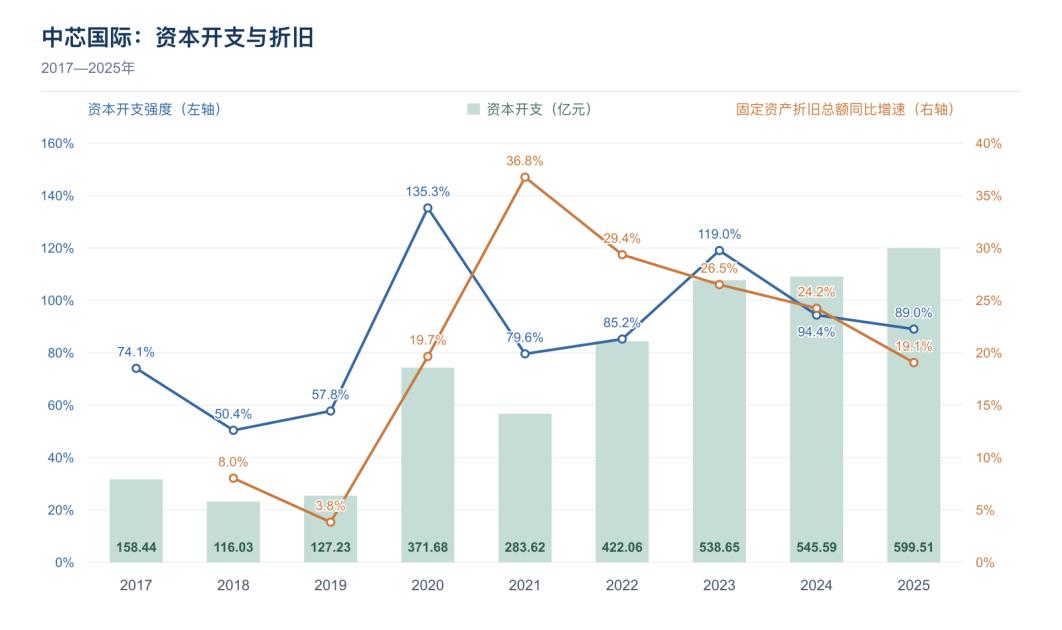
What really significantly pushes up costs and widens the gross profit margin gap between the two cycles is the high depreciation and amortization. A verifiable data is that in 2022, the total unit depreciation and amortization of SMIC's single equivalent 8-inch wafer was about 200 US dollars, while the unit depreciation and amortization in the third quarter of 2026 has risen to about 300 US dollars, and the proportion of total depreciation and amortization in operating revenue has also increased from 20% to 30%.
Under similar capacity utilization rates, the sharp increase in unit depreciation and amortization in 2026 is most likely due to the company's investment in more advanced equipment to produce higher-end wafers.
From historical data, equipment depreciation usually starts one year after capital expenditure. The intensive capital expenditure after 2022 has successively entered the peak depreciation period, and the amount of depreciation and amortization has also risen, dragging down the performance of gross profit margin. In contrast, during 2020-2022, some of SMIC's old production lines had entered the end of depreciation, and the new round of capital expenditure cycle had just started, so the impact of depreciation and amortization on the income statement was at a staged low point.
Source: Wind, company announcement, 36Kr collation
Therefore, although SMIC's single wafer selling price and capacity utilization rate are close to those in 2022, there is more than 100 US dollars of additional unit depreciation and amortization than in 2022. After excluding the depreciation and amortization amount allocated to expenses, the difference reflected in the gross profit margin (unit depreciation and amortization / unit selling price) just corresponds to the difference of nearly 10%.
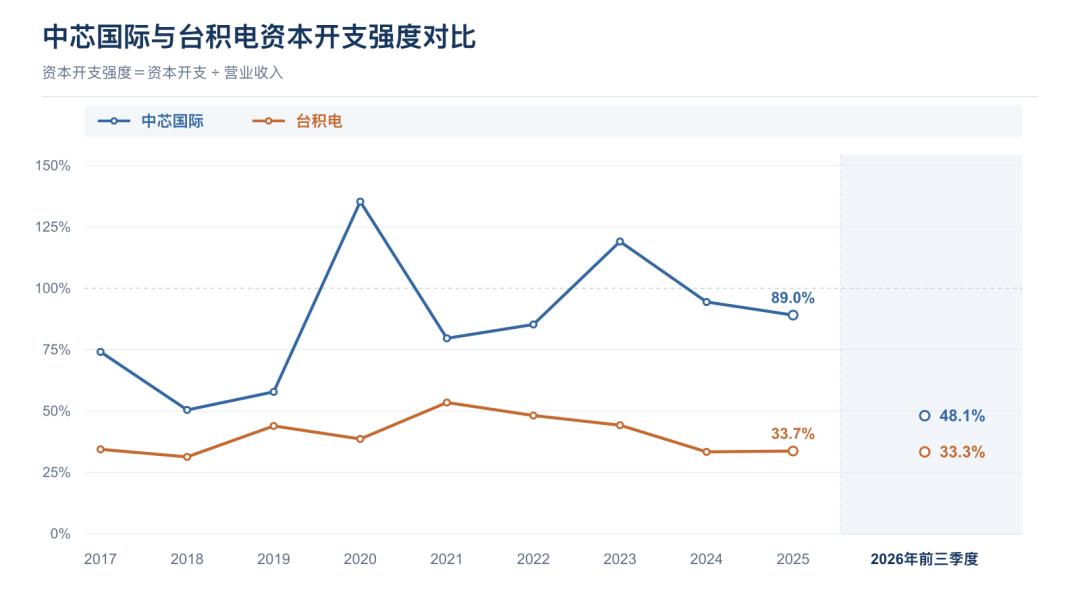
A horizontal comparison with TSMC can also confirm this logic. Although TSMC's absolute scale of capital expenditure after 2020 is also huge, its capital expenditure intensity (capital expenditure / operating revenue) is always significantly lower than that of SMIC, which is in the catch-up capacity expansion period. Reflected in the income statement, the depreciation and amortization of TSMC in the first three quarters of 2026 accounted for only about 15% of revenue (far lower than SMIC's 30%), which is an important financial reason for the two leading foundries to widen the gross profit margin gap.
Source: Wind, company announcement, 36Kr collation
Downstream cannot actually afford high prices
The depreciation and amortization brought by the rising period of capital expenditure is the main factor suppressing SMIC's gross profit margin. At the same time, the company's product price increase ability is weak, it is difficult to fully pass on the cost through price increases, resulting in the proportion of depreciation and amortization in revenue being passively pushed up, further dragging down the gross profit margin performance.
As mentioned earlier, under the background of rising memory prices, consumer electronics demand is generally suppressed, and the shipments of domestic consumer electronic products such as mobile phones and tablets all declined in the third quarter, the shrinkage of terminal demand will suppress SMIC's ability to raise prices.
Even the computing power and AI supporting chip customers who drove SMIC's revenue and average price growth in this round cannot actually fully bear the higher foundry price.
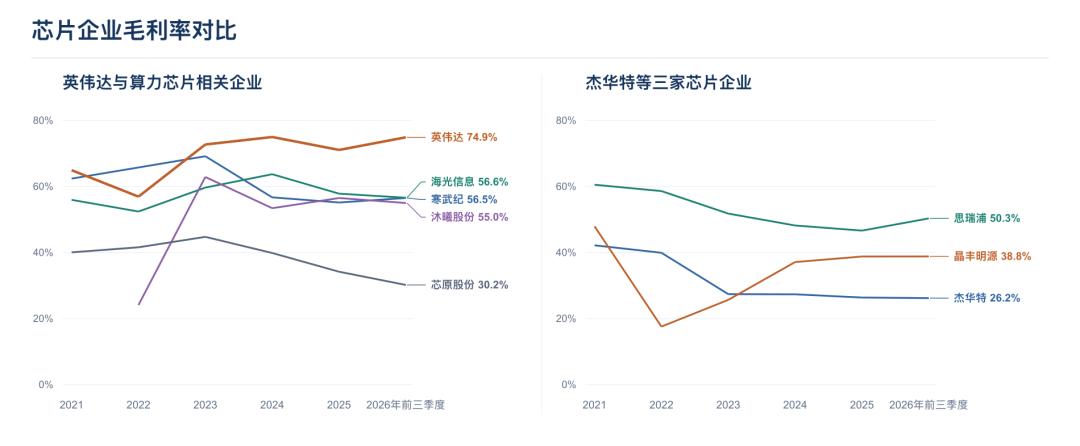
Taking some domestic AI computing power chip and power management chip design enterprises as examples, although these enterprises have not publicly disclosed the specific wafer foundry attribution, it is not difficult to see the cost pressure faced by SMIC's local chip design customers through their gross profit margin trend.
In the overseas market, NVIDIA's gross profit margin as high as 74.9% in the first three quarters of 2026 is enough to leave sufficient space for TSMC to raise prices and maintain gross profit margin. But in the domestic market, although leading computing power chip enterprises such as Cambricon and Hygon Information also reached 56.5%-56.6% in the first three quarters of this year, their overall trend has slightly converged in recent years; looking at the power management chip manufacturers supporting computing power and terminals, their gross profit margin is one tier lower than that of AI chip enterprises (mostly in the range of 26%-50%), and they are even less able to afford higher foundry price increases.
In other words, the current domestic computing power and AI supporting chip design industry has not formed the large-scale high profitability like overseas leaders, and the relatively thin profit cushion in the downstream in turn restricts the upward elasticity of SMIC's gross profit margin.
At the third-quarter results exchange meeting, SMIC's management pointed out that part of the price increases previously agreed with customers will enter the implementation period in the fourth quarter, and the average wafer price is expected to rise further slightly; at the same time, there is no clear general price reduction trend in the foundry prices of mobile phones and low-end consumer electronics.
However, this moderate price increase can only barely hedge the further rise of upstream raw material costs, and it is difficult to substantially drive the further expansion of gross profit margin.
In addition, the management also revealed a key detail at the performance meeting: one of the important reasons why the gross profit margin in the third quarter could rise to 29.9% is that the company temporarily allocated the capacity originally planned for internal engineering verification and R&D tape-out to customers' emergency orders, thus pushing the capacity utilization rate from the planned 95% to 97.3%. Entering the fourth quarter, as the R&D tape-out returns to the normal rhythm, the capacity utilization rate is expected to decline, superimposed on the continuous depreciation pressure, which also directly explains why SMIC gave the gross profit margin correction guidance of 26%-28% for the fourth quarter.
Source: Wind, company announcement, 36Kr collation
But the real constraint is actually capacity
Through the previous content, we can describe SMIC's current financial portrait:
Capacity utilization is at a high level, the previous intensive capital expenditure has entered the depreciation period, downstream customers are in different situations, and the overall price increase ability is weak.
From the perspective of growth, SMIC's future growth can only move in these two directions:
First, downstream demand is more prosperous, the price bearing capacity is enhanced, and SMIC raises the gross profit margin level by further raising prices.
Second, further expand capacity, relying on the growth of wafer shipments to drive the growth of revenue and profit scale.
On the price path, the recent market policy trend of penetrating regulation on overseas AI chips does give SMIC a potential bargaining opportunity. If the tightening of overseas bans forces the domestic AI industrial chain to accelerate the shift to domestic computing power chips and transmit more urgent order demand to the local foundry end, SMIC is expected to further raise prices by taking advantage of the tight capacity, and the inflection point of gross profit margin and prosperity that the market worries about may be broken.
However, compared with the imagination space on the price side, the logic of capacity expansion is not so smooth.
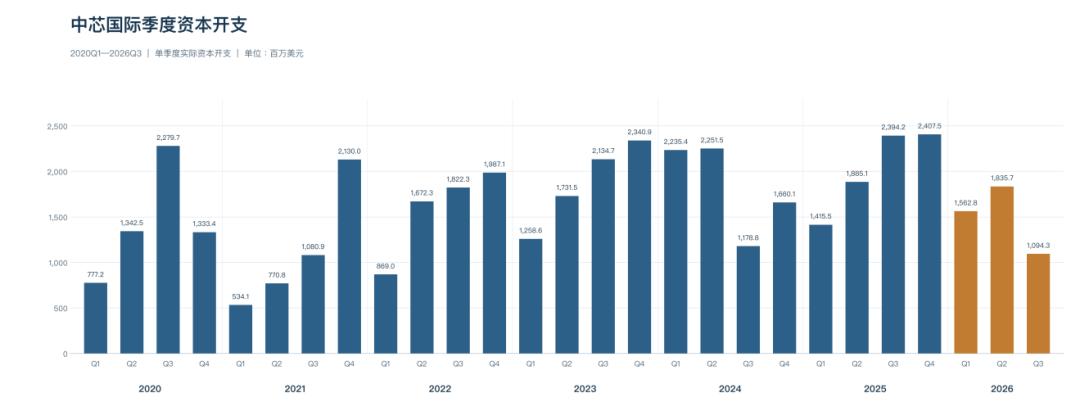
According to the capital expenditure situation disclosed by SMIC, the company's capital expenditure in the third quarter fell by nearly 50% compared with the same period in 2025, with a scale of about 1 billion US dollars. At the performance meeting, SMIC pointed out that the core reason for the slowdown in capital expenditure growth is the shortage of upstream equipment, the delivery period of some equipment exceeds 16-24 months, and even more than 24 months for tight equipment.