AI's proof of the Riemann Hypothesis has been recognized by two major mathematics communities, and Elon Musk called it "mind-blowing".
On November 21 local time in the United States, two mathematics communities Lean and Mathlib released a joint statement, saying they have "full confidence" in the proof of the Riemann Hypothesis completed by Levent Alpöge, a mathematician at Anthropic, in collaboration with Claude, and confirmed that this code proof is exactly the Riemann Hypothesis that has been studied in the mathematics community for 167 years.
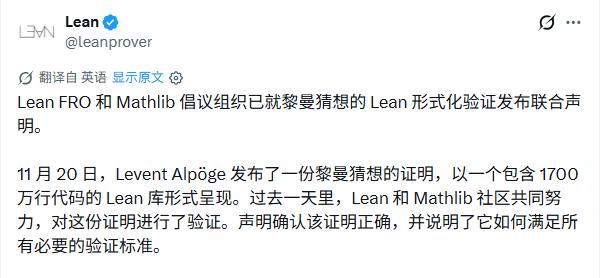
It took less than two days from the publication of Alpöge's achievement to the formalized proof community reaching a clear conclusion.
After the news spread, Elon Musk called it another "stunning" achievement of superintelligence. However, mathematicians did not focus on how powerful AI is. What they care more about is: what kind of inspection has this proof gone through? If the machine can confirm that the derivation is correct, does that mean humans have already understood it?
01 Over 170,000 modules, the machine gives a clear answer
The key to this verification is not that a certain mathematician stands up to express belief, but that the Lean and Mathlib communities confirm the formal validity of the proof.
Lean is a mathematical proof assistant system that can convert mathematical propositions and derivation processes into logical expressions that computers can check step by step.
The materials published by Alpöge are only 4 pages, but supporting this proof is a Lean formal proof library with about 17 million lines of code. If all of it is transcribed into human-readable mathematical text, the scale may exceed 250,000 pages.
How on earth can we confirm that there are no problems with such a huge amount of code?
The Lean and Mathlib communities explained in their joint statement that they mainly completed several checks.
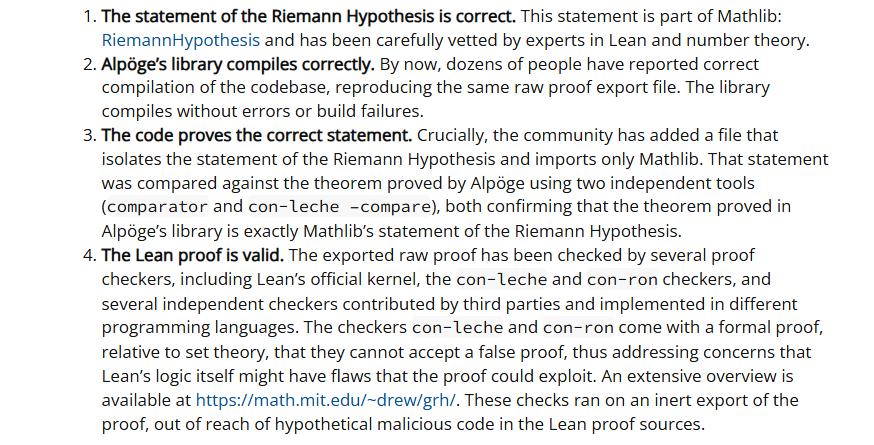
First, confirm that the proposition itself has not been tampered with. The Riemann Hypothesis has been included in the Mathlib mathematical library. The community compared the theorem proved by Alpöge with the reviewed standard expression in the mathematical library to confirm that the two are consistent. In other words, the code does not prove a modified, less difficult similar proposition, but the Riemann Hypothesis familiar to the mathematics community.
Second, check whether the code can be compiled normally. The joint statement stated that dozens of participants have independently compiled this code without encountering errors or build failures.
More importantly, check the proof process itself. The community uses tools such as comparator and con-leche to compare relevant theorems and their dependencies, and then verifies the exported proof files through Lean's own kernel and multiple independent checkers such as con-leche and con-ron. Among them, con-leche and con-ron also have formal reliability proofs relative to set theory.
The role of multiple sets of independent checkers is to reduce the risk of a single software system having vulnerabilities and thus incorrectly accepting the proof. They check the same derivation from different angles, increasing the credibility of the verification results.
Andrew Sutherland, a mathematician at the Massachusetts Institute of Technology, also published independent inspection records. His page shows that this set of code involves 175187 modules, and the relevant modules can be compiled in the Lean and Mathlib environments.
Finally, the Lean and Mathlib communities gave a very clear judgment in their joint statement:
"We have full confidence that Alpöge's proof of the Riemann Hypothesis is correct."
That is, "We are fully confident that the proof of the Riemann Hypothesis given by Alpöge is correct."
This has led to substantial progress in the event. Previously, the outside world was faced with a result published by researchers that was yet to be verified. Now, the formal proof community has confirmed that the mathematical proposition corresponding to the code is correct, and the derivation has also passed the verification of multiple checkers.
However, there is another point that needs to be distinguished here: Alpöge also stated that this method can be extended to the Generalized Riemann Hypothesis and the Extended Riemann Hypothesis. These extended claims are not equivalent to the classical Riemann Hypothesis proof that has been confirmed by the community this time, and cannot be confused.
Machine verification has given an important conclusion, but it has not completed all the work for the mathematics community. The code passing the check means that the derivation conforms to the rules of the formal system. As for what the mathematical ideas behind the proof are and why it holds, mathematicians need to conduct further research.
The Clay Mathematics Institute still lists the Riemann Hypothesis as an unsolved problem, and the formal academic review has not ended as a result.
02 The proof is passed, but mathematicians begin to ask "why"
A proof that passes machine inspection is not the same as a mathematician truly understanding the proof.
This is also the most obvious divergence in current comments.
James Maynard, a number theorist at the University of Oxford and a Fields Medal winner, has a positive attitude towards this achievement. He told *Nature*: "I guess this proof will eventually be proven correct."
But he did not equate machine verification with the end of mathematical research. In Maynard's view, even if the proof is finally established, it will take mathematicians a long time to digest the content. Only when people truly understand the proof and can extract valuable ideas from it, can this work fully demonstrate its significance.
Tristan Buckmaster, a mathematician at New York University, also affirmed Alpöge's contribution. He particularly emphasized that Alpöge himself built a system for using large language models to carry out mathematical research, instead of simply handing over the problem to Claude and waiting for the answer.
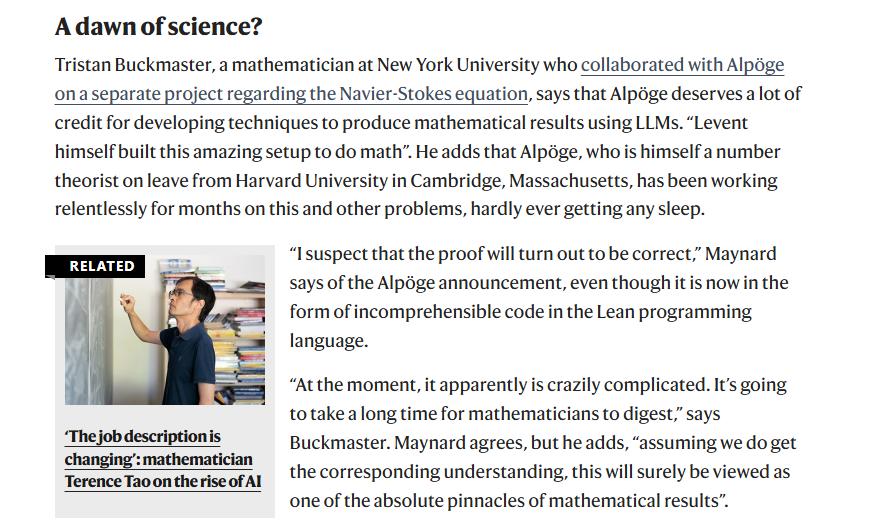
However, Buckmaster also pointed out that this proof is currently surprisingly complex, and it will take mathematicians a long time to truly understand it.
Those who question focus on the other side. Andrew Granville, a number theorist at the University of Montreal, believes that the materials published by Alpöge are not clear enough, and the proof should be organized well before it is released to the outside world. He used the word "garbled" to describe the currently public content, which means the expression is chaotic and difficult to understand.
Maksym Radziwiłł, a mathematician at New York University, put the problem more directly. He believes that what mathematical research really pursues is to understand the reasons behind the derivation, not just to confirm that every step is not wrong.
"Mathematics, like other sciences, really pursues 'why', and this work does not answer this question."
This is not to deny the verification result of Lean, but to ask another thing: when a proof is composed of 17 million lines of code, the machine can check it, but it is difficult for people to read it directly, how can mathematicians find mathematical ideas that can be understood, reused and further developed from it?
Ayush Khaitan from the Language and Intelligence Research Team at Princeton University evaluated this achievement from the perspective of human-machine collaboration. He believes that human participation is still the best way to use large language models to solve mathematical problems, and Alpöge should receive as much recognition as Claude.
03 Musk sees AI breakthrough, the mathematics community is waiting for the next step
This discussion quickly spread from the mathematics circle to the technology industry. Musk talked about the Riemann Hypothesis continuously on November 21, first responding to a joke from Tim Sweeney, CEO of Epic Games.
Sweeney wrote: "Rockstar actually released *GTA 6* before the Riemann Hypothesis was proven!" Musk replied with one word: "Banger", to express his appreciation.
Then Musk seriously explained the possible value of this proof:
"Simple explanation of the usefulness of the Riemann proof (so far) is that it removes the conditional nature of other math theorems dependent upon it."
That is, "Simply put, the value of the proof of the Riemann Hypothesis is that it can remove the conditional restrictions attached to other mathematical theorems that depend on this hypothesis."

There are many theorems in the field of mathematics that are derived under the premise of "assuming that the Riemann Hypothesis holds". Once the Riemann Hypothesis is strictly proven, these theorems no longer need to be attached with this assumption and can become conclusions that hold unconditionally. Musk later said that this is another stunning achievement achieved by superintelligence.
From the perspective of the technology industry, this incident does show the change in AI capabilities: large language models are no longer just answering mathematical questions or assisting in calculations, but participating in the proof process of a long-standing unsolved problem, and completing machine verification with the help of formal tools.
But mathematicians are still waiting for a more critical step.
Steven Strogatz, a mathematician at Cornell University, once used a metaphor to describe this kind of cooperation: "A very skilled AI jockey riding a very fast AI horse." That is, "A highly skilled AI rider riding an extremely fast AI racehorse." This sentence points out the different roles of humans and models in research: the model provides powerful computing and exploration capabilities, and researchers still need to design methods, judge directions, and decide which results are worth further tracking.
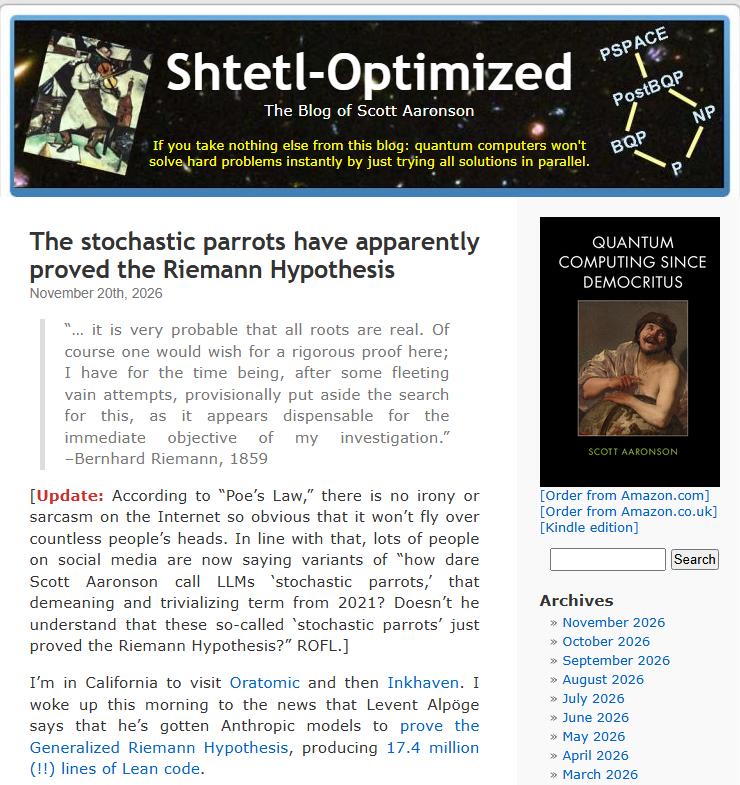
Scott Aaronson initially worried that there might be vulnerabilities in the Lean kernel. After further understanding the verification results, he clearly wrote: "The proof is correct." That is, "This proof is correct." But he also emphasized that next mathematicians need to explain, refine and reconstruct the ideas in it.
Alpöge's previous research can also show the weight of this progress. Last August, Anthropic once announced an achievement of Claude in the research of the Riemann zeta function: the model raised the lower bound of the proportion of zeta function zeros that satisfy the Riemann Hypothesis from 41.6% to 67.2%. That study advanced partial results in related fields, but did not prove the Riemann Hypothesis itself. This time, the research goal has progressed from improving a lower bound to giving a formal proof of the hypothesis itself.
Of course, this does not mean that AI can already independently replace mathematicians. Alpöge himself participated in the construction of the research system, problem exploration and proof advancement, and Lean is responsible for checking the final formal derivation. The model, researchers and verification tools together form this research chain.
For the mathematics community, the most important task at present is to convert the machine-verified proof into mathematical knowledge that humans can understand. For the AI industry, this achievement raises a more specific question: when the model can participate in solving problems that humans have not been able to overcome for a long time, can it not only give the answer in the next step, but also explain the reasoning behind the answer clearly?
The proof of the Riemann Hypothesis may have passed the formal verification stage. But what mathematicians really want is never just a correct answer, but also the path leading to the answer.
This article is from the WeChat Official Account "Tencent Tech", author: Worth Paying Attention To, published with authorization from 36Kr.