AI Sell-Off vs. Dot-Com Bubble: Is History Repeating Itself?
History may not repeat itself exactly, but the artificial intelligence sell-off that has swept through stock markets in recent weeks bears striking similarities to the bursting of the dot-com bubble, at least in terms of the magnitude of its impact on some U.S. tech stocks.
As investors continue to worry about whether there is a bubble in the artificial intelligence sector, a question worth exploring is: did the bubble ever exist? And has it already burst now?
People may turn their attention to those large tech giants that survived the baptism of the dot-com bubble and are still active at the center of the stage to this day.
An interesting comparison is that their declines from the full-year high to the end of the year (year-to-date for 2026) in 2000 and 2026 are almost comparable:
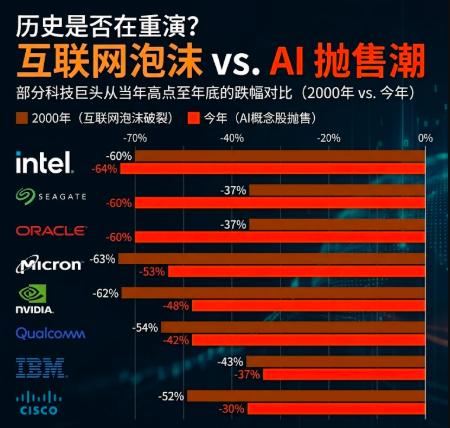
Intel: 60% decline from the high to the end of 2000, 64% decline from the high year-to-date in 2026
Oracle: 37% decline from the high to the end of 2000, 60% decline from the high year-to-date in 2026
Cisco: 52% decline from the high to the end of 2000, 30% decline from the high year-to-date in 2026
Micron: 63% decline from the high to the end of 2000, 53% decline from the high year-to-date in 2026
Qualcomm: 54% decline from the high to the end of 2000, 42% decline from the high year-to-date in 2026
Seagate Technology: 37% decline from the high to the end of 2000, 60% decline from the high year-to-date in 2026 (spin-off factors have been weighted)
NVIDIA: 62% decline from the high to the end of 2000, 48% decline from the high year-to-date in 2026
Among these giants, some have almost identical decline levels, some have suffered more severe losses this year, and some are slightly better than they were back then. But without looking at the timeline, it is actually difficult for people to definitively determine from these data alone which one is the real "bubble burst" and which one is not.
On March 10, 2000, the NASDAQ closed at 5048.62 points and once hit 5132.52 points during the trading session, setting a record high at that time, marking the peak of the dot-com bubble. The bubble then began to burst, and the Federal Reserve's interest rate hikes and the hearing of the federal government's antitrust lawsuit against Microsoft also triggered a market reversal. The stock index plummeted rapidly, and many companies went bankrupt as a result.
And so far, a notable difference is that the bursting of the dot-com bubble triggered an economic recession, which led to weakness in sectors that were previously unaffected, and triggered another round of deep sell-offs in 2001. What remains unknown is whether the AI sell-off will continue as it did back then.
Back in 2000, despite a massive rotation out of tech stocks into low-valuation and defensive stocks — with the utilities and consumer staples sectors both rising by more than 40% — the wide scope of stock price declines still caused the S&P 500 to fall by nearly 15% from its intra-year high to the end of the year.
This year, the sell-off has been concentrated mainly in artificial intelligence-related stocks, and a large-scale capital rotation has emerged again — including a 24% rise in the healthcare sector since late April — and the S&P 500 has now entered a correction zone.
Even Anthropic's high-profile successful IPO last Thursday failed to spark a market rebound — which is indeed a bad sign — but at least at this stage, the real economy is still showing considerable resilience.
How should we view this round of AI plunge?
At present, from an optimistic perspective, the current wave of AI plunge may only be a mini bubble, or a series of bubbles centered on data centers and the chips they use.
There is no doubt that behaviors usually associated with extreme bubbles have clearly emerged in memory chip stocks this year, especially prominent in the South Korean market, which attracted a large number of retail investors using leverage at the time when stock prices peaked. The surge and plunge in the sector's stock prices look like the final stage before most bubbles burst, but this process was compressed into just a few months — from the low point after the U.S. and Israel launched strikes against Iran in March to the peak in June.
The good news is that most of this "mini bubble" may have already been pricked. Micron, the chip manufacturer, saw its stock price almost quadruple in three months before falling by more than half. The stock prices of broader semiconductor companies first doubled and then fell by 43%. Suppliers providing energy and equipment for AI data centers have also shown the same trend — take Bloom Energy as an example, whose stock price fluctuation is equally extreme.
The same situation has also occurred in underperforming new cloud data center operators — which can be regarded as the "subprime borrowers" in this cycle, with NVIDIA-backed CoreWeave being the most typical example. CoreWeave's stock price soared more than fourfold after its IPO last year, but has since fallen back to its starting point.
If stock prices only fall further to return to the levels at the beginning of the year, although it will be painful, it may still be far less severe than the real panic during the bursting of the dot-com bubble — in fact, although the dot-com bubble peaked in 2000, the "catastrophic collapse" of some companies did not happen until 2001 — for example, router manufacturer Cisco, after its stock price had already halved, fell by another half in the first three months of 2001, and did not recover its March 2000 high until last December.
But right now, some pessimists are also worried that this may be more than just a "tiny mini bubble".
The broader artificial intelligence sector presents a worrying vicious cycle. Falling stock prices may lead companies to scale back their aggressive investment plans, which in turn hits suppliers that have also been bid up, harms their lenders, and further suppresses demand in reverse. If this happens, the market's expectations for extraordinary growth in data center spending will be revised down, which will not only hit the economy, but also spill over to the companies that investors originally expected to profit from.
Falling stock prices may also spill over to other industries. Retail investors have recently been big fans of the stock market, especially AI concept stocks. Economists generally believe that the "paper profits" that stock investors gain from rising stock prices have greatly stimulated consumption. Once this "wealth effect" reverses, weak consumption will drag down the entire economy, and even traditional industries that have nothing to do with AI cannot stay out of trouble.
As Vincent Mortier, Chief Investment Officer of asset management giant Amundi, said: "Usually, you don't really realize you are in a bubble until the moment it bursts."
To this day, the only thing people can be certain of is that the local mini bubble in data centers and their suppliers has indeed burst, and a considerable part of the speculative bubble in the entire AI sector has been ruthlessly squeezed out. It is still uncertain whether the larger artificial intelligence bubble is receding — but there is no doubt that the mere possibility is extremely chilling to think about.
This article is from the WeChat Official Account "CLS", author: Xiaoxiang, published with authorization from 36Kr.