A waterborne autonomous driving company has raised tens of millions of yuan in financing, accelerating the rollout of nearshore unmanned operation platforms | HardKr Exclusive First Release
Written by Huang Nan
Edited by Yuan Silai
36Kr has learned that Cangchao Technology, a surface intelligent driving company, recently closed a tens of millions of yuan Angel++ round of financing, co-invested by Industrial Securities' subsidiary Industrial Securities Capital and listed company Gaohua Technology. This marks the third round of financing completed by the company in 2026. The funds will be mainly invested in digitalization and product implementation of offshore operation and maintenance scenarios, marine physics AI technology R&D, classification society certification and industry standard formulation, while promoting cutting-edge exploration of the offshore world model.
After the completion of this round of financing, together with the previous series of seed round, Angel round and Angel+ round financing, Cangchao Technology's total financing amount has reached nearly 100 million yuan. The seed round was funded by Lianyungang Ocean Fund, the investors of the Angel round include Yungang Group, Tianhui Capital and Lianyungang Financial Holding Group, and the investor of the Angel+ round is Haizhou Bay Development Group.
Cangchao Technology was established at the end of 2023, with its headquarters located in Lianyungang. The company focuses on the offshore embodied intelligent track, takes "marine physics AI" as its technical base, and has built a three-layer product architecture covering underlying algorithms, full-vessel products and shore-based control. The bottom layer is the self-developed marine physics AI system, with the intelligent navigation AI brain "OceanHub" as the core; on this basis, three series of unmanned vessels including Lan, Yu and Yao, as well as the OceanHub on-board intelligent driving solution have been derived. This architecture enables the surface intelligent driving capability to adapt to different ship types, sea areas and operation scenarios.
The team is composed of professionals in cutting-edge technical fields such as ship engineering, underwater robots and commercial aerospace, and the core members have cross-professional backgrounds in both ship design and surface autonomous driving. Cheng Chen, founder and CEO of the company, holds a doctorate degree from Hohai University, once served as an external technical consultant for multiple local maritime administrations, and deeply participated in a number of national key R&D projects.
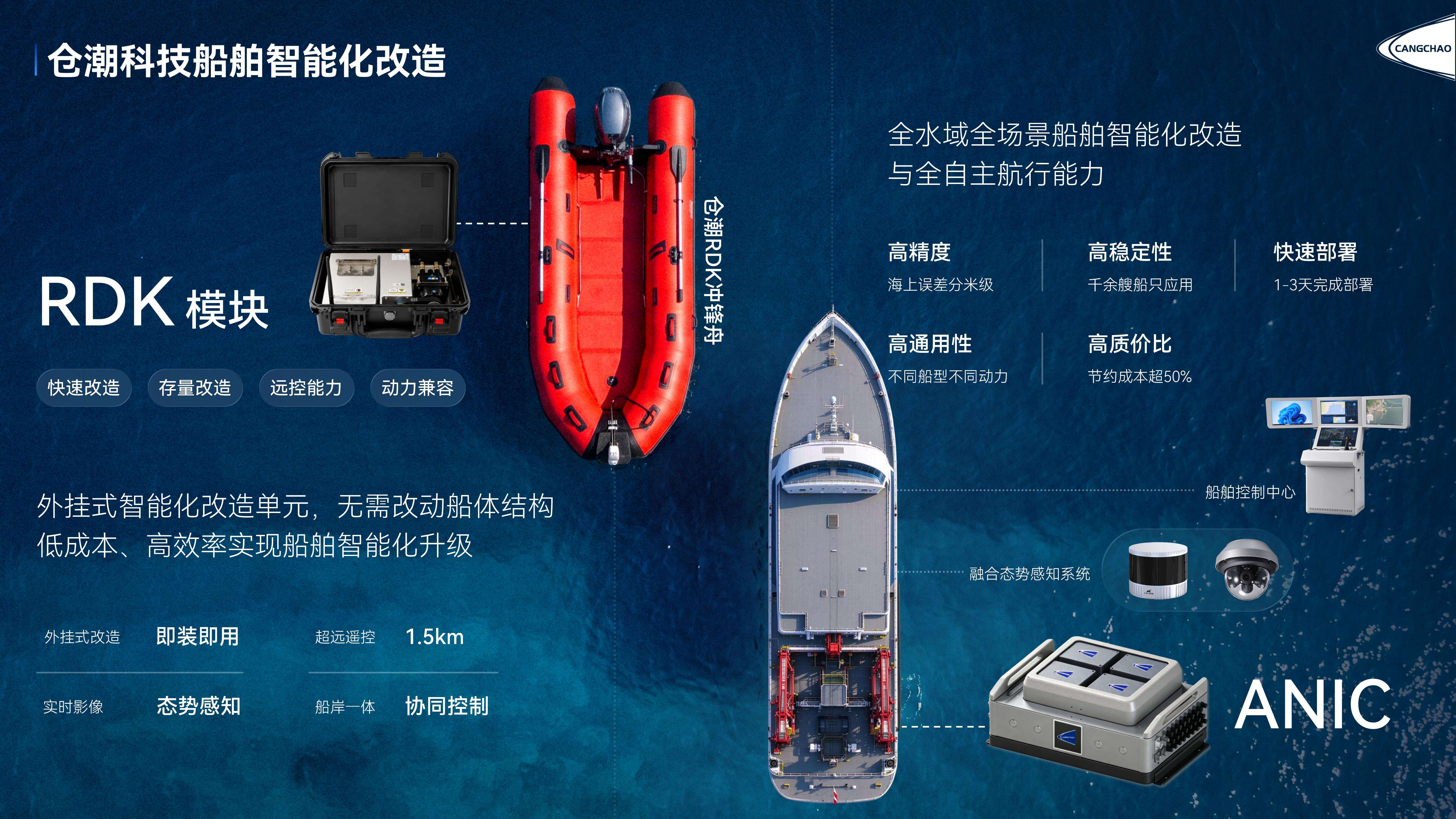
Intelligent transformation of ships by Cangchao Technology (Source/Enterprise)
Marine intelligent driving has long faced an unavoidable real-sea verification bottleneck.
The hydrology, wind and waves, ocean currents and visibility conditions in offshore waters are dynamically changing, with discrete and non-reproducible working conditions, so it is not easy to carry out stable and controllable offshore measurement continuously. The acquisition of effective samples under real marine working conditions features high cost and long collection cycle, and without sufficient on-site data covering various extreme working conditions, it is difficult for the model to carry out continuous iterative optimization; without normalized offshore field verification, the reliability and fault tolerance of the algorithm in the face of complex sea conditions can hardly be fully polished.
"Finding a suitable sea area to continuously carry out standardized field tests is a very difficult task in itself," Cheng Chen, CEO of Cangchao Technology, told 36Kr. The exploration of Cangchao Technology starts from solving this industry pain point. In the seed round stage, with the support of Lianyungang Ocean Fund, the company entered the initial test sea area to carry out multi-working condition and long-cycle real-sea tests, and completed the early algorithm and system verification work.
Cheng Chen pointed out that the core threshold of offshore intelligent algorithms is far more than the sea area environment itself. The deeper test lies in whether the team can build a complete closed-loop verification system of "data-model-scenario" to continuously precipitate exclusive data of marine scenarios; at the same time, based on system engineering capabilities, ensure the stable and reliable operation of unmanned navigation equipment in complex and changeable marine working conditions such as wind, wave and disturbance.
Specifically in terms of the design of underlying algorithms, the team deeply integrates the ship dynamics model with deep learning, and proposes a "physics-driven neural network control algorithm". By taking the physical motion law of the ship as the "pre-constraint" of the neural network, the model can further learn and understand how the hull is stressed and responds in wind, wave and water flow while absorbing data.
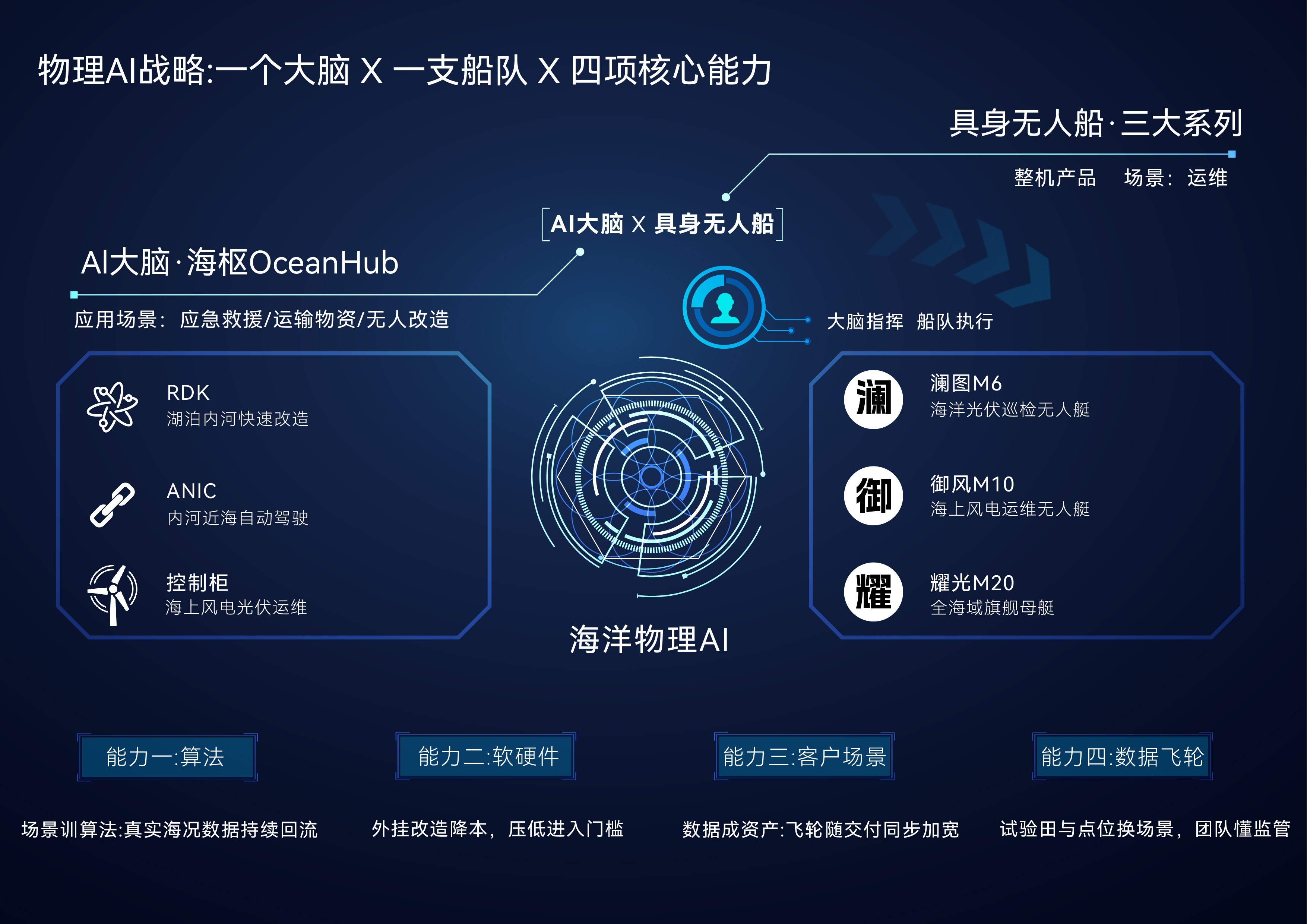
Full-stack capability of surface intelligence (Source/Enterprise)
This "physics + data" two-wheel drive mode enables Cangchao Technology's unmanned vessels to have higher-precision maneuvering control and trajectory tracking capabilities even in the face of complex sea conditions.
On this basis, Cangchao Technology simultaneously builds a domain world model for offshore areas. Different from the land road environment, there are no fixed lanes on the sea surface, and markers will continue to change with tides and water currents. The positions of buoys, navigation ships and underwater obstacles are all dynamic, and static electronic nautical charts are no longer sufficient to support real-time navigation decisions.
The value of the offshore world model is to upgrade the static nautical chart to a dynamic environment base that can perceive and deduce environmental changes. 36Kr learned that relying on the full-domain environment reconstruction and normalized real-sea tests in hundreds of kilometers of waters around Lianyungang, Cangchao Technology has integrated real-time sea condition data, dynamic obstacle information and electronic nautical charts, and trained an end-to-end model for vertical scenarios. This model can predict the impact of water flow, wind and waves on hull motion, deduce the navigation intention of surrounding ships, and identify potential risks at the front end of the decision-making link.
Entering the industrialization link, in the marine economic map, offshore law enforcement, marine surveying and mapping and offshore new energy operation and maintenance are three scenarios with clear demand increments. Taking offshore photovoltaic and wind power as examples, with the gradual rollout of large-scale infrastructure construction, operation demands such as daily operation and maintenance, submarine cable monitoring, seabed surveying and mapping, and drone cleaning are growing rapidly. The traditional manned ship operation mode faces pain points such as high labor cost, operation window limited by sea conditions, and high personnel safety risk, so the alternative space for unmanned and autonomous operation is opening up.
In the view of the Cangchao Technology team, if intelligent unmanned ships only stay at the level of "being able to sail on the water surface according to the predetermined route", they are still just a transportation tool, and cannot truly cut into the core pain points of the above scenarios.
The real threshold of offshore embodied intelligence lies in solving specific operation problems. To this end, Cangchao Technology has built a heterogeneous collaborative operation system, in which the unmanned ship acts as the central platform responsible for autonomous driving and task planning; the drone acts as the air perspective and lightweight load carrier; and the underwater robot undertakes underwater operation tasks. The three work in coordination to cover the full-dimensional monitoring and operation and maintenance demands from the sea surface to underwater.
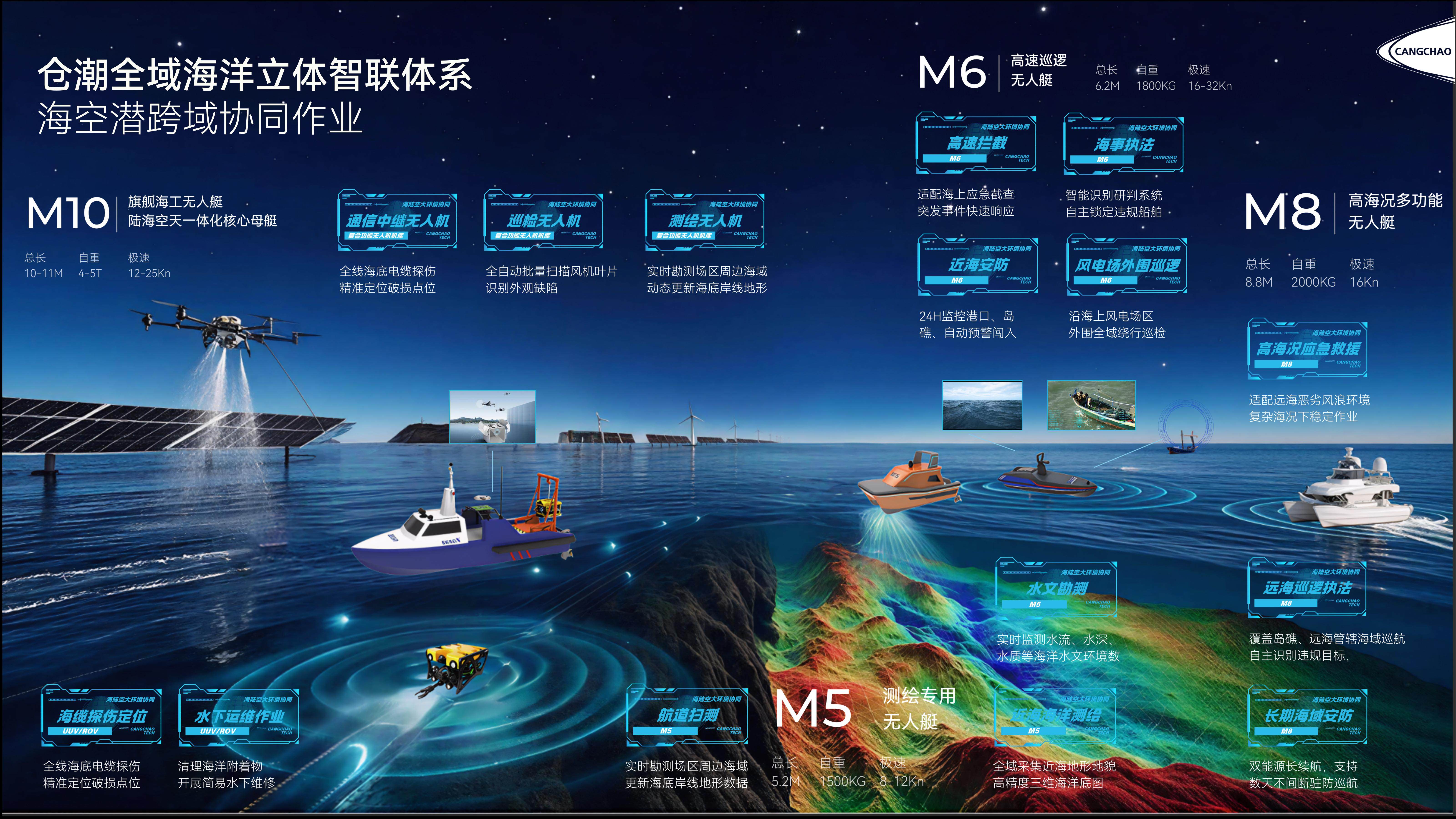
Global marine three-dimensional intelligent connection system (Source/Enterprise)
In terms of business model, Cangchao Technology has formed two parallel product lines. One is the standardized intelligent driving box, which is oriented to the intelligent transformation of existing ships, can adapt to scenarios such as assault boats, rescue boats and water target boats, with the installation process controlled within half an hour to one hour, and has achieved mass delivery at present; the other is the self-owned unmanned ship product line, focusing on scenarios such as maritime patrol, photovoltaic operation and maintenance, and wind power operation and maintenance, providing complete solutions from the hull to the intelligent driving system.
At present, Cangchao Technology has delivered products to nearly 100 customers in total, covering government units such as the maritime system, coast guard system and border defense system, as well as port-related units and many offshore wind power developers. It also cooperates with classification societies, universities and scientific research institutions such as China Classification Society, Hohai University, Jiangsu University of Science and Technology and Shanghai University, and its products are gradually entering the stable use stage.
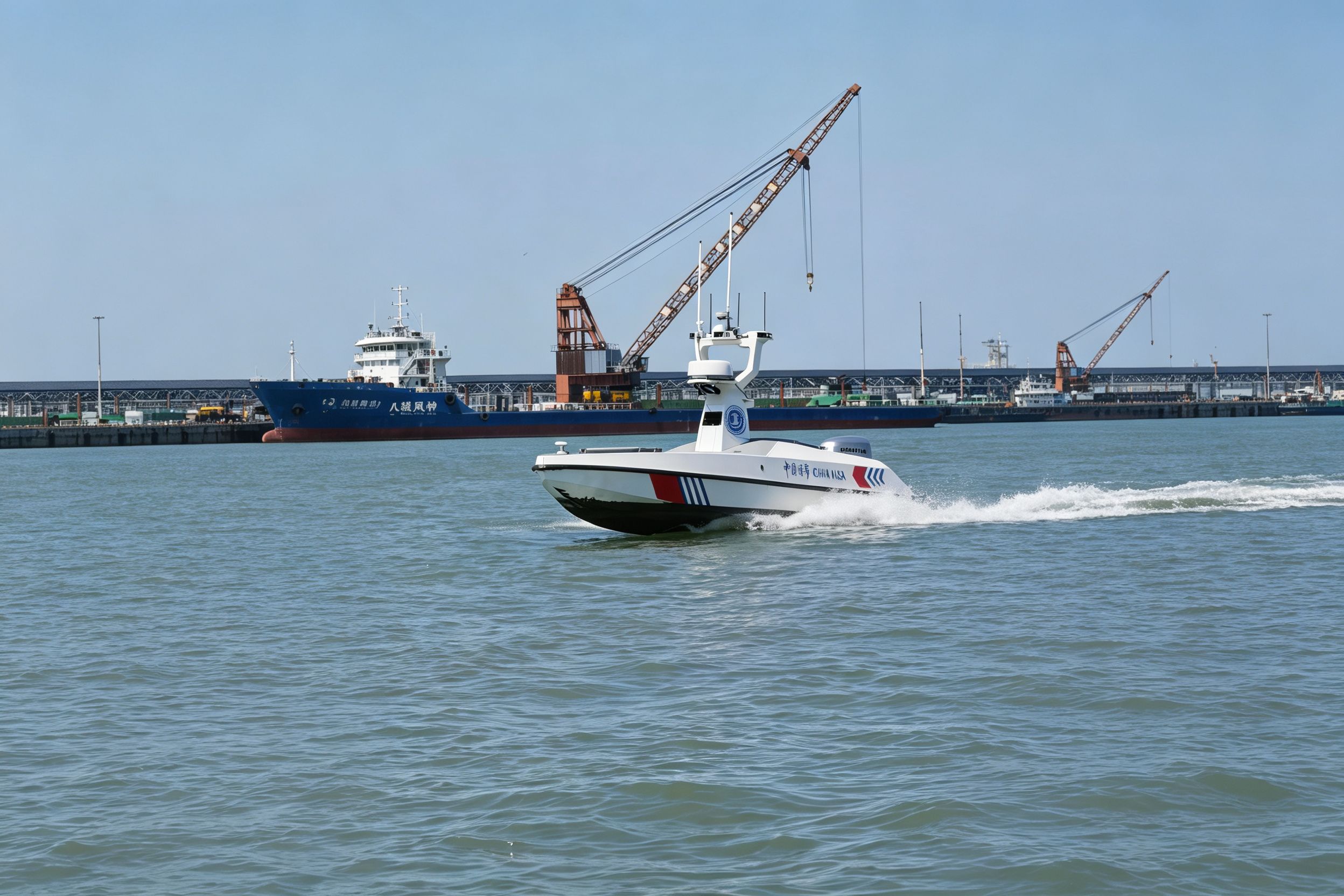
Application of Cangchao Technology's solutions in offshore scenarios (Source/Enterprise)
The following is an excerpt of the interview between 36Kr and Cheng Chen, founder and CEO of Cangchao Technology (slightly edited):
36Kr: If we only look at the navigation obstacle avoidance algorithm, the complexity of offshore scenarios is indeed lower than that of vehicle-mounted autonomous driving on urban roads. At present, what are the core engineering bottlenecks restricting the large-scale industrialization of offshore intelligent driving?
Cheng Chen: If the problem is only limited to "whether the ship can sail and avoid obstacles on the water surface according to the predetermined route", its algorithm complexity and computing power demand are indeed lower than that of vehicle-mounted autonomous driving. The ship has limited motion degrees of freedom, and the types of obstacles on the water surface are relatively controllable compared with the sudden mixed flow of people and vehicles on urban roads. But this is an ideal perspective that strips away the real operation environment.
To truly promote this system to industrialization, the biggest engineering bottleneck actually lies in two layers.
The first layer is the acquisition threshold of real-sea data closed loop. On land, car companies can deploy a large number of test vehicles on roads, and quickly drive algorithm iteration through high-frequency road tests. However, in offshore and inland rivers, due to extremely strict maritime supervision, you not only need compliant ships, but also need approved exclusive sea areas to carry out real-sea tests. The sample acquisition cost of dynamic working conditions such as wind, wave, tide, surge, sediment and visibility is extremely high. Without stable support of test sea areas, it is difficult to accumulate a complete extreme working condition data set. This is not a problem that can be solved purely by writing code, but a unique precondition for marine scenario engineering.
The second layer, which is the real point that widens the gap between different players, is the coupling of navigation intelligence and deep industry business logic. Behind each vertical field such as maritime patrol law enforcement, offshore photovoltaic and wind power operation and maintenance, and seabed surveying and mapping, there are decades of accumulated operation specifications, disposal procedures and industry standards. The real difficulty lies in deeply integrating these non-standard industry knowledge graphs with the intelligent driving decision-making layer, and converting the operation experience of captains and experts into task logic that machines can understand and execute.
Many teams in the industry can make ships sail on the sea. But making ships truly understand the operation logic of wind power operation and maintenance and the disposal specifications of maritime law enforcement requires the team to not only understand ship dynamics and AI models, but also deeply immerse themselves in the front-line marine engineering site. This is a typical interdisciplinary system engineering, and it is also the underlying barrier that we have been sticking to polish.
36Kr: From the perspective of industrial reality, how will the commercialization pace of high-level surface intelligent driving evolve? Why does Cangchao adopt the parallel product route of L2 standardized transformation and L3/L4 high-level systems, and what is the underlying logic behind it?
Cheng Chen: Technology R&D can appropriately go ahead of industrial demand, but commercial implementation must match industry policies, compliance and customers' real willingness to pay.
At present, there are many participants in the inland river surface intelligent driving track, and the market competition tends to be saturated. In our view, the real increment of the industry does not only come from realizing the autonomous navigation of ships, but from the operation and maintenance market spawned by offshore new energy infrastructure. The construction of offshore wind power and offshore photovoltaic is a one-time capital investment, and the full-cycle operation and maintenance of facilities for 10 to 20 years is the long-term track with larger space. Based on this judgment, Cangchao is not positioned as a pure unmanned ship hardware manufacturer, but as an unmanned operation platform service provider oriented to offshore scenarios.
Thus we have established a layered implementation product strategy. The OceanHub on-board intelligent driving series L2 intelligent driving box is aimed at the intelligent transformation market of existing ships in China. The product realizes modular plug-and-play, the modification and deployment of a single ship only takes half an hour to one hour, can adapt to various types of hulls such as rescue boats, target boats and fishery operation boats, and covers the demands of different users including government, enterprise and individual customers. On the one hand, we rely on standardized hardware to quickly complete market penetration and product verification; on the other hand, we continuously precipitate real offshore working condition data in mass transformation projects to feed back the iteration of high-level algorithms.
As for L3/L4 high-level intelligent driving systems and large and medium-sized unmanned ships, at the present stage we take pilot projects as the carrier to polish system capabilities, and do not pursue blind volume expansion.