36Kr Exclusive | Tsinghua-backed tactile system company that develops electronic skin has raised tens of millions of yuan in financing from 01 Capital, Zhisquare, Songyan Power and other investors.
Author | Qiao Yujie
Editor | Yuan Silai
This article is approximately 4000 words, with a recommended 10-minute reading time
Hard Krypton learned that Ubiligence, a company focusing on flexible electronic skin for robots and tactile intelligent systems, has recently completed tens of millions of RMB in angel round financing, with investments from Zero One Venture, Infinite Fund, Zhisquare, Starlink Capital, Songyan Power, and Dongshan Industrial Investment. Wanjia Capital acts as the exclusive financial advisor for this round and subsequent rounds of financing.
Ubiligence was founded in May 2026, with technology originating from the team of Associate Professor Jiang Chen of the Department of Electronic Engineering, Tsinghua University. It also invites Arokia Nathan, academician of four academies including Foreign Academician of the Chinese Academy of Sciences, Royal Academy of Engineering UK, Canadian Academy of Engineering, and National Academy of Inventors USA, to serve as the chief technical consultant. The team has carried out research on thin-film transistor (TFT) based sensing-storage-computing integrated flexible chips since 2019, and Ubiligence promotes the transformation and implementation of relevant scientific research achievements on this basis.
Fine motor skills are a major bottleneck for humanoid robots to move towards practical applications, and tactile perception capability is regarded by the industry as "the last piece of the puzzle for embodied intelligence". To complete tasks such as precise grasping and contact operation, robots not only need to know where the object is, but also need to judge the contact position, the magnitude of force and its dynamic changes.
However, as the number of contacts on the electronic skin increases from hundreds to tens of thousands, hundreds of thousands or even millions, the traditional "sensor + back-end computing" architecture begins to face challenges: a large number of original signals need to be transmitted to the back-end for processing through wiring harnesses, and then control instructions are fed back to the execution end. The bandwidth, power consumption, latency and wiring pressure brought by data transmission rise accordingly.
The technical route chosen by Ubiligence is to integrate sensing and part of computing capabilities into the flexible electronic skin, use TFT to build a flexible tactile computing architecture, so that the electronic skin is no longer just a thin film that collects signals, but a flexible integrated system with preliminary data processing capabilities.
What Ubiligence hopes to build is not a single tactile sensor, but a system similar to a "large-area flexible GPU" that combines tactile perception with lightweight computing. The electronic skin can complete trigger judgment at the front end, perform the first layer of feature extraction on the device side, and then transmit the compressed tactile features to the robot brain, reducing the amount of data that needs to be processed at the back end.
This idea draws on the working mechanism of the human nervous system. The human body does not transmit all sensory signals to the brain in the same way, but completes signal processing through neural circuits of different levels, and then the high and low level centers cooperate with division of labor. Ubiligence hopes to engineer this layered processing mechanism, so that before the tactile information enters the robot's main control system, the electronic skin completes part of the calculation first.
(Source: the company)
Ubiligence stated that to realize this architecture, the first problem to be solved is the hardware form. Traditional high-performance computing usually relies on silicon-based CMOS chips, but such chips are difficult to directly adapt to electronic skins that require large-area coverage, bending and fitting to the curved surfaces of robots, and there are also limitations in manufacturing costs and deployment methods.
The technical route chosen by the company is TFT. In the past few decades, TFT has been widely used in display panels, controlling a large number of pixels through an active matrix architecture to achieve large-area and large-scale integration. Robot electronic skin also needs to cover fingertips, palms, joints and even the whole body, requiring devices to be thin, flexible, bendable, and have large-area manufacturing capabilities. Ubiligence hopes to transfer the advantages of TFT in large-area integration to the field of tactile perception, so that a large number of tactile units can work together on a flexible substrate.
For TFT to undertake computing tasks, problems such as high operating voltage, unipolarity of most devices, and yield need to be solved. The Tsinghua team has been continuously promoting the research on TFT sensing-storage-computing integrated flexible chips since 2019, and has accumulated many years of experience in related computing architectures and system integration, which is also the basis for Ubiligence to carry out technology transformation.
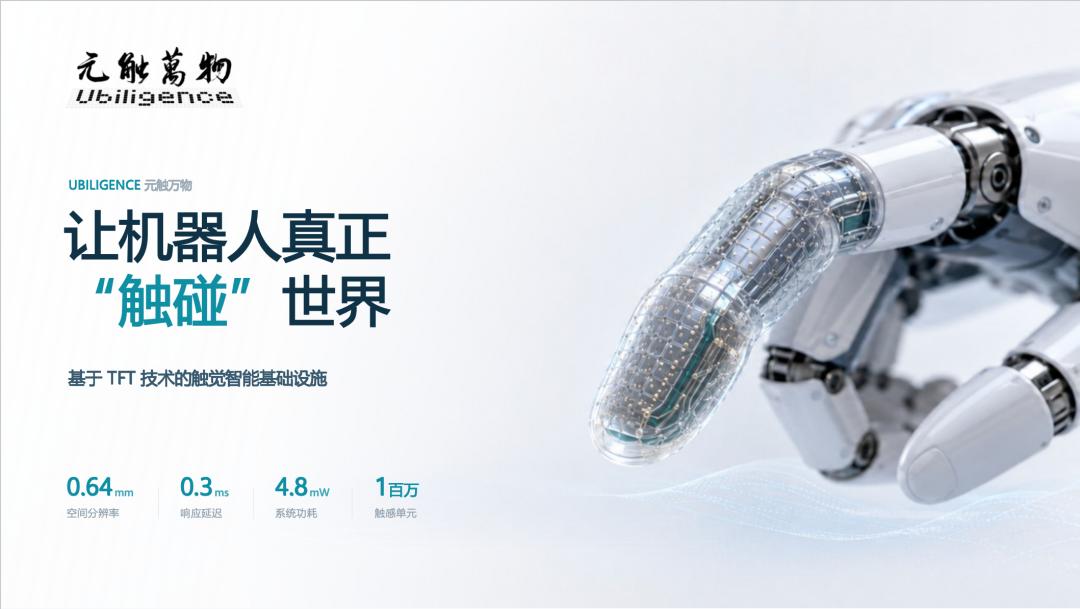
At present, Ubiligence has completed prototype verification. The core indicators disclosed by the company include: the number of sensing units exceeds 10,000, the spatial resolution is 0.91mm, the mechanical sensitivity reaches 1 millinewton, the force detection range is 1 millinewton to 20 newtons, the response latency is 0.3 milliseconds, and the system power consumption is 4.8 milliwatts.
In addition to device indicators, the company has also completed two system-level demonstrations: multi-functional intelligent recognition and dynamic mechanical perception of dexterous hand skin. This means that in addition to outputting sensing signals, the electronic skin has begun to have the ability to perceive and process dynamic contact processes, which can be used for real-time mechanical feedback during the grasping process of dexterous hands, and further support tactile recognition tasks.
In terms of product implementation, Ubiligence adopts a promotion path of "from point to surface": starting from the finger tactile module, then expanding to the full-palm tactile solution, and finally extending to the whole-body electronic skin. Fingers are the key parts where robots contact objects, and they are also entry points with relatively clear tactile requirements and easy to carry out verification. In the first stage, the company will develop finger tactile modules around the needs of contact detection, grasping feedback, demonstration verification and customer sampling; then gradually expand to full-palm and whole-body solutions.
At present, Ubiligence has sent samples to leading robot ontology and dexterous hand enterprises. In the next stage, the company will focus on co-defining product forms with customers, and promote solution verification and mass production implementation.
In terms of business model, the company has planned three stages. The first stage is dominated by tactile hardware sales, and the products include finger tactile modules, palm or full-hand solutions and large-area electronic skin; the second stage, on the basis of hardware, provides services such as tactile feature output, high-density tactile data sets, interface services and data subscription, to help customers lower the threshold of tactile data collection and model training; the third stage, further extends to the underlying chips, develops edge-oriented tactile intelligent chips with integrated "sensing, computing and control", and tries to connect perception, feature extraction and edge control.
The following is an excerpt from the exchange between Hard Krypton and Jiang Chen:
Hard Krypton: The first layer of calculation is performed on the device side, and then the data is transmitted to the back end. What tasks do these two parts of calculation undertake respectively?
Jiang Chen: The neural network contains multi-layer calculations, and the first layer usually undertakes the task of feature extraction. Ubiligence currently mainly implements this part of calculation on the electronic skin, compresses a large number of original tactile signals into lower-dimensional features, and then hands them over to the back-end chip for further processing.
For example, the signals generated by 10,000 sensors can be compressed to less than 100 feature channels through the first layer of feature extraction. This can significantly reduce the amount of data transmission and reduce the back-end processing pressure. The electronic skin itself is not suitable for directly deploying high-performance AI chips, and the computing tasks that TFT can undertake are also limited. Therefore, we hope to give play to the advantages of both: TFT completes lightweight computing, and then the back-end chip completes more complex model inference.
In addition, the weights of the first layer of the neural network can also be adjusted in real time. By changing the weights, we can also read the original information of more contacts when needed, but it will take longer to read a large amount of data. Therefore, this architecture is not only for compressing data, but also hopes to provide more flexible choices among data volume, reading speed and computing requirements.
Hard Krypton: How to understand deploying the model directly on the electronic skin?
Jiang Chen: From the perspective of neural network, the model includes network structure and corresponding parameters, among which weight is an important part. After the model is trained with tactile data, a set of determined parameters will be obtained. We can write the weights that are suitable for running on the electronic skin side into the hardware, so that the tactile signals can complete the corresponding calculations before entering the back end.
Hard Krypton: The company's business model plan is to sell hardware first, then expand data services, and finally develop tactile chips. Why adopt such a development path?
Jiang Chen: My suggestion to Ubiligence is that the underlying foundation is always hardware, but the capabilities of hardware need to be fully exerted through software and models. To truly improve the tactile capabilities of robots, collaborative design and joint optimization of hardware and software are required.
You can refer to Apple's hardware and software collaboration model. It not only designs hardware, but also has its own operating system, so it can carry out joint optimization around the same system. The same is true for the tactile field: if there is only hardware, customers may need to collect a large amount of data and train their own models to give full play to the hardware capabilities; if we further provide tactile data, interfaces and model collaboration solutions, we can help customers shorten the development cycle and apply tactile capabilities to robots faster.
Therefore, we will start with hardware, then gradually accumulate data and improve the hardware-software collaboration solution. As for further developing the tactile chip with integrated sensing, computing and control, we hope to continue to sink the computing and control capabilities to the end.
There is a similar mechanism in human tactile processing. For example, when the hand touches an overheated cup, it will retract quickly. This kind of rapid response can be completed through neural circuits such as the spinal cord, without waiting for the brain to complete complete high-level processing. Robots also need similar end response capabilities, so that tactile perception, calculation and action feedback can be connected more closely.
Another example is writing. The brain knows what kind of characters look better, but the actual pen movement still depends on the movement ability formed by long-term training of the hand. This shows that division of labor and collaboration are needed between high-level decision-making and end execution. We hope that through edge-side calculation and control, robots can process tactile information more timely and give feedback when performing fine operations. This is also the reason why our Tsinghua research group promotes the research of integrated sensing, computing and control chips, and it is also the underlying logic for Ubiligence to choose this technology.
Zero One Venture said: As humanoid robots and dexterous hands enter the inflection point of volume growth, tactile perception is changing from an "optional item" to a core component that determines the upper limit of robot operation capabilities. Ubiligence reconstructs tactile sensing from the underlying architecture — based on the mature mass-produced TFT process, it directly converts pressure events into digital trigger states at the skin end, and completes pixel-level sensing-computing integrated processing. The core team from the Department of Electronic Engineering of Tsinghua University, coupled with the team's accumulation in TFT technology and many years of production line experience, makes us believe that this team has the opportunity to define the industry standard for tactile sensing. We look forward to Ubiligence becoming the infrastructure of the robot tactile era.
Infinite Fund SEE Fund said: Tactile is one of the most core perceptual modalities for artificial intelligence to enter the physical world, and at the same time, it puts forward very high requirements for the low cost, reliability, flexibility and large-area mass production of sensors. Professor Jiang Chen's technical solution is one of the most likely routes to succeed. As an electronic information discipline guidance fund, Infinite Fund SEE Fund has been committed to building a bridge for the integration of scientific and technological innovation and industrial innovation. We hope that this scientific and technological achievement originating from the laboratory can help the development of the embodied intelligence industry and become the world-leading "Chinese solution".
Zhisquare said: Electronic skin is essential for the development of robots in the future. Ubiligence has very strong original capabilities, with systematic thinking and systematic innovation in materials, electronics and algorithms. Ubiligence adopts the array readout architecture of TFT active matrix to solve the pain points of crosstalk and poor signal-to-noise ratio of large-area high-density electronic skin, and the flexible TFT can rely on the mature thin film process base of the display panel, which provides huge imagination space for long-term large-scale mass production in the future.
Starlink Capital said: Tactile is the basic ability of AI to perceive and understand the physical world. The contact, force and interaction information carried by tactile has long-term value for AI to establish physical cognition and continuously learn through interaction. Ubiligence focuses on this underlying capability, and explores a new path for tactile information acquisition and processing with a flexible TFT sensing-storage-computing integrated architecture, which has distinct technical characteristics. We value the team's long-term accumulation in the fields of flexible electronics, device circuits and micro-nano manufacturing, as well as interdisciplinary technology integration capabilities, and are optimistic about the company's development potential of continuously extending from tactile hardware to high-quality data and perception capabilities. We look forward to the team transforming solid scientific research accumulation into scalable products and technology platforms, providing important basic support for AI to understand the physical world.
Dongshan Industrial Investment said: Ubiligence focuses on flexible electronic skin and tactile intelligent systems, which is an important upstream link of the embodied intelligence industry. According to the forecast of Mordor Intelligence, the global tactile sensor market size will grow from 4.01 billion US dollars in 2025 to 8.37 billion US dollars in 2030. As the scale of the tactile sensor market continues to expand, the industry has broad development space. The company deeply combines flexible tactile hardware with perception algorithms, carries out collaborative R&D around devices, circuits and systems, and the core team has solid scientific research accumulation and interdisciplinary technical background, which provides strong support for low-power design, flexible integration and tactile signal processing. At present, the dexterous hand team of Dongshan Precision has carried out cooperative development with Ubiligence, and the two sides have complementary advantages in tactile perception, flexible circuits and system assembly, with a solid foundation for industrial collaboration. We look forward to accelerating the transformation of technical achievements through joint R&D and engineering verification, and jointly promoting the application of tactile perception in the field of dexterous hands and embodied intelligence.