Deepseek, what are you panicking for?
The phrase "Huang sha zi ma" (literally "What's the rush?") has recently gone viral after being featured in a song by Zhao Benshan, but it quickly sparked heated debate. Supporters argue that it is a soothing track that urges people to slow down, leave room for mistakes, and "not chase perfection in everything", which is very comforting — especially when these words come from Zhao Benshan, a veteran who has navigated society for decades, making them even more convincing. Opponents, however, say the song is too disconnected from real life and fails to understand people's hardships: many people have already exhausted all their energy just to maintain a decent life, and there is simply no way for them to "not be in a hurry" — especially when these words are spoken by Zhao Benshan, a successful person who once owned a private jet, invested in Chinese football, and lived a wealthy life, they feel even more provocative.
At first glance, this argument is as pointless as an old lady refusing to eat pickled mustard greens — she is just being deliberately idle. Unfortunately, I am from Sichuan, and I fully understand that this song was bound to cause controversy. Because in the Sichuan dialect (especially the sharp, playful Chengdu dialect), "Huang sha zi ma" has two different intonations:
The first one puts the stress on "huang" (rush), pronounced as "Huang~ sha zi ma". This version is closer to the interpretation of the supporters, meaning telling others not to worry and take it easy. The second one puts the stress on "zi", pronounced as "Huang sha zi~~~ ma", where the "zi" sounds sharp and drawn out, like the hissing sound of a bicycle tire being punctured and deflated with a small knife. This version is extremely close to the interpretation of the opponents: it is a questioning tone, usually used when the other person has already "panicked" and "made a hasty decision/action", and the speaker as an observer expresses extreme incomprehension. For example, when you see a driver cause a car accident due to carelessness, you can say, "Huang sha zi~~~~ ma, now you hit someone."
In addition, "ma" is also a very subtle modal particle in Sichuan dialect. This is especially obvious when local Sichuan news programs interview passersby: for example, when asking them to evaluate a certain policy or the result of a municipal construction project, some shy elderly residents often say "Support ma", "As citizens we need to cooperate ma", "Everyone should do their part ma". Here "ma" actually acts as a sentence terminator, with the subtext of "I've said everything I need to say, that's it."
Once you restore the full context, the point that makes opponents unhappy becomes obvious: is "being in a hurry" my active choice? Don't I know that "not being in a hurry" would be more comfortable? Apart from this hectic pace, do I really have other choices? Should I be the one being "questioned"? — If the answers to all these questions are no, then this song is far too full of empty inspirational platitudes, and it is less comforting than Han Han's line from ten years ago: "I've heard so many truths, yet I still can't live a good life."
On the contrary, the tone of exhortation and instruction in "Huang sha zi ma" is far too heavy. Most people's lives do not need to be repeatedly interrogated by these four words. Everyone's social circle is limited, and the social division of labor is fixed. Even if you "fail to exercise small forbearance", there are not many "great plans" to achieve in daily life — so why bother? It would make more sense to direct this narrative at those more authoritative, influential figures who have greater decision-making power over major events and are more likely to "ruin big plans due to small impatience". For example, DeepSeek's latest round of financing is perfectly suited for the phrase "Huang sha zi ma".
This week, Deepseek's latest round of financing with a total scale of 100 billion RMB was officially completed, and the industrial and commercial change registration was finished. According to public industrial and commercial information, more than 30 entities participated in this round of financing, with a very diverse profile: it includes a series of industrial parties such as Tencent, China Mobile, China Telecom, CATL, GigaDevice, Xiaohongshu, vivo, as well as professional VC/PE firms such as Lisi, Boyu Capital, IDG Capital, Gaorong Capital, Legend Capital, and CIC Ventures, which fully proves Deepseek's status as a flag bearer in China's artificial intelligence industry.
Of course, strictly speaking, none of this is surprising. As early as October, the media had exposed the financing plan for this round. And through the vigorous fundraising progress of some of these investors in the same period, people had already guessed most of the participants in Deepseek's this round of investment. So at the very beginning, this news did not get much repost traffic. But people soon found an Easter egg:
The 31 entities that participated in this investment did not directly become shareholders of Deepseek's main entity, Hangzhou DeepSeek Artificial Intelligence Basic Technology Research Co., Ltd. Instead, they completed the investment through an SPV — Hangzhou Chengyan Enterprise Management Consulting Partnership (Limited Partnership). And in the previous first round of external financing, the new investors also completed their investment through another SPV — Hangzhou Chenli Enterprise Management Consulting Partnership (Limited Partnership). The executive partner of both SPVs is Hangzhou Cence Business Consulting Co., Ltd., and Liang Wenfeng holds 99% of the equity of Hangzhou Cence.
This means that although the new investors have obtained corresponding economic rights and interests through two rounds of financing, for the DeepSeek shares held by the platform, the voting rights are usually exercised centrally by the executive partner, which ensures that after the second round of financing, Liang Wenfeng's total shareholding, combining his personal direct shares and the shares held by Ningbo Chengen, still amounts to 75.31%.
In the eyes of many people, this is a direct signal that Deepseek is preparing for an IPO. Because on the technical level, in the listing review process of China's A-share market, regulators pay special attention to the identification and stability of the actual controller. Complex equity arrangements and valuation adjustment mechanisms that may change control rights all need to be explained or cleaned up. This equity structure design not only facilitates future share reform, but also reduces the complexity of having a large number of investors participate in major company decisions respectively. Then on the afternoon of November 19, multiple media outlets including CLSA News Agency explicitly mentioned in their reports, "DeepSeek's IPO preparation is also in progress... it has hired CITIC Securities to prepare for its IPO on the Science and Technology Innovation Board, and plans to launch the listing process within this year."
It was at this moment that everyone realized that things seemed serious.
When Chinese people write stories, there is an adverb "youyou", which describes the state of seeming "carefree and unhurried" while actually being "fully prepared and confident". If you read in a novel that "someone said youyou", the next line is most likely a well-thought-out clever plan or a sentence that reveals the truth. In fact, for a long time, this is the most appropriate adjective for Deepseek: No one knew where it came from, it "suddenly" made people's eyes light up, and everything seemed so easy and freehand.
To put it more exaggeratedly, we can even say that it is precisely this "unhurried ease" that made Deepseek a flag bearer. It is this momentum that makes us face up to the so-called "engineering thinking", face up to the "engineering capabilities" accumulated since China's full industrialization, and make us wake up to the fact that the global AI competition we once thought was infinitely similar to a capital consumption war with a soon-to-be-determined winner is actually full of uncertainties. Oh, it turns out that the advantages of computing power and capital are not as unbreakable as we imagined, and the latecomer advantage in the industrial field still works.
Even until July this year, when the so-called "DeepSeek Investor Closed-door Exchange Record" went viral online, people's attention was still highly focused on how counterintuitive Deepseek's business philosophy is, how focused it is on products, how "unworldly" Liang Wenfeng's corporate governance philosophy is, and how thorough Deepseek's understanding of the artificial intelligence industry is, which is worth learning for those impetuous peers.
As a result, only 3 months later, DeepSeek not only quickly completed the second round of financing with doubled scale, but also directly became a pre-IPO company, preparing to plunge straight into the center of the capital market and bear the pressure from market value management and the so-called "shareholder rights". This shift seems a bit too extreme. Even if we remove the symbolic aura around Deepseek and restore it to a company in the long-cycle, high-risk hard technology track with an essential narrative, and restore IPO to just one of the conventional financing tools in enterprise development, it is still hard to imagine that a company that has just proved its super strong financing ability in the primary market would take an eager attitude to actively push itself into the secondary market.
At least from the public information level, DeepSeek is far from reaching the predicament where it has to rely on IPO to continue its R&D. From V4 in April 2026 to V4.1-Flash in September, DeepSeek has maintained a reasonable model iteration pace. In this process, DeepSeek even had spare capacity to explore investments in side tracks such as Agent, domestic computing power, and embodied intelligence. Publicly verifiable investments include share placements in Winverse, Rige Wannwu, and Unitree Robotics.
So which link's impact has been seriously underestimated or ignored? No one knows, but it is especially suitable to sigh "Huang sha zi ma".
Moreover, this time node is far too delicate: November 19, 2026 is the big day for the IPO of Anthropic, the eternal enemy of the open source camp, the latest standard-bearer of the China threat theory, and the cult favorite of Silicon Valley. Before that, foreign media described the symbolic significance of Anthropic's listing as follows: "This is a historic value confirmation for the global AI industry, proving that valuations of hundreds of billions of dollars, astronomical computing power investments, and grand visions for the future productivity revolution can eventually be recognized in the public capital market."
Theoretically, if we want to justify our own development path and convey confidence to the outside world, November 19 is indeed the best time to launch a "point-blank" attack. But in reality, from Anthropic starting its IPO to officially completing the IPO and then to the two trading days after listing, the whole process went like this: On October 15, multiple media outlets reported that after the Anthropic Investor Day, some investors lowered their IPO valuation expectation from about 2 trillion US dollars to 1.5 trillion US dollars — On November 19, Anthropic completed its IPO at an issue price of 83 US dollars, raising about 813 billion US dollars, with a market value barely exceeding 1.2 trillion US dollars. Fortunately, its closing price rose to 97.17 US dollars — On the second trading day, Anthropic fell back to 88.91 US dollars, almost giving up most of the gains on the first day of listing. On the same day, the S&P 500 fell 2.02%, and the Nasdaq fell 2.25%.
Guys, describing Anthropic's IPO on November 19 as "turning a sad event into a celebration" is not an exaggeration at all. Everything that happened during Anthropic's IPO, all the doubts it received and challenges it encountered, Deepseek must have seen it, and definitely saw it more comprehensively than me, a small editor.
Under this premise, why did the so-called sources choose to leak this news on November 19? What are they implying? If everything is as they said (after all, the CLSA article has not been deleted or modified yet), then why did Deepseek choose the present moment? Why do they think this is a good window for "news leakage"?
To put it in a more narrow perspective, during this period, competitors keep publishing articles titled "Investors No Longer Care About XXX" and "XXX Even A-round Investors Are Not Making Money". All of these articles started from a seemingly hasty and imperfect IPO, and none of them did not implicitly use such an imperfect IPO to falsify the value of an entire track or a company. None of these articles were accused by public opinion of lacking media professionalism. And you can see that the stock K-line is indeed following this trend step by step.
In my common sense, or my life experience tells me, IPO is indeed just a tool, a mechanism, and never the end point. But the market is never a place that only follows instrumental rationality. To go a step further, that's why "quantitative trading" was invented. Ray Dalio has long commented sharply: "People's spontaneous decisions are easily destroyed by emotions and biases; machines can strictly execute verified principles and avoid human subjective loopholes."
I don't know, anyway, it seems that no amount of words can compare to sighing "Huang sha zi ma". For this issue of VC Weekly, I have selected 5 episodes of podcasts from Silicon Valley, and the content of these 5 episodes can be summarized into three questions: How does Silicon Valley view every step of DeepSeek's development? We keep saying that DS has brought a huge impact, what consensus has it actually broken? Why do Americans reflect on why DS was not born in the United States?
Because "the money was given too much and too easily", that's why the US did not produce DS?
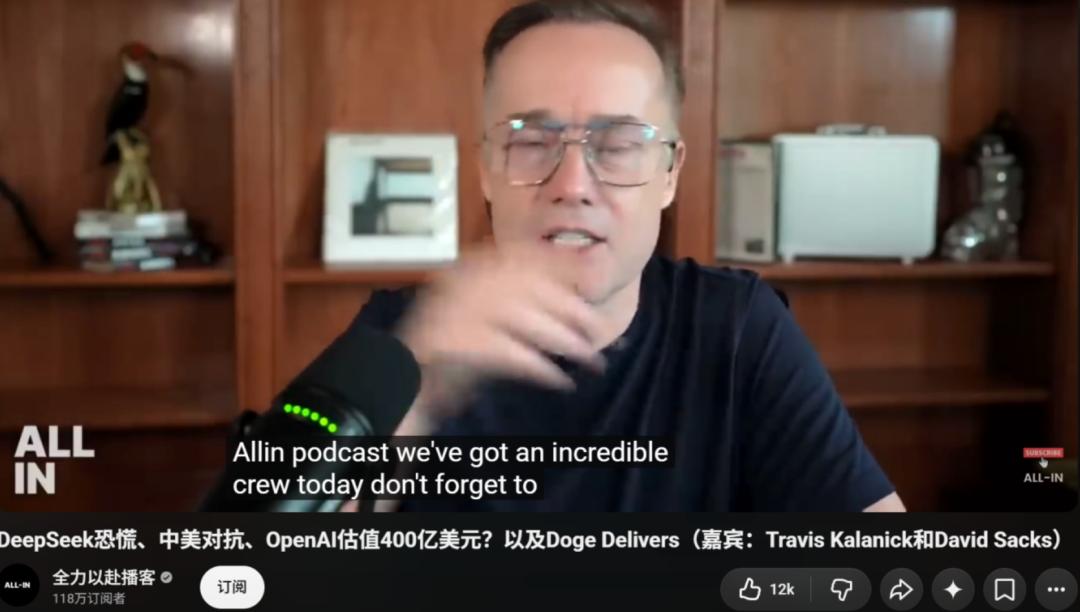
On January 31, 2025, the Silicon Valley venture capital podcast "All-In Podcast" released the episode "DeepSeek Panic, US vs China, OpenAI $40B?, and Doge Delivers". This episode was discussed by venture capitalists Chamath Palihapitiya, Jason Calacanis, David Friedberg and others, with guests including Uber co-founder Travis Kalanick, and David Sacks, then White House Head of AI and Cryptocurrency Affairs.
After DeepSeek released R1, the US market was in a state of panic. Nvidia's stock price plummeted, and companies such as TSMC and Broadcom were also sold off. The most widely spread statement at that time was that DeepSeek only spent about 6 million US dollars to train a model comparable to OpenAI's.
Chamath noticed a detail that was ignored by most people. DeepSeek optimized the use of GPU memory during the model development process, and also improved the operating efficiency of Nvidia GPUs through lower-level PTX programming. He suspects that the computing power restrictions imposed on Chinese companies have forced researchers to find solutions that US companies have no urgent motivation to explore.
He then raised an awkward question for VCs: If an AI startup is given 200 million US dollars by investors as soon as it is founded, will it still bother to study these problems? Maybe giving it 2 million US dollars is more likely to produce innovations like DeepSeek.
Chamath used a line to sum up the point: Constraint makes for great art.
Friedberg shifted the topic to investment returns. He believes that if model performance continues to improve and prices continue to fall, the value created by the model itself may not all be taken away by the model company, and applications, users and even other industries may gain more benefits. He also mentioned Jevons Paradox: the improvement of technical efficiency will reduce the cost of use, which may in turn stimulate the growth of total demand.
Sacks has reservations about this. He pointed out that DeepSeek R1 was mainly competing with o1 released by OpenAI a few months ago, and leading labs are still advancing cutting-edge models. It is too early to conclude that foundation models have been commoditized.
The most worthwhile part of this episode is that the reactions of several investors to DeepSeek are not consistent. Some began to question the effect of huge financing on innovation efficiency, some worried about the profit margin of model companies, and others insisted that cutting-edge R&D still has a sufficiently high return on investment.
DeepSeek is the contemporary "Sputnik Moment"

This very classic comment comes from the episode "DeepSeek: America's Sputnik Moment for AI?" updated by "The a16z Show" under Silicon Valley venture capital firm a16z on February 6, 2025. It invited Martin Casado, general partner in charge of infrastructure investment at a16z, and Steven Sinofsky, who was in charge of Microsoft Windows business for a long time