Ant relies on financial subsidies while JD secures its bottom line through drug sales: Medical AI experiments by large tech companies that bypass the medical insurance system
Big tech firms have driven the price of AI tools for physicians down to zero, but the 3-trillion-yuan national medical insurance fund only pays for cost reduction within hospitals.
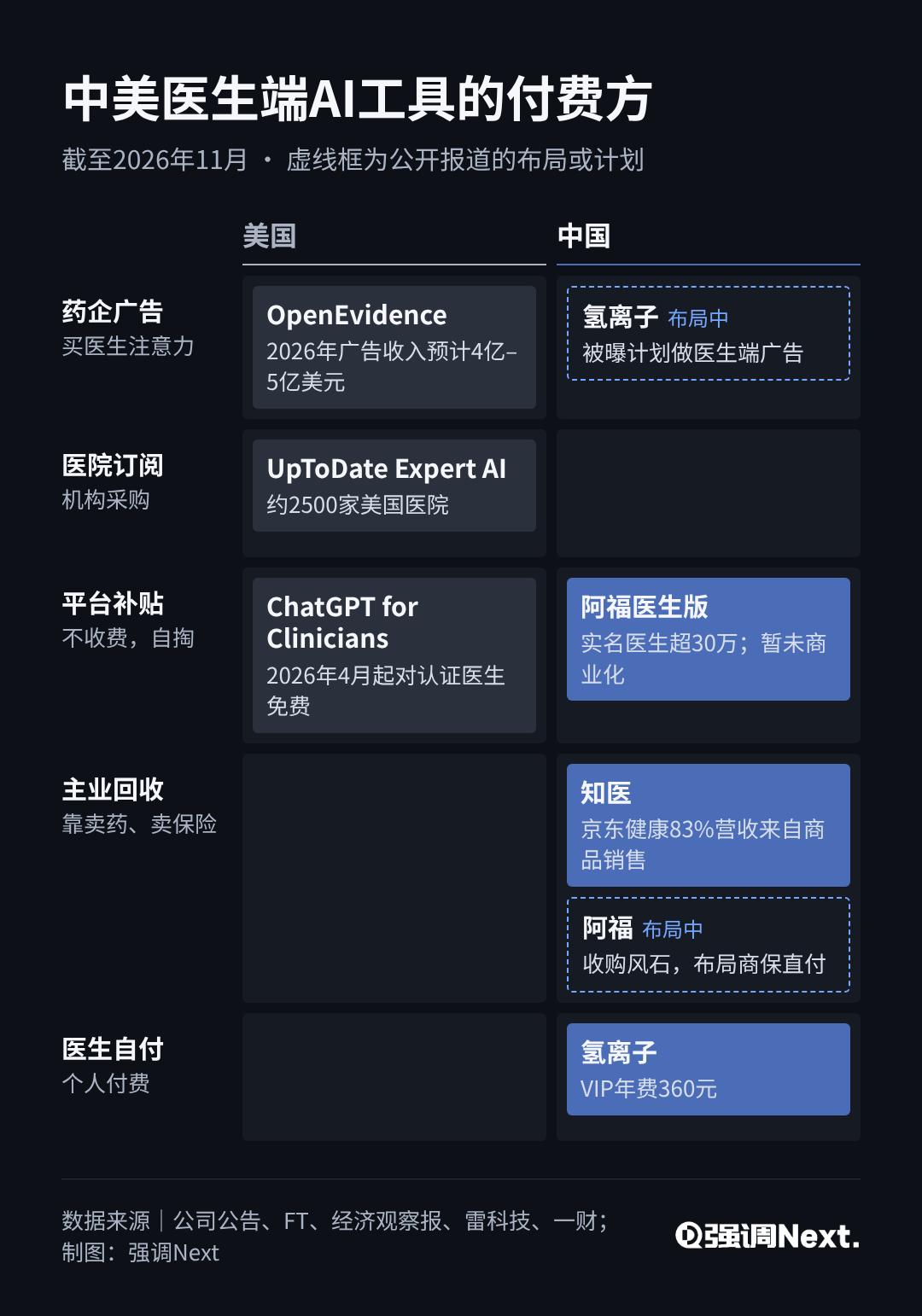
On November 22, the physician version of Ant Group's Afu launched its desktop workstation, and integrated UpToDate, the evidence-based decision-making tool from Wolters Kluwer, opening a limited-time free trial for medical workers and pharmacists across the country. Previously, "Hydrogen Ion", a physician tool under Alibaba Health which also belongs to the Alibaba ecosystem, charged physicians an annual VIP membership fee of 360 yuan. "Zhiyi" under JD Health has been open to all physicians for free since its launch. Large tech companies are joining forces to drive the price of physician-side AI tools down to zero.
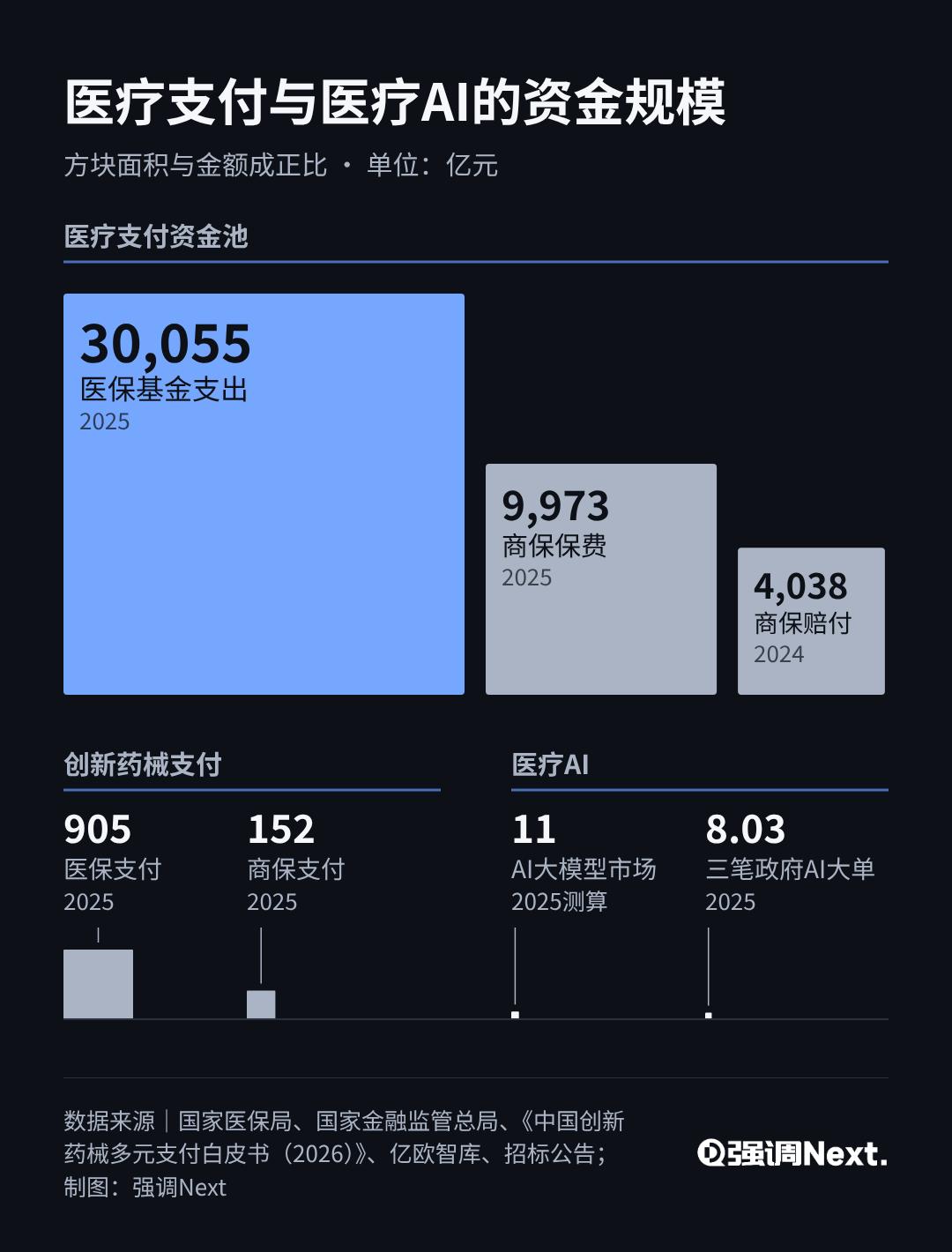
Free tools are not unexpected. What is truly striking is the huge gap in the market scale between buyers and sellers. In 2025, the total expenditure of the national basic medical insurance fund exceeded 3 trillion yuan for the first time. According to estimates by third-party institutions, the market size of medical AI large models in the same year was just over 1.1 billion yuan. Large tech firms have been releasing medical large models one after another for two years, but have barely tapped into the market of China's largest single payer in the healthcare sector.
The fault lies in the payment structure of the medical industry. In China's public medical system, there is only one buyer with real purchasing power, whose core demand is "cost control and reduction". However, the most high-profile medical AI products launched by internet giants today are mainly targeted at areas out of the reach of this buyer.
Medical insurance has already set the price for all medical AI
In China's public hospitals, the core policies of the National Healthcare Security Administration (NHSA) in the past two years have drawn a clear boundary for whether and how AI can be charged.
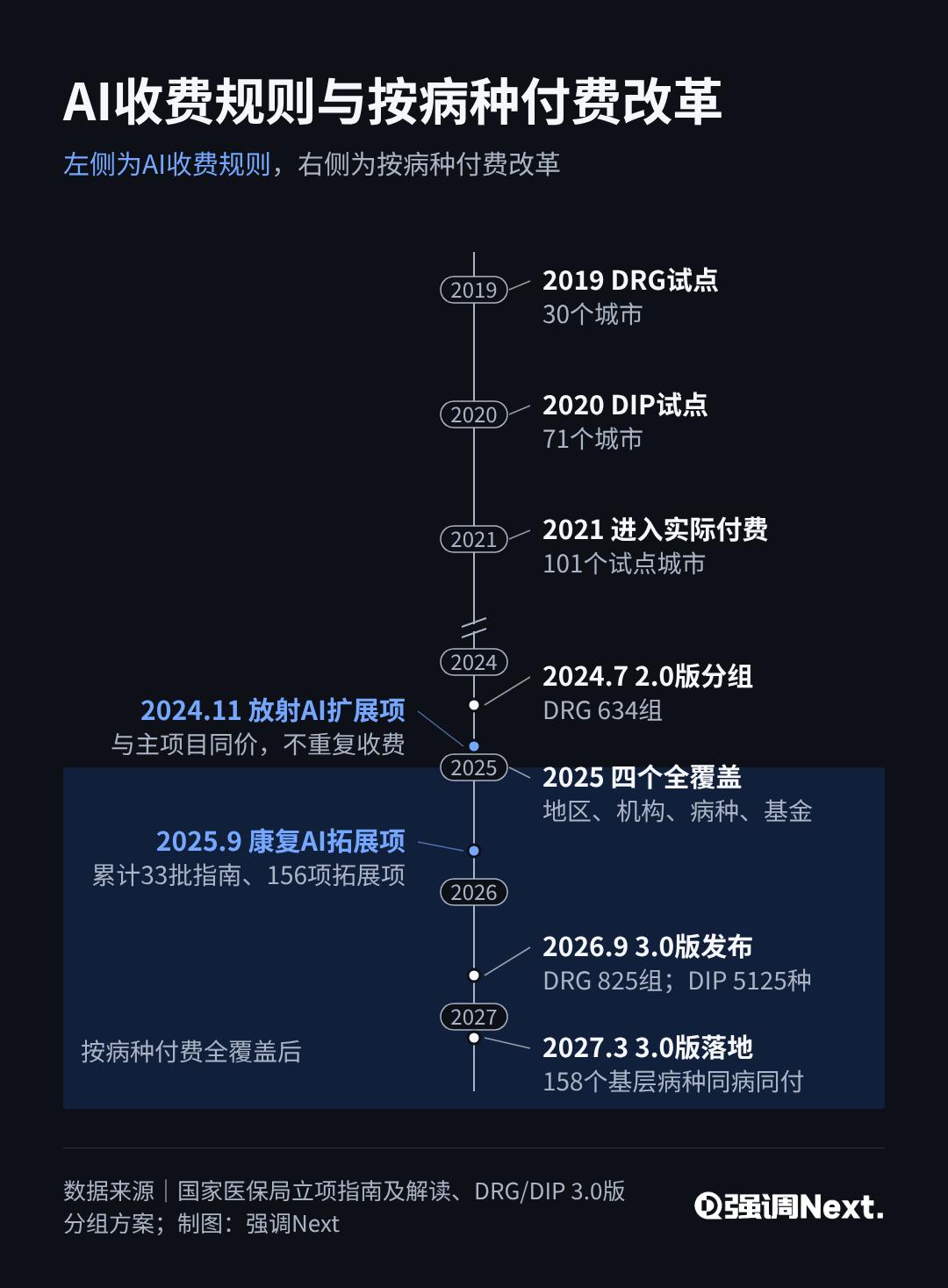
In November 2024, the NHSA included "AI-assisted diagnosis" for the first time in the guideline for setting up medical service prices for radiological examinations, but explicitly classified it as an extended item: Hospitals follow the same set of charging standards regardless of whether they use AI, and are prohibited from charging patients extra fees repeatedly. The NHSA gave a clear reason: AI cannot replace physician diagnosis yet, and it does not generate independent medical service output. Later, this pricing principle was extended intact to ultrasound and rehabilitation projects.
Most of the medical imaging AI companies that rose around 2018 initially envisioned a business path of "obtaining Class III medical device certificates, entering the price list, and charging patients per use", which has now been completely blocked by the project establishment guideline. In the era of large models, the same commercialization dilemma has expanded from the radiology department to the entire hospital.
No additional charges are allowed on the billing side, while the payment side is tightening. By 2025, Diagnosis Related Groups / Big Diagnosis Interests Payment (DRG/DIP) has achieved "four full coverages" in terms of coordinated regions, medical institutions, inpatient disease types and fund expenditure, and the latest version 3.0 grouping scheme will be implemented by the end of March 2027. For a patient from admission to discharge, the medical insurance pays the hospital a lump sum based on the disease group, and the hospital is fully responsible for all the costs, whether it spends more or less, has a balance or overspends.
The superposition of the two sets of rules has shattered the expectation that medical AI can make money through "new charging items". In public hospitals, AI can only exist as a "cost reduction tool", and every penny it saves goes to the party that bears the cost target.
This is also the starting point for the differentiation of business models for medical AI in China and the United States. OpenEvidence in the U.S. can achieve an annual revenue of 400 million to 500 million U.S. dollars relying on pharmaceutical advertisements, on the premise that U.S. healthcare payers are scattered among commercial insurers, pharmaceutical companies and medical institutions, and there is always a party willing to pay for physicians' attention and prescription rights. In contrast, China's medical AI is facing a super single buyer that has clearly stated that it "will not pay extra for AI".
Only those who bear cost pressure will pay for AI
In the era of payment by disease type, it is hospitals that are under cost pressure. The DRG/DIP version 3.0 clearly stipulates that the retained balance funds can be used as business income of medical institutions, but hospitals cannot take the disease payment standard as a quota to assess departments and physicians. The financial incentive to save money stays on the hospital side.
Whether hospitals are willing to spend money on AI depends entirely on how they calculate the accounts for inpatient and outpatient services.
The inpatient side focuses on compliance and cost control, with the core bottleneck lying in the front page of medical records. The grouping basis of DRG/DIP mainly comes from the front page of inpatient medical records and medical insurance settlement lists: once diagnosis and operation codes are missing or incorrectly filled, resulting in wrong grouping of cases, the hospital will receive medical insurance funds according to the wrong standard. Once the clinical pathway deviates, the length of hospital stay is extended, and drug and consumable expenses exceed the standard, the original balance will turn into loss.
Therefore, the AI that first generates real procurement demand on the inpatient side is concentrated in coding grouping, medical record quality control and clinical pathway early warning. The industry's judgment on the implementation of version 3.0 is the same: grouping tool vendors, HIS vendors and medical insurance big data companies that can help hospitals accurately calculate costs, codes and groupings are the most likely to obtain stable orders.
The outpatient side focuses on turnover rate. At present, most outpatient services are still paid by item, and the number of consultations directly determines revenue. According to data provided by some vendors, after the introduction of generative medical records, the time to write an outpatient medical record can be reduced from 5 to 6 minutes to 1 to 2 minutes, which translates to higher consultation volume and patient turnover in the outpatient department.
The largest single order within hospitals is held by the government. Within just one month at the end of last year, iFlytek won the 427.6 million yuan national-level AI application pilot base project, Alipay won the bid for the 206 million yuan Zhejiang Provincial Medical AI Platform, and Baidu obtained the 169 million yuan Guangzhou Respiratory Infectious Disease Early Warning System. These hundred-million-yuan level large orders are for regional intelligent infrastructure and data hubs, which are far from the front line of clinical diagnosis and treatment.
Although the payments are real money, this is essentially a traditional To G project-based business: project approval by local governments, customized development, acceptance and settlement, and you have to start all over again when you move to another province or city, making it difficult to achieve standardized platform compound returns. For service providers like iFlytek that are deeply rooted in government and enterprise services, this is their familiar core business. But for internet giants that are accustomed to scale effects, project-based income is just hard-earned money that cannot support their commercial imagination for the healthcare track.
However, the version 3.0 scheme also lays a longer-term payment point: promoting the same payment for the same disease for 158 primary-level disease types, and guiding common diseases to receive first diagnosis at the grassroots level. Only when community hospitals and tertiary hospitals get the same medical insurance payment standard for the same disease, can primary medical institutions have real motivation to purchase chronic disease follow-up and family doctor tools, on the premise that the grassroots can receive these patients, and AI can just make up for the shortcomings of grassroots diagnosis and treatment capabilities.
After sorting out all the cases, the real payers for China's current medical AI are deans who calculate cost control accounts, the medical insurance bureau that manages funds, and the National Health Commission that focuses on grassroots healthcare, but definitely not frontline physicians and patients. Funds flow along the policy orientation of cost control and sinking, which also sets a hard threshold for products: Even AI that can improve diagnosis and treatment quality will hardly sell well in this system if it pushes up the total medical cost.
Large tech firms are waging battles outside hospitals, bypassing the core buyer
Traditional HIS vendors are already entrenched inside hospitals, coupled with the long public bidding process and medical insurance cost control constraints, large tech firms can hardly expand according to internet logic inside hospitals except for winning government infrastructure projects. Therefore, almost all the core products that large tech firms have invested massive traffic and heavy subsidies in are placed outside hospitals.
Ant Group, JD, Alibaba Health and ByteDance are targeting the same family health entry, but their monetization plans are different: Ant Group aims to form a closed loop of medical services and payment, JD relies on the fulfillment of medicines and health products, ByteDance relies on content ecology and traffic conversion, and Alibaba Health's "Hydrogen Ion" is reported to plan to try medical advertising monetization on the physician side.
The awkward part is that outside hospitals is exactly the area with the thinnest coverage of medical insurance funds, and almost all these commercialization paths are at the edge of mainstream medical payment.
Take commercial health insurance, which Ant Group values the most, as an example. The domestic commercial health insurance premium income in 2025 was 997.3 billion yuan, which failed to cross the trillion-yuan threshold in the end, and its growth rate hit a new low in the past five years. The actual compensation expenditure in 2024 was about 403.8 billion yuan, less than one seventh of the basic medical insurance expenditure in 2025. Even in the innovative drug and device scenario where commercial insurance is most expected, the actual payment of commercial insurance in 2025 was only 15.2 billion yuan, far lower than the basic medical insurance's payment scale of about 90.5 billion yuan.
Fengshi Health, acquired by Ant Group, has its direct payment network covering the international departments, special demand departments of public hospitals and high-end private institutions, which is the thinnest tip of the pyramid in China's medical market. High-end insurance policies can indeed pay for AI follow-up, but they only cover a small group of people at the top of the pyramid.
Selling medicines and advertisements are also subject to a ceiling. Of JD Health's 73.4 billion yuan revenue in 2025, 83% came from the sales of medicines and health products, and its C-end AI physician and physician-side "Zhiyi" ultimately serve this pharmaceutical retail report. As for pharmaceutical advertisements, although it can support a medical AI company with a valuation of 15 billion U.S. dollars in the United States, in the current context of continuously tightening domestic pharmaceutical compliance, placing commercial promotion directly next to AI clinical evidence-based answers is still a red line that no one dares to step on publicly.
This determines that the medical AI of large tech firms is structurally difficult to grow into an independent medical business, and it is more like a customer acquisition and retention cost for each company's core main business. According to media reports, Ant Group invests tens of billions of yuan in its health business every year, and the monthly marketing investment after the independent launch of "Afu" reached several hundred million yuan. Compared with when medical AI itself will turn a profit, the more realistic question is: how long is Ant Group's payment and financial main business willing to subsidize the third leg of health?
Who ends up owning the time saved by AI
Payers are inside hospitals, while large tech firms focus on the outside, with clinical physicians caught in the middle. Almost all medical AI tells the same story: helping physicians save time. But who ultimately benefits from the saved time?
Inside hospitals, the accounts are very clear. The balance is retained in the hospital-level account, system procurement is decided by the dean, and the cost control pressure is passed down the administrative chain all the way to departments and frontline physicians. The version 3.0 scheme specifically states that "the disease payment standard shall not be used as a quota to assess departments and physicians", which also shows that many hospitals previously had the practice of "deducting physicians' performance for overspending". Even if there is no hard deduction by single disease type, hospitals can still use DRG evaluation indicators such as CMI (Case Mix Index), cost consumption index, and time consumption index to assess departments. The cost control pressure just changes its form and still falls on physicians.
An oncologist at a county-level tertiary hospital in Zhejiang once revealed to the media that after the implementation of DRG, the overall salary of him and his colleagues decreased by about 30%, while the red lines for the limit of hospital stay and average cost per visit are being lowered year by year. The AI inside hospitals improves the throughput of individual physicians in handling cases, which means higher operational efficiency for hospitals, but for frontline physicians, it is more like "doing more work for the same pay".
Outside hospitals, internet platforms divide physicians into two tiers for use.
At the top of the pyramid are top experts from tertiary hospitals. Ant Group once cooperated with top experts from national tertiary hospitals to create more than 300 "AI avatars of famous physicians", converting the professional reputation of senior directors into mass-producible traffic entrances, using one name to attract thousands of patients at low cost, and amplifying the commercial value of a very small number of top physicians.
At the base of the pyramid are 300,000 ordinary physicians, which is the group that free tools such as Ant's Afu and JD's Zhiyi really want to capture.
Large tech firms spare no expense to subsidize UpToDate copyright fees and computing power costs, and the core driving force comes from strict regulatory constraints: according to current rules, AI cannot independently generate prescriptions, all prescriptions must be reviewed and electronically signed by licensed physicians, and AI cannot review prescriptions on behalf of physicians. From consultation, prescription to payment, every step for the platform to run through the transaction closed loop requires a licensed physician to confirm on site. The free literature library, workstation and UpToDate are exchanged for the fragmented off-hospital time of these ordinary physicians, as well as the licensed physician certificate that the platform can never obtain on its own.
In other words, when large tech firms drive physician tools to be free, what they are competing for is not the annual several hundred yuan software subscription fee, but physicians' time and prescription signing rights. However, in China where public healthcare is absolutely dominant, physicians' identities are firmly bound to the in-hospital performance system. How much physician time off-hospital platforms can take away ultimately depends on the regulatory scale and how much space public hospitals are willing to open up.
This is the most fundamental divergence between Chinese and American medical AI. In the United States, the price of physician-side AI is determined by the advertising budget of pharmaceutical companies competing for prescription attention. While in China, it depends on the regulatory system and the performance office of public hospitals, how to price one hour of a physician's working time.
This article is from the WeChat official account "Emphasis Next" (ID: leo89203898), written by