Three ledgers of state-owned commercial property management: who creates assets, who sells capabilities, and who undertakes urban operation projects?
In 2025, only more than 300 new centralized commercial complexes opened across China. In the same period, the growth rate of the national stock of centralized commercial space has dropped to 4.0%, and stock renovation projects accounted for 46% of all newly opened projects.
In other words, nearly half of the new supply is "old wine in new bottles". By conventional logic, no enterprise should expand under such market conditions. However, in the list of projects scheduled to open in 2026, China Resources Mixc Life plans to launch more than 15 commercial projects, which is likely to become the enterprise with the largest number of new openings in a single year.
While the industry is going through its coldest period in a decade, central SOEs are ramping up investment against the trend. "State-owned commercial property operators (hereinafter referred to as state-owned commercial management institutions) are diverging internally."
01.
The old order is fractured, and the pillars of state-owned commercial management are loosening
Land dividend, asset appreciation, scale-based credit are the three pillars that supported the operation of state-owned commercial management institutions in the past.
Low land acquisition cost, fast development speed and retained appreciation of held assets lead to continuous expansion of asset scale and growing credit strength. The precondition for this cycle to operate is sustained growth of incremental supply and land prices, and assets are priced in the capital market based on "location + scale".
Now, the three pillars are loosening simultaneously. First, incremental supply has disappeared. The number of new shopping malls opened in 2025 hit a ten-year low. Among more than 400 planned shopping malls to open in 2026, 67 are stock renovation projects, accounting for over 15%. Second, the pricing logic has changed. Apart from location and scale, the value of assets also needs to be measured by NOI, occupancy rate, passenger flow and exit channels. Third, credit can no longer realize value automatically. Large scale does not equal high-quality assets, and abundant assets do not equal healthy cash flow.
The old formula of state-owned commercial management "land acquisition × scale × time = appreciation" has failed, and the transformation problem has emerged accordingly. The public begins to reflect: in the commercial real estate sector, what remaining scarcity do state-owned players have?
From the author's perspective, there are three very solid answers.
Low-cost long-term capital. The weighted average financing cost of China Resources Land dropped to 2.72% in 2025, with cash reserves of 117 billion yuan and asset-liability ratio of 61.1%. Such capital cost is inaccessible to the vast majority of private commercial management enterprises.
Government-enterprise relations and urban function undertaking capacity. For projects that are "not purely commercial businesses" such as urban renewal, public spaces, cultural tourism and commercial integration, agency construction and venue operation, state-owned enterprises have natural access advantages.
"Certainty premium" brought by credit endorsement. In REITs and bulk transactions, assets with state-owned background are more easily accepted by long-term capital. This is not just a valuation issue, but a matter of "whether the asset can be successfully exited".
Based on this, after the incremental supply of commercial real estate recedes, state-owned commercial management institutions are divided into three development paths — asset creation, capability output, and urban function undertaking.
02.
State-owned commercial management institutions take three different paths with distinct threshold requirements
The three paths have different qualification thresholds. Asset creation requires a "heavy" operation mode, with sufficient capital reserve and tolerance for transparency; capability output requires a "light" operation mode, with high speed, replicability and strong accounts receivable control; urban function undertaking requires a "stable" operation mode, with long-term capital support, government-enterprise coordination and tolerance for low returns.
A company can develop along all three paths at the same time, but it cannot manage the three business lines with a single assessment system and unified accounting standard.
Asset creation — building commercial operations into a "securitizable asset machine"
The first path is to continue the heavy asset operation model, but the profit model shifts from "waiting for passive appreciation" to "creating high-quality assets and then exiting".
In October 2025, China Overseas Land Commercial REIT was listed on the Shenzhen Stock Exchange, becoming one of the full-closed-loop cases of "stock acquisition — renovation — value improvement — exit" in consumer REITs, raising 1.584 billion yuan with offline inquiry multiple reaching 374.72 times.
In April 2026, Guangzhou City Investment issued the country's first inter-bank market consumer-oriented directional asset-backed notes (quasi-REITs) with Tianhe Xintiandi as the underlying asset, with a scale of 1.177 billion yuan, a term of 18 years, and a coupon rate as low as 2.38%.
The core of this path is not earning rental income, but earning "asset appreciation returns" — NOI growth, Cap Rate compression, and exit premium, with an extremely high entry threshold.
First of all, the asset quality must be excellent. Occupancy rate, passenger flow and NOI are all indispensable, otherwise the asset cannot enter the REIT asset pool. Secondly, it is necessary to open up the full cycle of "investment, financing, management and exit". If any link of fundraising, investment, management and exit breaks, the closed loop will turn into a "heavy asset trap". Finally, the operation precision must be high. REITs require high transparency, and every penny of NOI must stand the scrutiny of the capital market.
The asset creation path is suitable for state-owned platforms that hold high-quality assets in core locations and are willing to accept "public pricing". It is slow, capital-intensive and costly, but once successfully implemented, it forms the most solid competitive moat.
Capability output — shifting from "holding assets" to "exporting operation capabilities"
The second path is to no longer hold assets, but collect management fees and revenue sharing by relying on brand, investment promotion and operation capabilities.
Public data shows that as of the first half of 2025, more than 70 mainstream commercial operators have been engaged in light asset business, among which state-owned enterprises account for as high as 36% — the industry has shifted from "dominated by private enterprises" to "state-owned enterprises accounting for one third", with representatives including China Resources Mixc Life, Joy City, China Merchants Commercial Management, China Overseas Commercial, and Poly Commercial Tourism.
China Resources Mixc Life is the state-owned enterprise commercial management institution with the most complete light asset capability at present. As of June 30, 2026, the number of shopping malls under management of China Resources Mixc Life has increased to 218, including 132 management output projects, with a total floor area of 14.6 million square meters.
China Overseas Commercial is a full-format asset management player with rapid growth. In the first half of 2026, China Overseas Commercial disclosed 39 light asset management projects with a management area of 5.01 million square meters, accounting for about 25.5% of its total management area.
The path of "selling capabilities" transfers risks from the "asset side" to the "accounts receivable side and cash flow side". No matter how high the management fee is, if it cannot be collected, it is only paper profit.
Therefore, the capability output path is suitable for state-owned platforms with "premium brand, replicable operation system and excellent risk control capability". Its core is not "how many projects are taken over", but "whether the taken projects can generate collectible revenue".
Undertaking urban functions — earning "urban comprehensive returns" instead of "single commercial returns"
The third path is to embed commercial operation capabilities into urban functions — operating urban renewal projects, public spaces, cultural tourism and commercial complexes, agency construction projects, and public venues.
The value of this path does not lie in the return of a single store, but in the access to "non-market-oriented projects". In 2025, China Resources Land's cultural and sports industry operation business achieved a revenue of 1.2 billion yuan, a year-on-year increase of 53.5%, with assets under management of 63.9 billion yuan at the end of the year; its urban construction management and consulting business newly signed 87 projects, and the newly signed area of government agency construction ranked first in the industry. The return rate of a single project in these businesses is not high, but they are characterized by stable returns, long cycles, and are natural tracks for state-owned enterprises.
As of 2025, China Merchants Shekou has undertaken more than 620 agency construction projects in total, with a scale of over 35 million square meters, covering various urban functions such as convention and exhibition centers, industrial office buildings, cultural and sports centers, hospitals, schools, municipal parks and water conservancy facilities; and carries out subsequent operations through China Merchants Commercial Management, China Merchants Industrial Park, China Merchants Yidun and China Merchants Cruise. Representative models include Shekou Sea World, E-Cool Cultural and Creative Park, Net Valley Industrial Park, and the composite operation of cruise home port combined with commerce, hotels and cultural spaces.

The composite operation capability of urban functions requires government credit and long-term capital to support long payment cycles; it requires public operation capability, not simply copying the operation model of shopping malls; it requires a composite assessment system, instead of using only per-square-meter efficiency as the single measurement standard.
The cost is very clear: low return rate, long payment cycle, and complex assessment standards. It is not suitable for platforms pursuing short-term profits, but suitable for state-owned commercial management institutions positioned as "urban operators".
To sum up, from the author's perspective, business model is a function of the operating environment, not a result of pure capability. The CapitaLand model cannot be replicated in China, not because the Chinese team is incompetent, but because the capital environment is different. Similarly, for the three paths of state-owned commercial management institutions, it is not "choosing whichever path you want to take", but "capital structure, asset endowment and government-enterprise relations determine which path you can only take".
03.
Accounting dimension reduction and three major signals
To judge which path a state-owned commercial management institution is taking, just look at which financial statement its capital flows are recorded in.
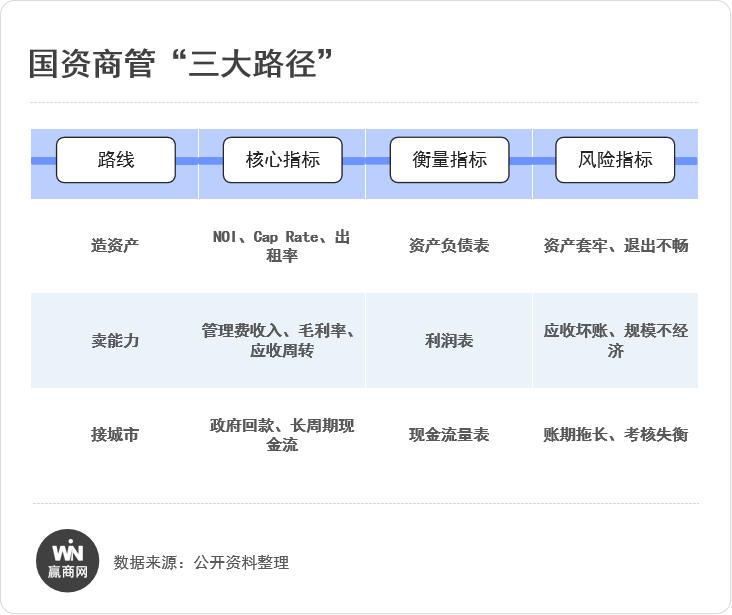
A group that develops along all three paths at the same time must separate the three sets of accounts and carry out separate assessments internally, otherwise there will be a situation where "profitable businesses subsidize unprofitable businesses, and finally all accounts become unclear".
Behind the accounts is the differentiation and matching of resource endowments of state-owned commercial management institutions. Which city they continuously invest in, which business format they sign concentrated contracts in, which type of entrusted project they participate in... Every action may indicate the emergence of new industry signals.
After continuously acquiring more than two stock projects in the same city, the competitive position is basically determined
For the asset creation path, the threshold lies in asset quality rather than operation. Once a state-owned commercial management institution makes continuous moves in the same city, it means that the eligible assets that can enter the REIT pool have been screened out in the first round — assets that meet the standards of occupancy rate, passenger flow and NOI are taken first, and the remaining assets are either too expensive or have inherent defects. At this time, if private commercial management institutions rush to grab similar assets, they can mostly only get the leftover assets after screening.
State-owned commercial management institutions do not pick the best assets, but pick assets that "meet the unified standards". This screening standard itself can be borrowed — even if you do not plan to issue REITs, it can also be applied to test the quality of the assets in hand.
If light asset contracts are concentrated in a certain business format, the management fee rate of this format may be repriced
The essence of the capability output path is to exchange brand value for management fees. The previous set of data is worth reviewing: state-owned enterprises already account for 36% of 70 mainstream operators, and 14 chain commercial management institutions signed 89 light asset projects in 2025.
Once state-owned commercial management institutions form scale advantage in a certain business format, their quotation to property owners will become the reference point for this format. If private commercial management institutions offer a price higher than the reference point in such formats, it is difficult to justify; if the price is lower than the reference point, the operation team cannot sustain its operation.
The feasible response is not to compete on fee rates, but to take over projects that state-owned enterprises are unwilling to take: non-standard renovation projects, small-scale projects, projects with complex property rights, and projects that require long-term communication and coordination with property owners. State-owned commercial management institutions have long decision-making chains and may not have matching assessment standards for such projects, which just leaves market gaps for private players.
Entrustment of urban renewal, public space and venue operation begins to go through state-owned channels, and private enterprises will shift their roles from competitors to partners.
Once the urban function undertaking path is fully formed, the government will increasingly prefer to entrust commercial projects to state-owned commercial management institutions. Private institutions in this track are usually not competitors, but subcontractors, operation service providers or content suppliers.
The difficulty here is not in winning projects, but in translating public attributes into feasible commercial models — how to calculate fiscal funds, how to allocate public welfare area, and how to meet multiple assessment standards at the same time. Whoever completes this translation work will occupy a place in the market, whether as a party B or a cooperative partner.
After all, the diversion of state-owned commercial management institutions does not necessarily squeeze the space of private enterprises. They need to develop along all three paths, and there are links that they cannot or do not want to handle on each path. The real change is not more fierce competition, but finding the position that belongs to you.
Looking ahead, the next five years for state-owned commercial management institutions is not a single-choice question of "whether to transform or not", but a classification question of "which cards you hold and which path you can take".
Three cards — long-term capital, credit, government-enterprise relations, corresponding to three paths — asset creation, capability output, urban function undertaking. Some players have succeeded in all three paths, while others have failed. The difference does not lie in slogans, but in three things: whether the assets are good enough, whether the operation is precise enough, and whether the accounts are clear enough.
After all, not all state-owned enterprises should run the same type of business.
This article is from the WeChat official account "Winshang", author: Lao Yang Disassembles Commerce, published with authorization from 36Kr.