"Extraterrestrial Intelligence" arrives, and AI teams up with humans to shatter the century-old mathematical holy grail.
AI has created a monster equation with nearly 300 billion variables. Eight days later, Chinese mathematicians reduced it to just 26.
292,890,231,905.
This is the number of variables in a certain mathematical equation.
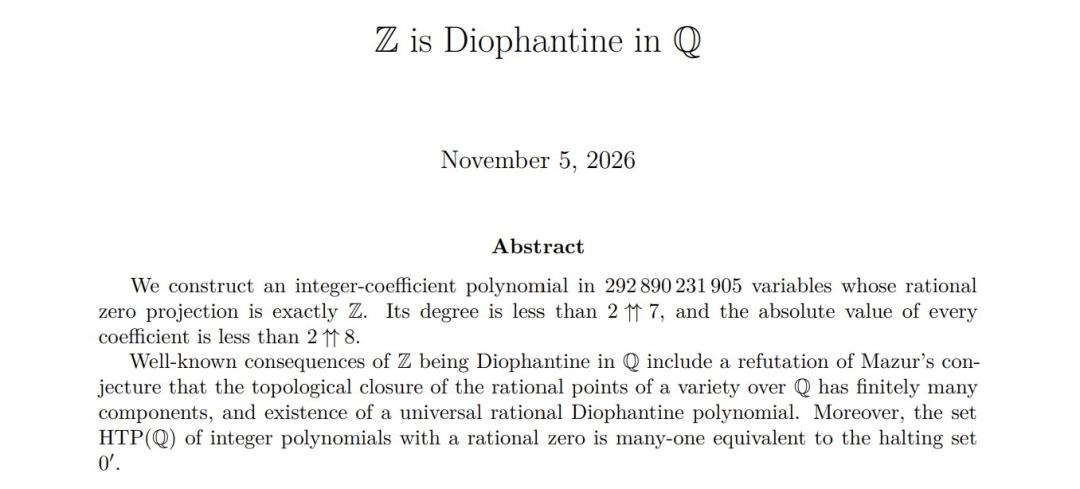
On November 5, logician Elliot Glazer released a manuscript. Working with several AI models, he built a polynomial equation containing nearly 300 billion variables.
This "monster" does only one thing: it accurately identifies which numbers among all rational numbers are integers.
Its highest degree is said to far exceed the total number of atoms in the entire universe. It cannot be printed in a paper at all, and can only be stored as a set of generation code.
As soon as the news came out, the academic circle was abuzz. Someone on social platforms made an analogy: it's just like humans just unearthed an unrecognizable alien Dyson Sphere on Mars.
The plot twist came faster than anyone expected.
Just one day later, several scholars from the University of Illinois Chicago (UIC) took over the manuscript, compressed it to 12504 variables, and directly reduced its degree back to 4.
After that, a relay race began. Hundreds, 221... the number kept plummeting all the way.
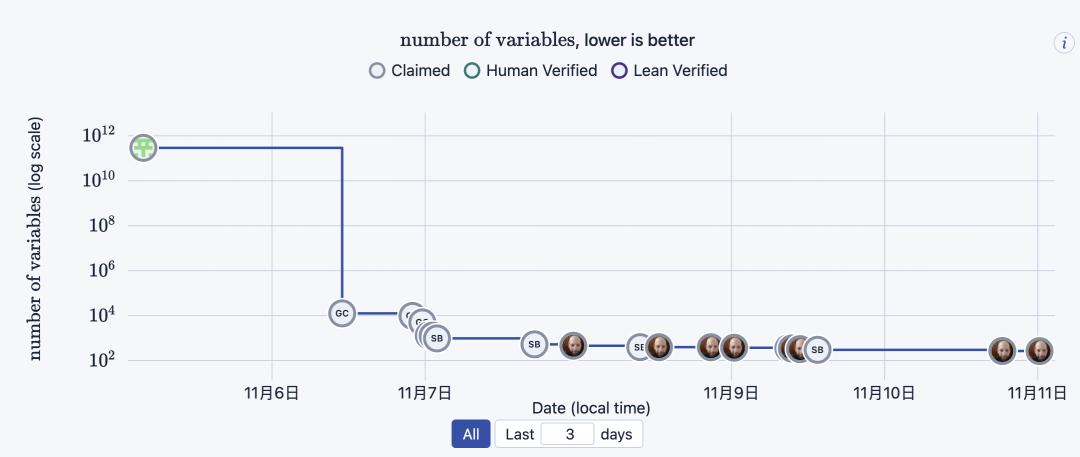
On November 13, Sun Zhiwei, a mathematician from Nanjing University, published a new paper.
The number of variables finally settled at: 26.
Eight days. From nearly 300 billion to 26.
A century-old unsolved problem and an "integer identifier"
In the summer of 1900, at the 2nd International Congress of Mathematicians in Paris, David Hilbert listed 23 mathematical problems, pointing out the direction for mathematics research throughout the 20th century.
The tenth problem among them sounds just like a programming problem:
Is it possible to find a universal algorithm to determine whether any "Diophantine equation" has a solution?
Don't be intimidated by the name. The so-called Diophantine equation is a polynomial equation with integer coefficients that only accepts integer solutions.
For example, 2x + y = 5. If we only consider non-negative integer solutions, its solutions are (0, 5), (1, 3), (2, 1).
The famous Fermat's Last Theorem essentially studies whether a family of Diophantine equations have positive integer solutions.
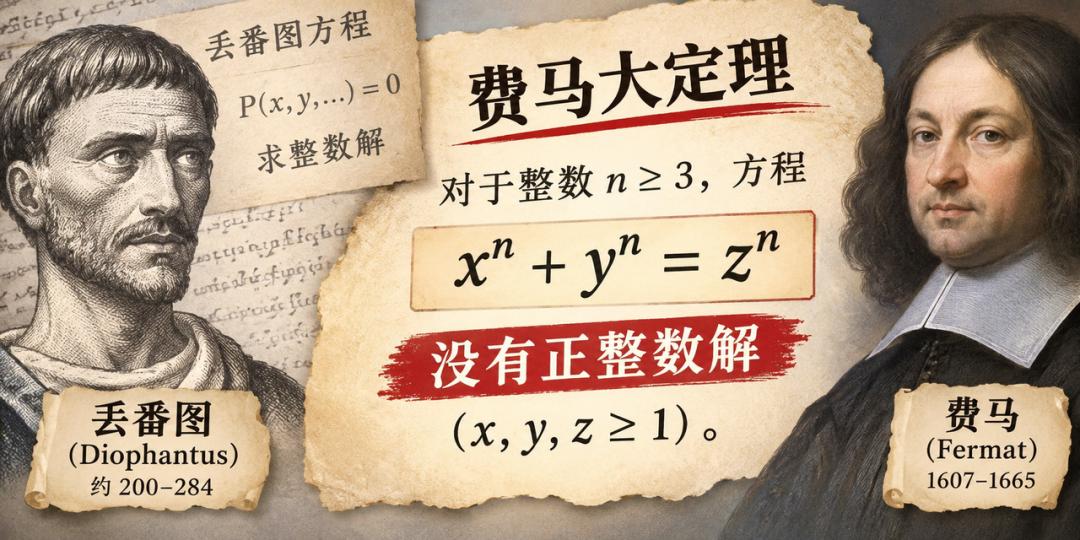
Humanity spent as long as 70 years working on this problem.
It was not until 1970 that Soviet mathematician Yuri Matiyasevich and his colleagues jointly solved it, which is known as the famous MRDP Theorem. The answer is straightforward: No such universal algorithm exists.
But mathematicians are naturally inclined to dig deeper. The problem in the integer domain has been solved, so what if we relax the restrictions a little?
If we no longer strictly require integer solutions, but allow the solutions to be rational numbers (meaning the unknowns can be fractions or integers), does a universal algorithm exist?
In mathematical terms, this is equivalent to proving that "the set of integers ℤ is Diophantine in the field of rational numbers ℚ".
However, this line of research has not made progress for a long time, and people even faced a more fundamental question: could such an "integer identifier" not exist at all?
As early as 1992, mathematician Barry Mazur put forward a conjecture about the topology of rational points, and further discussed it in his 1995 paper: for any algebraic variety defined over the field of rational numbers, the closure of its rational point set in the real point space has only finitely many connected components.
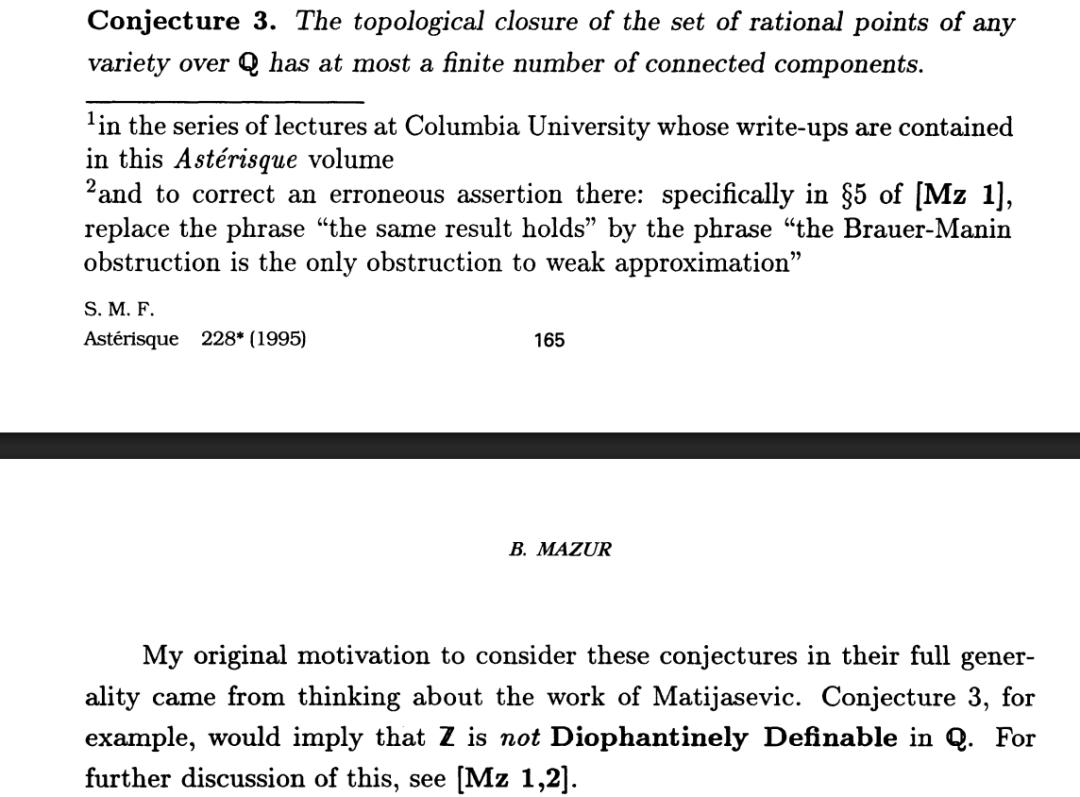
If this conjecture holds, then it is indeed impossible to accurately pick out integers from rational numbers using such a polynomial equation.
In other words: as long as Mazur's conjecture holds, the "integer identifier" can never exist.
For decades, countless scholars in number theory and algebraic geometry have been staring at this "high mountain", but never found a way to climb it.
Until the autumn of 2026, AI knocked on the door.
From nearly 300 billion to 26: Humans turn the answer into proper mathematics
This storm originated from a preprint released by OpenAI on October 6.
OpenAI's internal mathematics team announced that they had provided a negative solution to Hilbert's Tenth Problem over the rational numbers.
Shortly after, in mid-October, mathematician Sohail Farhangi built a conditional proof framework with the help of ChatGPT 6 Pro.
The real impact came on November 5.
Elliot Glazer, a researcher at Principia Labs, announced that with the assistance of multiple AI models, he had directly built that "integer identifier".
The well-known number theorist Abhishek Saha exclaimed the moment he saw the manuscript:
This polynomial directly maps the entire Diophantine theory of integers into the rational number equation completely!
The price to pay is that astronomical number: 292,890,231,905 variables.
The reason why the number is so huge is that the AI used a "brute-force literal translation" approach — it crammed all arithmetic rules, verification conditions, and high-dimensional geometric constructions layer by layer into the equation. The more straightforward the splicing, the more variables there are.
It only cares whether the logic can form a closed loop, and does not consider aesthetic appeal at all.
The entire academic circle was boiling online, with complaints and amazement going hand in hand:
It's just like humans just unearthed an incomprehensible alien Dyson Sphere on Mars, and a few hours later, aliens came over and folded it into a Rubik's Cube.
That's right, within 24 hours after Glazer released the monster equation, UIC scholars Gabe Conant, Caroline Terry and James Freitag quickly followed up.
They rewrote the translation scheme based on Farhangi's manuscript, cutting the number of variables from nearly 300 billion to 12504, and reducing the degree back to 4.
A degree-4 equation with 12504 variables... My brain has already crashed just imagining the corresponding matrix.
Later, Conant and his colleagues continued to compress the equation, reducing the number to 221.
The climax came on November 13.
Sun Zhiwei, a mathematician from Nanjing University, uploaded a preprint on arXiv, and with one cut, the number of variables was reduced to only 26.
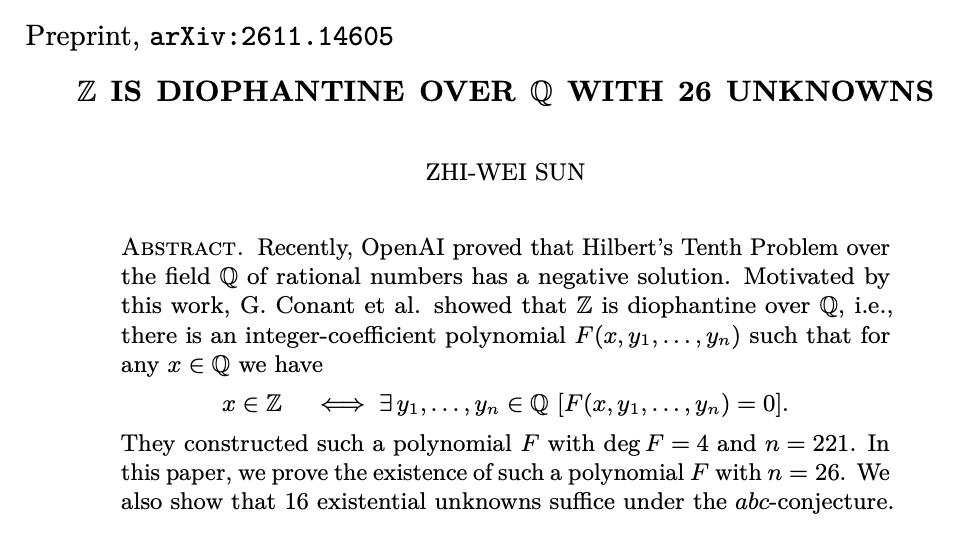
When you flip through Sun Zhiwei's paper, one detail is particularly touching.
The AI only appears in the first sentence of the abstract — it briefly states that this work is driven by OpenAI's achievements.
That's the only mention, no extra content.
Scroll down, the whole paper uses the familiar writing style of mathematicians, with rigorous and neat logic, and the 26 unknowns are neatly arranged on the pages.
The source is noted, and the answer has been digested. Those nearly 300 billion variables were worn away line by line by humans.
The answer given by the machine is too ugly to look at, it may be correct but no one can read it through. Humans took over the baton, polished it bit by bit, and finally turned it into mathematics that can actually be read and appreciated.
This is probably the ideal way for AI to enter the field of mathematics: Machines charge forward, and humans turn the answers into proper mathematics.
So far, neither the version with nearly 300 billion variables, the degree-4 equation with 12504 variables, nor Sun Zhiwei's 26-variable paper has passed strict peer review.
Glazer himself poured a bucket of cold water, admitting that the formal verification of this proof (for example, running it through Lean 4, the most rigorous theorem prover in the mathematical community) is progressing terribly:
Formal verification will take a very long time. We have consumed a huge amount of computing power, but the current internal estimate of the intelligent agent cluster has only completed 5% of the formalization progress.
Why is it so difficult?
Because the analytic number theory tools and algebraic geometry constructions used in this proof far exceed the coverage of Lean's existing mathematical library (Mathlib).
The proof contains a large number of intensive calculations, which cannot be completed only by Lean's three standard axioms within a reasonable time. The research team can only adopt "Factored Verification": run the intensive calculations on external software first, then package them as "certified axioms" and force them into the Lean framework.
This leads to a sharp trust crisis:
If a mathematical proof is written by multiple AI models and audited by multiple AI models, and most of the high-dimensional algebraic deformations in it cannot be manually calculated and checked by humans, why should we believe it is correct?
Facing the doubts, Glazer cited two famous "black boxes" in the history of mathematics to defend himself:
Logicians mention the MRDP Theorem all day long and use it as a tool, but the vast majority of them have never read its complete proof;
Scholars outside group theory also often cite the "Classification of Finite Simple Groups (CFSG)", but the proof of this theorem is tens of thousands of pages long, and no one in human history has ever read it from beginning to end completely.
Glazer believes that in many cases, the statement of the theorem itself is a high-value black box, and the outside world only needs a "truth certificate".
That being said, the edifice of mathematics cannot be built on sand after all.
Glazer honestly wrote a disclaimer on the homepage of the project repository: Multiple rounds of AI auditing are by no means equal to independent human peer review.
The arrival of alien intelligence, the next battlefield for mathematicians
What is more far-reaching than the specific theorem is the fate of mathematics itself.
For a long time, pure mathematics has been regarded as the glory of human intelligence, and the gymnastics of the mind.
But now, mathematics is forced to take on the temperament of an "experimental science" — AI, like a large hadron collider, smashes hundreds of billions of variables together for collision and screening, and spits out results; while human mathematicians identify the trajectories passing by on the instrument screen, and then refine them into axioms and beauty that humans can understand.
This does not mean that human mathematicians are going to lose their jobs. On the contrary.
When massive high-dimensional symbols gush out from the abyss of machines, only humans can ask "what does this actually mean", and only humans can translate the alien language into a poem with 26 variables.
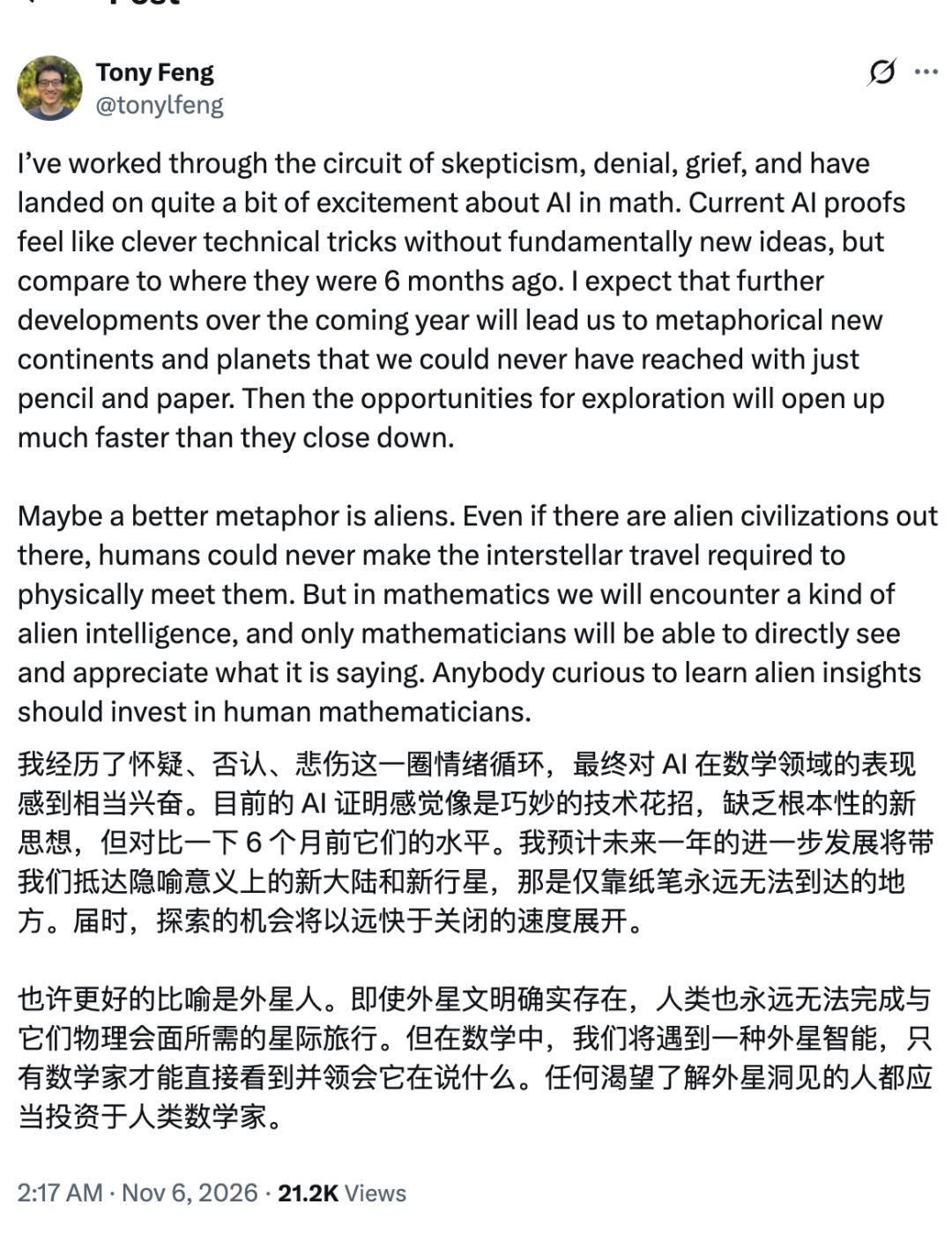
Just like what Feng Zhaolun wrote in his viral monologue after going through doubt, denial and sadness:
In mathematics, we are encountering an alien intelligence, and at present only human mathematicians can directly understand what it is saying. Anyone who wants to learn alien insights should now invest in human mathematicians.
The curtain has just been raised.
References:
https://arxiv.org/pdf/2611.14605
https://bigospeedrun.com/other/z-diophantine-in-q
This article is from the WeChat official account "Xinzhiyuan", author: David, republished with authorization from 36Kr.