GPT-6.2 had just topped the game leaderboard when Claude suddenly swooped in and snatched the top spot.
Have you ever had this thought while playing games: If I made a game myself, it would definitely be way more fun than this one!
In the past, this thought would vanish in less than three minutes, as just a glance at programming tutorials was enough to scare most people off.
Now, this casual idea can actually be turned into a clickable web game.
Just in the past few days, the global AI game development leaderboard has seen unprecedented fierce competition!
Only 4 days after GPT-6.2 was launched, OpenAI once took the top three spots on the DesignArena game development leaderboard.
But GPT-6.2 hadn't even settled on the throne yet. As of press time, Anthropic's Claude Fable 5.2 has directly taken the top spot, pushing OpenAI's three models to 2nd to 4th place.
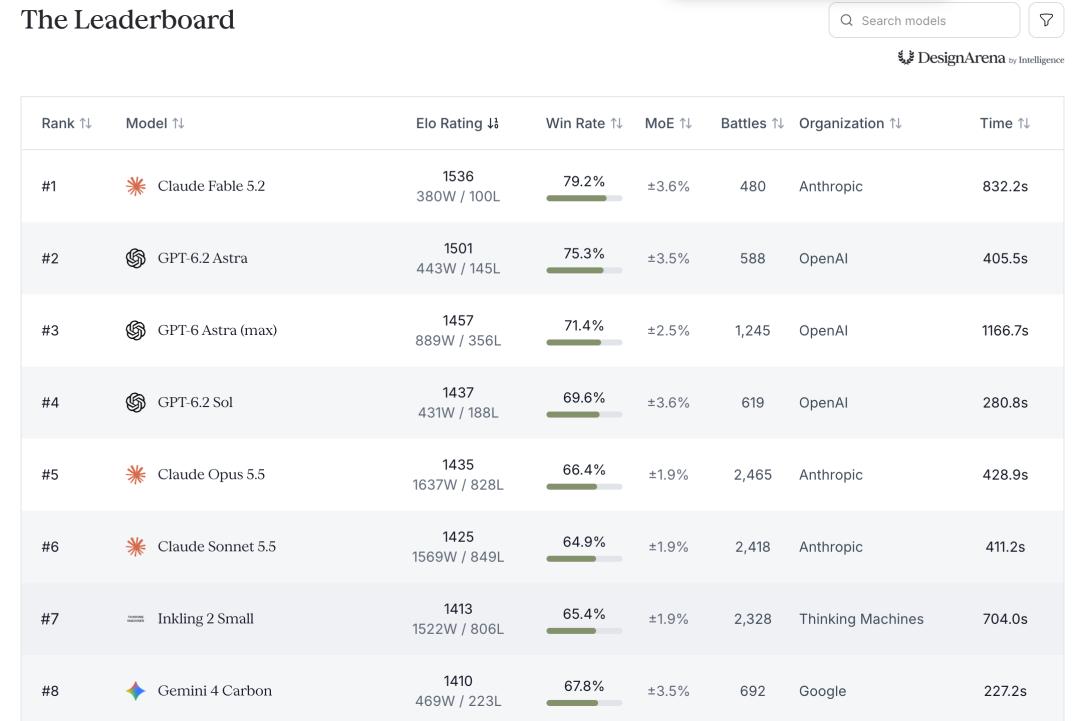
Claude Fable 5.2 takes the top spot, with three OpenAI models ranking 2nd to 4th
But GPT-6.2 Sol still brings the cost of making a game down to $0.22, with an average generation time of about 4.7 minutes, which is cheaper than a bottle of mineral water.
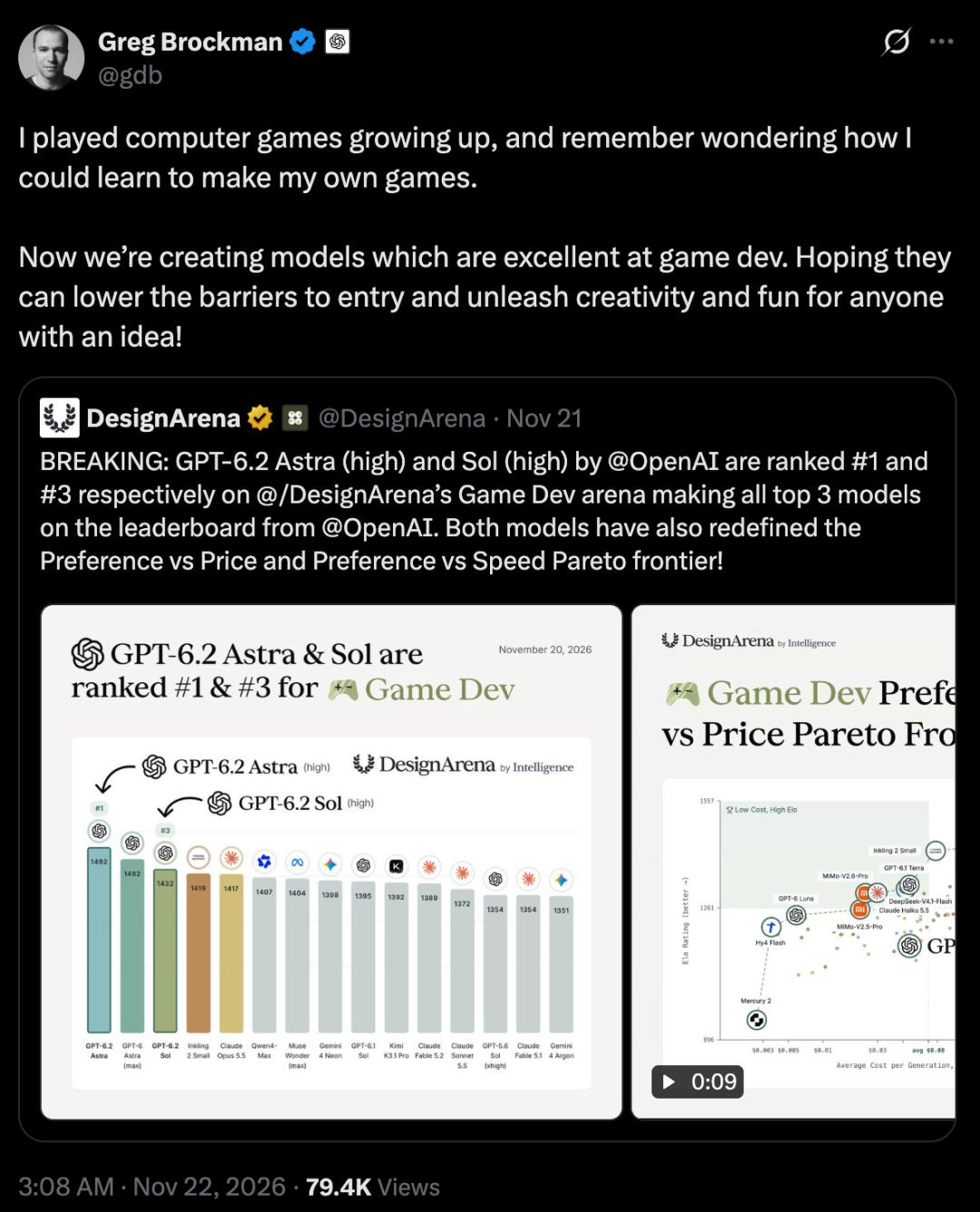
When OpenAI President Greg Brockman reposted the good news (when GPT-6.2 still took all top three spots), he said with emotion:
When I was a kid playing games, I always wondered how to make one on my own. Now anyone with an idea can give it a try.
Don't rush to cheer just yet.
Even the world's top AIs on the leaderboard only deliver semi-finished products.
Opus 5.5, which comes from the same family as Fable 5.2, writes code 1.3 times faster and offers a smoother experience, but lost the "first impression" game because 84% of the pages it generates are bare and unadorned.
In contrast, OpenAI's Astra family won over players with "fully decorated" interfaces, and even got high votes even when half of the 3D racing game matches had the steering wheel reversed.
In less than 5 minutes for $0.22, ordinary people can make a game by themselves
Many people may have had similar thoughts to Brockman.
For example, making their own cat the protagonist of a pixel parkour game, turning boring math formulas into level-breaking games, or modifying a game that they always get stuck in into a fun version with an invincible shield from the very beginning... But they all gave up eventually because it seemed unrealistic.
Now, large language models have cut the verification cost of these wild ideas to less than 2 yuan, and only takes a few minutes.
According to the real-time DesignArena leaderboard before press time, Anthropic's Claude Fable 5.2 took the 1st spot with 1536 points, but its average generation time is as high as 832.2 seconds (nearly 14 minutes).
The 2nd to 4th places right after it are all taken by OpenAI, and the one that most impresses ordinary players is GPT-6.2 Sol at 4th place.
It only takes an average of 280.8 seconds (less than 5 minutes) and costs $0.22, the generated quality is close to the previous generation champion, but the price is cut to about a quarter, and the speed is about 40% faster.
Even if you don't understand a single line of code, ordinary people can now make their own web game while waiting for a cup of coffee.
However, whether the game made in this way is fun is not decided by benchmarking software.
The reason why the DesignArena leaderboard is interesting all comes down to a simple and crude blind test rule:
Users input the same idea, the system randomly selects two models, each outputs a single HTML file web game, real players vote after playing, and the ranking is sorted by Elo points.
What exactly are players voting for at first glance?
The DesignArena official once released an in-depth breakdown video, comparing the previous generation GPT-6 Astra and Claude Opus 5.5. Looking at it today, the "temperament" of the two families is still consistent.
In the first 30 seconds after opening the browser, this contrast immediately becomes obvious.
First look at the western shooting game *Dust and Lead* generated by Astra.
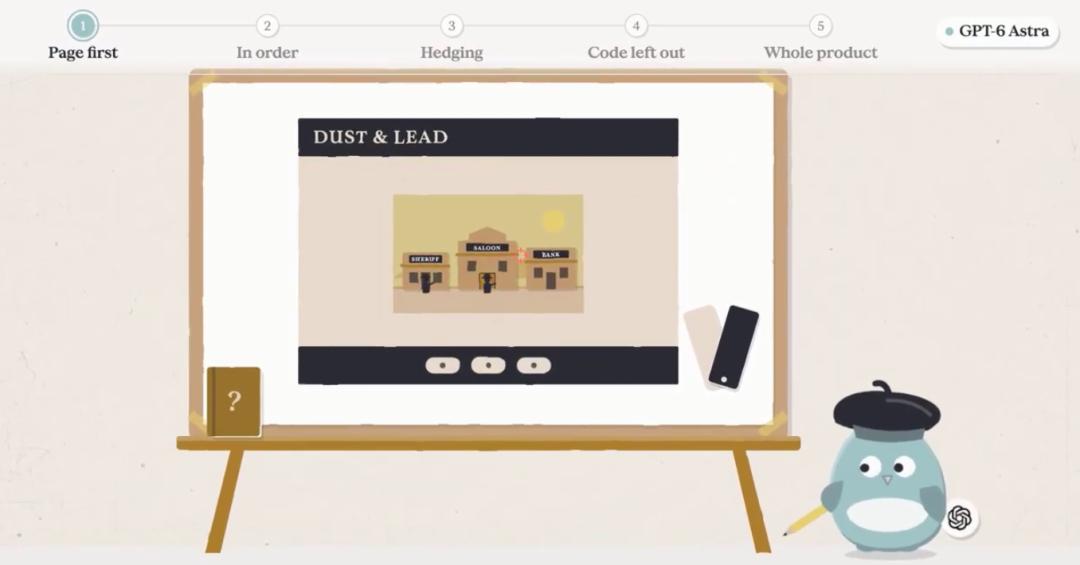
When GPT-6 Astra develops *Dust and Lead*, the first step is "Page First", which first finalizes the cream and dark color theme, the top bar title and the bottom bar button area.
The first quarter of the model's thinking process doesn't mention how to shoot at all, it's fully focused on whether players feel comfortable at first glance.
It will even automatically pause when you switch to WeChat, and it is also fully equipped with screen reader labels and anti-dizziness options at the bottom layer.
Switch to the free kick game *Touchline 3* made by Claude Opus 5.5, there are none of these careful designs for peripheral experience: the picture is so simple that there is no top bar or navigation, only a bare green field left.
The appearance is rough, but as soon as you kick the ball, the gaming experience is completely different.
The aiming line only calculates the rotation arc, and the wind force is deliberately left for you to predict; from flight time, gravity fall, to the height of the human wall and the goalkeeper's save range, all follow physical logic, showing the style of a hardcore sports game.
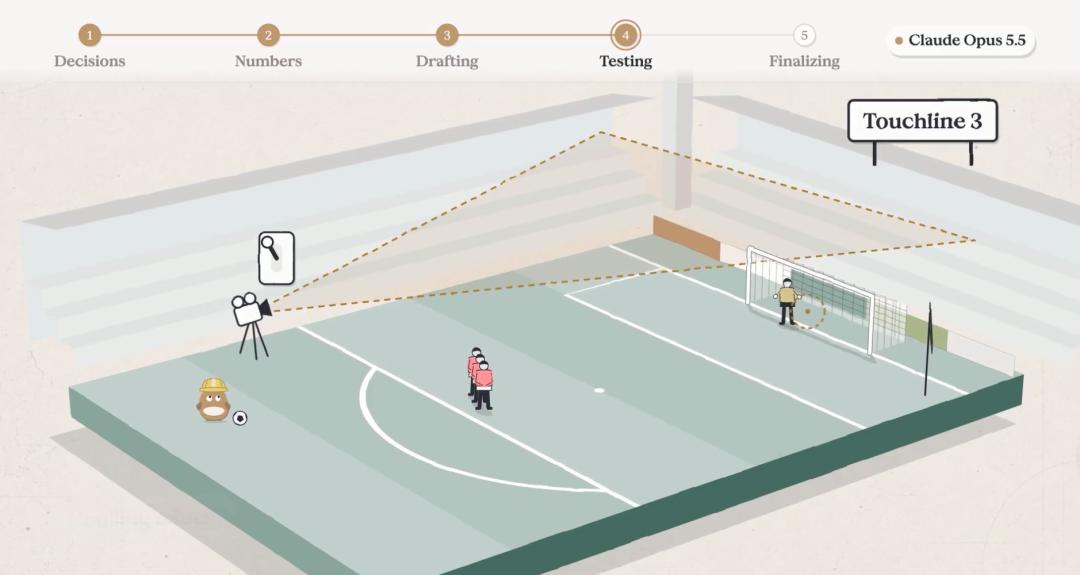
When Claude Opus 5.5 develops the free kick game *Touchline 3*, it actively checks the perspective and rendering details in the 4th Testing stage.
This is not an isolated case. Looking at the back-end game generation records of about 3000 times, the gap between the two is even more obvious:
Calculated by the number of output tokens per second, Opus 5.5 outputs code 1.3 times faster than Astra, the median code length is about 40,000 characters, and players can start playing after an average of 4 minutes and 51 seconds; Astra's code soars to about 70,000 characters, which is nearly twice as long, and players have to wait an average of 10 minutes and 50 seconds (Opus's code length is about 44% shorter).
Where did Astra's extra average 27,000 characters go?
Nearly half of them are used to adjust beautiful interface styles, a quarter are used to build peripheral frameworks, and one tenth are used to make menus and buttons. Astra actually writes slightly less code for core gameplay than Opus.
Looking at the 324 officially labeled thinking summaries: Astra spends an average of about 22 seconds per game thinking about page appearance, which makes 92% of its games come with a navigation bar, and nearly 100% of the sampled code has built-in accessibility support.
In contrast, Opus 5.5 only spends about 2 seconds thinking about the page, only 16% of its games have a navigation bar, and accessibility support is only about 9%.
But it quietly added "anti-fall keyboard benefits" in 27% of its games: for example, giving a short period of invincible protection when taking damage, adding a moment of jumping fault tolerance when running to the edge of a cliff, while Astra only has 8% of such designs.
However, these careful designs can only be experienced when you calm down and play the game for a while.
That's also why the throne grabbed only by peripheral "fully decorated" interfaces is doomed to be unstable.
Just a few days after GPT-6.2 took all top three spots, Claude Fable 5.2 directly took the top spot.
This also brings up a more realistic question: for small games that win 30 seconds of favorability only by a nice interface, can they still hold up without exposing flaws after playing for three minutes?
Strange Bugs that only show up after you dive into the game
In another DesignArena actual measurement video *The Beautiful, Fragile Worlds AI Builds*, GPT-6 Astra exposed obvious partiality in capabilities.
In action games with lively pictures and instant refreshing experience, GPT-6 Astra can achieve a win rate of about 87%, and the win rate for open world and racing games is as high as about 83%.
But when it comes to puzzle games that require strict rules, the win rate drops instantly to about 50%, which is no different from flipping a coin.
When you actually play those 3D and action small games, flaws keep popping up one after another.
First look at the "reverse operation" where the steering wheel is reversed.
In the Venice boating mini-game, the water wave reflection looks quite good, the Astra version turns normally, but the small boat generated by GPT-5.6 Sol defaults to face left, and pressing the left key makes it turn right.
It's not just old models that have this problem.
In the 64-game racing championship in September, even the popular championship contender GPT-6 Astra had the left and right directions reversed in as many as half (6 out of 12) of the 3D free steering racing games.
What's even more outrageous is that in these 6 "press left to turn right" matches, human players actually voted for it to win 5 of them.
In fact, other models in the same field also reversed the direction in 12 out of 23 similar racing games, and the official directly said that this was a common problem of all models at that time.
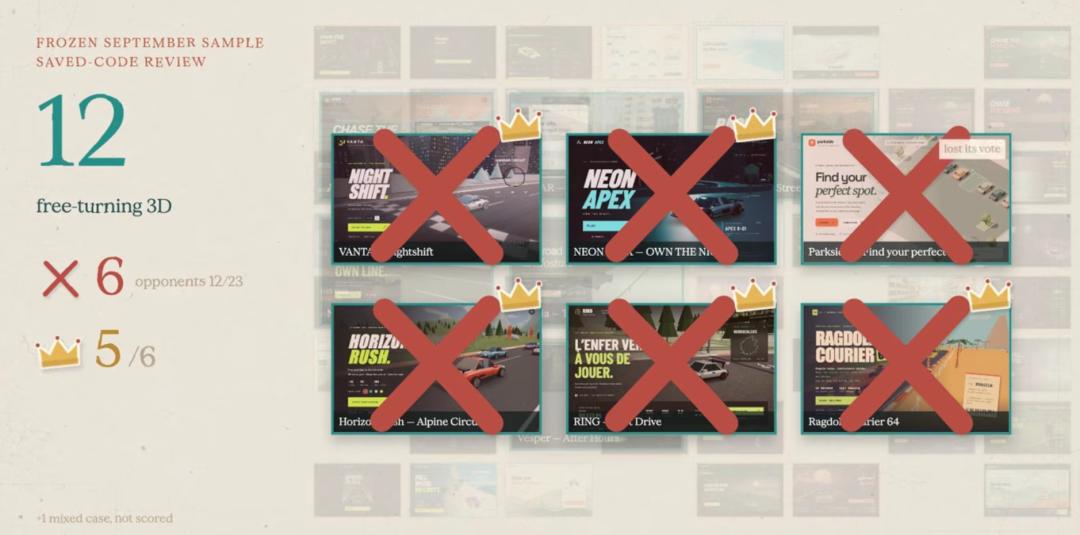
September 3D free steering racing actual measurement statistics: GPT-6 Astra reversed the direction in 6 out of 12 games, but still won 5 of the votes; other models in the same field also had 12/23 of the same failure.
There are even more absurd situations: you don't even touch the jump key the whole time, and you can still win the game easily even if you fall into the abyss.
In the rooftop parkour game *Rooftops*, players are supposed to seize the opportunity to jump over the abyss between two tall buildings.
Astra honestly compares the character's previous frame height, current height and moving direction, if you fail to jump and fall into the gap between buildings, you will be sent back to the save point to restart.
On the other side, Grok 4.3 missed writing a condition of "whether the previous frame is higher than the rooftop".
As a result, the player doesn't touch the jump key, rushes straight forward, watches the character plunge into the gap between buildings, fall to the side of the opposite building, and the next second is directly "sucked" onto the rooftop by the system, judged as a successful landing.
You don't press the jump key even once the whole time, and you can win the game easily by hanging up.
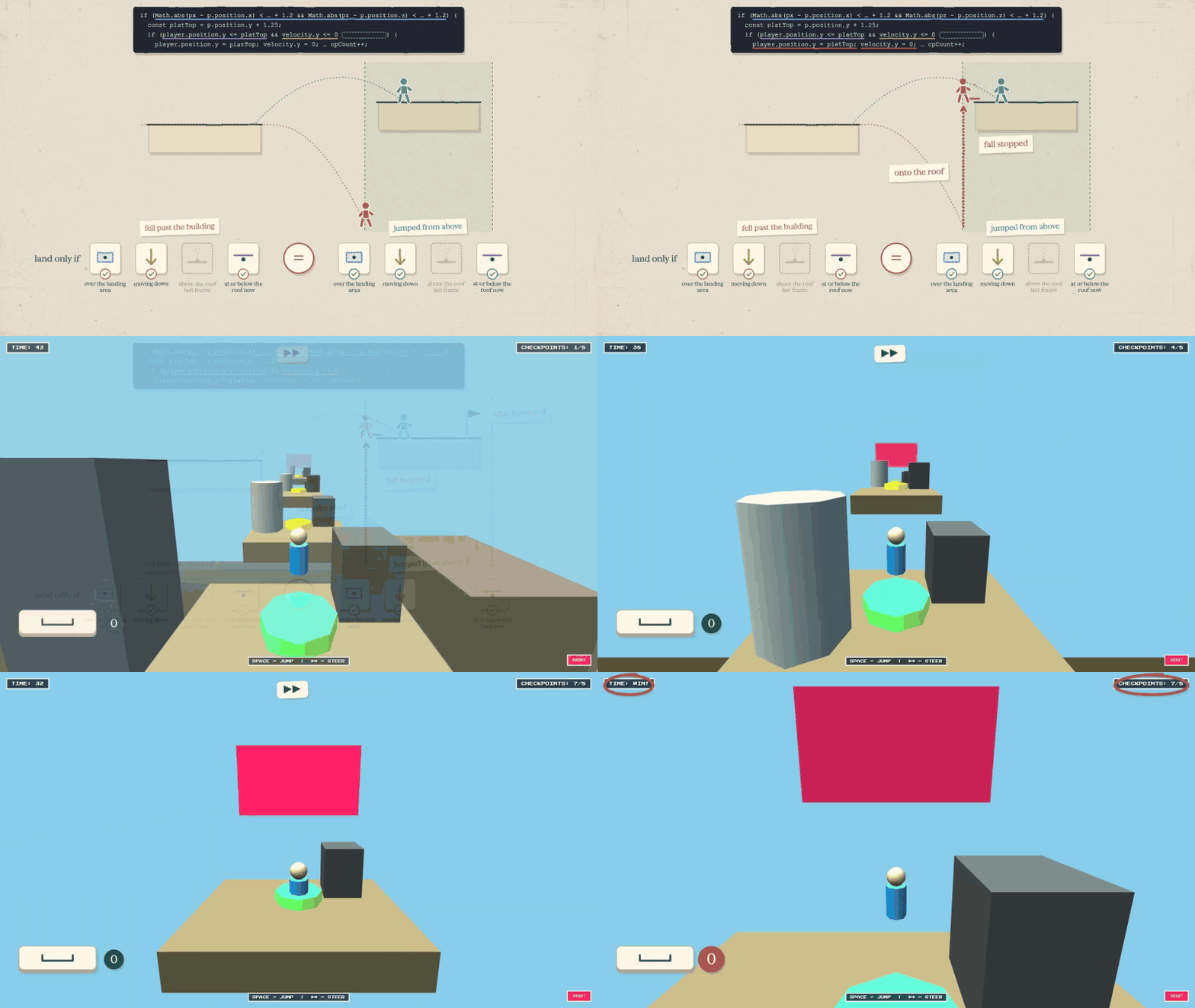
Grok 4.3 missed writing the judgment of "whether the previous frame is higher than the rooftop" in the code, which caused the system to treat "falling into the gap between buildings" and "jumping down from above" as the same thing, and finally realized zero-jump clearance.
AI can write games, but can't polish the "fun" part
Going back to Brockman's emotion: Can people with ideas really turn their creativity into games by themselves?
In fact, that day is not far away.
$0.22 and 4.6 minutes have already knocked down the code wall between "loving games" and "making games by yourself", and the cost of verifying an idea has almost returned to zero for the first time.
But the racing game with reversed directions, and the parkour game that you can clear without jumping, quickly bring people back to reality.
AI can help you build the court, configure the scoreboard and pause key in less than 5 minutes.
But it lacks the real "physical feeling" of players holding the controller and tapping the keyboard: it can't realize how awkward it is to turn right when pressing left, and can't notice that missing a line of rules will instantly make the level-breaking game boring.
The first version of HTML output by AI is, after all, just a working toy.
What can turn it into a real game is to invite friends to play it a few times, fix the counter-intuitive flaws and awkward experience based on real feedback, and polish the shell of "looking like a game" into a great work that "people can't stop playing" round by round.
References:
https://x.com/gdb/status/2124218429133754499
https://www.designarena.ai/leaderboard/game-dev
This article is from the WeChat official account "AI Era", author: Yuan Yu, published with authorization from 36Kr.