Which cities in China rank among the world's first-tier cities?
What is the ranking of Chinese cities in the eyes of foreigners?
Let's cut to the chase: A total of 6 cities in China are listed as world tier-1 cities. Among mainland Chinese cities, the Beijing-Shanghai-Guangzhou pattern remains unchanged.
01
Ranking of the world's top 10 cities: Hong Kong ranks first in Asia
After a two-year interval, GaWC, a globally renowned urban rating institution, has just released the 2026 World Cities Inventory.
GaWC is regarded as one of the world's most authoritative urban rating institutions. Its ranking is not based on the economic scale of a city, but on the connectivity of a city in the global network of high-end producer services. GaWC divides cities into four tiers: Alpha, Beta, Gamma, and Sufficiency (+/-), which are commonly known as global tier-1, tier-2, tier-3, and tier-4 cities.
In 2026, there are a total of 48 Alpha-level cities worldwide, including 1 Alpha++ city, 9 Alpha+ cities, and 18 Alpha cities.
The ranking of the world's top 10 cities is as follows:
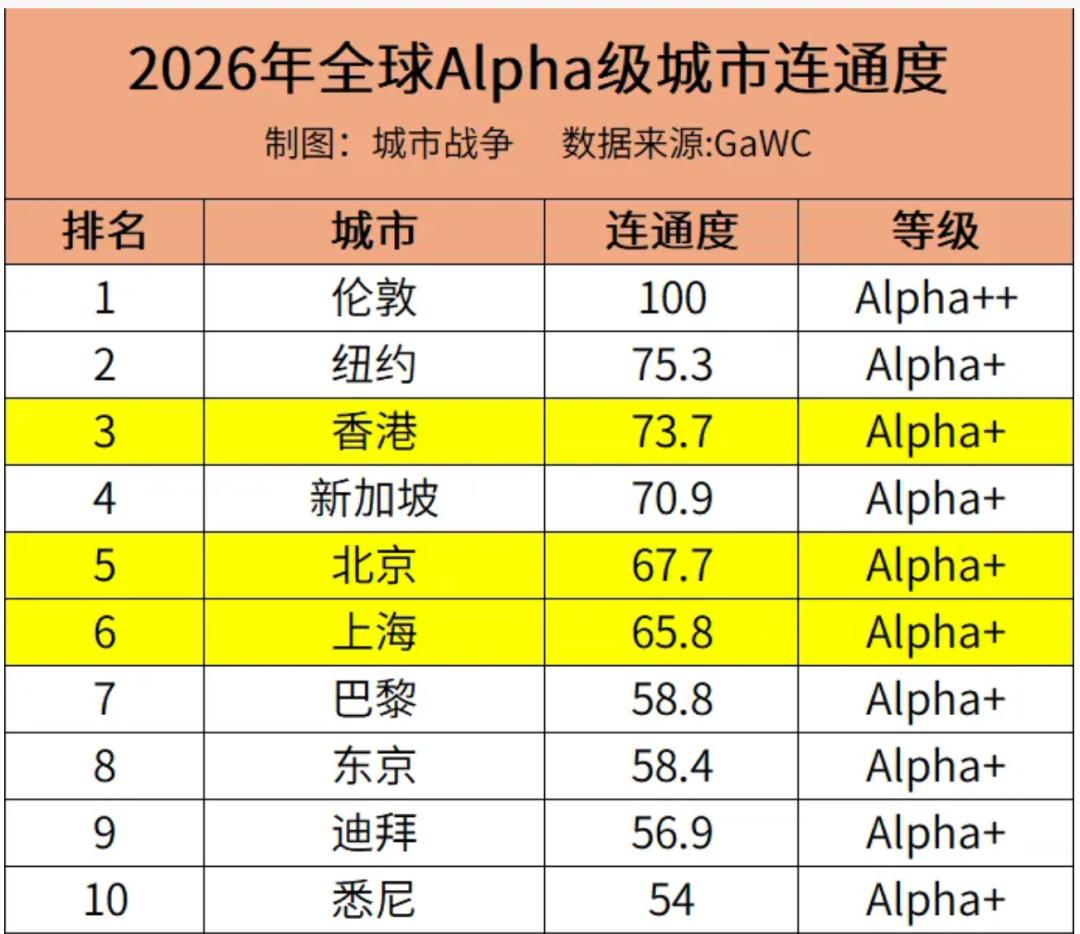
London, UK takes an absolute lead and is the only Alpha++ city in the world. New York, USA continues to rank second globally, but has rarely been downgraded, from the former Alpha++ to an Alpha+ city, widening the gap with London. Hong Kong, China ranks third in the world, is rated as an Alpha+ city, and ranks first in Asia.
Following London, New York and Hong Kong, there are 7 other cities rated as Alpha+, namely Singapore, Beijing, Shanghai, Paris, Tokyo, Dubai and Sydney. Among the world's top 10 cities, there are 3 Chinese cities, namely Hong Kong, Beijing and Shanghai.
02
Which Chinese cities are among the world's tier-1 cities?
Let's look at the ranking of Chinese cities.
In this year's list, a total of 6 Chinese cities have entered the global first camp - Alpha-level cities, in order: Hong Kong (3rd), Beijing (5th), Shanghai (6th), Guangzhou (24th), Taipei (32nd), Shenzhen (34th).
Then, which Chinese cities have made the greatest progress?
Compared with the 2024 list, Xi'an is the fastest rising city: its global ranking has jumped from 109th to 87th, advancing 22 places, with an increase of 20.2%, and it has crossed from Beta- to Beta. The second is Suzhou, which has risen from 92nd to 83rd in the world, advancing 9 places; Hefei has risen from 116th to 108th, advancing 8 places.
Nanchang has risen from 181st to 173rd, also advancing 8 places. Hangzhou has risen from 65th to 61st, keeping its Beta+ tier and overtaking Tianjin; Haikou has risen from 143rd to 139th and entered Gamma+; Nanjing has slightly risen from 75th to 74th, overtaking Chongqing.
It is worth noting that Xi'an and Suzhou, which have made the greatest progress, are precisely the two cities with the most explosive foreign trade growth in 2026, which may to a certain extent improve the connectivity of the two cities in the global high-end producer services network.
In addition, the rankings of some cities have declined: Beijing's ranking has dropped by one place, from 4th to 5th in the world; Guangzhou's ranking has dropped from 22nd to 24th in the world; Shenzhen's ranking has dropped from 30th to 34th in the world; Chengdu's ranking has dropped from 58th to 60th in the world; Chongqing's ranking has dropped from 70th to 74th in the world.
03
The ranking does not depend on GDP?
Some people may wonder, why does Guangzhou rank higher than Shenzhen? Why does Chengdu rank higher than Chongqing? Why does Hong Kong rank higher than Tokyo? Obviously the latter has a higher total economic output than the former.
This requires an understanding of GaWC's rating criteria. Based at Loughborough University in the UK, GaWC analyzes the status of 785 cities in the producer services association network based on the global business network of 175 high-end producer service enterprises (75 banks/financial/insurance institutions, 25 accounting firms, 25 law firms, 25 advertising enterprises, and 25 management consulting enterprises).
Simply put, it focuses on "network connectivity" rather than GDP volume. The network connectivity here cannot be simply understood as the international accessibility of airports and ports, but the hub status of a city in the business network of multinational corporations.
For example, Tokyo's GDP and the number of Fortune Global 500 headquarters both exceed those of Hong Kong and Singapore, but when multinational corporations set up branches in the Asia-Pacific region, their first choices are often Hong Kong, Singapore and Dubai, and Tokyo loses points in this dimension.
The same logic applies: although Shenzhen's GDP has surpassed that of Guangzhou, Guangzhou still has an advantage in international connectivity. It is home to more than 70 foreign consulates general, coupled with the international accessibility of Baiyun Airport and the brand appeal of the Canton Fair, attracting multinational corporations to prioritize setting up regional headquarters in Guangzhou. In addition, Chengdu also leads Chongqing in terms of international routes, consulates general, and the first western stores of multinational brands, so its "network connectivity" is higher.
In the final analysis, the GaWC ranking does not look at "who has the largest volume", but "who is more closely connected with the world", which is a core indicator to measure the internationalization level of a city.
This article is from the WeChat Official Account "City War", written by Tinghai Moyu, and published with authorization from 36Kr.