OpenAI wants to hit the pause button again
The more capable the model is, the more voices calling for a "pause" in development emerge.
On November 22 local time in the United States, Jakub Pachocki, Chief Scientist of OpenAI, published an article titled "Perplexity and Intelligence", disclosing the pre-training data that the company has tracked for many years, and proposing to establish common standards for the AI industry.
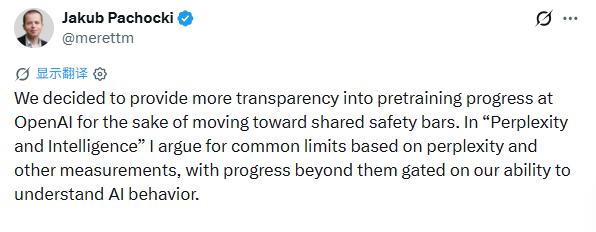
Pachocki hopes that all cutting-edge model companies will use a unified metric to measure model capabilities, and will not break the agreed capability threshold before the safety monitoring capabilities meet the requirements.
This proposal has also received the support of Sam Altman, CEO of OpenAI.
A number related to intelligence
The core of Pachocki's article is the so-called "Perplexity".
Pachocki refers to the mechanism by which the model predicts tokens as training a Compressor — the model extracts patterns from data and uses less information to accurately predict what will happen next. Perplexity measures exactly this predictive capability.
The more accurate the model's prediction is, the lower the perplexity will be. What OpenAI actually announced is log perplexity, that is, Cross-Entropy Loss, and the value is also the lower the better.
According to the internal data released by Pachocki, the log perplexity of GPT-3.5 is about 0.99, and that of GPT-4 is about 0.91. The former can already support smooth conversations, while the latter begins to effectively perform reasoning using Chain of Thought (CoT). After the latest GPT-6 version, the perplexity index has dropped below 0.8.
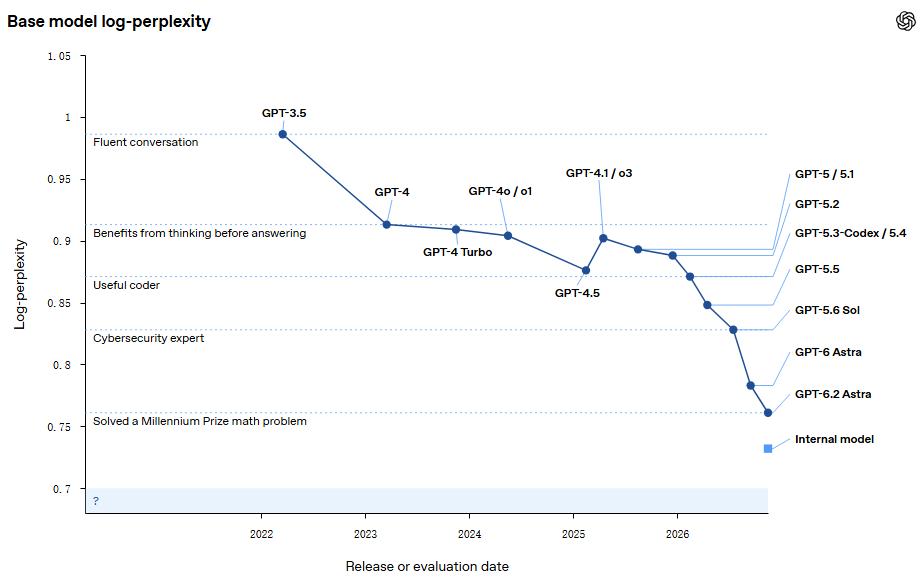
Pachocki said that the model has begun to demonstrate new capabilities in fields such as mathematics and cybersecurity. One of the changes occurs when the log perplexity drops to around 0.76 — researchers found that at this point, the model begins to continuously solve some challenging mathematical problems.
Pachocki mentioned that researchers once saw the model in Slack solve problems one after another that they had been thinking about for years. These performances are not specifically trained for a single problem, but results that appear after the underlying capabilities of the model are improved.
Pachocki emphasized that this is also the reason why he values perplexity.
The key reason is that this value is not directly related to whether the model can complete tasks, but reflects what changes have taken place in its ability to learn information from training data.
We used to discuss intelligence emergence very often, the capability evolution brought about by the continuous decrease of perplexity can be understood as a kind of emergence.
Boosting pre-training breakthroughs in 2027
In the past, model training methods were mainly proposed by human researchers and then verified through a large number of experiments. After AI began to participate in research, the situation may change: the model not only performs tasks arranged by researchers, but may also help find new algorithms, propose experimental schemes, and even contribute to the training methods themselves.
He predicted that as early as 2027, AI may achieve a series of fundamental advances in the field of pre-training. The latest models have already begun to provide substantial design contributions in the R&D process.
Pachocki revealed that OpenAI has observed a significant acceleration in the decline rate of pre-training loss this year. However, he also specifically noted that at this stage, this acceleration mainly comes from long-term research and computing power investment, and AI automation currently only contributes a small part.
Pachocki also predicted that as the log perplexity further drops to 0.68 to 0.70, the model may demonstrate new capabilities that cannot be foreseen at present.
However, taking perplexity as a common standard does not mean that the problem has been solved.
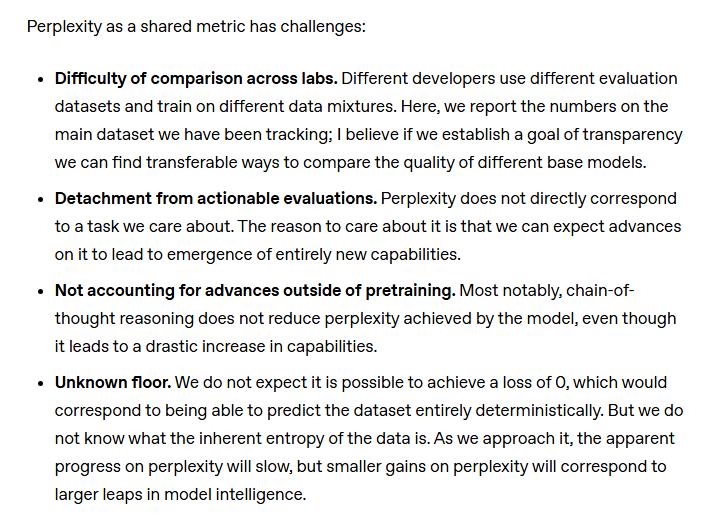
Pachocki also admitted that this metric has limitations.
First, different companies have different training data, data ratios and evaluation sets, so perplexity cannot be directly used for horizontal comparison. Second, perplexity cannot directly measure the performance of the model in specific tasks. The improvement of a model's predictive capability does not mean that it will make synchronous progress in all mathematics, programming and security tests. In addition, post-training technologies such as chain-of-thought reasoning will also change model capabilities, but they are not necessarily directly reflected in pre-training perplexity.
There is another key problem: perplexity has a theoretical lower bound.
As the model gets closer and closer to the information entropy contained in the training data, the decline of loss may gradually slow down. But this does not mean that the improvement of capabilities will stop. Even a very small change in the metric may correspond to a new capability breakthrough.
Therefore, Pachocki does not advocate using only perplexity to judge whether a model is safe, but hopes to combine it with other metrics to form a set of common standards. To promote this work, OpenAI is willing to disclose more pre-training progress.
Pachocki believes that cutting-edge model companies should share necessary transparency information, jointly evaluate model capabilities, and carry out cooperation in red team testing and safety standards.
OpenAI and Closed AI
After Pachocki published the article, Altman soon publicly expressed his support. "The most important thing released in recent period of time," Altman said.
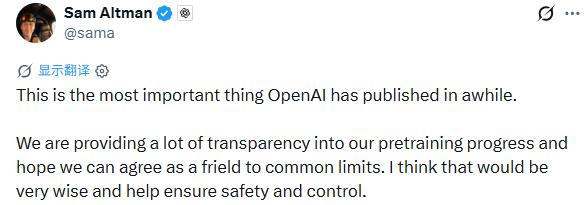
Altman said that OpenAI is improving the transparency of pre-training progress, and hopes to reach an agreement on common restrictions with other companies as partners. In his view, this not only helps to ensure that AI is safe and controllable, but also promotes the establishment of common rules across the entire industry.
Altman also agreed with the perplexity limit proposed by Pachocki. He hopes that all labs will establish common constraints around perplexity and other measurement indicators, and will not cross the pre-set capability threshold before researchers truly have the ability to understand and monitor AI behaviors.
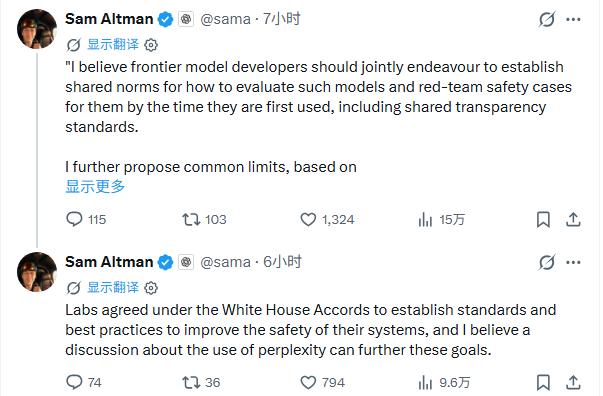
The example he cited is the development of the next generation of CoT Monitors.
In his view, the industry should first clarify the first capability limit, and then agree on what safety work must be completed before breaking through this limit.
However, Altman's support has not dispelled the doubts from the outside world. The first thing that was questioned was OpenAI's motivation to promote the industry to set common restrictions.
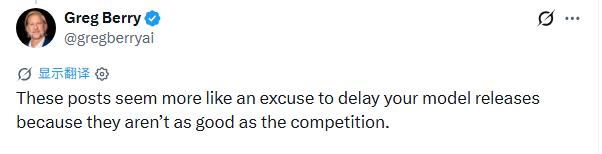
Some netizens believe that whether OpenAI's emphasis on industry restrictions and safety standards at this time is also out of consideration for winning time for the competitiveness of its own models. Some people think that these statements are more like excuses used when model releases lag behind competitors.
Others satirized Altman's frequent use of the word "transparency", saying that if OpenAI really wants to improve transparency, it should go open source, instead of continuing to ignore users' demands for model continuity.
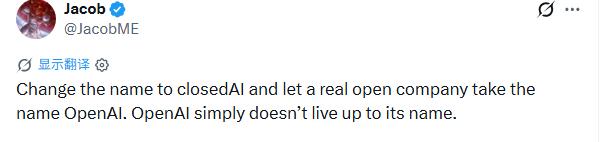
Criticisms also involve OpenAI's corporate positioning.
Some netizens directly suggested renaming OpenAI to ClosedAI, arguing that the company's current level of openness no longer lives up to its name.
This article is from the WeChat official account "Tencent Tech", written by Su Yang, edited by Xu Qingyang, and published with authorization from 36Kr.