Parents who used to be stumped by mobile phones are now starting to "take back everything" with AI.
Zhao Yi's 59-year-old mother is a middle school teacher. In daily life, she uses AI to look up information, discuss content in books and revise documents, and also asks AI to help grade students' compositions. In the past two months, she has also started using AI to record her weight and body fat, adjusted her diet and exercise by referring to the suggestions given by AI, and successfully lost 5 kilograms.
Zhao Yi is a video director who also frequently uses AI at work. He compares the performance parameters of different models, pays close attention to the development trends of new technologies, cross-checks the accuracy of AI-generated information, and keeps up with the updates of the AI engineering paradigm.
His mother enjoys using AI very much, and often shares her philosophical dialogues with AI with Zhao Yi. Seeing the way his mother uses AI, Zhao Yi wonders whether this practice is trendy or outdated.
Zhao Yi is not the only one who has such doubts. But from the perspective of the elderly, what exactly does using AI bring to them?
The elderly stranded by the digital divide are not blocked by AI
In the past, when the two terms "the elderly" and "electronic devices" were put together, people would easily associate it with situations like being unskilled at operating mobile phones, failing to find functions in apps, having no idea how to judge complicated information, and even falling victim to online fraud due to lack of experience.
These impressions are not completely groundless. As early as in a study published in 2012, scholars recorded this dilemma[1]. The research team tracked 17 middle-aged and elderly people aged 56 to 78, and found that the elderly often encounter several problems when using the Internet:
It is difficult for them to refine complex problems into effective search keywords;
They tend to confuse different search boxes in browsers and web pages;
They rely too much on existing knowledge instead of using the Internet retrieval function to expand information;
They are not good at judging the reliability of online information.
The whole process of entering keywords, filtering web pages, comparing information and finding required content is so smooth for young people that they will unconsciously ignore the inherent difficulty of these processes. For middle-aged and elderly people, all these constitute the "digital divide". Over time, there seem to be "invisible walls" everywhere on the Internet, where massive amounts of information can be seen but cannot be directly accessed.

The emergence of conversational AI has changed this situation to a certain extent.
They can directly describe their confusion in plain daily language without drafting in advance, and can continue to ask follow-up questions when encountering parts they do not understand; even if they cannot express themselves clearly, they can gradually clarify their needs through several rounds of dialogue; slow typing is not a problem either, as they can use voice interaction to speak their demands anytime and anywhere.
AI lowers the threshold for entering the information world and greatly reduces the cognitive cost for the elderly. It has not completely eliminated the "digital divide", and AI may still give wrong answers and cannot replace users' judgment on information. But as some researchers mentioned, the AI literacy of the elderly should not only be reflected in their ability to operate devices and use tools, but more importantly, in their ability to understand and judge AI-generated information, and become subjects who can actively participate in and use AI prudently[2], making it more possible for the elderly to become people who actively acquire information and solve problems.
The importance of this matter may be greater than we imagined.
Sense of control, the most significant meaning of AI for the elderly
50 years ago, Harvard professor Ellen Langer and her student Judith Rodin conducted a classic experiment in a nursing home[3].
The researchers divided the elderly into two groups. One group was given more opportunities for independent choices: they could decorate their rooms by themselves, decide whether to raise plants, and choose whether to watch movies and on which day to watch them. The other group received unified arrangements: their rooms were decorated by the nursing home, plants were given and taken care of by the staff, and movie watching schedules were also uniformly arranged by the nursing home.
Three weeks later, the elderly who had more autonomy showed more positive emotions, and their social activities increased significantly. The nurses who did not know the grouping rules also believed that the overall condition of this group had improved. In contrast, all indicators of the elderly in the second group declined, and only their communication with staff and researchers increased.
In other words, compared with the "everything is served to them" care arranged by others, the elderly prefer to take control of their own lives.
Researchers have designed quite a lot of studies on the relationship between the autonomy of the elderly and their health status, and the final results are generally consistent with the classic research 50 years ago. In 2024, a meta-analysis showed that the autonomy of elderly care institution residents has a positive impact on their health status, with a correlation coefficient of 0.33[4].
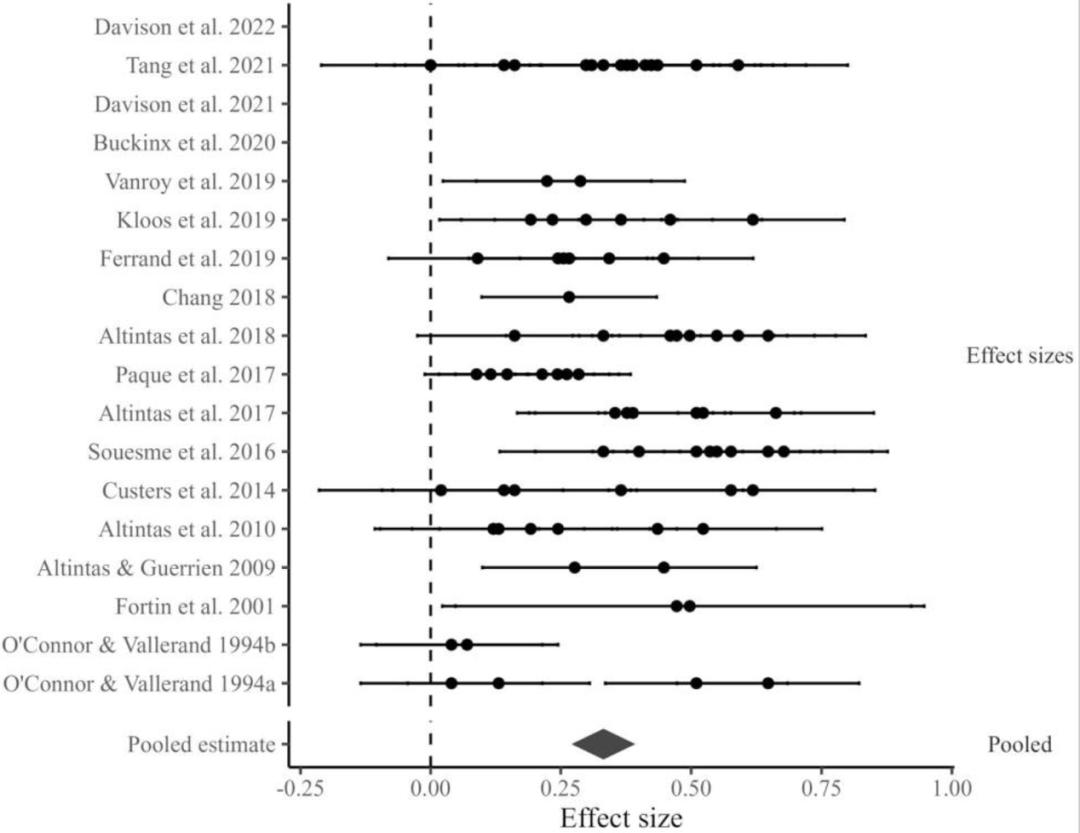
Forest plot of the association between resident autonomy and health status
From the perspective of sense of control, we can rediscover the value of AI for the elderly.
An old armed police officer who served in the army for 26 years said that he has always wanted to sort out his life experiences into a memoir. Those special tasks, unforgettable years and personal experiences closely linked to the development of the times are all worth recording for him.
But this is not an easy task. He revised and copied the manuscript repeatedly, but the progress has been very slow. However, after AI came into being, with the assistance of AI, his memoir is now nearly completed.
Similar things are far more than memoir writing.
Some elderly people begin to try to use AI to restore faded and blurry photos, including wedding photos from their youth, group photos with old friends, and portraits of their deceased relatives. In the past, restoration work that required professional software and technical personnel can now get a preliminary result simply by uploading the photo and stating their ideas.
Some other elderly people use AI simultaneous interpretation when traveling abroad, so that they can understand English broadcasts on cruise ships without asking others for help to explain every time.

For the elderly, these tasks that originally required professional skills, technical equipment or help from others to complete can now be tried and completed by themselves. This improvement of sense of control is perhaps the most important meaning of their use of AI.
People of different ages have different measurement standards
Why is this so? There is a classic socioemotional selectivity theory[5] in geriatric psychology, which holds that an individual's perception of future time will affect their choice of life goals.
When people feel that the time ahead is relatively abundant, they are often more willing to pursue knowledge acquisition, expand their horizons and accumulate experience; while when people feel that the time ahead is limited, emotional satisfaction, intimate relationships and current life experience may become more important.
This may explain the role positioning of AI in the minds of the elderly. Compared with instrumental rational concepts such as parameter scale, context length, model architecture and corpus scale, they may value more the emotional value that AI brings to them in life experience and emotional satisfaction, and do not care much about comparing its price, performance and speed.
This may also explain that the root cause of the different ways Zhao Yi and his mother use AI lies in their different criteria for measuring the value of AI.
A 2025 study surveyed 28 elderly people aged 65 to 84 about their usage experience and needs for AI chatbots, and found that the elderly's attitude towards AI is not simply acceptance or rejection, but presents diverse types: some are willing to take the initiative to try, some are cautious but still willing to use it, and some are not willing to accept it for the time being.
The functions they are interested in are not limited to chatting and companionship, but also include appointment reminders, emergency assistance, health monitoring, housework arrangement and helping themselves take care of others. At the same time, concerns about privacy protection and future technological dependence do exist[6].
It is worth noting that this measurement of AI by the elderly does not stem from blind trust due to lack of judgment. A 2025 study revealed that when interacting with generative AI, the elderly generally carry out rational "value trade-offs"[7]. On the one hand, they use AI to handle daily trivial matters and experience the joy of regaining control of their lives; on the other hand, they maintain healthy vigilance against algorithmic bias, information authenticity and excessive dependence on technology[7].
We can discuss whether the companionship of AI is virtual or real, and we also need to be alert to risks such as AI hallucinations, privacy leakage and excessive dependence in the process of the elderly using AI. However, we can be more optimistic: the various problems among people, AI and society need to be solved, but this does not prevent AI from becoming a handy walking stick to help the elderly cross the digital divide and establish closer connections with their children, friends and the outside world.
In fact, both young people and the elderly are looking for a balance between "technological convenience" and "subject control". These different balance points may be the most real and touching gesture when we coexist with technology.

References
[1] Huang, M., Hansen, D., & Xie, B. (2012). Older adults' online health information seeking behavior. In Proceedings of the 2012 iConference (pp. 338–345).
[2] Choi, S., Rojas-Alvarez, A. J., & Salinas, J. J. (2026). From access to agency: Empowering older adults for critical AI use. The Gerontologist, 66(6), gnag092.
[3] Langer, E. J., & Rodin, J. (1976). The effects of choice and enhanced personal responsibility for the aged: A field experiment in an institutional setting. Journal of Personality and Social Psychology, 34(2), 191–198.
[4] Bradshaw, E. L., Anderson, J. R., Banday, M. A., Basarkod, G., Daliri-Ngametua, R., Ferber, K. A., et al. (2024). A quantitative meta-analysis and qualitative meta-synthesis of aged care residents’ experiences of autonomy, being controlled, and optimal functioning. The Gerontologist, 64(5), gnad135.
[5] Ao Lingmin, Lv Houchao & Huang Xiting. (2011). An overview of socioemotional selectivity theory. Advances in Psychological Science, 19 (2), 217-223.
[6] Wolfe, B. H., Oh, Y. J., Choung, H., Cui, X., Weinzapfel, J., Cooper, R. A., Lee, H.-N., & Lehto, R. (2025). Caregiving artificial intelligence chatbot for older adults and their preferences, well-being, and social connectivity: Mixed-method study. Journal of Medical Internet Research, 27, e65776.
[7] Chattopadhyay, D., & Mubashshira, T. (2025). Unpacking value tensions in older adults' engagement with generative AI. Innovation in Aging, 9(Supplement 2), igaf122.4041.
[7] Chattopadhyay, D., & Mubashshira, T. (2025).Unpackingvaluetensionsinolderadults' engagementwithgenerativeAI.InnovationinAging, 9(Supplement2), igaf122.4041.
This article is from the WeChat official account "Guokr" (ID: Guokr42), author: Emeria, editors: Dai Tianyi, Wu Ou, Bu Qixuan, published with authorization from 36Kr.