The number of monthly active devices for AI applications has reached 835 million, yet both the usage duration and usage frequency have declined.
Abstract
In September 2026, the number of monthly independent devices on the artificial intelligence track of China's mobile Internet reached 835 million, a year-on-year increase of 54.4%. However, the effective daily duration per device and usage frequency decreased by about 18% and 13% year-on-year respectively. AI applications have moved from early adopter exploration to mass adoption, with the user scale continuing to expand, but new users are dominated by shallow trial use, and high-frequency usage habits still need to be cultivated. In the segmented tracks, large language models contribute the main user scale, while intelligent tools perform more prominently in terms of usage duration and frequency; at the specific APP level, leading products occupy a scale advantage, while some small and medium-sized applications show higher usage frequency.
As China's mobile Internet enters the stock competition stage, the growth of user scale is gradually slowing down, and the focus of industry competition has shifted to the attention and usage depth of existing stock users.
In September 2026, the number of monthly independent devices on China's mobile Internet reached 1.479 billion, a year-on-year increase of 1.8% and a month-on-month increase of only 0.1%. Mature tracks such as instant messaging, e-commerce, and short videos have reached a high level of user scale, and the growth rhythm is gradually slowing down. In contrast, artificial intelligence still maintains rapid growth and has become an important growth force in the mobile Internet traffic landscape.
However, while the coverage of AI applications continues to expand, the average user usage duration and frequency have declined. The mismatch between scale growth and usage stickiness has become an important phenomenon to observe the current AI application market.
iResearch's "2026 Q3 China Mobile Internet Traffic Quarterly Report" presents the development characteristics of the artificial intelligence industry in the process of popularization from dimensions such as overall traffic, user behavior, segmented tracks and the performance of popular APPs.
Monthly active devices of AI exceed 835 million, while both usage duration and frequency decline
Artificial intelligence is still one of the most prominent growth tracks in China's mobile Internet, but the industry has gradually entered a stable penetration period under a high base.
In September 2026, the number of monthly independent devices on the artificial intelligence track reached 835 million, a year-on-year increase of 54.4% compared with 541 million in the same period of 2025. However, the year-on-year growth rate of the industry has gradually declined from the previous level of nearly doubling.
In the third quarter of 2026, the number of monthly independent devices on the artificial intelligence track remained above 800 million. It decreased by 1.9% month-on-month in July, and rebounded by 0.8% and 1.5% in August and September respectively, showing an overall trend of small fluctuations at a high level. AI applications are shifting from the stage of rapid capacity expansion to steady growth under a high base.
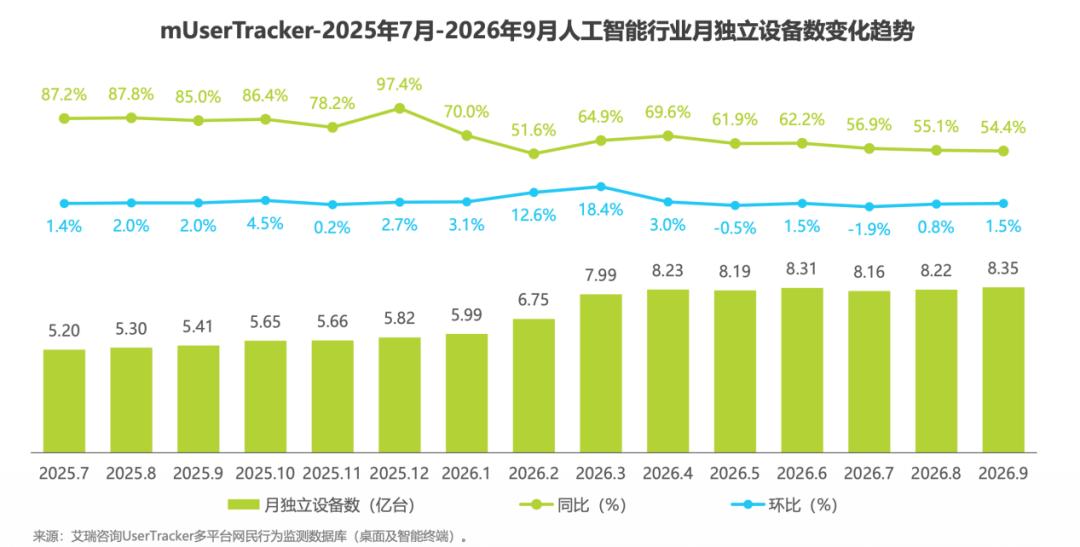
In contrast to the continuous expansion of user device scale, the usage stickiness of AI applications has weakened year-on-year.
In September 2026, the effective daily duration per device on the artificial intelligence track was 12.92 minutes, a decrease of about 18% compared with 15.76 minutes in the same period of 2025; the number of daily uses per device was 6.06 times, a decrease of about 13% compared with 6.99 times in the same period of the previous year.
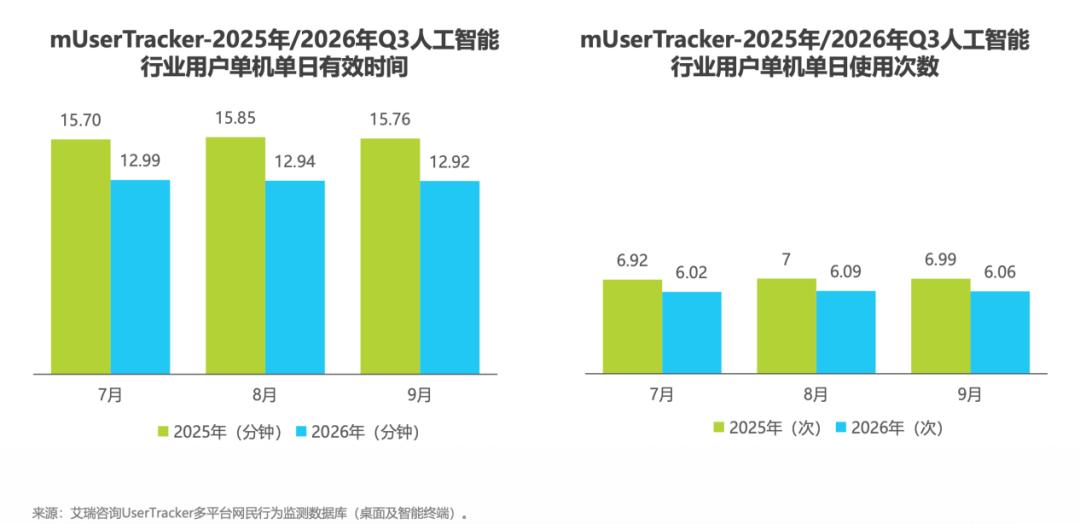
This change runs through the entire third quarter. From July to September, the effective daily duration per device for AI applications remained between 12.92 and 12.99 minutes, and the number of uses remained between 6.02 and 6.09 times, both lower than the level of the same period last year, with small fluctuations within the quarter.
Against the background of the continuous expansion of user device scale, the simultaneous decline of the two stickiness indicators reflects that the current incremental users are dominated by shallow trial use, and user awareness and high-frequency usage habits still need to be cultivated.
AI applications have formed a huge user coverage base, but the scale expansion has not brought about a simultaneous increase in the average usage depth. In the process of moving from early adopter experience to mass adoption, the formation of user coverage and stable usage habits shows different development rhythms.
Large language models form the user base, and intelligent tools undertake in-depth usage
Inside the artificial intelligence track, there are obvious differences in the user scale and usage depth of different types of applications.
In September 2026, the number of monthly independent devices of large language models reached 687 million, a year-on-year increase of 86.9%, constituting the most important user scale foundation of the AI track. Intelligent tools rank second with 273 million units, followed by image processing and intelligent chat companions with 17.09 million units and 4.14 million units respectively. Among them, the device scale of intelligent chat companions decreased both year-on-year and month-on-month.
Large language models occupy a significant advantage in user coverage, but intelligent tools perform more prominently in terms of usage duration and frequency.
In September 2026, the effective daily duration per device of intelligent tools reached 16.89 minutes, and the number of daily uses per device was 6.89 times, both indicators ranking first in the segmented artificial intelligence track. In contrast, the effective daily duration per device of large language models is 8.20 minutes, and the number of uses is 4.62 times.
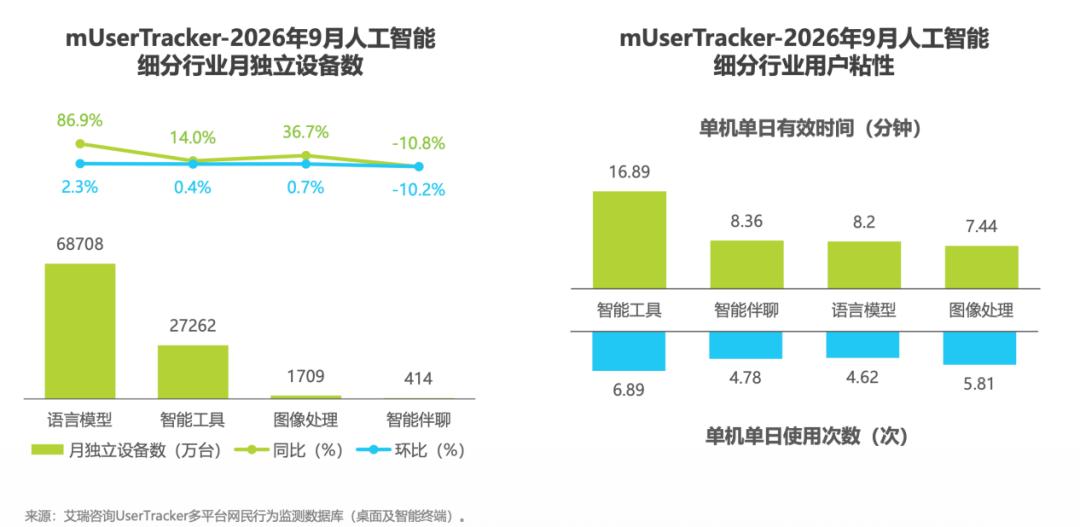
Different data performance reflects the differences in user usage behavior of the two types of applications.
Large language models cover a wide range of general needs, and users mainly use them for lightweight task calls, with relatively limited overall usage depth. Intelligent tools have advantages in duration and frequency, showing stronger ability to retain in-depth users.
Entry-oriented tracks focus on user coverage, while tool-oriented tracks carry in-depth usage. This difference makes the popularization and in-depth usage of AI applications present different characteristics, and also shows that user coverage scale does not fully correspond to usage stickiness.
Leading AI applications lead in scale, and user activity shows differentiation
From the perspective of specific APPs, the artificial intelligence track has formed a relatively obvious leading scale advantage, but the user scale and usage frequency of different products are not completely synchronized.
From January to September 2026, the number of monthly independent devices of Doubao maintained a small fluctuating growth, reaching 462 million in September, which is a clear gap with other major AI applications.
Qianwen entered the correction range after reaching a phased high in March, and the number of monthly independent devices in September was 162 million; DeepSeek and Yuanbao reached about 102 million and 87.01 million respectively, with the overall scale showing small fluctuations. Leading products have formed a relatively stable user scale pattern, and it has become more difficult for other applications to further expand their coverage.
However, user scale does not completely determine usage frequency.
In September 2026, the number of daily uses per device of Doubao was 5.07 times, and that of Qianwen and DeepSeek was 4.07 times and 3.51 times respectively. In contrast, Zhipu Qingyan and MiniMax, which have smaller scales, reached 8.24 times and 7.17 times respectively, with higher usage frequency than the above leading applications.
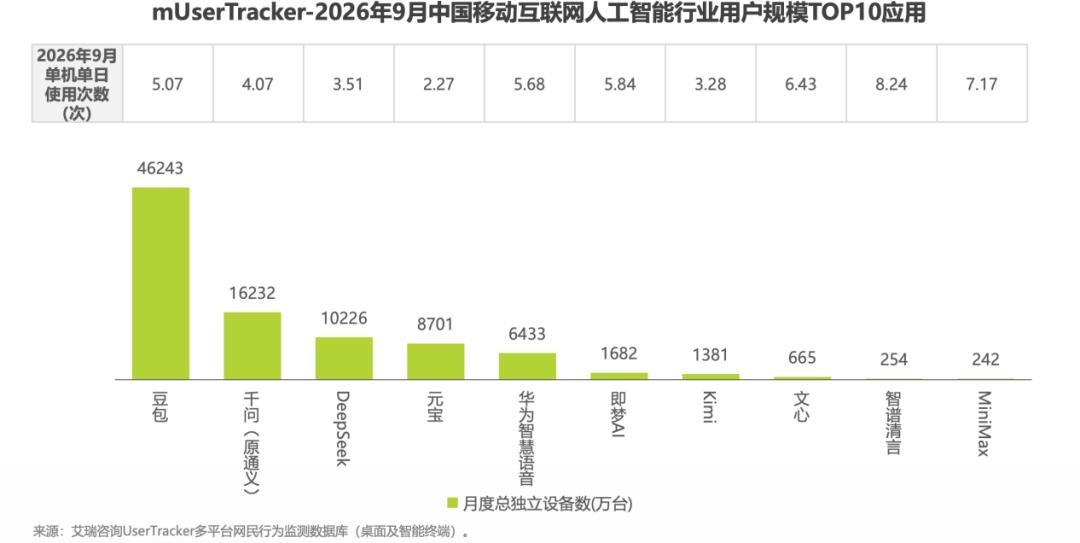
This difference reflects the user positioning characteristics of different AI products. Large-scale market-oriented products focus on covering a wide range of user needs and have a larger device scale; the user circles of some small and medium-sized applications are relatively focused, showing higher usage frequency and user stickiness.
From segmented tracks to specific products, the AI application market presents differences in usage behavior at different levels. The scale advantage of leading products coexists with the higher usage frequency of some small and medium-sized applications, and user coverage and usage activity have become different dimensions to observe product performance.
Conclusion
AI applications are moving from rapid capacity expansion to stable penetration under a high base. The continuous expansion of user device scale reflects the rapid popularization of artificial intelligence; the year-on-year decline in average usage duration and frequency indicates that high-frequency and in-depth usage habits still need to be cultivated.
At the same time, the differences between large language models and intelligent tools in user coverage and usage depth, as well as the differentiation of scale and activity of different AI products, also present more diversified usage characteristics of the artificial intelligence market.
For more information on the user scale, usage behavior and popular APP performance of artificial intelligence and other segmented mobile Internet tracks, please read iResearch's "2026 Q3 China Mobile Internet Traffic Quarterly Report" to obtain more industry data and research insights.
This article is from the WeChat Official Account "iResearch" (ID: iresearch-), author: iResearch, published with authorization from 36Kr.