Why was Levent Alpöge, of all people, the one to prove the Riemann Hypothesis?
On November 21, the Lean and Mathlib communities announced that after multiple experts conducted independent checks using different tools, they are convinced that a 17-million-line mathematical proof is completely correct. What it proves is exactly the Riemann Hypothesis, which has puzzled the mathematics community for 167 years.

There are only two authors of the proof. One is Levent Alpöge, an American mathematician born in the 1990s, and the other is Claude, an AI model from Anthropic.
The day before, Alpöge had just made this proof public. He claimed that he and Claude not only solved the Riemann Hypothesis, but also extended the conclusion to the Generalized Riemann Hypothesis. The mathematics community immediately launched a verification, and subsequently issued this rare formal verification statement.
Of course, after the machine check is passed, mathematicians still need to understand the ideas behind it. The Clay Mathematics Institute has not yet officially confirmed that this Millennium Prize Problem has been solved. But at least at the level of formal proof, this time, the result is quite solid.
It is thought-provoking that Alpöge confessed in the statement that in the final sprint, Claude had already run far ahead of him.
I led us to the correct analogical scenario, and then Claude began to amaze me.
But just three months ago, Anthropic gave Claude an almost identical task, letting it freely study the Riemann Hypothesis.
The model put forward 650 ideas, organized about 60 sub-Agents, but still failed to prove the Riemann Hypothesis in the end.
Later, Alpöge personally participated and cooperated with Claude for about six weeks, and finally came up with this proof.
Why?
They are both top-tier AI, but some people let it enumerate hundreds of paths, while others know exactly where to guide it.
Alpöge's own explanation may be hidden in his personal experience.
He wanted to solve the Riemann Hypothesis since he was a child, and he has been preparing for it for more than 20 years.
It was not until 2026 that he finally got Claude.
I. The Teenager Who Loved Coding
On April 1, 1992, Levent Alpöge was born in Dix Hills, Long Island, New York, USA, and holds dual American and Turkish citizenship.
Now when people talk about him, they always emphasize his mathematical talent. But Alpöge's first remarkable research achievement in his youth came from computer science.
In 2010, at the age of 17, he was a finalist in the Intel Science Talent Search. His project focused on blood vessel recognition in medical images.
Doctors hope to detect vascular abnormalities as early as possible through medical images, but accurately identifying blood vessels from complex images requires a large amount of computation.
Alpöge thought of graphics cards.
At that time, NVIDIA's CUDA technology had just come out, allowing programmers to use the parallel computing power of graphics processing units to solve other problems, but its application was far less extensive than it is today.
Alpöge cooperated with researchers from Yale University and other institutions to introduce CUDA into the blood vessel recognition algorithm, trying to use ordinary graphics cards to accelerate medical image analysis. In January 2010, this research had formed a publicly published technical paper.
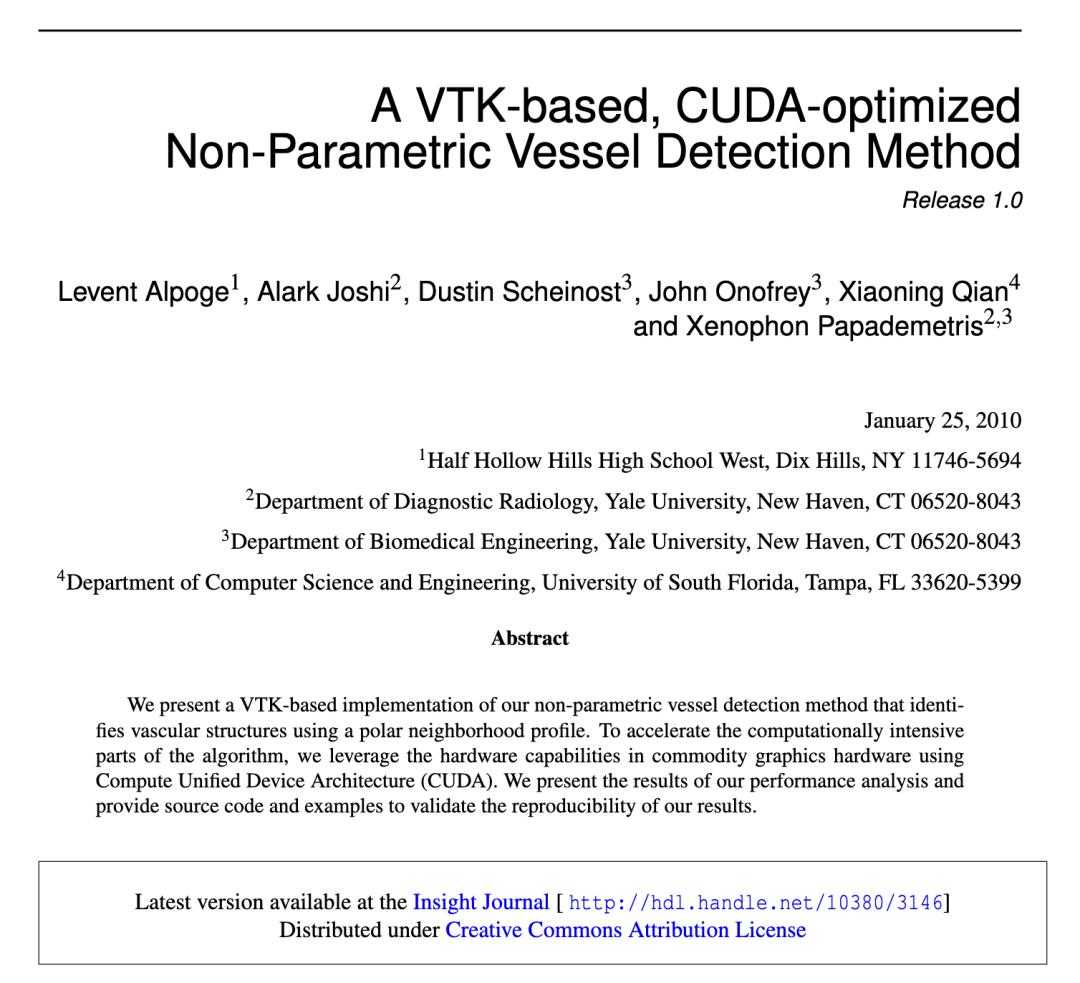
https://www.cs.usfca.edu/~apjoshi/papers/2010-J_Midas_vessel_detection.pdf
A high school student started figuring out how to turn gaming graphics cards into scientific research tools.
His personal website also records another past event.
Young Alpöge once scraped articles from The New York Times, trying to train a program to imitate economist Paul Krugman to write columns.
It ended in failure.
He still keeps this failed experience on his website today, with a relaxed tone and even quite proud of it.
However, Alpöge later found that he seemed to be better at mathematics, so he turned to mathematics.
This shift changed his life for more than a decade afterwards, and temporarily interrupted his connection with computer science.
II. A Young Man With Ambition
Alpöge truly fell in love with number theory starting from the Ross Mathematics Program held at The Ohio State University.
Number theory studies integers and various laws hidden between integers. Some of its problems are easy for even primary school students to understand, but solving them can take a mathematician's whole life.
Later, he was admitted to Harvard University, where he studied algebraic number theory, analytic number theory and combinatorial mathematics under mathematicians such as Benedict Gross, Steven Miller and Joe Gallian.
In just a few years, he has been exposed to several important branches of number theory.
In 2014, Alpöge graduated from Harvard with a bachelor's degree in mathematics and a master's degree in physics. He graduated with the highest honors with an undergraduate GPA of 4.0.
His graduation thesis on integer points of elliptic curves also won the Harvard University Best Undergraduate Thesis Award. By the time he graduated from undergraduate, he had completed 7 papers independently or in cooperation.
In 2015, he won the Morgan Prize, an important award in the field of undergraduate mathematical research in the United States.
However, at the award ceremony, he said something very interesting.
Alpöge specially thanked Joe Gallian. It was Gallian who encouraged him to take the initiative to find professors to apply for graduation thesis topics.
Alpöge confessed that without this encouragement, he would have thought that he was not qualified to make such a request at all.
It is naturally a good thing for young people to have talent. From his speech, we can also see something else.
He knows what he has learned from whom, and is willing to admit that he did not understand before.
In the same year, Alpöge entered Princeton University to pursue his doctorate in mathematics, under the supervision of Manjul Bhargava, who had just won the Fields Medal.
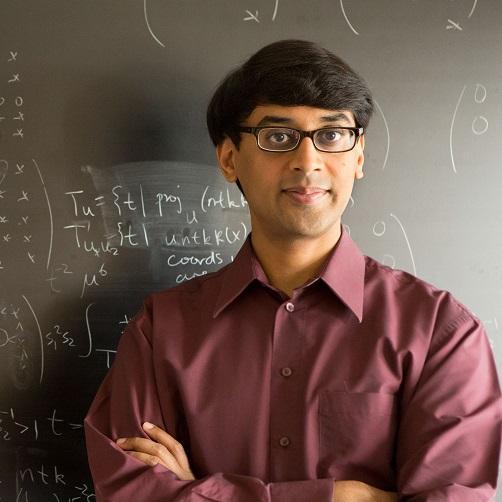
Manjul Bhargava
He continued to study arithmetic geometry, elliptic curves and Diophantine equations. In 2025, the important results he published in cooperation with Bhargava, Wei Ho and Ari Shnidman solved the generalization of Hilbert's tenth problem on the ring of integers of number fields.
At this point, Alpöge is already a number theorist with important achievements.
But it was not until November 2026 that people learned from his own words that he had hidden a grand plan since his student days.
The Riemann Hypothesis.
He wanted to spend decades solving it.
In 1859, German mathematician Bernhard Riemann put forward this hypothesis. He believes that all non-trivial zeros of the Riemann zeta function have a real part equal to 1/2.
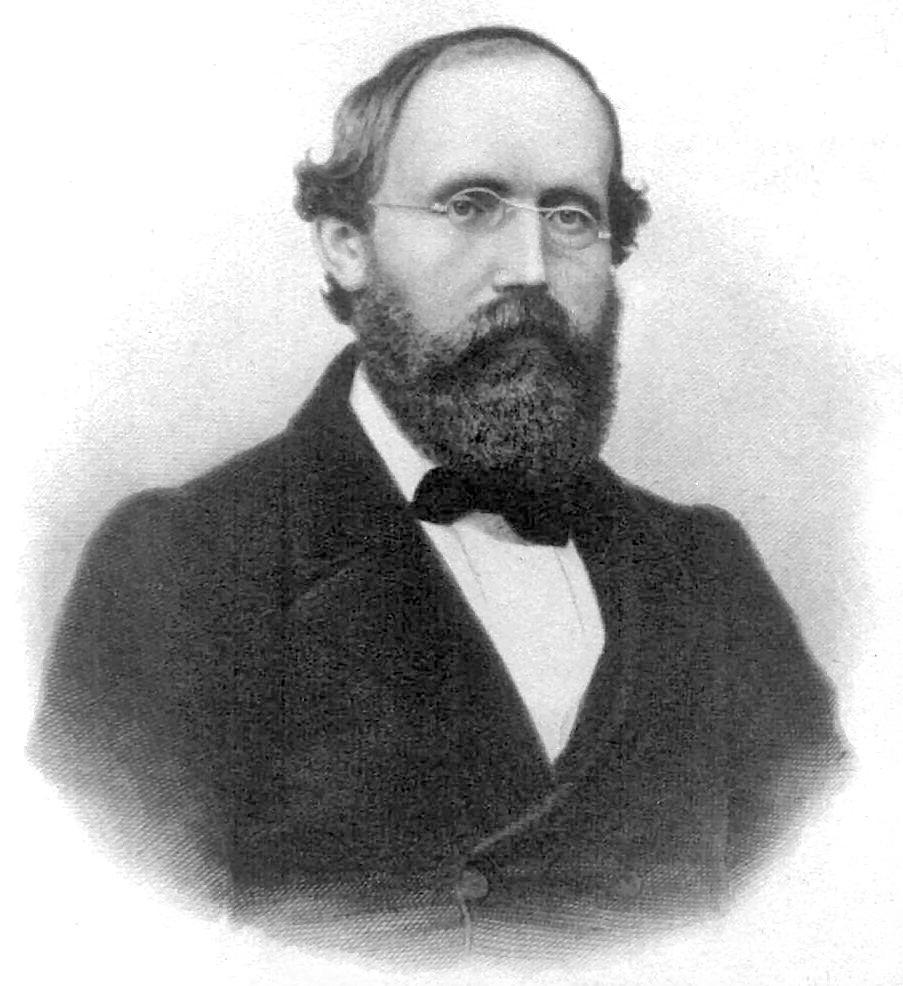
Bernhard Riemann
This is related to the fine law of prime number distribution. With the help of the Riemann zeta function, mathematicians can study the distribution of prime numbers extremely accurately. If the Riemann Hypothesis holds, many estimates that depend on it will have a solid basis.
In the more than 100 years that followed, countless mathematicians studied it.
Alpöge decided very early that he would try it too.
In the latest statement, he confessed that he secretly planned to spend decades studying the Riemann Hypothesis when he was a student. Therefore, he has been working hard to familiarize himself with various mathematical tools, hoping that one day when he really faces this problem, he can recognize what can be used in it.
The problem is so profound that no one can predict in advance which method will eventually work. He studied algebraic number theory, analytic number theory, arithmetic geometry, and then studied elliptic curves and Diophantine equations.
All this knowledge may come in handy in the future.
By 2026, he had been preparing for the Riemann Hypothesis for more than 20 years.
III. Becoming a Student Again
In 2023, GPT-4 was released.
Alpöge recalled on his personal website that he immediately felt that it was the most interesting thing ever created by mankind.
He decided to re-engage in computer science.
Later, he joined Anthropic to engage in AI research.
A mathematician who had made important achievements in the field of number theory started learning new research tools again.
In July 2026, he announced the counterexample of the Jacobian conjecture obtained in cooperation with Claude Fable, and attributed the important construction work in it to Claude.
He has obviously begun to adapt to a new way of working.
AI can continuously try a large number of directions, write programs to check counterexamples, retrieve relevant knowledge, and then submit the derivation to the formal proof system for verification.
However, these powerful capabilities do not automatically lead to major results at present.
In August 2026, Anthropic conducted a very interesting experiment.
Employee Jarred Sumner gave Claude a task, asking it to try to prove the Riemann Hypothesis seriously.
Sumner himself is not a mathematician. He is mainly responsible for encouraging the model to continue exploring, and leaving specific mathematical choices to Claude.
Claude first put forward 650 ideas, but did not succeed.
Then, it coordinated about 60 sub-Agents, executed 2400 Shell commands, wrote hundreds of Python programs, and retrieved dozens of mathematical papers.
The entire experiment output about 31 million tokens.
In the end, Claude still did not solve the Riemann Hypothesis, but made an important progress, raising the known lower bound of the proportion of zeros that can be proven to lie on the critical line from 41.6% to 67.2%.
Alpöge and another Anthropic mathematician Ralph Furman participated in the review of this result.
This experiment is very illustrative.
Claude already has quite strong mathematical research capabilities. It can independently put forward ideas and explore in depth along dozens of paths. But the routes it chose at that time could only push a related problem forward for a certain distance.
A few months later, Alpöge personally led Claude to study the Riemann Hypothesis. The result was very different.
Of course, this change cannot be simply attributed to Alpöge alone. The model is constantly improving, research tools are being updated, and the time and resources invested in different experiments are also different.
But Alpöge brought something that the previous experiment lacked.
He has his own understanding of number theory, and knows which techniques in the history of mathematics can be borrowed from each other. He has also prepared a lot of mathematical knowledge for the Riemann Hypothesis long ago.
All this knowledge finally got a chance to be used now.
IV. The Last Six Weeks
On October 6, 2026, Alpöge and Claude made a key progress in their research.
They began to explore the Stepanov method.
This is a set of mathematical techniques related to the study of algebraic curves over finite fields. There is a corresponding version of the Riemann Hypothesis in the function field world, and mathematicians have already made important achievements there.
Since the problems in the two worlds are deeply connected, can we borrow the proof ideas in the function field to study the Riemann Hypothesis in the ordinary integer world?
Alpöge is very interested in this. But the difficulties are also obvious.
The Stepanov method needs to use a certain "multiplicity" structure. The related techniques in the function field are relatively natural, but in the integer world, it is very difficult to find equally effective operations.
Alpöge explained in the statement that it is a bit like trying to take the derivative of an integer.
The research then advanced to more complex mathematical fields.
On October 8, they obtained new estimates. On October 14, the research continued to advance in the directions of determinants, period integrals and other fields. Around October 19, it involved automorphic forms, theta functions and related representation theory tools.
These branches of mathematics have a long history and each has a huge theoretical system. Their terminology and techniques are unfamiliar to most professional mathematicians.
On November 15, the truly key idea emerged.
Claude suggested using iterated theta lifts, and setting the number of iterations to a scale equivalent to √X.
Why is this step important?
The original Stepanov method needs to use multiplicity to strengthen mathematical constraints. It is very difficult to directly replicate this operation in the integer world, and continuous theta lifts can accumulate effects similar to multiplicity in specific mathematical constructions.
Claude further suggested setting the number of lifts to the order of √X, so that this effect can reach the scale required by the proof.
Alpöge believes that this idea alone is enough to surprise his peers.
It connects technologies that originally belonged to different mathematical fields, helping to solve previously intractable obstacles.
Of course, the 17 million lines of code contain far more than this one technique. The entire argument also involves determinants, representation theory, automorphic forms, arithmetic geometry and a large number of fine estimates.
Alpöge admitted in the statement that the mathematics contained in this proof is far larger than he imagined in his student days.
The further the research went, he even gradually entered fields that he was not familiar with.
His mastery of automorphic forms on higher rank groups is limited. Claude's knowledge in some technical links has surpassed his.
He did not hide this point. He even confessed that his current understanding of part of the argument still depends on the explanations given by Claude.
On November 15, the research log recorded a number of consecutive key progresses.
By November 16, the last entry in the log had only three letters.
GRH.
Generalized Riemann Hypothesis.
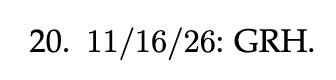
In Alpöge's view, they have obtained a complete argument to solve the problem.
Looking back on these six weeks, it is difficult to draw a simple line between the respective contributions of humans and AI.
Alpöge chose the research problem,