How to write a valuable 2026 annual summary for product managers
A good year-end review should answer three questions: What is my core judgment in this past year, what irreplaceable capabilities have I gained compared to last year, and what goals will I achieve next year.
Recently I read a product manager's year-end review, which starts like this:
I completed 18 requirements throughout the year, including 8 P0-level requirements and 10 P1-level requirements. On average, user growth increased by 25% after each requirement was launched. I participated in 60 user interviews, collected 3,200 pieces of feedback, organized 6 product review meetings, and promoted 3 cross-departmental collaboration projects.
After reading a large pile of numbers, I was completely confused. I asked him, "What do you think is your most important gain this year?" He thought for a moment and said, "Hmm... ensuring the requirement delivery rate?"

This is the common problem with most product managers' year-end reviews.
01 The Real Problem That Year-End Reviews Need to Solve
For many people, the year-end review is essentially a process of "handing over accounts" to their leaders, showing how much work they have done this year. But this understanding is wrong from the very beginning.
The real problems that a year-end review should solve are threefold:
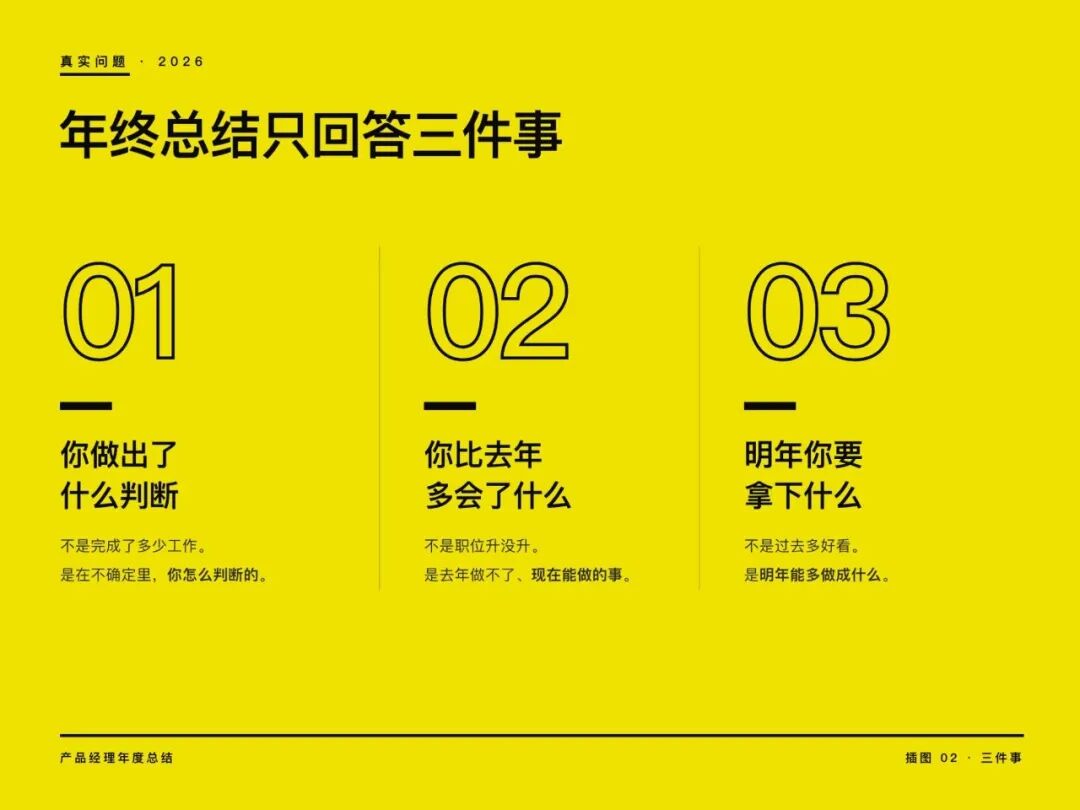
First, what decisions have you made in this past year
It is not about how much work you have completed, but about how you analyzed the situation and finally made decisions when facing uncertainties. The year 2026 is a year of rapid evolution of large model capabilities, with new AI products emerging every month, market demands changing, and competitors' strategies also shifting. In such an environment, what is the most critical job for you as a product manager? It is decision-making: judging which requirements are truly worth implementing, judging when to persist and when to give up, and judging how to reposition products in the AI era.
A good year-end review should describe 3 to 5 key decisions you have made, explain whether these decisions turned out to be right or wrong, and analyze the reasons behind the results. This is the most valuable part of the review.
Second, what new capabilities have you gained compared to last year
It is not about whether you got a promotion or how much your salary increased, but about the things you can do now that you could not do last year. This capability can be technical (you can now write a Python script by yourself to test an idea), business understanding (you can quickly judge what a market trend means now), or cross-departmental collaboration capability (you can promote multi-departmental projects more effectively now).
In 2026, many product managers started to learn Vibe Coding, which means they can generate prototypes with AI by themselves, validate their ideas without waiting for designers or technical teams. If you have mastered this skill, it is an irreplaceable new capability you have gained compared to last year.
Third, what is your plan for the next year
The plan for the next year is an extension of the year-end review. The purpose of the review is not to show off your past achievements, but to help you perform better next year. Some people write 10 pages of year-end review without a single word mentioning their plan for the next year. Such a review is meaningless.
02 Reality vs. Process: Why Year-End Reviews Are Always Poorly Written
I have seen many product managers get tangled up at the end of the year. They do not refuse to write reviews, but they do not know how to write something valuable.
The reasons are usually as follows:
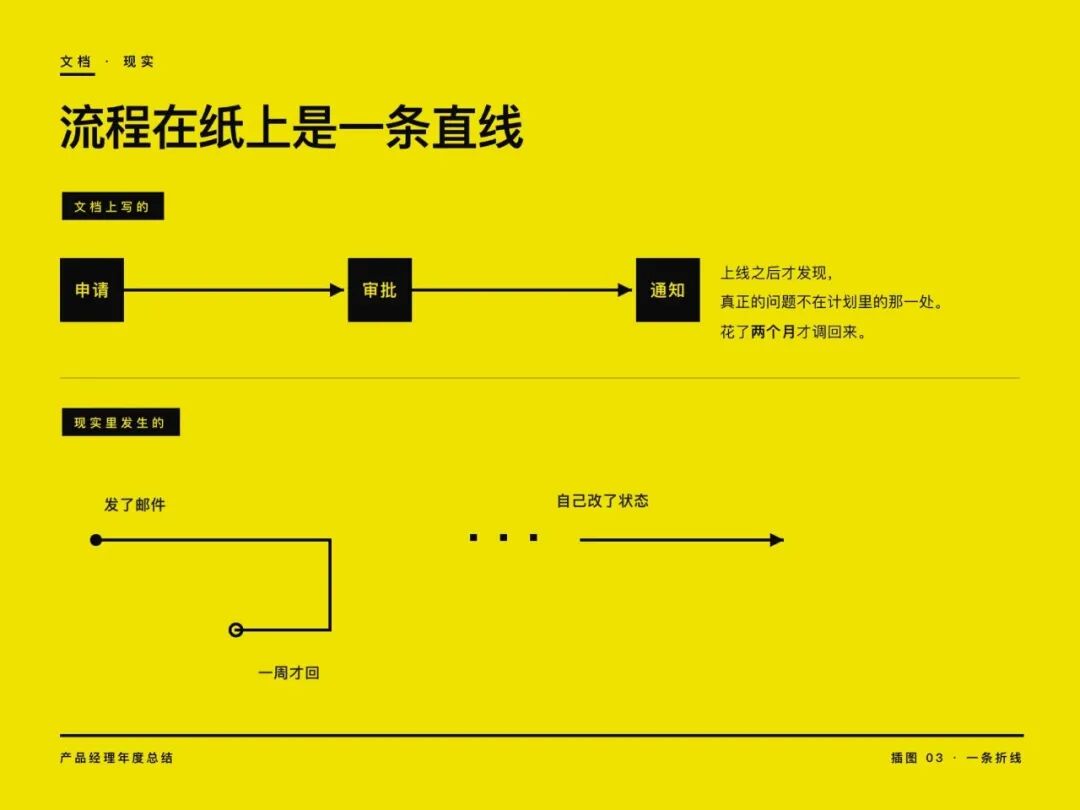
First, they write the documented processes instead of what actually happened in reality.
For example, for an approval process, the document writes: Application → Approval → Notification. But what is the reality? The applicant writes an email to the approver, the approver may reply after a whole week, during which the applicant follows up 3 times, and finally the applicant even changes the approval status by themselves.
The same logic applies to year-end reviews: the process written on the document is very clear, but what actually happened in the real work is far more complicated.
What product managers need to do is not to sort out the processes with a fancy framework, but to honestly describe what happened in reality.
A PM developed a feature, with the original plan to solve a certain user pain point. After the feature was launched, they found that the problem was not the one they thought of, and it took them half a month to find that the real problem was elsewhere, and finally spent two months to adjust the product. Most people would write in their review that "this feature improves user experience". But the correct way to write it is: "We took the wrong direction at the beginning of developing this feature, and spent two months finding where the problem was. Next time we need to confirm with users at an earlier stage."
The latter sounds less pleasant, but contains far more information, because you are talking about the real things that happened and what you have learned from them.
Second, they take the requirement completion rate as the main body of the year-end review.
What can the statement like "completed 18 requirements" explain?
It proves that you have execution ability, but this is exactly the part of product managers that is easiest to be replaced.
Because there may be ten people in the team who can execute requirements.
What is the thing that only you can do?
It is the judgment of which requirements should be implemented. It is the ability to quickly judge whether a phenomenon behind is a real demand or a false demand. It is the ability to find the key point between two conflicting user feedbacks.
The differentiation between AI product managers and traditional product managers is particularly obvious in 2026: some PMs are still filling in forms in requirement management tools and completing work on schedule and in quantity, while others have started to use AI to change their working methods. They use AI to analyze user interview results, quickly generate prototypes with AI, and predict market trends with AI.
The two groups of people have the same number of requirements, but the value they create is completely different.
A valuable year-end review should clearly explain what choices you have made in the changes of this industry this year.
Do you continue to use the methodology from last year, or try new methods?
What is the reason for you to make this choice?
Finally, they ignore the impact of the changes in the general environment on their work.
2026 is a special year. The capabilities of large models are iterating rapidly, and new capabilities emerge every month. AI has evolved from a cutting-edge concept to a daily tool. Enterprise users are also changing: some enterprises have begun to deploy FDE teams, while others are still struggling with how to develop AI products properly.
A good year-end review should reflect what choices you have made in such a general environment. Do you keep up with the market changes, or stick to your own judgment? Do you learn new tools and new methods, or think that experience is the most important thing? These choices reflect your understanding of the industry.
03 How to Write a Valuable Year-End Review
Based on the above understanding, my suggestions are as follows:
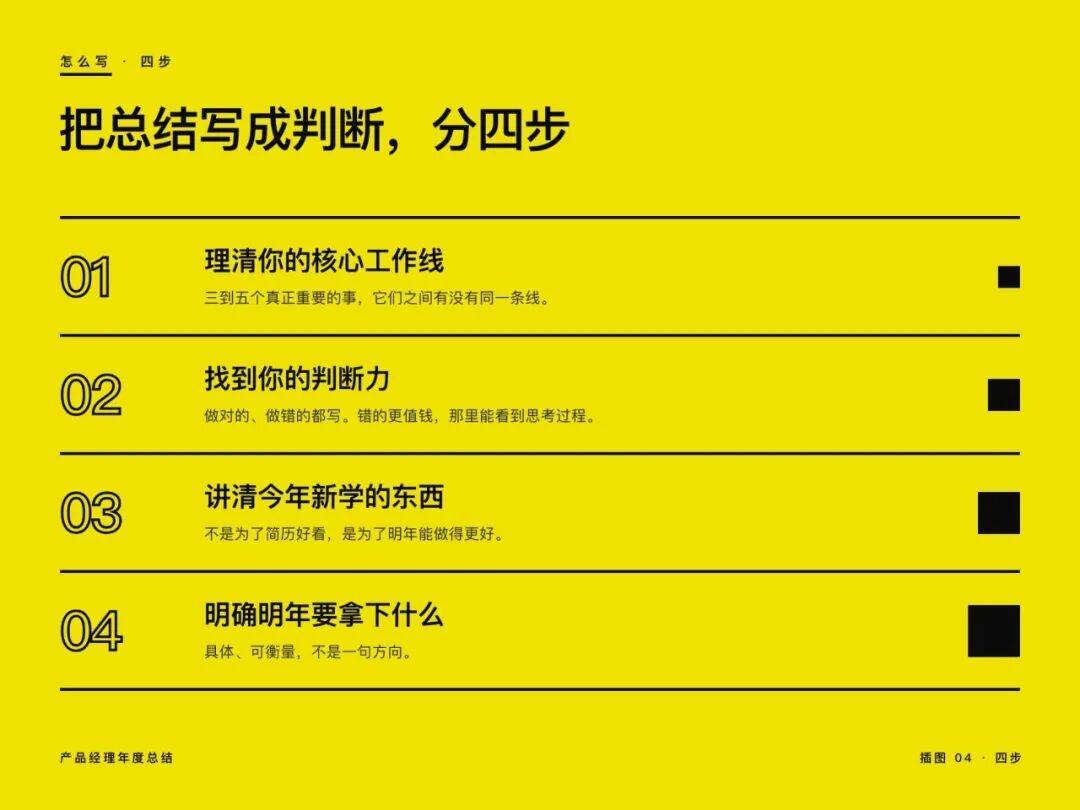
Step 1: Sort out your core work line
Not all requirements have equal weight. In your work this year, there may be 3 to 5 things that are truly important. Is there any logical connection between these things? Do they all point to the same product direction? If there is no logical connection, it means your work this year is scattered. If there is, it means you have a clear product line.
For example, the requirements you completed this year are: optimizing the login process, adding AI recommendation function, and building a feedback and evaluation system. These three seem irrelevant at first glance, but if you look at them from another angle, what do they have in common? It may be "improving user retention" or "building a data-driven feedback closed loop". When you sort out your work from this perspective, you will find a clear clue immediately.
Step 2: Find the manifestation of your judgment ability
Which decisions you made this year turned out to be correct? Which ones are wrong? The wrong decisions are more valuable, because you can show your thinking process in those wrong decisions.
Do not say something like "we investigated user demands and found...". You need to talk about specific things. For example: "We originally thought that the function A was what users needed most. But in the third user interview, I found that the biggest bottleneck for users was data flow, not function problems. So we changed our direction and realized data interconnection. This change reduced user churn rate by 15%."
Such a description allows others to see how you think and how you find problems.
Step 3: Explain clearly what new things you have learned this year
The industry is changing so fast in 2026, if you have not learned anything new this year, that is actually a problem. The new thing can be technical (mastering a certain tool), methodology (learning a new user research method), or way of thinking (shifting from "scaling up" to "FDE-style in-depth service").
The key is to explain what impact this new thing will have on your work next year. You learn this new thing not to make your resume look better, but to perform better next year. Explain this logic clearly.
Step 4: Clarify what goals you will achieve next year
Most people's year-end review stops here, but my suggestion is to add another part: what you will do next year. It should not be a general direction, but something specific and measurable.
For example: "Next year I will improve my technical ability, so that I can write RAG applications by myself. My goal is to independently complete the MVP of an AI recommendation system within three months." Or: "Next year I will deepen my understanding of users in specific industries. I plan to visit ten enterprise customers, talk to their CTOs, and understand their real pain points in AI application."
Such a description shows that you not only summed up the past, but also planned for the future, and this plan is based on your cognition of your own capabilities.
04 The New Variable of Year-End Review
Finally, I want to mention a special point:
There is a new variable in the 2026 year-end review, which is the change AI brings to the work of product managers themselves.
In this year, more and more product managers began to use AI to change their working methods: some use AI to conduct user interviews, some use AI to analyze competing products, some use AI to generate product prototypes. This transformation itself should become an important part of your year-end review.
Because it shows that you are not only adapting to industry changes, but also actively transforming your own working methods. This ability of self-transformation may be more valuable than specific business results.
Therefore, if you have started to use AI tools to change your workflow this year, you must explain it clearly in your review: how you use it, why you use it in this way, what the effect is, and what inspiration it brings to your next year's work.
Only such a review is truly valuable.
This article is from the WeChat Official Account "Everyone is a Product Manager" (ID: woshipm), written by A Bao, and published with authorization from 36Kr.