She, who once worked in a restaurant, sold her company for 8.2 billion U.S. dollars less than three years after starting her business.
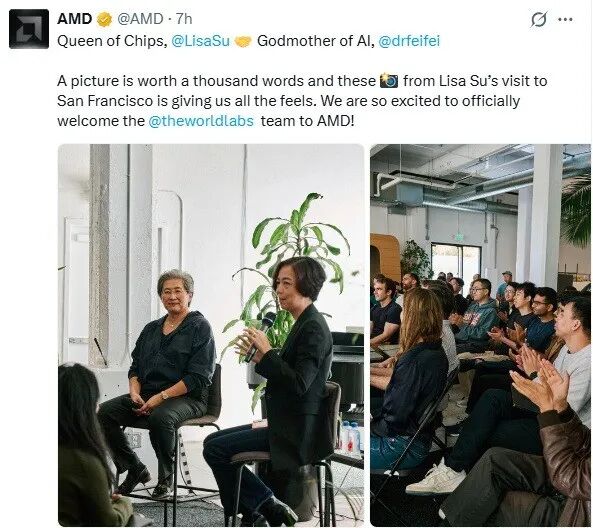
At World Labs' headquarters in San Francisco, two women of Chinese descent jointly cut the celebration cake.
On local time November 16, semiconductor giant AMD announced the completion of its acquisition of world model developer World Labs for $8.2 billion, paid entirely in stock.
Source: official AMD screenshot
Founded in 2024, World Labs was co-founded by Stanford University professor Fei-Fei Li, her former PhD student Justin Johnson, and Ben Mildenhall, the first author of the NeRF paper, and currently has around 70 employees. After the transaction is completed, Fei-Fei Li will serve as AMD's Executive Vice President and Chief Scientist, reporting directly to Lisa Su, Chair and CEO of AMD.
From the signing on September 28 to the closing on November 13, the whole process took only 46 days. This company, which has just started its commercialization, has become the second largest acquisition target in AMD's history. In 2022, AMD acquired Xilinx for approximately $49 billion.
Compared with the lively celebration scene, the capital market reacted relatively calmly. On November 16, AMD's stock price closed down 5.58% at $504.28, with a total market value of about $8.27 trillion. It is worth noting that the semiconductor and AI infrastructure sectors also corrected on the same day.
Over the past decade and more, Fei-Fei Li has stood at several critical junctures of artificial intelligence paradigm shifts. She led the construction of the large-scale image database ImageNet, which provided a unified data and evaluation foundation for machine vision research; World Labs has advanced the research into the 3D space. After joining AMD, her work will further extend to the computing systems behind the models.
At the end of the celebration video released by World Labs' official account, AMD's slogan "together we advance" was changed to "together we advance_worlds". The extra "worlds" not only refers to the newly joined World Labs under AMD, but also serves as a pun —
This time, what Fei-Fei Li and AMD hope to advance together is not only chips and models, but also the ability for machines to understand and enter the physical world.

46 Days, $8.2 Billion
World Labs, which was founded just over two years ago, is far more than a cutting-edge concept. In November 2025, its first commercial product Marble was launched, allowing users to input a piece of text or an image to generate an accessible, editable and exportable 3D scene. In September 2026, World Labs released Atlas, a multimodal world model that attempts to unify text, images, videos and 3D content with a single model. One day before the acquisition closed, Atlas was still opened to the public and developers as scheduled.
What Fei-Fei Li wants to do is not limited to 3D content generation. In 2026, World Labs acquired SceniX, a robot simulation company, to place robot bodies, workbenches, sensors and other components into a resettable, parameter-adjustable virtual environment. It has demonstrated tasks such as dual-arm packing and cable operation, and verified part of the simulation training results on real physical robots.
As AI expands from the digital space to the physical world, machines not only need to "know what the world looks like", but also understand the consequences brought by perspective changes, object movement and grasping operations.
This is exactly the answer AMD is looking for.
In the past few years, AMD has continuously completed its computing landscape — it acquired ZT Systems to strengthen its rack-level system capabilities, and launched Helios to integrate GPUs, CPUs and ROCm software into a single solution. After the hardware, systems and software are gradually in place, the next question arises: how will customers' next-generation models actually use these computing capabilities?
The training and inference demands of large language models are relatively clear, but spatial intelligence is evolving rapidly. It is difficult for chip engineers to deduce on their own what kind of computing bottlenecks will be brought by tasks such as generating 3D scenes, maintaining consistency across different perspectives, simulating object collisions, and feeding robot training results back to the model.
In the common cooperation model, chip companies usually stay at the back of the industrial chain, waiting for models and demands to gradually mature before providing stronger computing power. One of the values of Fei-Fei Li joining AMD is to reverse this order: to bring real model workloads into the design process of chips, software and systems at an earlier stage, and tell engineers exactly where the next-generation AI is bottlenecked before the hardware roadmap is fully finalized.

Source: AI-generated
Through this acquisition, AMD has obtained not only models and products, but also a research team that can continuously raise new computing problems. Fei-Fei Li joining the core management team provides a more direct organizational channel for such communication.
For Fei-Fei Li, this is also an active choice.
In her open letter "To Seek a Newer World" released on September 28, she explained: "Without dedicated hardware investment, the efficiency and scale of AI will be limited, and so will its scope; for our goals, it will also be trapped in the digital world."
After the acquisition is completed, World Labs co-founders Justin Johnson, Ben Mildenhall and other members will remain in their positions. The team will continue R&D on foundational models as an independent cutting-edge research organization, while collaborating with AMD's hardware, software and system engineers.
What Else Is Missing for the Next Step of AI?
Fei-Fei Li is often referred to as the "Godmother of AI".
She was born in Beijing in 1976 and grew up in Chengdu. In her autobiography The World I See: Fei-Fei Li's Memoir, she recalls that in 1992, at the age of 15, she moved to the United States with her mother, and the family settled in New Jersey. Due to the language barrier, her parents initially worked in a dry cleaner before eventually buying their own store. In high school, Fei-Fei Li ran the family store after school and worked in a Chinese restaurant on weekends. After she got a scholarship to enter the Department of Physics at Princeton University, she still took the intercity bus home on weekends to help out.
In 2007, 31-year-old Fei-Fei Li was already an assistant professor at Princeton University. At that time, computer vision researchers generally focused on improving algorithms, but she paid increasing attention to the role of data.
She wrote in her autobiography: "If the data used to train algorithms cannot accurately reflect the real world, even the best algorithms cannot perform their tasks well."
Therefore, she decided to build a large enough image database. This work was labor-intensive and could not bring immediate returns in terms of academic papers, and was once regarded as a thankless task. Using Amazon's crowdsourcing platform, Fei-Fei Li's team organized nearly 50,000 annotators from 167 countries, and finally labeled about 14 million images with more than 22,000 categories.
In 2009, ImageNet only got a poster spot in a corner at the CVPR conference, with no oral presentation and very few passers-by stopping by. In the following two years, the related competitions did not attract much attention either.
The turning point came in 2012. The AlexNet trained by Geoffrey Hinton's team on GPUs reduced the recognition error rate to 15.3% in the ImageNet competition, 10.8 percentage points lower than the second place.
That "manual labor" task that no one was willing to do back then became the foundation of the entire AI industry — over the next decade, almost all image recognition models relied on this dataset. In the era of large models, the scale and quality of data remain one of the basic conditions for model capabilities, and the form of data has expanded from images to text, videos and 3D environments.
Fei-Fei Li's expectations for AI do not stop at technical indicators.
During the years when she put the most effort into ImageNet, Fei-Fei Li's mother was seriously ill in hospital. She took care of her mother while revising her papers. Her mother once asked her: "Feifei, what are you doing all this for?"
This question did not disappear with the success of ImageNet. In 2017, Fei-Fei Li joined Google during her academic sabbatical as Chief Scientist of Google Cloud AI, advancing her research to the front line of the industry; in 2019, she promoted the establishment of the Stanford Institute for Human-Centered Artificial Intelligence (HAI) to continue studying the relationship between AI, human beings and society.
For her, beyond what technology can do, there is always another question: For whom should it be built, and how will it affect people? The more powerful AI becomes, the more unavoidable this question is.
At that time, large language models were attracting a lot of attention, but Fei-Fei Li took the lead in pointing her research direction to spatial intelligence. In her TED2024 speech, she proposed that spatial intelligence connects perception and action: machines should not only process visual information and understand relationships in 3D space, but also make predictions and take actions based on that.
In April 2024, Fei-Fei Li started her second business and founded World Labs.
In September of the same year, World Labs completed a $230 million Series A financing. In November 2025, it launched its first product Marble, which can generate explorable and editable 3D scenes from text or images. In February 2026, it completed a financing of about $1 billion, in which both NVIDIA and AMD participated.
From ImageNet to World Labs, she has always been asking the same question: What else is missing for the next step of AI?

The Acquisition Is Only the Beginning
After joining AMD, the problems Fei-Fei Li faces have become more specific and more challenging.
What she needs to do is not just to make Atlas run faster on a certain chip, but to convert the bottlenecks in model training, scene generation, physical simulation and real robot feedback into design requirements for computing platforms in advance. On November 11, Lisa Su revealed in a live talk at CoRL 2026 that AMD already has a physical AI and robotics research team, but the overall layout is still in its early stage. The two sides need to connect models, simulation tools, chips and robotic systems next.
Among all these, the hardest part to fill in is still data.
World Labs mentioned in its official research paper that for robots to enter the real world, a large amount of data collection and repeated testing are required, leading to very high labor investment and hardware trial-and-error costs. Videos can show how a cup moves and collides, but they usually do not contain motion commands, contact force and tactile feedback that robots can directly use. Letting real robots make repeated mistakes in the real world is expensive, slow, and sometimes accompanied by safety risks.
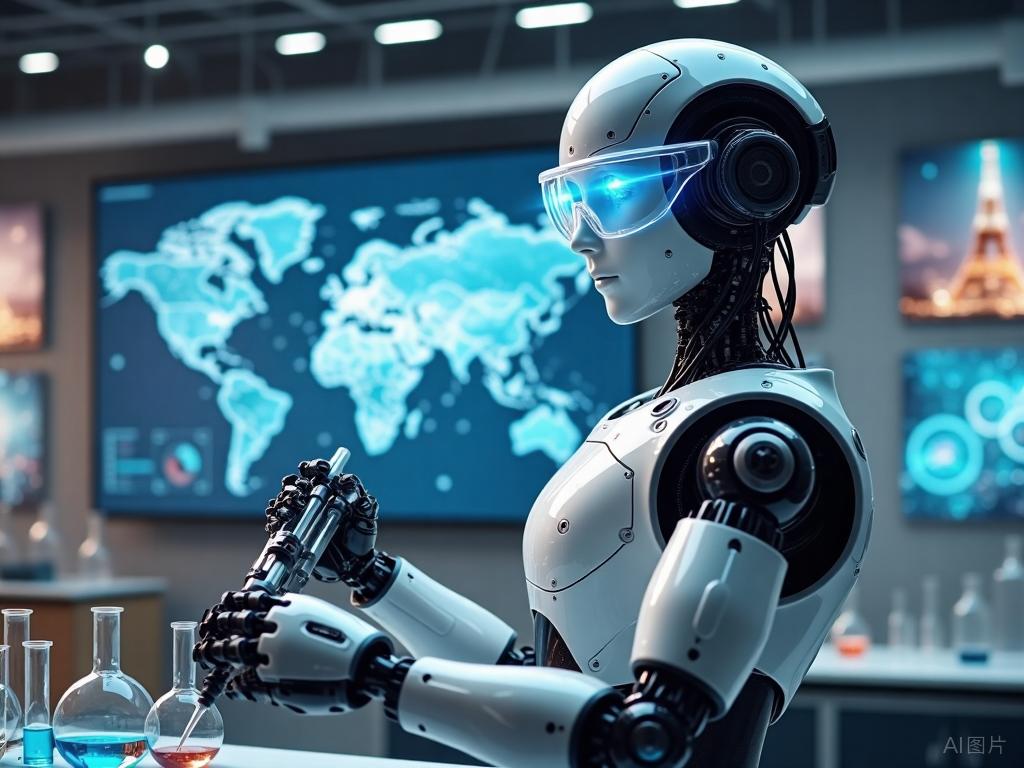
Simulation provides a possible path: let robots practice repeatedly in a virtual environment, and then return to the real robot for verification. It can not only reduce part of the training cost, but also make it possible for some problems to be exposed in advance before robots enter the real world.
Source: AI-generated
However, a scene that looks realistic does not mean that robots can learn effectively in it. Deviations in friction, material deformation and contact feedback may all cause the training results to fail on real robots. What Fei-Fei Li needs to push World Labs to cross is exactly the gap from "the world looks realistic" to "the world is physically credible enough".
This also gives more specific requirements to the "human-centered" concept that she has long emphasized. Once machines enter the physical world, errors will not only cause fluctuations in recognition rates, but may also lead to real costs and safety risks. The closer technology is to people's daily lives, the more important reliability and controllability become.
Apart from technology, another challenge comes from developers.
NVIDIA still holds a clear advantage in the field of spatial AI and physical simulation, and has accumulated mature tools and a developer ecosystem. Fei-Fei Li's joining can help AMD better understand model demands, but cannot directly change the existing choices of developers. After the acquisition, AMD still needs to prove with its products that this solution is worth developers trying and using continuously.
AMD emphasized an open AI ecosystem in its closing announcement. For Fei-Fei Li, openness is not only related to AMD's ecological competition, but also related to whether external teams can continue to use, test and improve these tools. The influence of ImageNet back then was inseparable from open access and extensive participation; spatial intelligence may not follow the same development path as ImageNet, but it also needs to prove its value in real tasks and external cooperation.
The acquisition is only the beginning. When AI steps out of the screen and into the real 3D world, Fei-Fei Li still needs to answer the question she has long been asking:
How will technology ultimately affect people?
.END.
Duty Editor: Yijie Wang Proofreader: Chenyu Jiang Producer: Shiyuan Jing (Intern)
Written by | Siyu Shi, Trainee Reporter of China Entrepreneur
Reporter: Yijie Wang
Edited by | Jiying Ma
Cover Image Source | Visual China
This article is from the WeChat Official Account "China Entrepreneur Magazine" (ID: iceo-com-cn), author: Siyu Shi, republished by 36Kr with authorization.